AB Tasty alternative (2026): Marketing Tests vs Shopify
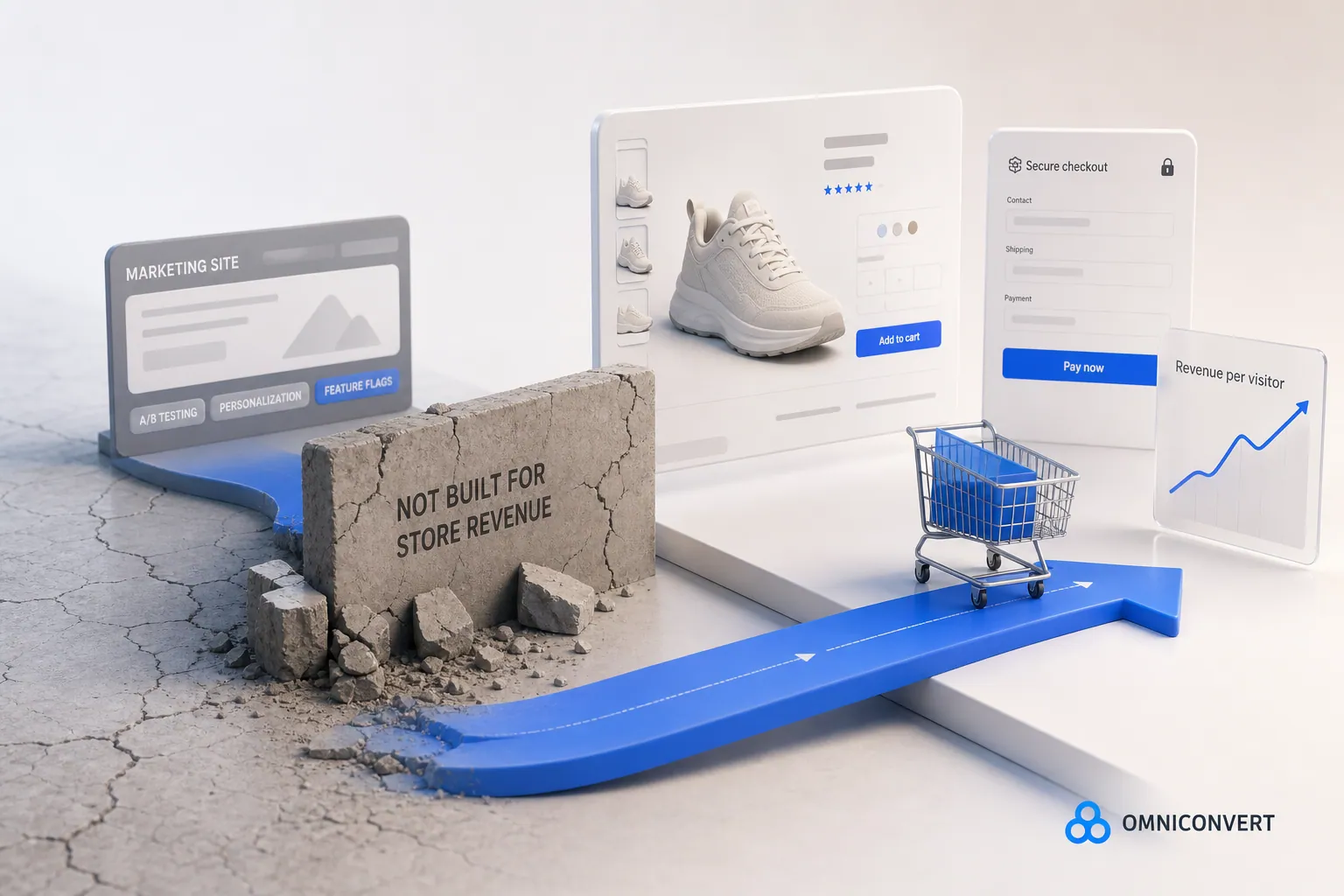
AB Tasty combines A/B testing, personalization, and feature management in one platform with a strong no-code editor, and it merged with VWO in 2025. Omniconvert Explore centers on the eCommerce store: a native Shopify integration, tests covering product pages, cart, and checkout, and results measured in revenue per visitor. For Shopify CRO they compete; for marketing-site experimentation AB Tasty is broad.
- AB Tasty combines A/B testing, personalization, and feature management in one platform with a strong no-code editor, and it merged with VWO in 2025.
- AB Tasty uses custom pricing through contact sales, with server-side testing available only as a separate add-on module.
- AB Tasty is oriented to marketing websites, with limited native Shopify integration and no eCommerce checkout templates.
- Omniconvert Explore tests product, cart, and checkout pages natively on Shopify and reports outcomes as revenue per visitor.
- Decide by orientation: pick AB Tasty for broad marketing experimentation and feature flags, pick Explore for Shopify revenue surfaces.
Teams comparing AB Tasty vs Omniconvert Explore are usually deciding how to run experiments on a Shopify store. AB Tasty is a marketing-friendly platform that pairs A/B testing with personalization and feature flags, now part of VWO since 2025. Omniconvert Explore takes a focused approach: A/B, multivariate, and personalization tests aimed at a store's revenue surfaces, with results reported as revenue per visitor. This page covers what each does well, where AB Tasty hits its ceiling for eCommerce, and when to pick one.
What is AB Tasty, and what does it actually do?
AB Tasty joined VWO in 2025, combining web experimentation and personalization into one merged platform. It pairs A/B testing with feature flags and personalization, and its strong no-code editor lets marketing teams run experiments without developer involvement. [AB Tasty, 2026]
AB Tasty is well regarded by marketing teams, with a 4.4 out of 5 rating on G2 across more than 180 reviews. [G2, 2026] Its appeal is breadth in one place: testing, personalization, and feature management, accessible to non-technical users through a no-code editor.
AB Tasty sits in the marketing-site experimentation and feature management category. It optimizes campaigns and pages and rolls out features to audiences, primarily on marketing websites. That wide scope defines what the product is designed to do.
The question this page answers is narrower: is marketing-site experimentation the same job as running conversion experiments on a Shopify store? If the two differ, what does that mean for a Shopify team choosing a tool?
Feature flags turn application features on or off for specific audiences, often tied to experiments and gradual rollouts. AB Tasty bundles this with testing and personalization, which suits marketing and product collaboration. Whether those flags and tests reach a Shopify store's checkout is a different question entirely.
Where AB Tasty is genuinely strong
- Three jobs in one platform: A/B testing, personalization, and feature management together.
- Strong no-code editor: marketing teams can build and ship experiments without developers.
- Marketing-team fit: designed around campaign and page experimentation workflows.
- Expanded resources post-merger: the 2025 VWO merger broadened the feature set and support.
Where AB Tasty hits its ceiling for an eCommerce store
- Post-merger reorganization: since joining VWO the roadmap and pricing have been reorganized.
- Server-side is an add-on: server-side testing requires a separate add-on module.
- Limited native Shopify: Shopify integration is limited and there are no eCommerce checkout templates.
- Marketing-site orientation: the platform is built for marketing websites rather than eCommerce conversion flows.
None of this makes AB Tasty a weak product. It makes it a marketing experimentation platform. The mismatch appears when the site being tested is a Shopify store and the number that matters is revenue per visitor, not a generic conversion event.
What AB Tasty cannot do for an eCommerce store
AB Tasty is designed around marketing website experiments and feature rollouts. It has no native Shopify integration or eCommerce-specific templates, so checkout integrations are built manually, and revenue-focused experiments do not run natively on product pages and cart flows. Omniconvert Explore exists precisely to fill that gap for Shopify stores.
Omniconvert Explore is built for the layer AB Tasty leaves open. AB Tasty can test and personalize marketing sites well, but a store does not need any page tested; it needs the product page, the cart, and the checkout tested, and the result expressed in revenue per visitor. Testing a marketing page and running a Shopify checkout experiment are distinct jobs.
Most marketing experimentation tools are built around a generic web page and a generic conversion event. They optimize the execution of a test or a personalization rule. Product pages, cart flows, and checkout, the places where a store's revenue is decided, are not the surfaces these tools are designed around, and revenue per visitor is not the metric they track natively.
When a Shopify store runs CRO, the experiments target revenue surfaces: product pages, cart, and checkout. Success is measured in revenue per visitor and order rate, not a broad conversion percentage. Omniconvert Explore was designed around those surfaces: it is a Shopify-native platform priced by store traffic, focused entirely on product, cart, and checkout testing.
What AB Tasty cannot tell an eCommerce team
- Revenue impact of the winning variant. Whether a Shopify variant that beat the control actually drove higher revenue per visitor and order rate, not simply a downstream click or micro-conversion.
- Where your next test belongs. Which pages in the Shopify funnel, product, cart, or checkout, carry the greatest revenue impact when tested next.
- Checkout compatibility without manual setup. How an experiment interacts with the Shopify catalog, variants, and checkout flow natively, without manual integration.
- Confirmation from high-value segments. Whether repeat buyers and high-value segments confirm the result, the core Customer Value Optimization question, not just visitors on their first session.
The CROBenchmark Report 2026 covers 7,000+ eCommerce websites tracked via Omniconvert. It finds that AB Tasty wins on marketing pages and personalization campaigns rarely produce more orders, because its no-code testing stops short of the Shopify checkout where purchases actually happen. [CROBenchmark Report 2026, Omniconvert]
Omniconvert Explore runs the experiment directly on the store's product, cart, and checkout pages and reports the result as revenue per visitor. That distinction separates a marketing experimentation tool from a platform built around store revenue.
AB Tasty vs Explore: the capability comparison
Side by side, AB Tasty is broader across personalization and feature flags, while Explore is deeper on eCommerce. Both run A/B and multivariate tests with a no-code editor. Explore adds native Shopify experiments, built-in surveys, and revenue-per-visitor measurement on product, cart, and checkout.
| Capability | AB Tasty | Omniconvert Explore |
|---|---|---|
| Primary function | Marketing-site experimentation, personalization, and feature management | CRO across Shopify product pages, cart, and checkout |
| A/B testing | Yes no-code editor with feature flags | Yes both visual and code-based editors |
| Multivariate testing | Yes | Yes |
| Server-side testing | Partial requires a separate add-on module | Yes |
| Visual editor | Yes strong no-code | Yes no developer required |
| Surveys and on-site overlay tools | Partial personalization widgets, no native surveys | Yes native surveys and overlay tools included |
| Shopify integration | Medium limited, not native | Yes native |
| eCommerce focus | Medium marketing-site oriented | High designed around Shopify revenue workflows |
| Pricing model | Custom, contact sales, free trial | Priced by store sessions, free trial included |
| Best for | Marketing teams wanting experimentation and feature management in one platform | eCommerce and Shopify teams testing product pages, cart, and checkout for revenue gains |
| User rating | G2 rating: 4.4 out of 5 (424 reviews, as of 2026) | 4.6 out of 5 (G2, 197 reviews, as of 2026) |
One desktop A/B test run with Omniconvert Explore showed Nextbase a product navigation layout grouped by use case delivering +26.16% conversion rate, +23.7% revenue per user, and a 98.53% chance to win. [Omniconvert, Nextbase case study]
AB Tasty pricing, modules, and roadmap reflect publicly listed information as of 2026 and may change following the VWO merger. Omniconvert Explore is priced per session for store traffic; current plans are listed at the Omniconvert pricing page.
Get the full CROBenchmark data behind these stats: 7,000+ websites, 15+ industries, 248+ audit criteria, 100+ CRO experts. See exactly where eCommerce growth teams are losing margin in 2026.
Get the CROBenchmark ReportFrequently Asked Questions
Should you choose Explore over AB Tasty?
If your important experiments run on a Shopify store, choose Explore: it tests product, cart, and checkout natively, includes server-side testing and built-in surveys, and measures revenue per visitor rather than a generic conversion. If you need broad marketing-site experimentation, personalization, and feature flags in one place, AB Tasty is the wider platform. Most stores do not need both; decide by orientation and where revenue is won.
AB Tasty earns its standing with marketing teams. It bundles testing, personalization, and feature management behind a strong no-code editor, and the VWO merger broadened its resources.
For a store, the question is specific: do tests run natively on product, cart, and checkout pages, and do they report in revenue per visitor? Those are the two criteria Omniconvert Explore was built to satisfy.
Stop guessing.
Start testing what moves revenue.
Omniconvert Explore covers A/B, multivariate, and personalization tests on Shopify product pages, cart, and checkout. Each experiment reports its impact as revenue per visitor, not just click counts.
4.6 out of 5 across 197 reviews, G2 , as of 2026