OptiMonk alternative (2026): Popups vs Full-Funnel Testing
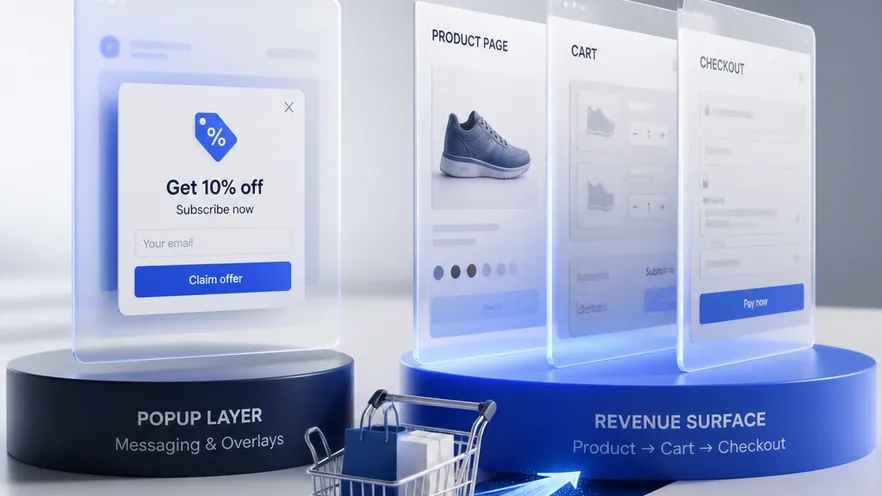
OptiMonk is a popup and website personalization tool for eCommerce, specializing in overlays, exit-intent messaging, and A/B testing on popup variants with native Shopify integration. Omniconvert Explore runs A/B, multivariate, and server-side tests on product pages, cart, and checkout. They are complementary: OptiMonk optimizes on-site messaging, Omniconvert Explore tests the full revenue funnel.
Compare and choose: Omniconvert Explore Omniconvert Explore website overlays Omniconvert Explore web personalization Omniconvert Explore advanced segmentation
- OptiMonk is a specialist popup and website personalization tool for eCommerce with A/B testing built for popup and overlay variants, rated 4.8 on G2 across 159 reviews.
- OptiMonk uses session-based pricing from $39 per month with a free trial and native Shopify integration.
- OptiMonk cannot A/B test product page layouts, cart, or checkout flows, and does not offer server-side testing.
- Omniconvert Explore runs A/B, multivariate, and server-side experiments on product, cart, and checkout pages and measures results in revenue per visitor.
- The two are complementary: pair OptiMonk for popup personalization and lead capture with Explore for full-funnel page and checkout testing.
Teams comparing OptiMonk vs Omniconvert Explore are usually deciding how to lift eCommerce conversion on a Shopify store. OptiMonk is a specialist popup and overlay personalization tool with A/B testing on overlay variants, native Shopify integration, and one of the highest G2 scores in its category. Omniconvert Explore runs A/B, multivariate, and server-side experiments on product pages, cart, and checkout, measured in revenue per visitor. This page covers what each does well, where OptiMonk stops for full-page and checkout testing, and how the two fit together.
What is OptiMonk, and what does it actually do?
OptiMonk is a popup and website personalization platform built specifically for eCommerce, with A/B testing on popup and overlay variants. It has native Shopify integration and holds one of the highest ratings in the personalization category on G2. [G2, 2026]
OptiMonk holds a 4.8 out of 5 rating on G2 across 159 reviews, and it earns that score by doing one job well. [G2, 2026] It ships exit-intent popups, cart abandonment overlays, sticky bars, dynamic content blocks, and personalized on-site messaging, with native Shopify integration and eCommerce-specific templates.
Its A/B testing capability is built for the same layer. It runs variants of popups and personalized experiences against each other to find the highest-converting overlay, headline, or offer. Multivariate testing is included for the same overlay layer.
The question this page answers is narrower: is popup and overlay A/B testing the same job as running conversion experiments on product pages, cart, and checkout? And where is the gap for a Shopify store that needs both surfaces tested?
Popup personalization is the practice of showing tailored on-site overlays, exit-intent messages, sticky bars, and product recommendation widgets to specific visitor segments, and running A/B tests on those overlay variants. OptiMonk specializes in this layer. It is a separate concern from experiments on the underlying page layout, product details, or checkout form, which belong to full-funnel CRO.
Where OptiMonk is genuinely strong
- Top-rated personalization tool: 4.8 out of 5 on G2 across 159 reviews. [G2, 2026]
- Specialist popup and overlay tooling: exit-intent, cart abandonment, sticky bars, and dynamic content blocks.
- Native Shopify integration: installs cleanly on a store with eCommerce-specific templates.
- A/B testing on the popup layer: variant testing built in, plus multivariate for overlays.
- Session-based pricing: from $39 per month, with a free trial, suited to store traffic.
Where OptiMonk hits its ceiling for an eCommerce store
- Popup-only testing scope: testing is limited to popup and overlay variants, not page layouts.
- No page-level visual editor: cannot A/B test product page copy, variant selectors, or PDP structure.
- No checkout experimentation: the checkout flow, forms, and badge stack are outside the testing scope.
- No server-side testing: back-end changes and pricing experiments need a separate platform.
- Full-funnel CRO needs a second tool: teams testing beyond overlays add a dedicated experimentation platform.
None of this makes OptiMonk a weak product. It makes it a specialist. The friction shows up when the surface a store needs to test is the product page description, the cart layout, or the checkout badge stack, and the metric that matters is revenue per visitor, not overlay click rate.
What OptiMonk cannot do for an eCommerce store
OptiMonk optimizes on-site messaging and lead capture. It cannot run A/B tests on product page layouts, cart, or checkout flows. That is not a defect; it is where its category stops. It is also the layer where most eCommerce revenue is won or lost.
Omniconvert Explore is built for the layer OptiMonk does not reach. OptiMonk lifts conversion on the messaging surface: it raises email signups, coupon claims, and cart save actions. A store still needs to know whether the product page copy, the variant selector, and the checkout form itself move revenue per visitor.
Most popup and personalization tools are built around an overlay and a generic engagement event. They optimize the execution of an overlay and measure success in overlay click rate or lead capture rate. They are not built around the pages where the purchase is actually completed, or around the metric a store runs on.
Both jobs matter for eCommerce. They are just different jobs, and popup A/B testing does not cover both surfaces.
eCommerce CRO means running controlled experiments on the pages where revenue is made, product listings, cart, and checkout, and tracking success through revenue per visitor and order rate, not a generic conversion percentage. Omniconvert Explore is an eCommerce conversion rate optimization platform built for testing product, cart, and checkout pages on Shopify, with pricing tied to store traffic rather than a flat seat fee.
What OptiMonk cannot tell an eCommerce team
- Revenue impact, not just click rate. Whether a winning popup or overlay actually raised revenue per visitor and order rate, not just overlay click rate or email signup rate.
- Which page to test next. Which funnel stage, whether product detail, cart, or checkout, will move revenue most if you run an experiment there first.
- Did the checkout hold up. How the experiment interacts with the Shopify catalog, variants, and checkout flow natively at the page and form level, not the overlay level.
- Did it hold for repeat customers. Whether the result holds for high-value, repeat customers, the Customer Value Optimization question, not just first-session popup viewers.
The CROBenchmark Report 2026 covers 7,000+ eCommerce stores tracked by Omniconvert, and it shows that stores limiting experiments to popup variants gain little at checkout, because overlay wins do not carry through to the page where the order is placed. [CROBenchmark Report 2026, Omniconvert]
Explore runs the experiment on the store's real revenue surfaces, including the checkout, and reports the outcome in revenue per visitor. That is the difference between a popup personalization tool and a platform built for store revenue.
OptiMonk vs Explore: the capability comparison
Side by side, OptiMonk is deeper on popups and website personalization, while Explore is deeper on full-funnel A/B testing. Both are eCommerce-first with native Shopify integration and session-based pricing. Explore adds page-level, multivariate, and server-side testing on product, cart, and checkout, with revenue per visitor as the outcome.
| Capability | OptiMonk | Omniconvert Explore |
|---|---|---|
| Primary function | Popup and overlay personalization for eCommerce | Full-funnel eCommerce CRO: product pages, cart, and checkout |
| A/B testing | Partial limited to popup and overlay variant tests | Yes both a visual editor and a code editor |
| Multivariate testing | Yes on the overlay layer | Yes |
| Server-side testing | No | Yes |
| Visual editor | Partial popup builder, no page-level editor | Yes no developer required |
| Surveys and on-site overlays | Yes overlays are the core product | Yes includes native surveys and overlays |
| Shopify integration | Yes native | Yes native |
| eCommerce focus | High eCommerce-first | High designed around eCommerce revenue workflows |
| Pricing model | Session-based, from $39 per month, free trial | Priced per session, matched to store traffic, free trial available |
| Best for | eCommerce teams wanting popup-driven lead capture and on-site personalization | eCommerce and Shopify teams that want to grow revenue across product pages, cart, and checkout |
| User rating | Rated 4.8 out of 5 on G2, based on 159 reviews as of 2026 | 4.6 out of 5 (G2, 197 reviews, as of 2026) |
In one A/B test with Omniconvert Explore, AliveCor placed a 'New' label on recently released products across all devices and reached +25.17% conversion rate, +29.58% revenue per user and a 99.4% chance to win. [Omniconvert, AliveCor case study]
OptiMonk pricing and features reflect publicly listed information as of 2026 and may change. Omniconvert Explore is priced on a session basis; check the Omniconvert pricing page for current plan details.
Compare OptiMonk with other tools
OptiMonk compared with other tools
- AB Smartly vs OptiMonk
- Convert vs OptiMonk
- Crazy Egg vs OptiMonk
- Dynamic Yield vs OptiMonk
- Eppo vs OptiMonk
- Evergage vs OptiMonk
- Fibr AI vs OptiMonk
- Instapage vs OptiMonk
More OptiMonk comparisons: Intelligems vs OptiMonk, Kameleoon vs OptiMonk, OptiMonk vs Unbounce.
Get the full CROBenchmark data behind these stats: 7,000+ stores, 15+ industries, 248+ audit criteria, 100+ CRO experts. See exactly where eCommerce growth teams are losing margin in 2026.
Get the CROBenchmark ReportFrequently Asked Questions
Should you choose Explore over OptiMonk?
If your priority is testing product pages, cart, and checkout flows to move revenue per visitor, choose Explore: it runs full-funnel A/B, multivariate, and server-side experiments native to Shopify. If your priority is exit-intent popups, on-site overlays, and lead capture, OptiMonk is the specialist. Most stores use both together, OptiMonk for on-site messaging and lead capture, Explore for the pages that determine order rate.
OptiMonk earns its 4.8 G2 score by owning the popup and overlay layer for eCommerce. It ships exit-intent popups, cart abandonment overlays, and dynamic content blocks with native Shopify integration, and A/B tests each of them against a variant.
The question for a store is whether the experiments that move order rate are running natively on the product, cart, and checkout pages, and whether they are measured in revenue per visitor. That is the surface Explore is built for, and it is why the two tools sit next to each other rather than replace each other.
Stop guessing.
Start testing what moves revenue.
With Omniconvert Explore, you run A/B, multivariate, and personalization tests across product pages, cart, and checkout, and the results are reported in revenue per visitor rather than raw clicks.
4.6 out of 5 across 197 reviews, G2 , as of 2026