Omnichannel Customer Experience: A Complete Guide (2026)

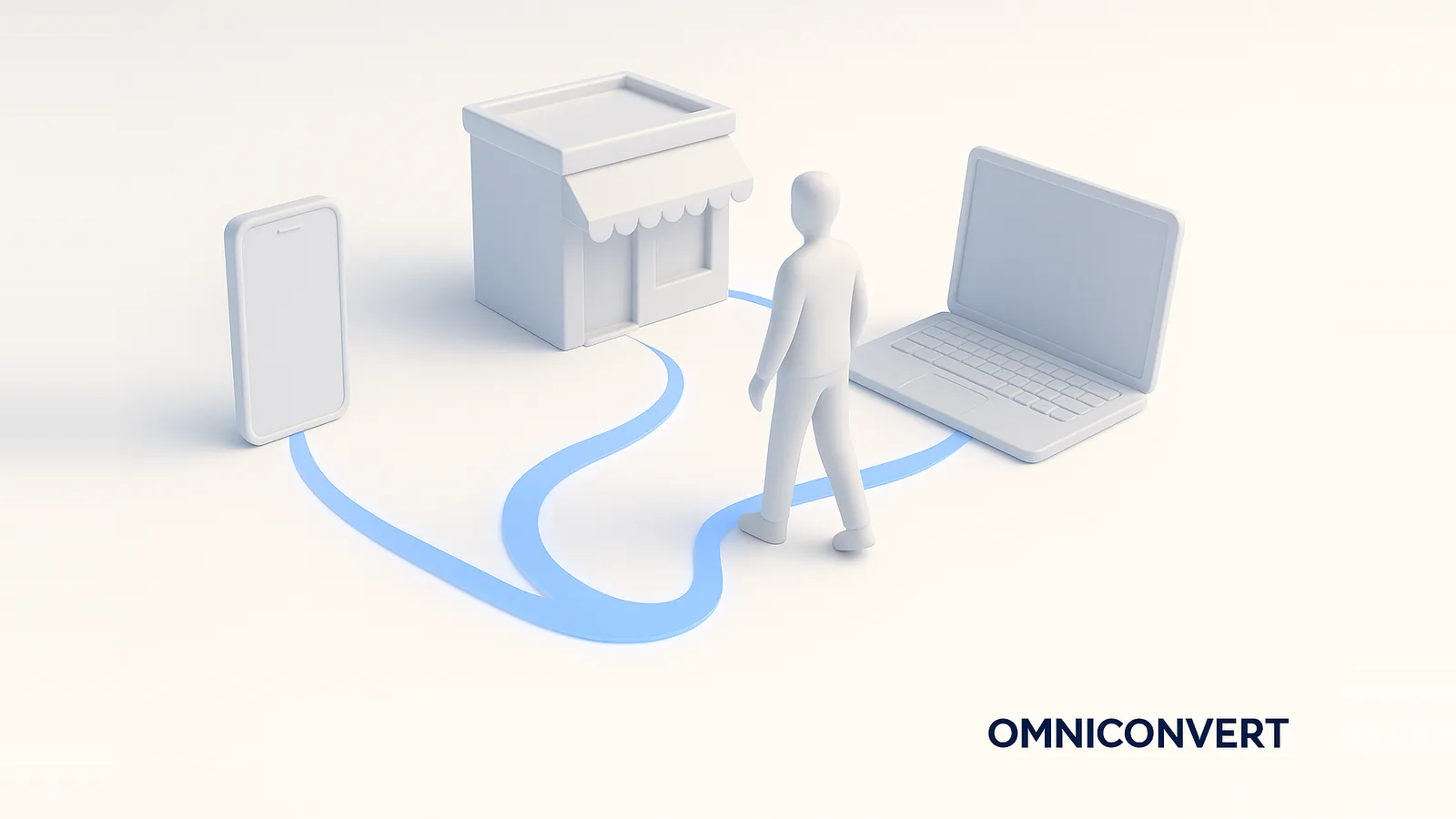
- Omnichannel customer experience connects every channel into one seamless journey, with data shared so the customer is recognized across touchpoints.
- It differs from multichannel (channels run separately) and single-channel (one channel only); only omnichannel keeps context flowing across channels.
- It pays: the Aberdeen Group found strong omnichannel engagement retains about 89 percent of customers vs 33 percent for weak engagement, and connected customers carry higher lifetime value.
- Build it with the Omniconvert Omnichannel CX Framework: unify data, map the journey, personalize, stay consistent, then measure and act.
- Unified data is the foundation. Nexus by Omniconvert gives teams the single customer view omnichannel depends on, turned into ranked actions.
Omnichannel customer experience is a strategy that connects every channel a customer uses, website, app, social, email, phone, and physical store, into one seamless, consistent journey, with data shared so the customer is recognized across touchpoints. It is a high-value discipline because connected customers retain and spend more, and Omniconvert has studied the link between experience, retention, and customer value across the CROBenchmark dataset of 7,000+ websites in 15+ industries, against 248+ audit criteria, drawing on 13 years in eCommerce conversion rate optimization [CROBenchmark Report 2026, Omniconvert].
Nexus by Omniconvert is the AI eCommerce growth engine that unifies customer data into the single source of truth omnichannel depends on, then turns it into ranked actions. This guide covers what omnichannel customer experience is, how it differs from multichannel and single-channel, why it matters, a framework to build it, how to measure it, and the brands that do it well. Every section answers the question directly, then goes deeper.
What is omnichannel customer experience?
Customers no longer engage with a brand through a single channel. They discover a product on social, research it on a phone, ask a question over chat, and buy in a store or on a laptop, often in one journey. Omnichannel customer experience is the discipline of making all of that feel like one conversation rather than a dozen separate ones.
The defining requirement is memory. Customers expect a brand to remember past interactions and carry context forward, so a return started in an app can be finished in a store without re-explaining anything. When channels share data, that memory exists; when they do not, the customer feels the seams, and every seam is a chance to lose them.
It helps to separate omnichannel from simply having many channels. A brand can run a website, an app, a physical store, and five social accounts and still deliver a disjointed experience if those channels cannot see one another. Omnichannel is defined by the connections between channels, not the count of them. That distinction matters because the instinct, when an experience feels incomplete, is to add another channel, when the real fix is usually to connect the ones you already have. The work is less about launching new touchpoints and more about unifying the data behind the existing ones so they finally act as one.
Omnichannel vs multichannel vs single-channel
The three approaches are easy to confuse, because more channels can look like progress even when they are not connected. The table below shows how they diverge, and why integration, not channel count, is what moves retention and lifetime value. The relative retention and CLV levels reflect Omniconvert's CRO experience and the direction the research points; the exact gain is specific to your business, so treat the levels as direction, not a promise.
| Dimension | Single-channel | Multichannel | Omnichannel |
|---|---|---|---|
| Channel integration | One channel only | Several, operating separately | All channels connected |
| Customer experience | Limited, no cross-channel context | Fragmented, customer restarts each time | Seamless and unified |
| Data sharing | None across channels | Stored separately per channel | Centralized, flows across channels |
| Personalization | Minimal | Limited | Highly personalized |
| Relative retention | Baseline | Moderate | Highest |
| Relative lifetime value (CLV) | Baseline | Higher | Highest |
The practical takeaway: adding channels without connecting them is multichannel, and it caps out fast because every silo makes the customer start over. Omnichannel is the step that turns those same channels into compounding retention and customer lifetime value.
Why omnichannel customer experience matters
The business case rests on retention economics. According to the Aberdeen Group, companies with strong omnichannel engagement retain roughly 89 percent of their customers, against just 33 percent for those with weak omnichannel engagement [Aberdeen Group]. Because retained customers cost far less than acquired ones and buy repeatedly, that retention gap compounds into a large revenue gap over time.
- Higher retention and loyalty: A connected experience removes the friction that pushes customers to competitors.
- Higher lifetime value: Customers engaged across several connected channels tend to buy more often and stay longer than single-channel customers.
- Better data and personalization: Unified data across channels enables sharper segmentation and more relevant recommendations.
- Operational efficiency: Centralized data and automation cut redundant work and lower the cost to serve.
- Competitive advantage: With leaders like Nike, Starbucks, and Sephora setting the bar, a connected experience is now an expectation, and falling short of it is a reason to switch.
The flip side is the cost of fragmentation. When channels do not share data, customers repeat themselves, lose carts between devices, and get conflicting answers from support and sales. Each of those moments is friction the customer did not expect and the brand cannot see, and in a market where switching is one tap away, friction is churn. Omnichannel is how you remove it systematically rather than one complaint at a time.
Mapping the omnichannel customer journey
You cannot connect a journey you have not mapped. Listing every touchpoint across the lifecycle, from first ad to post-purchase support, shows where channels hand off to one another and where those handoffs break. The touchpoints group into three phases:
- Before purchase: Ads, social media, search, reviews, email, influencers, and word of mouth, where customers discover and consider the brand.
- During purchase: The website, mobile app, physical store, chatbot, live chat, and checkout, where the decision is made and friction is most expensive.
- After purchase: Confirmation and shipping emails, invoices, support, returns, how-to guides, and loyalty programs, where retention is won or lost.
Mapping these against the customer lifecycle, acquisition, engagement, conversion, retention, and advocacy, reveals the seams: the moments a customer has to repeat themselves or switch context. Those seams, not the channels themselves, are where omnichannel experiences succeed or fail, and they are the highest-value places to integrate first. Start with the seam that sits on your most valuable journey, not the one that is easiest to fix.
The Omniconvert Omnichannel CX Framework
Most omnichannel efforts stall because teams add channels before they connect data. The framework fixes the order, making unified data the foundation and everything else build on it.
| Stage | Goal | Main lever | Metric that tracks it |
|---|---|---|---|
| Unify | One customer view across channels | Integrate data via CRM or a customer data platform | Single-profile coverage |
| Map | Know every touchpoint in the journey | Journey mapping across pre, during, and post purchase | Touchpoints, drop-off points |
| Personalize | Relevant experience per customer | Segmentation and AI recommendations on unified data | Conversion, engagement |
| Be consistent | Same brand, price, and message everywhere | Cross-channel governance of content and inventory | CSAT, brand consistency |
| Measure and act | Improve the experience continuously | NPS, CSAT, CES plus journey analytics | NPS, CES, retention |
Read top to bottom, the framework explains why so many omnichannel projects disappoint: they jump to personalization or a new channel without the unified data that makes either work. Nexus by Omniconvert is the AI eCommerce growth engine built for the first and last stages, unifying customer data, RFM segments, Customer Lifetime Value, and NPS into one source of truth and turning it into ranked actions.
See which segments to prioritize, on which channel, and which action protects the most revenue.
Learn more about Customer Intelligence in Nexus →How to measure omnichannel customer experience
No single number captures an experience that spans channels, so use a small set that covers loyalty, satisfaction, effort, and behavior:
- Net Promoter Score (NPS): Willingness to recommend, the clearest relationship-level loyalty signal. See promoters, passives, and detractors.
- Customer Satisfaction (CSAT): Happiness with a specific interaction or touchpoint, measured right after it happens.
- Customer Effort Score (CES): How easy a task was; lower effort correlates with higher retention.
- Customer journey analytics: Heatmaps, session recordings, and funnel reports that show how customers actually move across channels and where they stall.
The discipline that matters most is reading these by segment and across the journey, not as one blended score. A strong company-wide NPS can hide a high-value segment whose cross-channel experience is quietly breaking, which is exactly the failure omnichannel is meant to prevent. For the satisfaction side specifically, see customer satisfaction.
Examples of omnichannel customer experience
Sephora connects discovery, consideration, purchase, and retention into one loop. Shoppers find products through social and influencers, use the app's Virtual Try-On and personalized recommendations to consider, then buy across the website, app, or store with buy-online-pickup-in-store, all tied to a single Beauty Insider loyalty profile. It works because the digital and physical experiences share data and real-time inventory, so the customer is recognized everywhere.
Spotify delivers a seamless experience across every device. Listeners discover through social and word of mouth, get personalized onboarding and AI recommendations, then move between phone, desktop, and speakers with synced playback through Spotify Connect. Proactive, personalized moments like Spotify Wrapped keep people engaged and sharing. The common thread with Sephora is unified data: the experience continues across channels instead of resetting on each one.
The lesson from both is that omnichannel excellence is built on a single customer view, not on the number of channels. The brands that win connect the data behind their channels first, then let personalization and consistency follow. For the wider context, see how to optimize the customer journey.
Frequently Asked Questions
Omnichannel customer experience is a strategy that connects every channel a customer uses, website, app, social media, email, phone, and physical store, into one seamless, consistent journey. The channels share data, so the customer is recognized and their context carries from one touchpoint to the next. The aim is an experience that feels like a single continuous relationship with the brand rather than a series of disconnected interactions, which reduces friction and builds loyalty.
A multichannel strategy uses several channels, such as social, email, and stores, but runs them independently, so a customer who switches channels often has to start over. An omnichannel strategy integrates those same channels so data and context flow between them and the experience stays continuous. In short, multichannel is about being present on many channels; omnichannel is about connecting them into one unified journey.
A single-channel strategy interacts with customers through just one channel, such as a physical store or a website alone. An omnichannel strategy connects multiple channels into one integrated experience where data follows the customer everywhere. Single-channel is simpler but limits reach and resilience; omnichannel meets customers wherever they are and remembers them across touchpoints, which is why it consistently produces higher retention and lifetime value.
Omnichannel customer experience is important because customers now move across many channels in a single buying journey, and a disconnected experience costs retention, revenue, and trust. The Aberdeen Group found companies with strong omnichannel engagement retain about 89 percent of customers, compared with 33 percent for weak engagement. Connected customers also buy more often and carry higher lifetime value, so omnichannel directly drives growth, not just convenience.
You measure omnichannel customer experience with both survey metrics and behavioral analytics. Net Promoter Score captures loyalty, CSAT captures satisfaction with a specific interaction, and Customer Effort Score captures how easy a task was. Customer journey analytics then maps how customers move across channels and where they drop off. Read these together and by segment, since the cross-channel journey is exactly what a single, blended metric tends to hide.
Two strong examples are Sephora and Spotify. Sephora connects its mobile app, website, and physical stores, letting shoppers try products virtually, check store stock, buy online and collect in-store, and keep one loyalty profile across all of it. Spotify syncs playback and recommendations seamlessly across devices and re-engages listeners with personalized features like Spotify Wrapped. Both unify customer data so the experience continues across channels instead of resetting.
You build an omnichannel customer experience by unifying customer data into a single view, mapping the journey and its touchpoints across channels, personalizing with that data, keeping branding, pricing, and messaging consistent everywhere, and continuously measuring and improving with NPS, CSAT, CES, and journey analytics. The foundation is unified data; without one source of truth, channels stay siloed and the experience fragments no matter how many you add.
Nexus by Omniconvert is the AI eCommerce growth engine that unifies customer data, RFM segments, Customer Lifetime Value, NPS, and behavior across channels into one source of truth, then turns it into ranked actions. Because omnichannel depends on a single customer view, Nexus gives teams exactly that, showing which segments to prioritize on which channel and which intervention protects the most revenue, so the experience stays connected and acted upon.
Pick one customer and follow them across every channel you run: your site, app, email, support, and store. Note every place they would have to repeat information, lose their cart, or get a different answer. Each of those breaks is a seam in your omnichannel experience, and the worst one is your first project. Fix it by connecting the data behind those two channels, not by adding a new channel. Omnichannel is won by removing the seams between the channels you already have, not by trying to be everywhere at once.
Give omnichannel the unified customer view it needs
Nexus by Omniconvert unifies customer data, RFM segments, Customer Lifetime Value, and NPS into one source of truth, then turns it into ranked actions across channels. The single customer view your omnichannel experience depends on, made actionable.