Amperity vs Omniconvert Commander: Enterprise CDP Compared
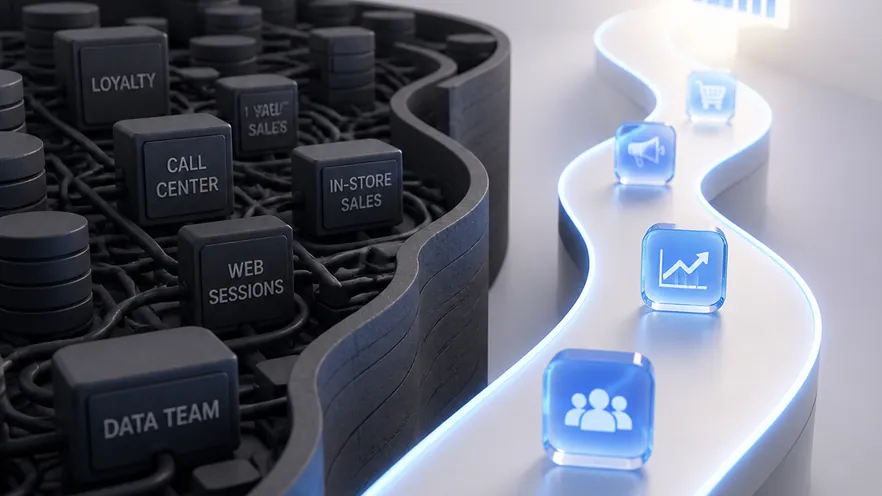
Amperity is an enterprise customer data platform. Its identity resolution matches records across hundreds of online and offline sources to build unified profiles, and it is priced per profile for organizations with dedicated data teams. Omniconvert Commander delivers the outputs an eCommerce marketing team needs from that data, RFM, CLV, cohorts, and churn, starting on a free plan and with no data team required.
- Amperity is an enterprise customer data platform whose core job is identity resolution across hundreds of online and offline sources.
- It is bought and operated by data teams, priced per unified customer profile, and rolled out on annual enterprise contracts.
- Unified profiles are an input, not a decision. RFM, CLV, churn, and activation still need models, a BI layer, and downstream tools.
- Omniconvert Commander ships those outputs pre built for marketers, pushes RFM audiences to Meta and Google Ads, and starts on a free plan.
- Decide by organizational shape. Broken identity across many systems favours Amperity, Shopify-first retention work favours Omniconvert Commander.
Teams comparing Amperity with Omniconvert Commander are usually weighing organizational fit rather than feature counts. Amperity is built for large enterprises: airlines, hospitality groups, and media companies with customer records scattered across call centres, loyalty systems, stores, and the web. Its identity resolution stitches those records into one profile, and that work is genuinely hard. Omniconvert Commander is built for eCommerce brands whose customer data already lives in Shopify, GA4, Meta Ads, and Klaviyo, and whose priority is CLV led growth this quarter rather than a multi-year data programme. This page covers what Amperity does well, what it asks of your organization, and when each is the right call.
What is Amperity, and what does it do?
Amperity is an enterprise customer data platform. Its core capability is identity resolution: matching customer records across hundreds of online and offline sources into a single unified profile, at a scale that suits large organizations. It holds a 4.4 out of 5 rating on G2 and is priced per unified profile on annual enterprise contracts. [G2, 2026]
Amperity solves a problem most eCommerce brands do not have. When one customer appears as four records across a loyalty database, a call centre log, an in-store transaction, and a web session, someone has to decide those four are one person. Amperity does that probabilistic matching well, which is why brands like Warnermedia, Hertz, and Alaska Airlines run it.
The output is a clean, unified profile store that a data team can query and feed into downstream systems.
The question this page answers is narrower. If your customer data already lives in Shopify and a handful of connected tools, is an enterprise identity layer the thing standing between you and growth? And what does it cost to run one?
An enterprise customer data platform unifies customer records from many online and offline sources using identity resolution, then serves those profiles to downstream systems. It is bought and operated by data teams. An eCommerce customer intelligence platform, such as Omniconvert Commander, starts from data that is already unified in the store and delivers the decision ready outputs marketers need: RFM segments, CLV scores, cohort curves, and churn signals.
Where Amperity is genuinely strong
- Identity resolution at scale: probabilistic matching across hundreds of sources, including offline systems.
- Complex enterprise estates: built for organizations with loyalty programmes, call centres, and physical retail.
- Warehouse friendly: unified profiles feed BigQuery, Snowflake, and downstream enterprise tooling.
- Governance and scale: designed for the compliance and volume requirements of large brands.
- Strong review sentiment: 4.4 out of 5 on G2 among enterprise buyers. [G2, 2026]
What Amperity asks of an eCommerce team
- A dedicated data team: the platform serves data engineers and analysts, not marketers directly.
- An implementation programme: enterprise CDP rollouts are measured in months, not days.
- Per profile pricing: the bill grows with database size regardless of how much those customers spend.
- Annual enterprise contracts: commitment terms rather than monthly flexibility.
- Downstream tooling: profiles still need a BI layer, an activation layer, and an experimentation tool.
None of this makes Amperity a weak product. It makes it an enterprise product. The friction appears when a Shopify first brand buys enterprise infrastructure to answer marketing questions.
What can't a unified customer profile store do on its own?
A unified profile is an input, not a decision. Knowing that four records are one customer does not tell a marketer which customers are slipping away, which segment deserves the next campaign, or which experiment to run first. In an enterprise CDP stack those answers still come from a data team and a downstream tool.
Omniconvert Commander starts one layer up. Because eCommerce customer data is already keyed by order and email in Shopify, the hard identity problem is mostly solved before the platform starts. What remains is the part marketers care about: value, risk, and what to do next.
Omniconvert Commander ships those outputs pre built. RFM cells, CLV scores, cohort curves, churn flags, and product level intelligence appear in a dashboard a marketer can read, then leave the platform as ad audiences, experiment priorities, and creative briefs.
Customer intelligence turns unified customer data into decisions a marketing team can act on: who the valuable customers are, which ones are slipping away, which cohorts repeat, and which segment deserves the next campaign or experiment. It is measured by whether a marketer can act without an analyst, not by how many sources were merged.
What a profile store cannot tell an eCommerce team
- Which customers are about to churn. Churn risk needs a maintained model and a refresh cadence.
- Which segment should get the next budget. RFM cells only help once they reach Meta and Google Ads.
- Which experiment to run first. A profile store does not rank site opportunities by revenue impact.
- Whether the result held after costs. Reported revenue is not contribution margin once discounts, returns, and cost of goods are counted.
The CROBenchmark Report 2026 reviewed 7,000+ eCommerce websites against 248+ audit criteria. One pattern stands out for retention: brands that grow do not wait for perfect data. Getting from signal to campaign fast beats having complete data. [CROBenchmark Report 2026, Omniconvert]
What does Omniconvert Commander deliver without an enterprise programme?
Omniconvert Commander is the AI eCommerce Growth Engine. The Customer Intelligence layer delivers RFM segmentation, CLV tracking, cohort analysis, churn identification, and NPS through Pulse. The execution layer pushes RFM audiences to Meta and Google Ads, ranks the experiment queue, generates creative, and measures True Profit. Setup is days, not months.
Omniconvert Commander plugs into Shopify, GA4, Meta Ads, and Klaviyo. A specialist walks you through the Customer Intelligence layer in a single 60 minute onboarding call. There is no implementation project to staff and no per-profile billing meter ticking against your database.
Omniconvert Commander brings together two layers for eCommerce teams: customer intelligence (RFM segmentation, churn identification, CLV tracking, and cohort analysis) and autonomous execution (experiment prioritization, AI creative generation, True Profit measurement, and ad audience building).
What arrives in the first weeks
- Pre-built customer intelligence: RFM cells, CLV scores, cohort curves, and churn flags without a query.
- Audience activation: high-value RFM segments flow straight into Meta and Google Ads as both custom and lookalike audiences.
- Prioritized experiment queue: each opportunity is scored by expected revenue impact and routed into Omniconvert Explore for testing.
- AI creative generation: ad briefs and copy variants are built around the specific segment you are targeting.
- True Profit measurement: results read in CLV weighted contribution margin.
- Guided onboarding and support: a 60 minute session with a specialist, a data and CRO audit, and a dedicated contact.
Amperity vs Omniconvert Commander: how do the capabilities compare?
Amperity leads on enterprise identity resolution, multi-source unification, and warehouse integration. Omniconvert Commander leads on marketer ready outputs, paid audience activation, experimentation, support services, and a free plan to start. They suit different organizations and can coexist where both needs are real.
| Capability | Amperity | Omniconvert Commander |
|---|---|---|
| Enterprise identity resolution | Yes: the core product, across hundreds of sources | No: Omniconvert Commander starts from store data that is already keyed |
| Shopify integration | Yes | Yes: native and central to the product |
| Warehouse and BigQuery integration | Yes | No |
| RFM segmentation | Yes | Yes: pre built and refreshed |
| Customer lifetime value tracking | Via data team models | Yes: CLV per customer and per cohort |
| eCommerce cohort analysis | Via data team models | Yes |
| Churn risk identification | Via data team models | Yes |
| Product intelligence at SKU level | Via data team models | Yes |
| Built for marketers without SQL | No: a data team is required | Yes |
| RFM audiences pushed to Meta and Google Ads | No: activation through downstream tooling | Yes: native audience sync |
| NPS tracking | No | Yes: through Pulse |
| Prioritized experiment queue | No | Yes: ranked by expected revenue impact |
| A/B testing and personalization | No | Yes: through Omniconvert Explore |
| AI creative generation | No | Yes |
| True Profit measurement | No | Yes: CLV weighted contribution margin |
| Guided onboarding and managed services | Implementation consultants | Yes: onboarding in 60 minutes, data and CRO audit, managed CRO |
| Pricing model | Per unified profile: annual enterprise contracts | Free plan, then $49 to $499/mo: no per profile fee |
| Best fit | Large enterprises unifying identity across online and offline systems | eCommerce brands that need CLV led decisions and execution without a data team |
| User rating | 4.4 out of 5 (G2, as of 2026) | 5.0 out of 5 (Shopify App Store, 63 reviews, as of November 2026) |
The Amperity column reflects publicly available Amperity product documentation as of August 2026.
When is Amperity the right choice, and when should you run both?
Pick Amperity when identity is genuinely broken across many systems and a data team owns the fix. Pick Omniconvert Commander when the store already holds the customer record and the priority is decisions and execution. Large organizations sometimes run both, because they serve different departments.
You operate loyalty, retail, call centre, and web systems that each hold a partial view of the same customer. You have a Chief Data Officer or an equivalent function, an implementation budget, and a multi-quarter roadmap. Resolving identity is the prerequisite for everything else, and Amperity is built for exactly that.
You are a Shopify first brand. Customer records are already keyed by email and order, and the pressing question is retention: which customers are valuable, which are lapsing, and which segment should receive the next campaign. Omniconvert Commander answers those within days of connecting your sources, with no data team and no per profile meter.
Some organizations keep Amperity as the enterprise identity layer for the data team and run Omniconvert Commander as the customer intelligence and execution layer for eCommerce marketing. They operate in parallel, and neither blocks the other.
How does Amperity pricing compare with Omniconvert Commander?
Amperity charges by the number of unified customer profiles on annual enterprise contracts, with implementation as a separate line item. Omniconvert Commander offers a Founding Free plan at no cost, followed by monthly tiers priced at $49, $199, and $499, plus a custom Unlimited plan. Starting on the free tier while you wind down Amperity means you will not pay for both tools at once.
The practical difference is what each cost tracks. A per profile bill grows with your database, including inactive customers who will never buy again. Omniconvert Commander plans step up by usage limits such as credits, ad creatives and landing pages, not by the size of your database. The Founding Free plan is the starting point, with paid tiers ready when your usage outgrows it.
Count the staffing line too. An enterprise CDP assumes data engineers and analysts to operate it, and that role is usually the largest cost in the stack even though it never appears in a vendor quote.
What is included with Omniconvert Commander
- Free plan: The Founding Free tier carries a $0 price tag and can be added to Shopify without any payment. You get 18 ad creatives, 3 landing pages, and access to 12 months of data history.
- Monthly paid plans: Creator at $49, Growth at $199, Scale at $499, and a custom Unlimited plan. Features and limits differ by plan.
- Time the switch on the free plan: start on Founding Free before you cancel Amperity, so you avoid double billing.
- Guided onboarding included: every plan starts with a 60 minute specialist session and a data and CRO audit.
All pricing tiers are listed on the Omniconvert Commander pricing page.
Get the full CROBenchmark data behind these stats: 7,000+ websites, 15+ industries, 248+ audit criteria, 100+ CRO experts. See exactly where eCommerce growth teams are losing margin in 2026.
Get the CROBenchmark ReportAmperity vs Omniconvert Commander: FAQs
Should you choose Omniconvert Commander over Amperity?
If customer identity is fragmented across many online and offline systems and a data team owns the problem, Amperity is built for that job. If your customer record already lives in Shopify and the priority is CLV led retention, paid audiences, and experiments this quarter, Omniconvert Commander delivers those outputs in days, starting on a free plan and with no data team.
Amperity's identity resolution is genuinely sophisticated work, and the organizations it serves need it. Nothing in this comparison argues that an enterprise CDP is the wrong purchase for an enterprise data problem.
The question for an eCommerce brand is narrower. Is identity actually the blocker, or is the blocker the distance between customer data and a marketer's next decision. That second gap is the one Omniconvert Commander is built to close.
Enterprise grade intelligence.
Without the enterprise programme.
Amperity needs a data team, an implementation budget, and per profile pricing. Omniconvert Commander delivers customer intelligence to your marketing team, pushes RFM audiences to Meta and Google, and measures True Profit.
5.0 out of 5 across 63 reviews, Shopify App Store , as of November 2026