Contentsquare alternative (2026): analysis vs experimentation
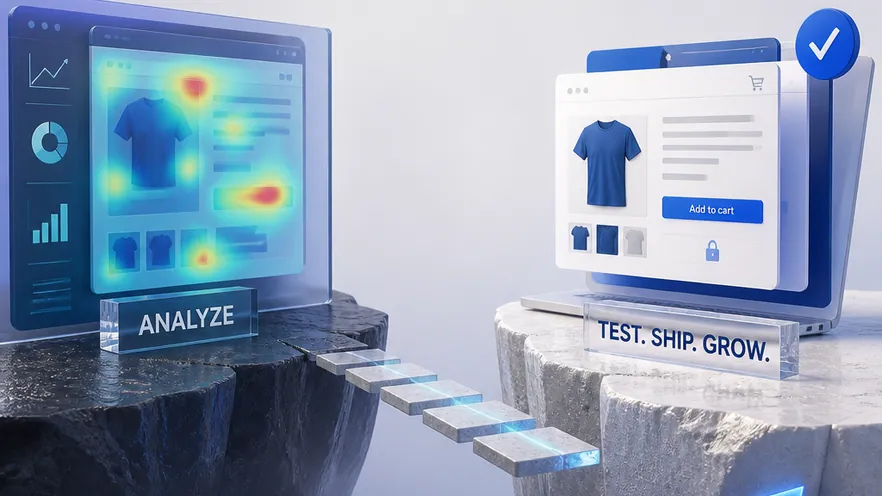
Contentsquare is an enterprise digital experience analytics platform: journey analysis, zone-based heatmaps, session replay, and revenue attribution down to individual page elements. Omniconvert Explore is a Shopify-native eCommerce CRO platform that runs the A/B, multivariate, and personalization experiments that fix the friction Contentsquare quantifies. Analysis and experimentation, complementary rather than competing.
- Contentsquare is an enterprise digital experience analytics platform with a 4.4 out of 5 G2 rating across 2,070+ reviews, and now owns both Hotjar and Heap. [G2, 2026]
- It captures every session, maps journeys, overlays zone-based heatmaps, and attributes revenue down to individual page elements at enterprise scale.
- Contentsquare has no A/B, multivariate, or server-side testing; it quantifies where a funnel leaks but cannot run the experiment that fixes it.
- Omniconvert Explore runs A/B, multivariate, and personalization experiments on Shopify product, cart, and checkout, and reports outcomes in revenue per visitor.
- The two rarely compete: enterprise stores often run Contentsquare for journey analytics and Explore as the experimentation engine that acts on it.
Teams comparing Contentsquare vs Omniconvert Explore are usually holding two different jobs in the same evaluation. Contentsquare is an enterprise digital experience analytics platform that quantifies exactly how much revenue a broken product page or checkout element costs, down to the pixel. Omniconvert Explore is a Shopify-native experimentation platform that runs the test which fixes that broken element and measures the lift in revenue per visitor. This page explains where each fits, and where enterprise stores end up running both.
What is Contentsquare, and what does it actually do?
Contentsquare is the enterprise category leader in digital experience analytics. It captures every session on a site, maps the journeys visitors actually take, overlays zone-based heatmaps on every page, and attributes revenue impact down to individual page elements so large eCommerce and retail teams know exactly which friction points are costing the most. [Contentsquare, 2026]
Contentsquare carries a 4.4 out of 5 rating on G2 across more than 2,070 reviews, and now owns both Hotjar and Heap, which anchors it as the enterprise standard in the digital experience analytics category. [G2, 2026]
The category Contentsquare sits in is enterprise digital experience analytics. It answers questions like: which zone on this product page is being ignored, which step in the checkout is losing the most revenue per session, and what did the customers who did convert see that the ones who abandoned did not.
The question this page answers is narrower: is quantifying where an eCommerce funnel leaks the same job as testing the fix? And if not, where is the gap?
Digital experience analytics is the practice of capturing every session on a site and reconstructing the visitor journey with zone-level heatmaps, session replay, and revenue attribution against individual page elements. It is powerful for diagnosing where and how much a funnel leaks. It is a separate concern from whether the platform can run a controlled experiment to fix the leak.
Where Contentsquare is genuinely strong
- Deepest journey and zone-based analytics in the category: every session captured, every zone on every page mapped, and revenue attributed down to individual page elements.
- Enterprise traffic volumes: the platform is built to ingest and model very high traffic without sampling or breaking under load.
- Impact quantification: friction points are ranked by the revenue they cost, so an enterprise CRO team knows exactly which product page or checkout element to fix first.
- Category standing: 4.4/5 on G2 across 2,070+ reviews, and Contentsquare now owns Hotjar and Heap, so the analytics stack around it is unusually consolidated. [G2, 2026]
Where Contentsquare hits its ceiling for an eCommerce store
- No experimentation: Contentsquare is an analysis platform, not a testing platform. It quantifies the cost of a problem but cannot run the A/B or multivariate test that fixes it.
- Implementation is a project: deploying Contentsquare across a store is closer to an integration project than an app install, and it assumes analyst time on the team to interpret the output.
- Enterprise pricing bracket: quote-based, custom pricing sized for very large retailers; smaller Shopify and DTC stores rarely justify the cost.
- Medium Shopify fit: integration exists but it is not a native Shopify app experience, and the product is built around enterprise data teams rather than storefront operators.
None of this makes Contentsquare a weak product. It makes it an enterprise analysis platform. The friction shows up specifically when a store already knows where its funnel is leaking, or has a quantified list from Contentsquare, and needs to actually run the experiments that turn that diagnosis into measured revenue.
What Contentsquare cannot do for an eCommerce store
Contentsquare tells an enterprise retailer precisely how much revenue a broken product page costs. What it cannot do is test the replacement. Teams pairing it with eCommerce CRO still need an experimentation platform to run the A/B and multivariate tests that turn a quantified problem into a measured revenue gain. That is the gap an experimentation-first platform closes.
Omniconvert Explore is built for the layer Contentsquare leaves open. Contentsquare can rank every friction point on a store by the revenue it costs, but a store does not just need to know the ranking; it needs the winning variant shipped to product, cart, and checkout, and the lift reported in revenue per visitor. Those are not the same task.
Most analytics platforms in this category are built around a generic session and a generic conversion event. They optimize the measurement of a problem. They are not built around the surfaces where eCommerce revenue is actually won or lost, or around running the controlled experiment that ships the fix.
eCommerce CRO is the practice of running controlled experiments on the revenue surfaces of an online store, product pages, cart, and checkout, and measuring the result in revenue per visitor and order rate rather than generic conversion rate. Omniconvert Explore is defined as an eCommerce conversion rate optimization platform for product, cart, and checkout experiments, native to Shopify and priced for store traffic.
What Contentsquare cannot tell an eCommerce team
- Whether the fix actually worked. Whether a proposed change to a friction point moved revenue per visitor and order rate, not just cleaned up the zone-heatmap.
- Which variant of the fix to ship. Which version of the product page, cart, or checkout element produces the highest lift when a variant is served against a control.
- How the variant behaves in Shopify. How the experiment interacts with the Shopify catalog, variants, and checkout flow natively, without a fresh enterprise implementation.
- Whether it holds for valuable customers. Whether the win holds for repeat, high-value customers, the Customer Value Optimization question, not just first-session traffic.
Across the 7,000+ eCommerce websites in Omniconvert's CROBenchmark Report 2026, the stores compounding revenue fastest are the ones that close the loop from diagnosis to shipped experiment inside the same week; analysis-only stacks tend to accumulate long backlogs of quantified friction that never get tested, and the benchmark shows testing cadence, not analysis depth, is what separates the top quartile on conversion rate from the rest. [CROBenchmark Report 2026, Omniconvert]
Explore runs the experiment on the store's real revenue surfaces and reports the outcome in revenue per visitor. AliveCor used Omniconvert Explore to run a structured A/B testing program and achieved +21% conversion rate, +5% revenue per visitor, and 94% statistical relevance across their experiments. [Omniconvert, AliveCor case study]
Contentsquare vs Explore: the capability comparison
Side by side, Contentsquare and Explore barely overlap in daily job. Contentsquare captures sessions, maps journeys, and attributes revenue to page elements at enterprise scale. Explore runs Shopify-native A/B, multivariate, and personalization experiments on product, cart, and checkout, plus surveys and overlays, and reports in revenue per visitor. One diagnoses. The other tests the fix.
| Capability | Contentsquare | Omniconvert Explore |
|---|---|---|
| Primary function | Enterprise digital experience analytics: journey analysis, zone heatmaps, session replay, revenue attribution | eCommerce CRO on product, cart, and checkout pages |
| A/B testing | No not part of the product | Yes visual editor plus code editor |
| Multivariate testing | No | Yes |
| Server-side testing | No | Yes |
| Visual editor | No analytics tool, no editor to build test variants | Yes no developer required |
| On-site surveys and overlays | No voice-of-customer sits outside the platform | Yes surveys and overlays built in |
| Shopify integration | Medium integration exists, not a native Shopify app experience | Yes native |
| eCommerce focus | High strong enterprise retail focus on the analysis side | High built for store revenue experimentation |
| Pricing model | Quote-based, custom pricing, no free trial | Session-based, built for store traffic, free trial |
| Best for | Enterprise eCommerce and retail teams analysing journeys across very high traffic volumes | Shopify and eCommerce teams testing the fix on product, cart, and checkout for revenue |
| User rating | 4.4 out of 5 (G2, 2070 reviews, as of 2026) | 4.6 out of 5 (G2, 191 reviews, as of 2026) |
Competitor pricing and plan details reflect publicly listed figures as of 2026 and can change. Explore uses session-based pricing; see the Omniconvert pricing page for current plans.
Get the full CROBenchmark data behind these stats: 7,000+ websites, 15+ industries, 248+ audit criteria, 100+ CRO experts. See exactly where eCommerce growth teams are losing margin in 2026.
Get the CROBenchmark ReportFrequently Asked Questions
Should you choose Explore over Contentsquare?
If your enterprise team needs journey analytics and revenue attribution across very high traffic volumes, Contentsquare is the standard, and Explore does not replace it. If you need the experimentation engine that acts on that insight without another enterprise implementation project, choose Explore: it runs A/B, multivariate, and personalization tests on Shopify product, cart, and checkout, and reports outcomes in revenue per visitor. Most enterprise stores end up pairing them.
Contentsquare earns its place inside enterprise retail organizations that already have analyst capacity and very high traffic. It is the deepest journey and zone-based analytics layer in the category, and the revenue attribution work is genuinely useful for prioritising which friction points cost the most.
The question for a store is narrower: once you know where the funnel leaks, who is running the controlled experiment that fixes it, on Shopify, without another enterprise implementation project, and reports the lift in revenue per visitor. That is the surface Explore is built for.
Stop guessing.
Start testing what moves revenue.
Explore runs A/B, multivariate, and personalization experiments on your product pages, cart, and checkout, then measures the outcome in revenue per visitor, not just clicks.
4.6 out of 5 across 191 reviews, G2 , as of 2026