Evergage alternative (2026): Personalization vs Shopify CRO
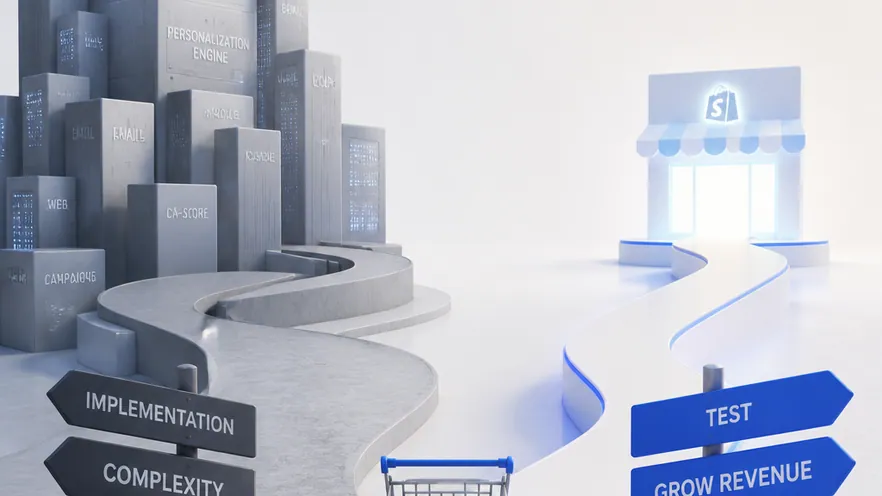
Evergage, now Salesforce Marketing Cloud Personalization, is an enterprise real-time one-to-one personalization platform with built-in A/B testing across web, email, and mobile. Omniconvert Explore is a Shopify-native conversion rate optimization platform for product, cart, and checkout experiments, priced for store traffic and measured in revenue per visitor. Different jobs; a Shopify store rarely needs the Salesforce stack.
- Evergage, now Salesforce Marketing Cloud Personalization, is an enterprise real-time personalization platform rated 4.3 out of 5 on G2 across 94 reviews. [G2, 2026]
- Evergage runs one-to-one personalization across web, email, mobile apps, and onsite search, with A/B and multivariate testing embedded inside personalization campaigns.
- Evergage needs enterprise implementation, sits at custom pricing, delivers full value inside the Salesforce stack, and has no native Shopify integration.
- Omniconvert Explore runs standalone A/B, multivariate, and personalization experiments on Shopify product, cart, and checkout pages, measured in revenue per visitor.
- The two rarely overlap for a Shopify store: Evergage fits Salesforce-committed enterprises; Explore fits stores that need a focused eCommerce CRO program without a Salesforce implementation.
Teams comparing Evergage vs Omniconvert Explore are usually asking whether an enterprise personalization suite is the right tool to run their Shopify conversion experiments. Evergage, now Salesforce Marketing Cloud Personalization, is a real-time one-to-one personalization platform built for enterprise marketing teams inside the Salesforce ecosystem. Explore is a Shopify-native CRO platform that runs A/B, multivariate, and personalization experiments on product, cart, and checkout, and reports outcomes in revenue per visitor. This page explains where each fits, and where a store rarely needs both.
What is Evergage, and what does it actually do?
Evergage, now sold as Salesforce Marketing Cloud Personalization, is an enterprise real-time personalization platform. It builds a live behavioral profile of each visitor and serves individualized product and content recommendations across web, email, mobile apps, and onsite search, with built-in A/B and multivariate testing to validate those personalization rules. [Evergage, 2026]
Evergage is rated 4.3 out of 5 on G2 across 94 reviews. [G2, 2026] It carries a strong reputation among enterprise marketing teams and was named a G2 Leader in personalization engines, especially inside the Salesforce ecosystem.
The category Evergage sits in is real-time personalization with embedded experimentation. Machine-learning models score each session, rules and recommendations fire across channels, and A/B tests exist inside those personalization campaigns to prove which variant of a personalized experience wins.
The question this page answers is narrower: is enterprise cross-channel personalization the same job as running conversion experiments on a Shopify store? And if not, where is the gap?
Real-time personalization means the platform maintains a live profile per visitor and serves individualized content, product recommendations, and campaigns across web, email, mobile, and onsite search. It is powerful for enterprise teams running one-to-one journeys at scale across a stack. It is a separate concern from whether a marketer can launch a Shopify product page or checkout A/B test without a Salesforce implementation.
Where Evergage is genuinely strong
- Real-time one-to-one personalization: a machine-learning profile per visitor drives individualized product and content recommendations in the same session.
- Cross-channel reach: the same personalization logic spans web, email, mobile apps, onsite search, and in-store touchpoints from one platform.
- Deep Salesforce integration: native ties to Salesforce CDP and Marketing Cloud make it the natural personalization layer for teams already committed to that stack.
- Behavioral analytics and segmentation: strong session-level segmentation and audience modeling, with A/B and multivariate testing built into every personalization campaign.
- Enterprise pedigree: named a G2 Leader for personalization engines, with a track record at large B2C and B2B brands.
Where Evergage hits its ceiling for an eCommerce store
- Enterprise implementation required: the platform needs technical resources to stand up and ongoing support to run, so it is rarely self-serve for a single Shopify team.
- Custom enterprise pricing: contact sales, no published tier, no free trial, shaped for organizations buying into the Salesforce stack.
- Full value inside Salesforce: the strongest workflows assume a Salesforce CDP and Marketing Cloud investment, so a standalone Shopify buyer pays for surface area they will not use.
- Testing scoped to personalization campaigns: A/B and multivariate exist to validate personalization rules, not as a standalone conversion experimentation program for product, cart, and checkout.
- No native Shopify integration: Shopify support is low, so product page, cart, and checkout tests require custom integration work against the catalog and checkout flow.
None of this makes Evergage a weak product. It makes it an enterprise cross-channel personalization tool. The friction shows up specifically when the buyer is a Shopify store running a focused CRO program and the team wants product page, cart, and checkout experiments measured in revenue per visitor, without an implementation project or a Salesforce commitment behind every hypothesis.
What Evergage cannot do for an eCommerce store
Evergage is built for enterprise marketing teams running real-time personalization across many channels, usually inside the Salesforce ecosystem. It is not a Shopify-native CRO tool, and its testing exists to validate personalization rules rather than to run revenue-per-visitor experiments on product pages, cart, and checkout.
Omniconvert Explore is built for the layer Evergage leaves open. A Shopify store evaluating Evergage takes on enterprise implementation and custom pricing when what it often needs is a focused eCommerce experimentation platform that measures revenue per visitor natively. Those are not the same purchase.
Most personalization platforms are built around a generic web session and a generic engagement event. They optimise the delivery of a personalized rule. They are not built around the surfaces where eCommerce revenue is actually won or lost (product pages, cart, checkout), or around the metric that matters to a store, revenue per visitor rather than a click.
eCommerce CRO is the practice of running controlled experiments on the revenue surfaces of an online store, product pages, cart, and checkout, and measuring the result in revenue per visitor and order rate rather than generic conversion rate. Explore is defined as an eCommerce conversion rate optimization platform for product, cart, and checkout experiments, native to Shopify and priced for store traffic.
What Evergage cannot tell an eCommerce team
- Did the win move revenue. Whether a winning personalization variant actually raised revenue per visitor and order rate, not just a click or a rule-fired engagement event.
- Which surface to test first. Which pages in the Shopify funnel (product, cart, checkout) carry the highest revenue impact if experimented on next.
- How it behaves in Shopify checkout. How an experiment interacts with the Shopify catalog, variants, and checkout flow natively, without integration work against a Salesforce data model.
- Whether it holds for valuable customers. Whether the result holds for repeat, high-value customers, the Customer Value Optimization question, not just personalized first-session traffic.
Across the 7,000+ eCommerce websites in Omniconvert's CROBenchmark Report 2026, checkout friction is the single largest unrecovered margin lever, and stores that route storefront experiments through an enterprise personalization stack ship a fraction of the checkout tests their Shopify-native peers do in the same quarter. [CROBenchmark Report 2026, Omniconvert]
Explore runs the experiment on the store's real revenue surfaces and reports the outcome in revenue per visitor. AliveCor used Explore to run a structured A/B testing program and achieved +21% conversion rate, +5% revenue per visitor, and 94% statistical relevance across their experiments. [Omniconvert, AliveCor case study]
Evergage vs Explore: the capability comparison
Side by side, Evergage and Explore aim at different buyers. Evergage runs enterprise cross-channel personalization inside Salesforce with A/B and multivariate testing embedded in campaigns. Explore runs Shopify-native experiments on product, cart, and checkout, adds surveys and overlays, and reports in revenue per visitor.
| Capability | Evergage | Omniconvert Explore |
|---|---|---|
| Primary function | Real-time one-to-one personalization across web, email, mobile, and onsite search | eCommerce CRO on product, cart, and checkout pages |
| A/B testing | Partial supported inside personalization campaigns, not as a standalone program | Yes visual editor plus code editor for standalone tests |
| Multivariate testing | Yes | Yes |
| Server-side testing | Yes | Yes |
| Visual editor | Yes within the personalization campaign builder | Yes no developer required |
| On-site surveys and overlays | Partial personalization messages and recommendations, no dedicated survey tool | Yes surveys and overlays built in |
| Shopify integration | Low no native app, custom implementation against the catalog and checkout | Yes native |
| eCommerce focus | Medium broad B2C and B2B use cases, not store-first | High built for store revenue workflows |
| Pricing model | Custom enterprise, contact sales, no free trial | Session-based, built for store traffic, free trial |
| Best for | Enterprise B2C and B2B teams in the Salesforce ecosystem wanting real-time personalization and ML recommendations | Shopify and eCommerce teams optimizing product, cart, and checkout for revenue |
| User rating | 4.3 out of 5 (G2, 94 reviews, as of 2026) | 4.6 out of 5 (G2, 191 reviews, as of 2026) |
Competitor pricing and plan details reflect publicly listed figures as of 2026 and can change. Explore uses session-based pricing; see the Omniconvert pricing page for current plans.
Get the full CROBenchmark data behind these stats: 7,000+ websites, 15+ industries, 248+ audit criteria, 100+ CRO experts. See exactly where eCommerce growth teams are losing margin in 2026.
Get the CROBenchmark ReportFrequently Asked Questions
Should you choose Explore over Evergage?
If your experiments run on a Shopify storefront and you need marketers to launch product page, cart, and checkout tests without an enterprise Salesforce project, choose Explore: it ships a visual editor, native Shopify integration, and measures revenue per visitor. If you are a Salesforce-committed enterprise running one-to-one personalization across web, email, and mobile, Evergage is purpose-built for that. The two rarely overlap for a store; decide by scale and stack.
Evergage earns its place with enterprise marketing teams inside the Salesforce ecosystem. Its real-time one-to-one personalization, machine-learning recommendations, and cross-channel reach are exactly what a Salesforce-committed brand wants from a personalization layer.
The question for a Shopify store is narrower: are the experiments that move revenue running natively on the product, cart, and checkout pages, without an enterprise implementation in the loop, and are they measured in revenue per visitor. That is the surface Explore is built for.
Stop guessing.
Start testing what moves revenue.
Explore runs A/B, multivariate, and personalization experiments on your product pages, cart, and checkout, then measures the outcome in revenue per visitor, not just clicks.
4.6 out of 5 across 191 reviews, G2 , as of 2026