Mouseflow alternative (2026): Diagnose Forms vs Test Checkout
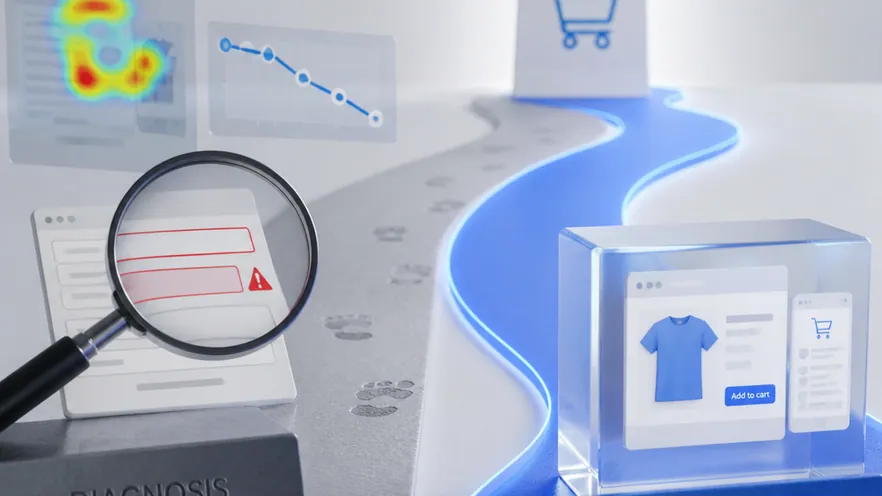
Mouseflow is a behaviour analytics tool with session replay, heatmaps, funnel drop-off, and strong form analytics for checkout diagnosis. It has no A/B testing engine. Omniconvert Explore is built for the eCommerce store: native Shopify experiments on product, cart, and checkout, measured in revenue per visitor. Mouseflow shows which form field breaks; Explore tests the fix. Often complementary.
- Mouseflow combines session replay, heatmaps, funnel drop-off, and form analytics in one tool, with paid tiers starting at 39 EUR per month.
- Form analytics is Mouseflow's differentiator: field-by-field reporting is genuinely useful for diagnosing why an eCommerce checkout drops.
- Mouseflow has no A/B testing engine at all: no multivariate, no server-side, and no visual editor for shipping variants.
- Omniconvert Explore runs A/B, multivariate, and server-side experiments on Shopify product, cart, and checkout, measured in revenue per visitor.
- Decide by job: pick Mouseflow to diagnose which form field breaks, pick Explore to test and ship the fix, or run both.
Teams comparing Mouseflow vs Omniconvert Explore are usually deciding how to move from watching visitors abandon a form field to actually testing a shorter checkout on a Shopify store. Mouseflow is a behavioural analytics tool: session replay, heatmaps, funnel drop-off, and form analytics, priced predictably for mid-market teams. It has no A/B testing capability at all. Omniconvert Explore runs A/B, multivariate, and personalization tests on product, cart, and checkout and reports the outcome in revenue per visitor. This page covers what each does well, where Mouseflow hits its ceiling for eCommerce, and when to pick one or use both.
What is Mouseflow, and what does it actually do?
Mouseflow is a behaviour analytics tool that combines session replay, heatmaps, funnel drop-off analysis, and form analytics in one product at mid-market pricing. Its form analytics is the differentiator: it shows exactly which checkout or lead-form field causes hesitation, blanking, or abandonment. It is a diagnostic instrument, not an experimentation platform, and every plan includes unlimited users. [Mouseflow, 2026]
Mouseflow rates 4.6 out of 5 on G2 across roughly 690 reviews, one of the higher scores in the behaviour analytics category. [G2, 2026] It installs by snippet, its paid tiers start at 39 EUR per month, and a free trial is available on the paid plans. [Mouseflow, 2026]
Compared to the wider heatmap and session replay category, Mouseflow's strongest angle for an eCommerce team is form analytics: field-by-field reporting on which parts of a checkout, address form, or lead form actually cause visitors to stop. That is a genuinely useful diagnostic for Shopify stores whose checkout conversion rate suddenly drops.
The question this page answers is narrower: is a behaviour diagnostic tool with form analytics the same job as running conversion experiments on a Shopify store? And if not, where is the gap?
Form analytics is field-level reporting on how visitors interact with a form: which fields they focus on, how long they spend on each, which ones they blank out, and where they abandon the form entirely. Mouseflow pairs form analytics with session replay and funnel drop-off to help teams diagnose checkout and lead-form friction. It is a diagnostic instrument, distinct from a controlled experiment that measures a revenue outcome.
Where Mouseflow is genuinely strong
- Form analytics for checkout: field-by-field abandonment reporting most heatmap tools do not offer.
- Session replay plus heatmaps in one product: the diagnostic layer non-technical teams read most easily.
- Funnel drop-off reporting: visualise where visitors leak between steps of a checkout or signup flow.
- Predictable mid-market pricing: paid tiers from 39 EUR per month with unlimited users on every plan.
- Solid third-party standing: 4.6 out of 5 on G2 across around 690 reviews. [G2, 2026]
Where Mouseflow hits its ceiling for an eCommerce store
- No A/B testing at all: Mouseflow shows friction in a form but cannot test a shorter form against it.
- No multivariate or server-side testing: both are outside the product scope entirely.
- No visual editor: nothing to author or ship an experiment variant from.
- Medium Shopify integration: installs via snippet, but does not run experiments on product, cart, or checkout templates.
- Session limits scale unfavourably: higher traffic volumes push costs up faster than mid-market teams typically forecast.
- No revenue-based segmentation: cannot slice results by AOV, repeat customers, or CVO cohorts.
None of this makes Mouseflow a weak product. It makes it a behaviour analytics tool with a form-diagnostics edge. The friction shows up specifically when the site under test is a Shopify store and the team needs to move from watching a checkout field fail to shipping a fix that lifts revenue.
What Mouseflow cannot do for an eCommerce store
Mouseflow is strong at showing which checkout field visitors abandon. It has no way to test a shorter form against the current one to prove the fix works. A store using Mouseflow for eCommerce CRO gets a precise diagnosis and then needs an experimentation platform to run the test that converts that diagnosis into revenue.
Omniconvert Explore is built for the layer Mouseflow leaves open. Mouseflow can pinpoint the exact field where visitors blank out or the checkout step where the funnel drops, but a store does not just need to see the friction; it needs to test a fix on product, cart, and checkout and read the result in revenue per visitor. Those are not the same task.
Most behaviour analytics tools are built around a generic web page and a generic engagement signal. They optimize how a team sees user behaviour. They are not built around the surfaces where eCommerce revenue is actually won or lost, or around the metric a store runs on.
eCommerce CRO is the practice of running controlled experiments on the revenue surfaces of an online store, product pages, cart, and checkout, and measuring the result in revenue per visitor and order rate rather than generic conversion rate. Explore is defined as an eCommerce conversion rate optimization platform for product, cart, and checkout experiments, native to Shopify and priced for store traffic.
What Mouseflow cannot tell an eCommerce team
- Did the fix move revenue. Whether a shorter form or a reordered checkout step actually raised revenue per visitor and order rate, not just field completion.
- Which surface to test first. Which pages in the funnel (product, cart, checkout) carry the highest revenue impact if tested next.
- How it behaves in checkout. How an experiment interacts with the Shopify catalog, variants, and checkout flow natively, without engineering glue work.
- Whether it holds for valuable customers. Whether the result holds for repeat, high-value customers, the Customer Value Optimization question, not just first-session visitors.
Across the 7,000+ eCommerce websites in Omniconvert's CROBenchmark Report 2026, checkout friction is the single largest source of lost revenue for Shopify stores, and form-field abandonment is where most of that friction concentrates, yet the diagnostic tools that surface it rarely feed a controlled experiment that repairs it. [CROBenchmark Report 2026, Omniconvert]
Explore runs the experiment on the store's real revenue surfaces and reports the outcome in revenue per visitor. That is the difference between a behaviour analytics tool and a platform built for store revenue.
Mouseflow vs Explore: the capability comparison
Side by side, Mouseflow is deeper on form analytics and session-level diagnostics, while Explore is the experimentation platform Mouseflow does not try to be. Mouseflow wins on field-by-field form reporting, funnel drop-off, and session replay at predictable mid-market pricing. Explore adds A/B, multivariate, and server-side testing, native Shopify experiments, and revenue-per-visitor measurement on product, cart, and checkout.
| Capability | Mouseflow | Omniconvert Explore |
|---|---|---|
| Primary function | Session replay, heatmaps, funnels, and form analytics | eCommerce CRO on product, cart, and checkout pages |
| A/B testing | No not part of the product | Yes visual editor plus code editor |
| Multivariate testing | No | Yes |
| Server-side testing | No | Yes |
| Visual editor | No | Yes no developer required |
| On-site surveys and overlays | Partial feedback campaigns, no overlays for experiments | Yes surveys and overlays built in |
| Shopify integration | Medium snippet install, no native product or checkout experiments | Yes native |
| eCommerce focus | Medium general product and marketing sites with form-heavy flows | High built for store revenue workflows |
| Pricing model | Session-based, paid tiers from 39 EUR per month, free trial available | Session-based, built for store traffic, free trial |
| Best for | Mid-market teams wanting session replay, funnels, and form analytics at a predictable price | Shopify and eCommerce teams optimizing product, cart, and checkout for revenue |
| User rating | 4.6 out of 5 (G2, 690 reviews, as of 2026) | 4.6 out of 5 (G2, 191 reviews, as of 2026) |
AliveCor used Explore to run a structured A/B testing program and achieved +21% conversion rate, +5% revenue per visitor, and 94% statistical relevance across their experiments. [Omniconvert, AliveCor case study]
Competitor pricing and feature availability reflect publicly listed information as of 2026 and can change. Explore uses session-based pricing; see the Omniconvert pricing page for current plans.
Get the full CROBenchmark data behind these stats: 7,000+ websites, 15+ industries, 248+ audit criteria, 100+ CRO experts. See exactly where eCommerce growth teams are losing margin in 2026.
Get the CROBenchmark ReportFrequently Asked Questions
Should you choose Explore over Mouseflow?
If your important experiments run on a Shopify store, choose Explore: it tests product, cart, and checkout natively, supports multivariate and server-side, and measures revenue per visitor rather than clicks or form field engagement. If you want session replay, funnels, and form analytics to diagnose where the checkout leaks before you test, Mouseflow is a solid diagnostic layer alongside it. Most eCommerce teams run Mouseflow for the diagnosis and a dedicated CRO platform for the experiment that actually moves orders.
Mouseflow earns its place with session replay, funnel drop-off, and field-level form analytics. It gives non-technical teams a fast, visual read on where a checkout or a lead form is losing visitors, with predictable pricing and unlimited users on every plan, and it remains a useful diagnostic tool inside an eCommerce stack.
The question for a store is narrower: are the experiments that move revenue running natively on the product, cart, and checkout pages, and are they measured in revenue per visitor. That is the surface Explore is built for, and it is a job Mouseflow was not designed to do.
Stop guessing.
Start testing what moves revenue.
Explore runs A/B, multivariate, and personalization experiments on your product pages, cart, and checkout, then measures the outcome in revenue per visitor, not just clicks.
4.6 out of 5 across 191 reviews, G2 , as of 2026