Rebuy alternative (2026): test structure, not just upsells
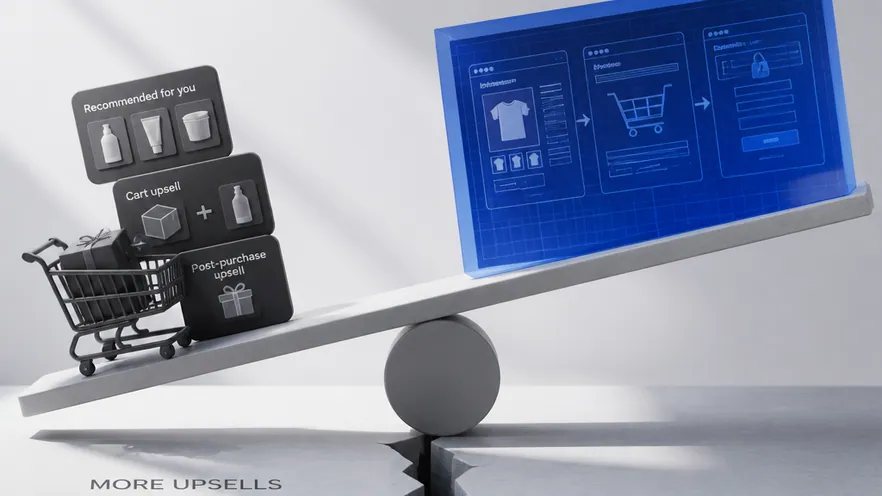
Rebuy is a Shopify personalization engine that raises average order value through AI product recommendations, smart carts, and post-purchase upsells, with A/B testing scoped to validating those rules. Omniconvert Explore is an eCommerce experimentation platform that tests product page, cart, and checkout structure, measured in revenue per visitor. Rebuy and Omniconvert Explore are complementary, not substitutes.
- Rebuy is a Shopify personalization engine for AI recommendations, smart carts, and post-purchase upsells, not a structured page and checkout experimentation tool.
- Rebuy A/B tests recommendation rules and upsell offers; Explore A/B tests product page, cart, and checkout structure, with multivariate and server-side variants.
- Rebuy reports incremental order value on the upsell. Explore measures revenue per visitor and order rate, the metrics that decide store P&L.
- Shopify integration is native in both; Rebuy pricing is usage-based from $99 per month and scales with monthly order volume, Explore is session-based.
- Most Shopify teams that use Rebuy still need Explore alongside it: one tool for the merchandising and upsell layer, one for the page and checkout layer.
Rebuy vs Omniconvert Explore is the choice between an upsell and merchandising engine that lifts average order value and an experimentation platform that tests how the store itself converts. Rebuy is strong at Shopify cart, checkout, and post-purchase upsells; its testing exists to validate recommendation rules, not to run a broad CRO program. Omniconvert Explore runs A/B, multivariate, and personalization tests on the revenue surfaces of a Shopify store. Most eCommerce teams end up using both: one for the offer, one for the page.
What is Rebuy, and what does it actually do?
Rebuy is a Shopify-native personalization engine that lifts average order value through AI product recommendations, smart carts, and post-purchase upsells. It is built for DTC brands that want a single app covering cart merchandising, checkout add-ons, and thank-you-page offers.
Rebuy's core promise is that every shopper sees the right recommendation at the right step: a related-product widget on the PDP, a cross-sell inside the cart drawer, a one-click upsell after checkout. The platform combines a rules and AI recommendations engine with a smart-cart interface and a post-purchase upsell layer. A/B testing sits inside this stack: teams test which recommendation rule, which cart layout, or which upsell offer wins on incremental order value.
Rebuy is a Built for Shopify app priced on a usage-based model, starting at $99 per month and scaling with monthly order volume [Rebuy, 2026]. A free trial is available for teams evaluating the platform.
Where Rebuy is genuinely strong
- Deep Shopify integration: cart drawer, checkout extensions, and post-purchase pages are handled inside one app, without engineering glue work for each surface.
- Fast AOV lift: recommendation rules, smart-cart bundles, and post-purchase one-click upsells produce measurable order-value gains inside weeks of setup.
- Rule-level A/B testing: a built-in testing module lets teams validate that a given recommendation rule actually produces incremental lift, not just visible engagement.
- Usage-based pricing: costs tied to order volume keep early spend low for growing DTC stores rather than an enterprise commit.
Where Rebuy hits its ceiling for a store
- No visual page editor: tests target recommendation rules and cart widgets, not the layout, copy, or structure of the PDP.
- No multivariate or server-side testing: single-variable A/B on personalization experiences only; no combinatorial testing and no server-side variant delivery for gated flows.
- No on-site surveys: the platform reads behavioral signals, but there is no way to ask shoppers directly why they did or did not buy.
- Cost curve and platform lock-in: pricing climbs steeply with order volume, and the tool is scoped to Shopify only.
What Rebuy cannot do for an eCommerce store
Rebuy tests which upsell wins. It does not test whether the PDP layout, the cart friction, or the checkout copy is what is actually capping revenue per visitor. Teams using it for eCommerce CRO improve average order value and still need an experimentation platform for the structural questions behind conversion.
Rebuy tests personalization and upsell experiences but cannot run structured experiments on page layouts, copy, or checkout design. It offers no visual editor, no multivariate or server-side testing, and no on-site surveys. Brands wanting a complete CRO program, rather than average-order-value tooling, need a dedicated experimentation platform.
Most upsell tools built into a merchandising app are wired around a widget slot and an incremental order-value event. They optimize which product to recommend, which bundle to show, which post-purchase offer converts. They are not built around the surfaces where eCommerce revenue is actually won or lost (product pages, cart structure, checkout flow), or around the metric that matters to a store: revenue per visitor, not a click on a recommendation.
eCommerce CRO is the practice of running controlled experiments on the revenue surfaces of an online store, product pages, cart, and checkout, and measuring the result in revenue per visitor and order rate rather than generic conversion rate. Omniconvert Explore is defined as an eCommerce conversion rate optimization platform for product, cart, and checkout experiments, native to Shopify and priced for store traffic.
What Rebuy cannot tell you
- Whether a winning upsell moved revenue per visitor. Rebuy reports incremental order value on the recommendation rule, not the structural revenue-per-visitor and order-rate impact of the page carrying it.
- Which page in the funnel to test first. A smart cart adds to the current cart; it does not surface which of product page, cart, or checkout has the highest revenue impact for the current traffic mix.
- How a variant behaves inside the Shopify checkout. Rule-level testing on a widget cannot cleanly test structural checkout changes, copy variants, or shipping-step redesigns.
- Whether the result holds for high-value repeat customers. The Customer Value Optimization question, not just first-order behavior on a bundle offer.
Explore is built for this layer. It runs A/B, multivariate, server-side, and personalization experiments on the store's real revenue surfaces, and measures the outcome in revenue per visitor and order rate.
Across the 7,000+ eCommerce websites Omniconvert benchmarks, checkout friction is the single largest gap between top-quartile and bottom-quartile Shopify stores, and it is a gap that cannot be closed by adding another upsell to the cart [CROBenchmark Report 2026, Omniconvert].
AliveCor used Explore to run a structured A/B testing program and achieved +21% conversion rate, +5% revenue per visitor, and 94% statistical relevance across their experiments [Omniconvert, AliveCor case study].
Rebuy vs Explore: the capability comparison
Side by side on the ten capabilities that matter to an eCommerce testing program. Rebuy wins on cart, checkout, and post-purchase upsell mechanics. Explore wins on structural page and checkout experimentation, with revenue-per-visitor measurement.
| Capability | Rebuy | Omniconvert Explore |
|---|---|---|
| Primary function | Shopify personalization engine: recommendations, smart cart, post-purchase upsells | eCommerce experimentation on product page, cart, and checkout |
| A/B testing | Partial, built-in testing scoped to personalization and upsell rules | Yes, on product page, cart, and checkout structure |
| Multivariate testing | No | Yes, for page and checkout structural variants |
| Server-side testing | No | Yes, for checkout and gated flows |
| Visual editor | No, configuration flows through recommendation rules and widget settings | Yes, WYSIWYG variant editor for store pages |
| On-site surveys and overlays | Partial, upsell modals and smart-cart widgets, no structured on-site surveys | Yes, on-site surveys plus overlays and personalization |
| Shopify integration | Yes, native Built for Shopify app | Yes, native Shopify integration |
| eCommerce focus | Yes, high, Shopify DTC is the core vertical | Yes, purpose-built for eCommerce CRO |
| Pricing model | Usage-based, from $99/mo, scales with monthly order volume [Rebuy, 2026] | Session-based, priced for store traffic |
| Best for | Shopify brands lifting AOV through recommendations, smart carts, and post-purchase upsells | DTC and Shopify stores running structured product, cart, and checkout experiments |
| User rating | No public G2 rating | 4.6 out of 5 (G2, 191 reviews, as of 2026) |
Notes on this table: Rebuy A/B testing is scoped to validating personalization and upsell rules, not to running an independent structural experimentation program. Explore is scoped to the experimentation layer itself, without the merchandising and upsell engine.
Get the full CROBenchmark data behind these stats: 7,000+ websites, 15+ industries, 248+ audit criteria, 100+ CRO experts. See exactly where eCommerce growth teams are losing margin in 2026.
Get the CROBenchmark ReportFrequently Asked Questions
Should you choose Explore over Rebuy?
Choose Rebuy if the next revenue lever is a smarter cart, a stronger recommendation rule, or a post-purchase upsell that lifts average order value on Shopify. Choose Explore if the next lever is the PDP layout, cart friction, or checkout flow, tested structurally and measured in revenue per visitor. Most eCommerce teams that use Rebuy still run Explore alongside it: the two answer different questions and are complementary, not competing.
The honest answer for most Shopify brands is: keep Rebuy for what it does best (AI recommendations, smart cart, post-purchase upsells) and add Explore for the structural questions the upsell engine does not answer. Ask what your next revenue lever actually is. If it is an offer or a merchandising rule, that is Rebuy territory. If it is the PDP layout, the cart, or the checkout flow, that is Explore territory.
Explore is built around eCommerce revenue surfaces, native to Shopify, and priced on sessions rather than order volume. It measures the outcome of an experiment in revenue per visitor and order rate, which is what actually decides whether a variant ships. For a store already running Rebuy, adding Explore is additive, not a rip-and-replace decision.
Stop guessing.
Start testing what moves revenue.
Explore runs A/B, multivariate, and personalization experiments on your product pages, cart, and checkout, then measures the outcome in revenue per visitor, not just clicks.
4.6 out of 5 across 191 reviews, G2 , as of 2026