SiteSpect alternative (2026): Enterprise proxy vs Shopify CRO
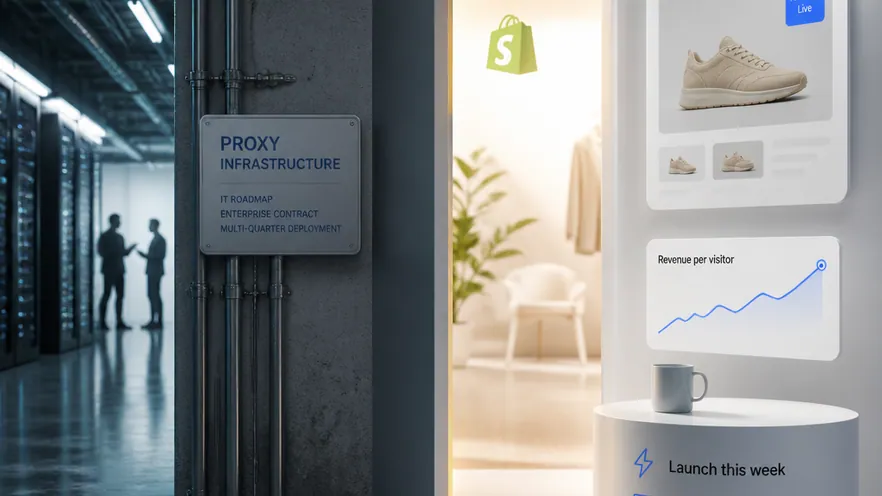
SiteSpect is an enterprise experimentation platform that runs server-side tests through a proxy architecture to avoid client-side flicker. Omniconvert Explore is a Shopify-native CRO platform that runs product, cart, and checkout experiments through a visual editor without an infrastructure deployment, and measures the outcome in revenue per visitor. Different buyers, rarely overlapping.
- SiteSpect is an enterprise experimentation platform that runs A/B, multivariate, and server-side tests through a reverse-proxy architecture with no client-side flicker.
- SiteSpect's proxy model handles complex implementations that client-side tools cannot cleanly reach, and its support quality rates 9.0 on G2. [G2, 2026]
- SiteSpect has low native Shopify fit, no free trial, quote-based pricing, and reviewers report a steep learning curve and onboarding friction.
- Omniconvert Explore runs experiments on Shopify product, cart, and checkout pages without an infrastructure deployment, and measures results in revenue per visitor.
- The two rarely land on the same shortlist: SiteSpect wins enterprise proxy-testing evaluations, Explore wins Shopify CRO evaluations.
Teams comparing SiteSpect vs Omniconvert Explore are usually asking two different questions dressed as one. SiteSpect is an enterprise experimentation platform whose defining choice is a proxy architecture that runs tests server-side without the flicker and performance cost of client-side tools. Explore is a Shopify-native CRO platform that runs experiments on product, cart, and checkout without a proxy deployment, and measures the outcome in revenue per visitor. This page explains where each fits and where they rarely land on the same shortlist.
What is SiteSpect, and what does it actually do?
SiteSpect is an enterprise experimentation platform built around a reverse-proxy architecture. Traffic routes through SiteSpect's infrastructure, so variants are injected server-side without the page-tagging model and no-flicker cost of client-side tools. It supports A/B, multivariate, and server-side tests, and is shaped for enterprise IT and marketing teams that treat experimentation as a platform decision rather than a marketing add-on.
SiteSpect sits in the enterprise server-side testing category. It is one of the older testing platforms in the market, and its defining choice is the proxy model: rather than dropping a JavaScript tag that mutates the page in the browser, SiteSpect proxies the request and returns a modified response. The upside is real: no page flicker, no client-side performance tax, and the ability to test flows a client-side tag cannot cleanly reach.
Support quality on G2 rates 9.0, one of the strongest signals in the category. The trade-off is architectural: a proxy is a piece of production infrastructure, not a snippet, and it is bought and deployed as such.
The question this page answers is narrower: is enterprise proxy-based experimentation the same job as running conversion experiments on a Shopify store? And if not, where is the gap?
Proxy-based experimentation routes site traffic through the vendor's infrastructure, which rewrites the response before it reaches the visitor. Variants ship server-side, so there is no client-side flicker and no page-tagging overhead. It is powerful for enterprise IT organisations that can accept an inline dependency in the traffic path. It is a separate concern from whether a Shopify store owner can launch a product page test the same week without a platform decision.
Where SiteSpect is genuinely strong
- No client-side flicker: variants render server-side through the proxy, so visitors never see a repaint or a lag from the tag firing.
- Server-side and client-side in one tool: teams can run backend tests and frontend tests in the same platform, without stitching two vendors together.
- Handles complex implementations: the proxy model can reach flows that client-side tags struggle with, including checkout-adjacent pages and edge-cached content.
- Support quality rates 9.0 on G2: a strong signal that enterprise implementations are well shepherded once the contract is signed. [G2, 2026]
Where SiteSpect hits its ceiling for an eCommerce store
- Steep learning curve: reviewers repeatedly note the interface and onboarding need work, which pushes small CRO teams off the platform.
- Thin third-party evidence: the G2 review base is small, which gives limited visibility into broad user satisfaction outside enterprise engagements.
- Low native Shopify fit: the proxy model is not a Shopify app; integrating with Shopify's catalog, variants, and checkout is an infrastructure project.
- Quote-based enterprise pricing: pricing is custom quote with no free trial, shaped for enterprise buyers who can absorb an infrastructure deployment as part of the sale.
None of this makes SiteSpect a weak product. It makes it an enterprise platform. The friction shows up specifically when the site under test is a Shopify store and the team running experiments does not have an IT sponsor, a platform team, and a multi-quarter deployment window behind every hypothesis.
What SiteSpect cannot do for an eCommerce store
SiteSpect is a capable testing platform but an enterprise infrastructure one. Most Shopify and mid-market eCommerce teams cannot justify a proxy deployment and a quote-based contract to run product page and checkout experiments they need running this quarter. That is the gap a Shopify-native CRO platform closes.
Omniconvert Explore is built for the layer SiteSpect leaves open. SiteSpect can run any enterprise-scale test its infrastructure supports, but a store does not need a proxy in the traffic path to test the product page and the checkout; it needs the experiment live this week, and the result expressed in revenue per visitor. Those are not the same task.
Most enterprise experimentation tools are built around a generic web page and a generic conversion event. They optimise the rigour and reach of a test at scale. They are not built around the revenue surfaces of a Shopify store, or around a marketer-accessible workflow that does not require an infrastructure decision to launch the first test.
eCommerce CRO is the practice of running controlled experiments on the revenue surfaces of an online store, product pages, cart, and checkout, and measuring the result in revenue per visitor and order rate rather than generic conversion rate. Omniconvert Explore is defined as an eCommerce conversion rate optimization platform for product, cart, and checkout experiments, native to Shopify and priced for store traffic.
What SiteSpect cannot tell an eCommerce team
- Did the win move revenue. Whether a winning variant actually raised revenue per visitor and order rate, not just a proxy-tracked click event.
- Which surface to test first. Which pages in the Shopify funnel (product, cart, checkout) carry the highest revenue impact if tested next.
- How it behaves in checkout. How an experiment interacts with the Shopify catalog, variants, and checkout flow natively, without a proxy deployment sitting in the traffic path.
- Whether it holds for valuable customers. Whether the result holds for repeat, high-value customers, the Customer Value Optimization question, not just first-session traffic.
Across the 7,000+ eCommerce websites in Omniconvert's CROBenchmark Report 2026, the stores testing fastest are the ones where a CRO lead can launch a product page or checkout experiment the same week it is proposed; SiteSpect's proxy-first model pushes that work into IT scoping, and the benchmark shows testing cadence drops sharply when every experiment needs an infrastructure sign-off before the first variant goes live. [CROBenchmark Report 2026, Omniconvert]
Explore runs the experiment on the store's real revenue surfaces and reports the outcome in revenue per visitor. AliveCor used Omniconvert Explore to run a structured A/B testing program and achieved +21% conversion rate, +5% revenue per visitor, and 94% statistical relevance across their experiments. [Omniconvert, AliveCor case study]
SiteSpect vs Explore: the capability comparison
Side by side, SiteSpect and Explore share a feature list on paper but diverge on shape. SiteSpect runs A/B, multivariate, and server-side tests through a proxy sold as an enterprise contract. Explore ships Shopify-native experiments on product, cart, and checkout, adds surveys and overlays, and reports in revenue per visitor. Where they touch is server-side testing, and the fit still splits by scale.
| Capability | SiteSpect | Omniconvert Explore |
|---|---|---|
| Primary function | Enterprise proxy-based server-side and client-side experimentation | eCommerce CRO on product, cart, and checkout pages |
| A/B testing | Yes proxy-based, no client-side flicker | Yes visual editor plus code editor |
| Multivariate testing | Yes | Yes |
| Server-side testing | Yes via proxy architecture | Yes |
| Visual editor | Yes though reviewers cite a steep learning curve | Yes no infrastructure required |
| On-site surveys and overlays | No not part of the core product | Yes surveys and overlays built in |
| Shopify integration | Low no native app, proxy integration required | Yes native |
| eCommerce focus | Medium serves eCommerce but shaped for enterprise IT | High built for store revenue workflows |
| Pricing model | Custom quote, no free trial | Session-based, built for store traffic, free trial |
| Best for | Enterprise teams needing server-side testing through a proxy with no client-side performance cost | Shopify and eCommerce teams optimizing product, cart, and checkout for revenue |
| User rating | No public G2 rating | 4.6 out of 5 (G2, 191 reviews, as of 2026) |
Competitor pricing and plan details reflect publicly listed positioning as of 2026 and can change. Explore uses session-based pricing; see the Omniconvert pricing page for current plans.
Get the full CROBenchmark data behind these stats: 7,000+ websites, 15+ industries, 248+ audit criteria, 100+ CRO experts. See exactly where eCommerce growth teams are losing margin in 2026.
Get the CROBenchmark ReportFrequently Asked Questions
Should you choose Explore over SiteSpect?
If your experiments run on a Shopify store and you need product page, cart, and checkout tests running this quarter without a proxy deployment or an enterprise contract, choose Explore: it ships a visual editor, native Shopify integration, session-based pricing, and revenue-per-visitor reporting. If your enterprise team needs server-side testing through a proxy with no client-side performance penalty, SiteSpect is purpose-built for that. The two rarely land on the same shortlist.
SiteSpect earns its category standing. The proxy model is a real answer to a real problem: no flicker, no client-side performance tax, and coverage for flows that client-side tags cannot reach, which is exactly what an enterprise IT sponsor wants from a testing platform.
The question for a store is narrower: are the experiments that move revenue running natively on the product, cart, and checkout pages, without a proxy in the traffic path, and are they measured in revenue per visitor. That is the surface Explore is built for.
Stop guessing.
Start testing what moves revenue.
Explore runs A/B, multivariate, and personalization experiments on your product pages, cart, and checkout, then measures the outcome in revenue per visitor, not just clicks.
4.6 out of 5 across 191 reviews, G2 , as of 2026