Unbounce alternative (2026): Landing Pages vs Store Checkout
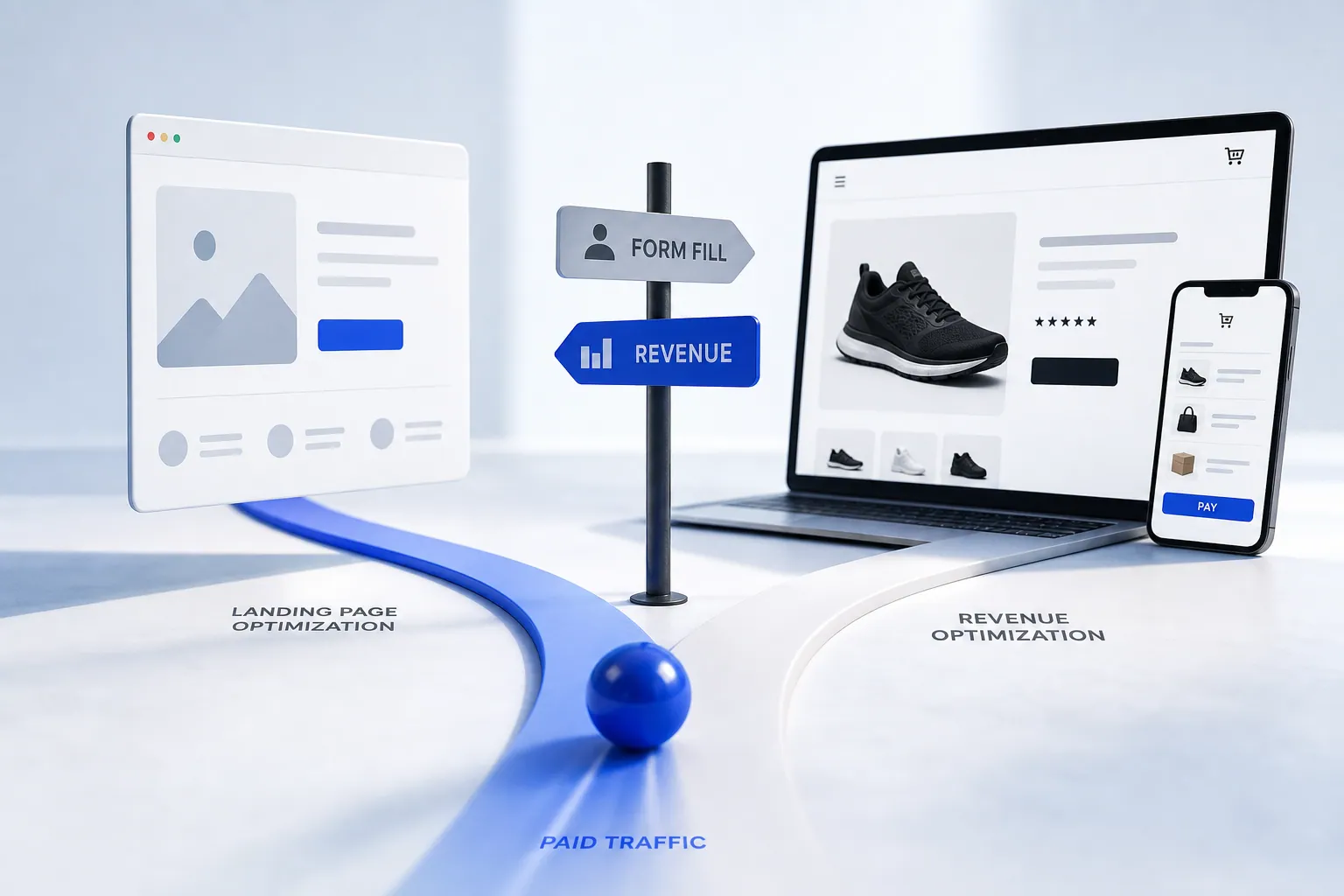
Unbounce is a landing page builder with built-in A/B testing and Smart Traffic AI that routes paid visitors to the best-performing variant. Omniconvert Explore is built for the eCommerce store: native Shopify integration, experiments on product, cart, and checkout, and revenue-per-visitor measurement. They solve different jobs: Unbounce for paid landing pages, Explore for store revenue.
- Unbounce is a landing page builder with built-in A/B testing and Smart Traffic AI that routes paid visitors to the winning variant, aimed at marketing teams running paid campaigns.
- Unbounce cannot test existing website pages: no server-side testing, limited multivariate, and no experiments on Shopify product, cart, or checkout pages.
- Unbounce Shopify integration is low, and its reach stops at the landing URL: everything past the click into the store is outside its scope.
- Omniconvert Explore runs experiments on product, cart, and checkout pages natively on Shopify and measures results in revenue per visitor, not clicks.
- Decide by scope: pick Unbounce for paid-campaign landing pages, pick Explore for eCommerce testing on the store's real revenue surfaces.
Teams comparing Unbounce vs Omniconvert Explore are usually deciding how to run experiments for a Shopify store. Unbounce is a landing page builder for paid campaigns, pairing a drag-and-drop editor with A/B testing and Smart Traffic routing. Omniconvert Explore is narrower on purpose: it runs A/B, multivariate, and personalization tests on a store's revenue surfaces and measures the outcome in revenue per visitor. This page covers what each does well, where Unbounce hits its ceiling for eCommerce, and when to pick one.
What is Unbounce, and what does it actually do?
Unbounce is a landing page builder with built-in A/B testing and Smart Traffic, an AI that routes paid visitors to the best-performing variant automatically. It sits between the ad platform and the offer, aimed at marketing teams who need to build and test landing pages without a developer. [Unbounce, 2026]
Unbounce is well regarded by performance marketers, with a 4.4 out of 5 rating on G2 across more than 370 reviews. [G2, 2026] Its appeal is speed of execution: a marketer can build a landing page in an afternoon, ship an A/B test, and let Smart Traffic route paid clicks to the winning variant.
The category Unbounce sits in is landing page building for paid traffic. It creates and tests standalone pages that live behind Google, Meta, and other ad campaigns. That specialization is the point of the product.
The question this page answers is narrower: is a landing page tool the same thing as an experimentation platform for a Shopify store? And if not, where is the gap?
Smart Traffic is Unbounce's AI feature that routes each paid visitor to the variant most likely to convert them, based on attributes like device, location, and referral source. It optimizes the click-to-form-fill or click-to-lead step of a paid campaign. It runs on the Unbounce-hosted landing page, not on the Shopify store the visitor lands in afterward.
Where Unbounce is genuinely strong
- Landing pages plus A/B testing in one tool: build, publish, and test without leaving the platform.
- Smart Traffic AI routing: paid visitors are matched to the variant most likely to convert them automatically.
- Ad-platform and CRM integrations: connects to Google, Meta, HubSpot, Salesforce and the tools a paid-media team already uses.
- No developer required: the drag-and-drop editor lets a marketer ship a campaign page the same day.
Where Unbounce hits its ceiling for an eCommerce store
- Landing pages only: Unbounce cannot test existing website pages, only pages it hosts.
- No server-side testing: back-end variants and pricing or catalog experiments are out of scope.
- Multivariate is limited: the platform is built around A/B and Smart Traffic, not full MVT designs.
- Low Shopify reach: integration is limited and no experiments run on product, cart, or checkout pages.
None of this makes Unbounce a weak product. It makes it a landing page tool. The friction shows up specifically when the site under test is a Shopify store and the metric that matters is revenue per visitor, not a form fill on a page upstream of the store.
What Unbounce cannot do for an eCommerce store
Unbounce is a landing page builder with A/B testing for paid traffic campaigns. It cannot run experiments on an existing Shopify site, and it has no reach past the landing URL: the product detail page, add-to-cart flow, and checkout sequence are all outside its scope. That is the gap an eCommerce-first platform closes.
Omniconvert Explore is built for the layer Unbounce leaves open. Unbounce can host and test a paid-campaign landing page well, but a store does not only need the landing page tested; it needs the product page, the cart, and the checkout tested, and the result expressed in revenue per visitor. Those are not the same task.
Most landing page and experimentation tools are built around a standalone page and a generic conversion event, usually a form fill or a click. They optimize the top of the paid funnel. They are not built around the surfaces where eCommerce revenue is actually won or lost, or around the metric a store runs on.
eCommerce CRO is the practice of running controlled experiments on the revenue surfaces of an online store, product pages, cart, and checkout, and measuring the result in revenue per visitor and order rate rather than generic conversion rate. Explore is defined as an eCommerce conversion rate optimization platform for product, cart, and checkout experiments, native to Shopify and priced for store traffic.
What Unbounce cannot tell an eCommerce team
- Did the win move revenue. Whether a winning landing page actually raised revenue per visitor and order rate, or only lifted the click into the store.
- Which surface to test next. Which pages in the funnel (product, cart, checkout) carry the highest revenue impact once the paid visitor is inside the store.
- How it behaves in checkout. How an experiment interacts with the Shopify catalog, variants, and checkout flow natively, without leaving the platform for a second tool.
- Whether it holds for valuable customers. Whether the result holds for repeat, high-value customers, the Customer Value Optimization question, not just first-session paid visitors.
Across the 7,000+ eCommerce websites in Omniconvert's CROBenchmark Report 2026, the checkout is the stage with the largest untested revenue drop-off, and campaigns that end at a standalone landing page never get to test it. [CROBenchmark Report 2026, Omniconvert]
AliveCor used Explore to run a structured A/B testing program and achieved +21% conversion rate, +5% revenue per visitor, and 94% statistical relevance across their experiments. [Omniconvert, AliveCor case study] That is the outcome shape a store gets when the experiment lives on the product page and checkout, not on a page upstream of them.
Unbounce vs Explore: the capability comparison
Side by side, Unbounce is deeper on landing page building and paid-traffic routing, while Explore is deeper on eCommerce testing. Only Unbounce ships a native page builder with Smart Traffic AI. Only Explore runs experiments natively on Shopify product, cart, and checkout with revenue-per-visitor measurement and built-in surveys.
| Capability | Unbounce | Omniconvert Explore |
|---|---|---|
| Primary function | Landing page building and A/B testing for paid traffic | eCommerce CRO on product, cart, and checkout pages |
| A/B testing | Partial landing pages only, no site-wide testing | Yes across product, cart, and checkout |
| Multivariate testing | Limited | Yes |
| Server-side testing | No | Yes |
| Visual editor | Yes full drag-and-drop page builder | Yes no developer required |
| On-site surveys and overlays | No not on the customer's own site | Yes surveys and overlays built in |
| Shopify integration | Low limited, no product or checkout reach | Yes native |
| eCommerce focus | Low paid-campaign landing pages | High built for store revenue workflows |
| Pricing model | Session-based, from $99/mo, free trial | Session-based, built for store traffic, free trial |
| Best for | Marketing teams running paid campaigns who need to build and test landing pages without a developer | Shopify and eCommerce teams optimizing product, cart, and checkout for revenue |
| User rating | 4.4 out of 5 (G2, 377 reviews, as of 2026) | 4.6 out of 5 (G2, 191 reviews, as of 2026) |
Competitor pricing and features reflect publicly listed information as of 2026 and can change. Explore uses session-based pricing; see the Omniconvert pricing page for current plans.
Get the full CROBenchmark data behind these stats: 7,000+ websites, 15+ industries, 248+ audit criteria, 100+ CRO experts. See exactly where eCommerce growth teams are losing margin in 2026.
Get the CROBenchmark ReportFrequently Asked Questions
Should you choose Explore over Unbounce?
If your important experiments run on a Shopify store, choose Explore: it tests product, cart, and checkout natively, supports server-side and multivariate testing, and measures revenue per visitor rather than a generic conversion. If your growth is driven by paid campaigns and standalone landing pages that a marketer must ship without a developer, Unbounce is the tool for that job. Many teams use both: Unbounce for the ad, Explore for the store.
Unbounce earns its standing with paid-media teams. It combines a drag-and-drop landing page builder with A/B testing and Smart Traffic AI, and a marketer can ship a campaign the same day without engineering support.
The question for a store is narrower: are the experiments that move revenue running natively on the product, cart, and checkout pages, and are they measured in revenue per visitor. That is the surface Explore is built for, and it is not the surface a landing page tool ever reaches.
Stop guessing.
Start testing what moves revenue.
Explore runs A/B, multivariate, and personalization experiments on your product pages, cart, and checkout, then measures the outcome in revenue per visitor, not just clicks.
4.6 out of 5 across 191 reviews, G2 , as of 2026