UXCam alternative (2026): Mobile app analytics vs Shopify CRO
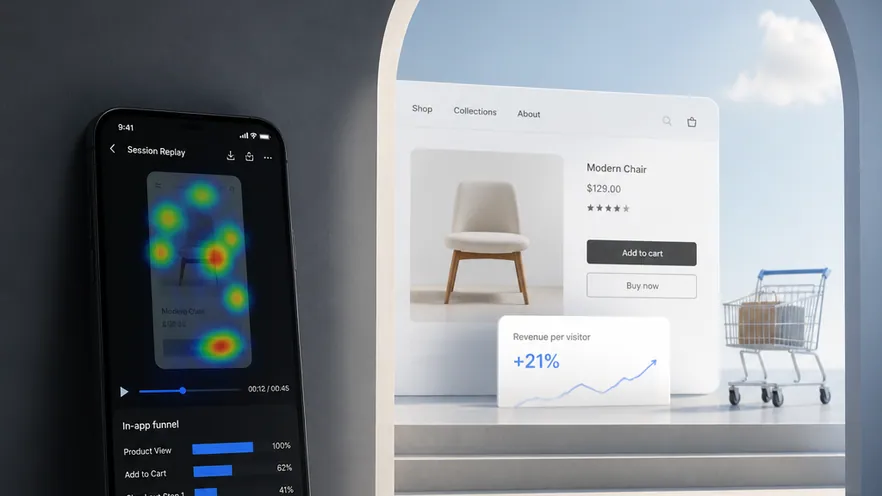
UXCam is a mobile product analytics platform built for native iOS and Android apps: session replay, heatmaps, and funnel analysis tuned to in-app behaviour. Omniconvert Explore is a Shopify-native eCommerce CRO platform that runs A/B, multivariate, and personalization experiments on product, cart, and checkout, measured in revenue per visitor. Different surfaces, different jobs.
- UXCam is a mobile product analytics platform for native iOS and Android apps, with session replay, gesture-level heatmaps, and funnel analysis built for in-app behaviour.
- Support quality rates 9.3 out of 10 on G2 and the platform processes very high data volumes across more than fifty countries. [G2, 2026]
- UXCam has no A/B testing, multivariate, or server-side experimentation capability of any kind on any surface.
- Omniconvert Explore runs experiments on Shopify product, cart, and checkout pages natively, and measures results in revenue per visitor.
- The two rarely compete: UXCam optimises native mobile app screens; Explore optimises web storefront revenue on the Shopify checkout.
Teams comparing UXCam vs Omniconvert Explore are usually asking two different questions in the same breath. UXCam is a mobile product analytics platform, well-liked for session replay, heatmaps, and funnel analysis tuned to native app interactions on iOS and Android. Omniconvert Explore is a Shopify-native CRO platform that runs experiments on product, cart, and checkout and measures the outcome in revenue per visitor. This page explains why the two rarely compete and when neither swaps for the other.
What is UXCam, and what does it actually do?
UXCam is a mobile product analytics platform built for iOS and Android apps. It records native app sessions as pixel-accurate replays, layers heatmaps on real app screens, and analyses funnel drop-offs where users tap, swipe, or abandon inside the app.
UXCam is used by mobile product teams that need to understand in-app behaviour at a level that generic analytics dashboards do not surface. Quality of support rates 9.3 out of 10 on G2 and the platform processes very high data volumes across more than fifty countries. [G2, 2026]
The category UXCam sits in is mobile product analytics: session replay for native apps, gesture-level heatmaps, funnel analysis on app screens, and event tracking for iOS and Android product managers. It is an observation tool for teams asking "what is happening inside our app, and where are users getting stuck?"
The question this page answers is narrower: is mobile app analytics the same job as running conversion experiments on a Shopify storefront? And if not, where is the gap?
Mobile product analytics means the platform instruments a native iOS or Android app with an SDK, records sessions as replays, layers heatmaps on app screens, and reports funnel drop-off between in-app steps. It is powerful for understanding what happens inside a mobile app. It is a separate concern from whether a proposed fix on a website checkout actually lifts revenue when tested against the current experience.
Where UXCam is genuinely strong
- Mobile-first session replay: native iOS and Android sessions are captured with gesture and touch data, not a rough web-style approximation.
- Gesture-level heatmaps: heatmaps render on real app screens and account for taps, swipes, and pinches rather than mouse clicks.
- Funnel analysis for in-app flows: drop-off between app screens is easy to visualise for a product manager without a data engineer.
- Strong customer support: support quality rates 9.3 on G2, and the platform runs at very high data volumes across more than fifty countries. [G2, 2026]
Where UXCam hits its ceiling for an eCommerce store
- No experimentation of any kind: UXCam does not run A/B tests, multivariate tests, or variant delivery on any surface, so a hypothesis can be documented but never validated inside the tool.
- Mobile-first, not web: the SDK targets native iOS and Android, so a Shopify web storefront gets little from it directly and the product page, cart, and checkout on the site are outside its coverage.
- Analytics depth trails specialists: reviewers note the event-tracking depth sits below Mixpanel and Amplitude for advanced product analytics work.
- Low Shopify fit: no Shopify integration for experiment surfaces, no revenue-per-visitor framing, and no reporting tied to store orders.
None of this makes UXCam a weak product. It makes it a native-app observation tool. The friction shows up specifically when the team looking at it is a growth or CRO lead at a Shopify brand whose revenue is decided on the website, not inside an app.
What UXCam cannot do for an eCommerce store
UXCam analyses in-app behaviour and runs no experiments. Teams doing eCommerce CRO on a web storefront get little from it directly, and in either case still need an experimentation platform to test which changes lift conversion and revenue on the site.
Omniconvert Explore is built for the layer UXCam does not reach. UXCam can replay a user tapping through a native app screen and show the funnel drop-off between two app steps. It cannot render a variant of your Shopify checkout to half your website traffic and tell you which version earned more revenue per visitor. Those are different surfaces and different jobs.
Most mobile analytics tools are built around a captured in-app event stream and a qualitative investigation loop for product managers. They optimise the discovery of friction on a mobile screen. They are not built around the surfaces where eCommerce revenue is actually won or lost on the web (product pages, cart, checkout), or around the metric a Shopify store runs on.
eCommerce CRO is the practice of running controlled experiments on the revenue surfaces of an online store, product pages, cart, and checkout, and measuring the result in revenue per visitor and order rate rather than generic conversion rate. Omniconvert Explore is defined as an eCommerce conversion rate optimization platform for product, cart, and checkout experiments, native to Shopify and priced for store traffic.
What UXCam cannot tell an eCommerce team
- Did the fix move website revenue. Whether a change to your Shopify product page or checkout actually raised revenue per visitor and order rate, not just reduced friction inside a mobile app.
- Which web surface to test first. Which pages in the Shopify funnel (product, cart, checkout) carry the highest revenue impact if tested next, ranked by expected lift rather than by app session count.
- How the change behaves in checkout. How a variant of the cart or checkout interacts with the Shopify catalog, variants, and payment flow natively, without an engineer building a bespoke deployment.
- Whether it holds for valuable customers. Whether the result holds for repeat, high-value customers, the Customer Value Optimization question, not just first-session traffic on the storefront.
Across the 7,000+ eCommerce websites in Omniconvert's CROBenchmark Report 2026, testing cadence on the website drops sharply for teams whose insight layer is scoped to mobile app behaviour: they can describe what users do inside the app but have no self-serve way to test a fix on the Shopify storefront where the order is actually placed. Stores that lift revenue fastest pair discovery with an experimentation platform sitting directly on the store. [CROBenchmark Report 2026, Omniconvert]
Explore runs the experiment on the store's real revenue surfaces and reports the outcome in revenue per visitor. AliveCor used Omniconvert Explore to run a structured A/B testing program and achieved +21% conversion rate, +5% revenue per visitor, and 94% statistical relevance across their experiments. [Omniconvert, AliveCor case study]
UXCam vs Explore: the capability comparison
Side by side, UXCam and Explore share almost no overlap in daily job. UXCam records native app sessions, layers heatmaps on app screens, and analyses in-app funnels. Explore ships Shopify-native experiments on product, cart, and checkout, adds surveys and overlays, and reports in revenue per visitor. Where they touch is qualitative insight, and even there they cover different surfaces.
| Capability | UXCam | Omniconvert Explore |
|---|---|---|
| Primary function | Mobile app session replay, heatmaps, and funnel analysis for native iOS and Android | eCommerce CRO on product, cart, and checkout pages |
| A/B testing | No not part of the product | Yes visual editor plus code editor |
| Multivariate testing | No | Yes |
| Server-side testing | No | Yes |
| Visual editor | No UXCam does not deliver variants | Yes no developer required |
| On-site surveys and overlays | No not part of the product | Yes surveys and overlays built in |
| Shopify integration | Low mobile SDK, no Shopify app for experiment surfaces | Yes native |
| eCommerce focus | Low built for mobile product teams, not for store revenue | High built for store revenue workflows |
| Pricing model | Session-based, free plan available, free trial | Session-based, built for store traffic, free trial |
| Best for | Mobile product teams analysing in-app user behaviour on iOS and Android | Shopify and eCommerce teams optimizing product, cart, and checkout for revenue |
| User rating | No public G2 rating | 4.6 out of 5 (G2, 191 reviews, as of 2026) |
Competitor pricing and plan details reflect publicly listed figures as of 2026 and can change. Explore uses session-based pricing; see the Omniconvert pricing page for current plans.
Get the full CROBenchmark data behind these stats: 7,000+ websites, 15+ industries, 248+ audit criteria, 100+ CRO experts. See exactly where eCommerce growth teams are losing margin in 2026.
Get the CROBenchmark ReportFrequently Asked Questions
Should you choose Explore over UXCam?
If your team is optimising a native mobile app and needs deep session replay and funnels built for in-app behaviour, choose UXCam: it is purpose-built for mobile product teams and processes very high data volumes. If your revenue depends on validating fixes with controlled experiments on Shopify product, cart, and checkout, choose Explore: it tests hypotheses natively and measures outcomes in revenue per visitor. The two rarely compete; the surfaces they optimise do not overlap.
UXCam earns its place inside mobile product organisations that need to understand exactly what a user did inside a native iOS or Android app. Pixel-accurate replay, gesture heatmaps, and app-screen funnel analysis give product managers a level of in-app depth that a generic analytics tool cannot match, which is exactly what a mobile team wants when a screen loses users and no one can say why.
The question for a store is narrower: your revenue is decided on product pages, cart, and checkout in the browser, not inside an app, and the fixes that recover it need to run as controlled experiments on those pages and be measured in revenue per visitor. That is the surface Explore is built for, and it is a surface UXCam does not touch.
Stop guessing.
Start testing what moves revenue.
Explore runs A/B, multivariate, and personalization experiments on your product pages, cart, and checkout, then measures the outcome in revenue per visitor, not just clicks.
4.6 out of 5 across 191 reviews, G2 , as of 2026