Varify.io alternative (2026): GDPR testing vs Shopify CRO
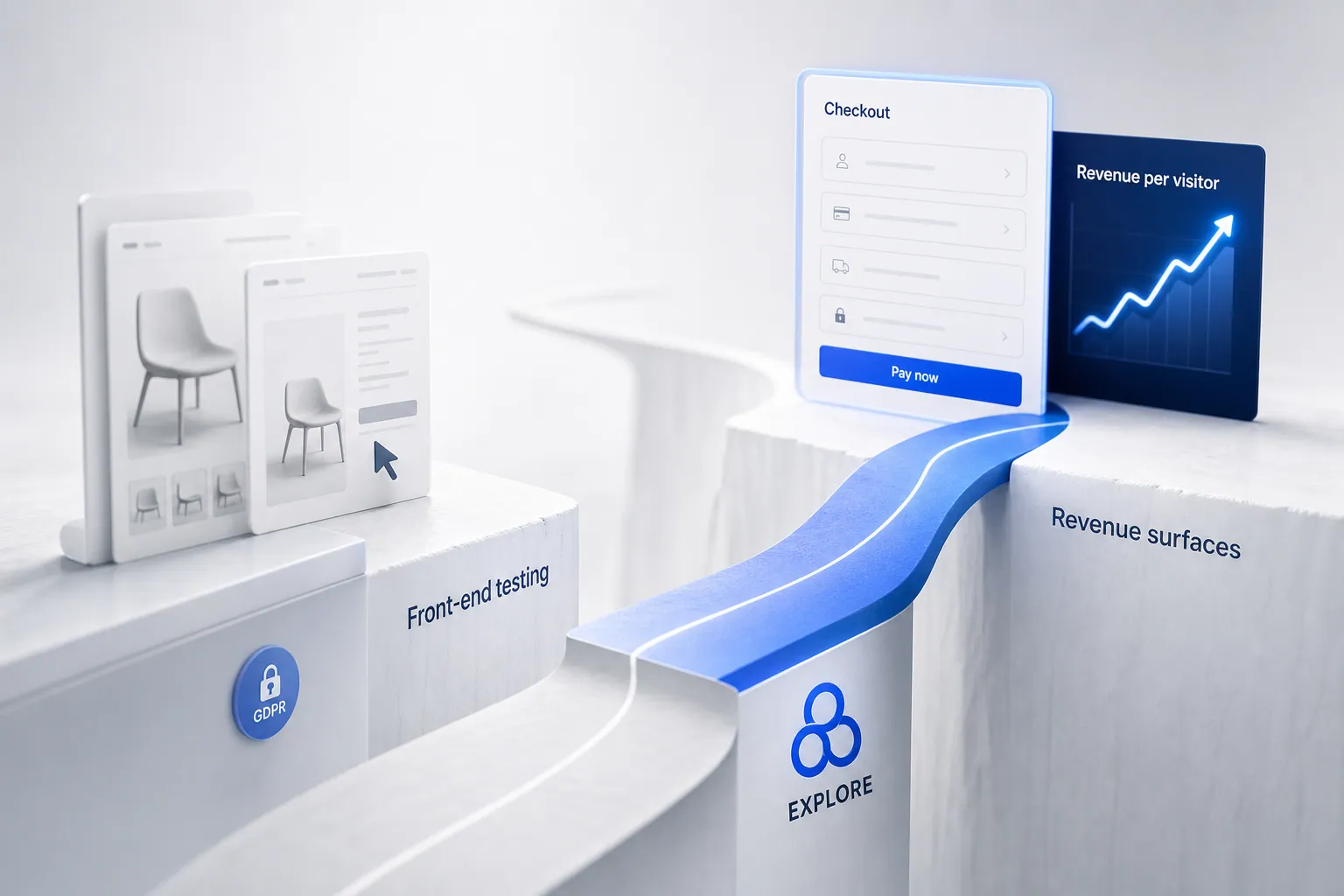
Varify.io is a European, GDPR-compliant A/B testing platform with a clean visual editor and transparent session-based pricing that appeals to mid-market teams. Omniconvert Explore is built for the eCommerce store: native Shopify integration, experiments on product, cart, and checkout, and revenue-per-visitor measurement. Both bill on sessions; the divergence is eCommerce depth and native checkout testing.
- Varify.io is a European, GDPR-compliant A/B testing platform with a clean visual editor and a 4.8 out of 5 G2 rating across 36 reviews. [G2, 2026]
- Varify.io uses flat-rate session-based pricing that keeps costs predictable during traffic spikes, and is well rated for support.
- Varify.io has no server-side testing, limited multivariate features, no native Shopify checkout support, and no built-in surveys or overlays.
- Omniconvert Explore runs experiments on product, cart, and checkout pages natively and measures results in revenue per visitor.
- Both bill on sessions, so decide on eCommerce depth: pick Varify.io for European front-end GDPR testing, pick Explore for Shopify revenue surfaces.
Teams comparing Varify.io vs Omniconvert Explore are usually deciding how to run experiments on a Shopify store while keeping data handling clean under European privacy rules. Varify.io is a GDPR-first, front-end A/B testing tool with a polished visual editor and predictable flat-rate session pricing. Omniconvert Explore is narrower on purpose: it runs A/B, multivariate, and personalization tests on a store's revenue surfaces and measures the outcome in revenue per visitor. This page covers what each does well, where Varify.io hits its ceiling for eCommerce, and when to pick one.
What is Varify.io, and what does it actually do?
Varify.io is a GDPR-compliant A/B testing platform popular with European mid-market teams. It ships a clean visual editor, supports advanced targeting, and uses a transparent flat-rate session-based pricing model that keeps costs predictable regardless of traffic spikes. [Varify.io, 2026]
Varify.io holds a 4.8 out of 5 rating on G2 across 36 reviews. [G2, 2026] It is well known in European markets for its GDPR posture, its clean interface, and support that reviewers consistently praise.
The category Varify.io sits in is privacy-first, front-end web testing. It runs A/B tests on general web pages, with a compliance stance and pricing model that appeal to teams handling European traffic under strict data rules. That focus is the point of the product.
The question this page answers is narrower: is GDPR-compliant front-end testing the same job as running conversion experiments on a Shopify store? And if not, where is the gap?
GDPR-compliant testing means the platform is engineered to collect the minimum data required to run an experiment and to keep processing inside a compliant boundary, which matters for European teams under strict privacy rules. Varify.io builds this into its product and pricing. It is a separate concern from whether a test runs natively on a store's checkout.
Where Varify.io is genuinely strong
- GDPR-first compliance: a European-built posture that makes privacy reviews easier for EU teams.
- Flat-rate session-based pricing: predictable costs that hold up during traffic spikes.
- Clean visual editor and advanced targeting: a polished front-end editor with granular audience rules.
- Highly rated support: 4.8 out of 5 on G2 across 36 reviews, with support consistently called out.
Where Varify.io hits its ceiling for an eCommerce store
- No server-side testing: checkout and back-end logic experiments are out of scope.
- Limited Shopify integration: no native checkout flow experiments, so store setups need custom work.
- Only limited multivariate testing: fewer advanced statistical features than VWO or Optimizely.
- Generic conversion focus: results are framed around front-end conversion, not revenue per visitor.
None of this makes Varify.io a weak product. It makes it a European, privacy-first, front-end testing tool. The friction shows up specifically when the site under test is a Shopify store and the metric that matters is revenue, not a click on a landing page.
What Varify.io cannot do for an eCommerce store
Varify.io is a European, privacy-first A/B testing platform focused on front-end web optimization. It has no native Shopify integration and no purpose-built checkout experiment templates, so revenue-connected tests on the cart and checkout require custom integration work. That is the gap an eCommerce-first platform closes.
Omniconvert Explore is built for the layer Varify.io leaves open. Varify.io tests front-end web pages well, but a store does not need any page tested; it needs the product page, the cart, and the checkout tested, and the result expressed in revenue per visitor. Those are not the same task.
Most privacy-first testing tools are built around a generic web page and a generic conversion event. They optimize the execution of a front-end test. They are not built around the surfaces where eCommerce revenue is actually won or lost, or around the metric a store runs on.
eCommerce CRO is the practice of running controlled experiments on the revenue surfaces of an online store, product pages, cart, and checkout, and measuring the result in revenue per visitor and order rate rather than generic conversion rate. Explore is defined as an eCommerce conversion rate optimization platform for product, cart, and checkout experiments, native to Shopify and priced for store traffic.
What Varify.io cannot tell an eCommerce team
- Did the win move revenue. Whether a winning variant actually raised revenue per visitor and order rate, not just a click on a front-end page.
- Which surface to test first. Which pages in the funnel (product, cart, checkout) carry the highest revenue impact if tested next.
- How it behaves in checkout. How an experiment interacts with the Shopify catalog, variants, and checkout flow natively, without custom integration.
- Whether it holds for valuable customers. Whether the result holds for repeat, high-value customers, the Customer Value Optimization question, not just first-session visitors.
Across the 7,000+ eCommerce websites in Omniconvert's CROBenchmark Report 2026, checkout friction is the single largest source of unrealized revenue for mid-market stores, and front-end testing tools like Varify.io cannot reach the step where the order is actually decided. [CROBenchmark Report 2026, Omniconvert]
Explore runs the experiment on the store's real revenue surfaces and reports the outcome in revenue per visitor. That is the difference between a front-end testing tool and a platform built for store revenue.
AliveCor used Omniconvert Explore to run a structured A/B testing program and achieved +21% conversion rate, +5% revenue per visitor, and 94% statistical relevance across their experiments. [Omniconvert, AliveCor case study]
Varify.io vs Explore: the capability comparison
Side by side, Varify.io and Explore both run on transparent session-based pricing and share the core front-end testing primitives. The divergence is eCommerce depth: Explore adds server-side testing, native Shopify experiments, built-in surveys and overlays, and revenue-per-visitor measurement that Varify.io leaves to custom integration work.
| Capability | Varify.io | Omniconvert Explore |
|---|---|---|
| Primary function | GDPR-first front-end A/B testing for European mid-market teams | eCommerce CRO on product, cart, and checkout pages |
| A/B testing | Yes visual editor, front-end only | Yes visual editor plus code editor |
| Multivariate testing | Limited fewer statistical features | Yes |
| Server-side testing | No | Yes |
| Visual editor | Yes clean, front-end focused | Yes no developer required |
| On-site surveys and overlays | No needs third-party tools | Yes surveys and overlays built in |
| Shopify integration | Medium not native, checkout not supported | Yes native |
| eCommerce focus | Medium European front-end web | High built for store revenue workflows |
| Pricing model | Session-based, from $299/mo, free trial | Session-based, built for store traffic, free trial |
| Best for | European mid-market teams wanting GDPR-compliant A/B testing with predictable flat-rate pricing | Shopify and eCommerce teams optimizing product, cart, and checkout for revenue |
| User rating | 4.8 out of 5 (G2, 36 reviews, as of 2026) | 4.6 out of 5 (G2, 191 reviews, as of 2026) |
Competitor pricing and plan details reflect publicly listed figures as of 2026 and can change. Explore uses session-based pricing; see the Omniconvert pricing page for current plans.
Get the full CROBenchmark data behind these stats: 7,000+ websites, 15+ industries, 248+ audit criteria, 100+ CRO experts. See exactly where eCommerce growth teams are losing margin in 2026.
Get the CROBenchmark ReportFrequently Asked Questions
Should you choose Explore over Varify.io?
If your important experiments run on a Shopify store, choose Explore: it tests product, cart, and checkout natively, ships built-in surveys and overlays, and measures revenue per visitor rather than a generic click. If your team is in Europe, prioritizes GDPR compliance across general web pages, and wants predictable flat-rate pricing without needing native checkout tests, Varify.io remains a strong choice. Both bill on sessions; decide on eCommerce depth.
Varify.io earns its high ratings. It is GDPR-first, transparently priced, well supported, and a fair pick for European mid-market teams testing front-end web pages.
The question for a store is narrower: are the experiments that move revenue running natively on the product, cart, and checkout pages, and are they measured in revenue per visitor. That is the surface Explore is built for.
Stop guessing.
Start testing what moves revenue.
Explore runs A/B, multivariate, and personalization experiments on your product pages, cart, and checkout, then measures the outcome in revenue per visitor, not just clicks.
4.6 out of 5 across 191 reviews, G2 , as of 2026