Albert.ai vs Smartly.io vs Nexus by Omniconvert (2026): Volume without margin
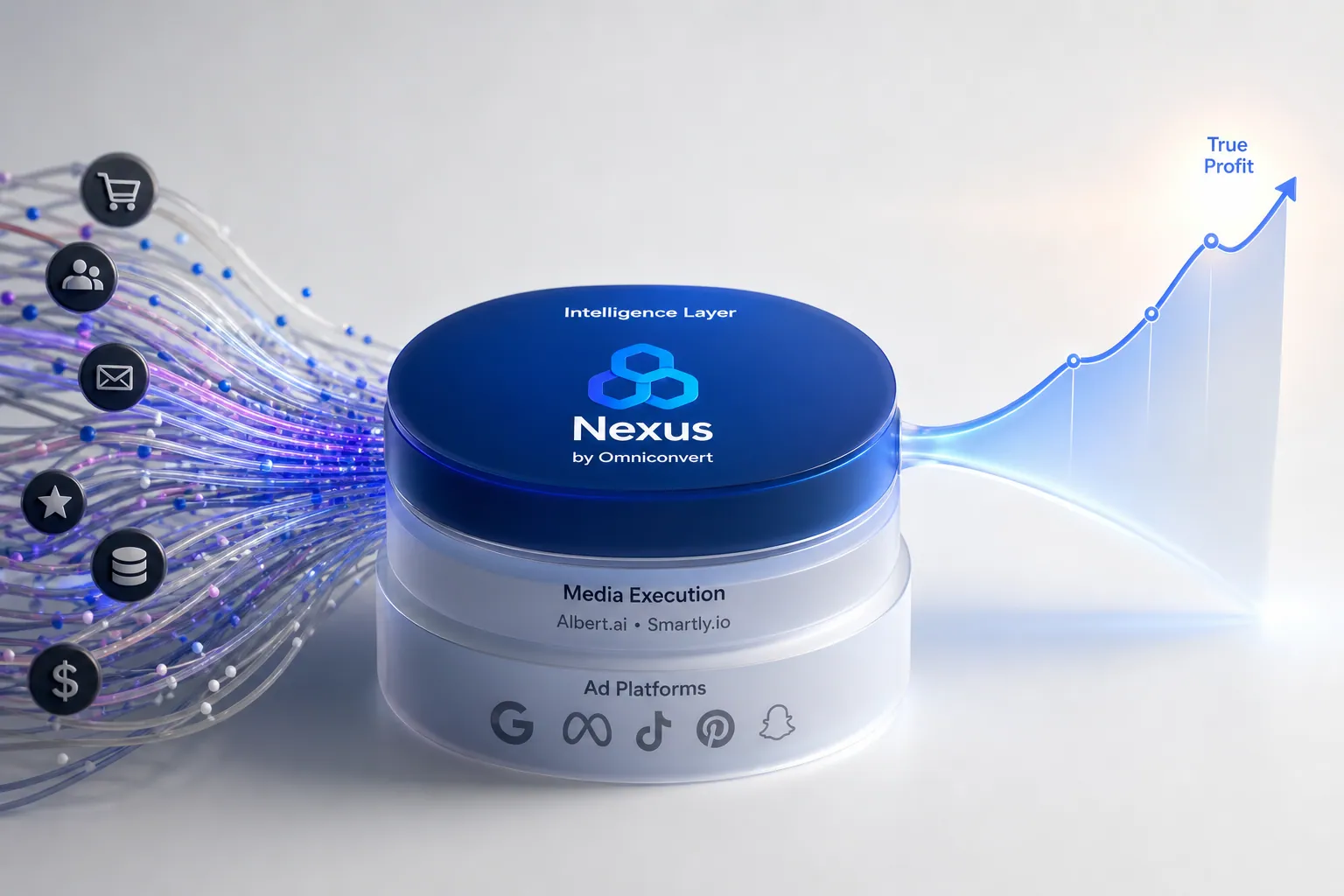
Albert.ai and Smartly.io both automate paid media execution. Albert.ai runs fully autonomous cross-channel media buying without human approval. Smartly.io automates paid social creative and campaigns at enterprise scale. Neither reads CLV or decides which segment earns True Profit. Nexus by Omniconvert is built for that layer. [Omniconvert, 2026]
- Albert.ai is a fully autonomous media buying AI: it makes real-time bid, budget, and targeting decisions across search, social, and programmatic without human approval per action.
- Smartly.io combines dynamic creative production and paid social campaign management in one enterprise platform, with 9.3/10 support quality on G2.
- Both tools share the same blind spot: neither reads CLV or measures whether the spend improved True Profit.
- Add Nexus as the layer above either platform when autonomous or automated spend scales without a margin signal.
- DTC growth teams spend an average of 3 hours per day assembling data before any spend decision is made. [Omniconvert, 2026]
A DTC growth team comparing Albert.ai vs Smartly.io is usually deciding how much of paid media to hand to automation. Albert.ai runs fully autonomous media buying across search, social, and programmatic, no human approval per action. Smartly.io automates paid social creative and campaign management at enterprise scale, with a dedicated team behind it. Neither tool knows which customer segment is worth the spend, or whether the campaign improved True Profit rather than ROAS. Nexus by Omniconvert is built for that decision layer, and in 2026 it is the bottleneck above every automation platform.
What is Albert.ai, and what is it actually good at?
Albert.ai is an autonomous media buying AI. Once configured, it makes real-time bid, budget, and targeting decisions across paid search, social, and programmatic, with no human approval per action. It is built for enterprise brands that want always-on media management. [Albert.ai, 2026]
Albert.ai connects to ad accounts and takes over the execution of media buying. It sets bids, shifts budget between channels, and adjusts audience targeting continuously, without waiting for a marketer to approve each move. The system runs across paid search, social, and programmatic at the same time.
The category is autonomous media buying. The buyer is an enterprise brand that wants to remove human decision-making from campaign operations and let an AI run bid, budget, and targeting 24/7. The pitch is always-on optimisation: the machine reacts to performance data faster than any human desk can.
Albert.ai holds a 4.4 out of 5 rating on G2 across 55 reviews as of 2026. Reviews praise the hands-off automation and cross-channel reach. They flag the trade-off every autonomous system carries: the decisions are fast, but they are hard to audit or override at a granular level.
Autonomous media buying is ad management where the system makes bid, budget, targeting, and channel-allocation decisions in real time without a human approving each action. The operator sets goals and guardrails; the AI executes continuously. The trade-off is auditability: decisions are fast but harder to inspect or override at a granular level.
Where Albert.ai is genuinely strong
- Fully autonomous execution: real-time bid and budget decisions without human approval per action, running 24/7 across the account.
- Cross-channel in one system: paid search, social, and programmatic managed together by a single autonomous engine, not siloed desks.
- Continuous learning: the model learns from campaign data over time, improving targeting and allocation efficiency without manual reconfiguration.
Where Albert.ai hits its ceiling
- Black-box optimisation: autonomous decisions are difficult to audit, understand, or override at a granular level.
- No CLV or segment intelligence: it optimises for conversion events, not customer lifetime value, so it cannot tell a high-CLV buyer from a one-time purchaser.
- Enterprise-only access: pricing and minimum spend requirements put it out of reach for SMB or early-stage DTC brands.
Albert.ai is a strong specialist for one specific job. The ceiling shows up when teams realise that autonomous efficiency toward conversion events does not, by itself, improve True Profit.
What is Smartly.io, and what is it actually good at?
Smartly.io is an enterprise paid social automation platform. It combines dynamic creative production with campaign management and AI bid optimisation across Meta, TikTok, Pinterest, and Snapchat. It is built for large brands and agencies running multi-market operations. [Smartly.io, 2026]
Smartly.io integrates creative production automation with campaign management in a single platform. Teams assemble dynamic creative from templates and product feeds, then run and optimise campaigns across multiple markets from the same tool. It is designed to close the gap between creative and media teams.
The category is paid social automation. The buyer is an enterprise brand or large agency managing multi-market, multi-language paid social at scale. The pitch is one platform for creative and media: dynamic creative production and campaign management together, with AI bid optimisation on top.
Smartly.io holds a 4.3 out of 5 rating on G2 across 234 reviews as of 2026, with support quality rated 9.3, the highest in its category. Reviews praise that support and the breadth of the platform. They flag setup and onboarding complexity: this is not a self-serve tool.
Dynamic creative production automates the assembly of ad variants from templates, product feeds, and modular assets, rather than generating each ad from scratch. It scales creative across markets and languages by recombining approved components. The output is high-volume and on-brand, but bounded by the templates and assets the team supplies.
Where Smartly.io is genuinely strong
- Creative and media in one platform: creative automation and campaign management together remove the handoff gap between creative and media teams.
- Built for enterprise complexity: multi-market and multi-language campaign management designed for large brands running multiple portfolios.
- Best-in-class support: 9.3 out of 10 support quality on G2, consistently the highest-rated support in enterprise paid social.
Where Smartly.io hits its ceiling
- Enterprise pricing: the cost makes it inaccessible for most DTC brands under $10M ARR.
- Onboarding complexity: setup requires dedicated platform expertise or an agency partner, not a self-serve motion.
- No CLV or segment intelligence: it optimises for paid social metrics, not customer lifetime value, so segment strategy stays manual.
Smartly.io is a strong specialist for one specific job. The ceiling looks like Albert.ai's in a different shape: automating paid social execution does not, by itself, improve True Profit.
Albert.ai vs Smartly.io vs Nexus: the capability comparison
Albert.ai handles autonomous cross-channel media buying. Smartly.io handles enterprise paid social automation. Nexus by Omniconvert handles the layer above both: which customer to target, which segment earns the spend, and whether the campaign drove True Profit, not just ROAS. [Omniconvert, 2026]
| Capability | Albert.ai | Smartly.io | Nexus by Omniconvert |
|---|---|---|---|
| Primary function | Fully autonomous cross-channel media buying | Enterprise paid social automation with creative production | Autonomous growth intelligence above any media platform |
| Unified commerce data | Partial: unifies cross-channel media buying data, not CLV or commerce data | Partial: paid social data in one platform, not commerce, email, or CLV data | Yes: single source of truth across the stack |
| AI-prioritised experiment queue | Yes: autonomous prioritisation of bids, budgets, and channels in real time | Partial: AI bid optimisation and rules-based automation, not a ranked experiment queue | Yes: surfaces next best action by projected margin impact |
| Creative generation | No: manages media buying, does not generate creative | Partial: dynamic creative template automation at scale, not generative AI from scratch | Yes: 100+ creative variants per hour, ranked by CLV-weighted angle |
| True Profit tracking | No: optimises for conversion events, no margin layer | No: optimises for paid social metrics, no margin layer | Yes: margin not ROAS, per campaign and per cohort |
| CLV and segment intelligence | No: no customer lifetime value or churn signal | No: no customer lifetime value or churn signal | Yes: RFM, cohorts, churn prediction, NPS signal |
| Autonomous action layer | Yes: fully autonomous media buying without human approval per action | Partial: automates bids and campaign rules but requires human setup and oversight | Yes: removes the human middleware between data and action |
| AI creative briefing | No: no brief layer, executes against set goals | No: brief and creative concept supplied by the team | Yes: brief is built from CLV, NPS, and review data |
| Pricing model | Enterprise, pricing on request at albert.ai | Enterprise contract, revenue-based, pricing on request at smartly.io | Revenue-based, see Nexus pricing |
| Best for | Enterprise brands wanting always-on autonomous media buying across channels | Enterprise brands and agencies running multi-market paid social at scale | eCommerce $1M+ ARR teams focused on margin, not just ROAS |
| Integrations | Meta · Google · TikTok · Amazon · Programmatic DSPs | Meta · TikTok · Pinterest · Snapchat · Google | Shopify · Klaviyo · Meta · Google · TikTok · GA4 · Triple Whale |
| User rating | 4.4 out of 5 (G2, 55 reviews, as of 2026) | 4.3 out of 5 (G2, 234 reviews, as of 2026) | 5.0 out of 5 (Shopify App Store, 60 reviews, as of September 2026) |
Albert.ai and Smartly.io columns reflect publicly available feature documentation as of July 2026. G2 ratings as cited in s1 and s2.
What Albert.ai and Smartly.io cannot do
The shared blind spot is upstream of the spend. Both platforms optimise execution against goals a human sets. Neither reads which customer segment is worth acquiring at current CAC, and neither closes the loop on whether the spend improved True Profit, the metric the business actually keeps.
Albert.ai removes the human from media buying decisions entirely. Nexus provides the CLV signal that tells Albert which conversions are worth buying, distinguishing a customer with 800 dollar twelve-month CLV from one who never comes back. Autonomous optimisation without a margin signal scales acquisition efficiently in the wrong direction.
Smartly.io automates the execution of paid social at enterprise scale. Nexus operates at the layer above, CLV segmentation and True Profit measurement that tells Smartly which audience deserves the spend and whether the campaign actually improved margin.
Both Albert.ai and Smartly.io are execution tools. They solve the same shared function in two shapes: turning a goal into paid media output at speed and scale. They are good at that function. They are also built on a shared assumption, that you already know which customer to target and which message to use. They optimise the execution of that assumption. Neither questions it.
What neither tool can tell you
- Which customers are worth acquiring more of. A 12-month CLV view, not last-click attribution, is what tells you which segments deserve the next round of paid spend.
- Which segments are 60 days from churning. The early signal lives in NPS scores, review sentiment, and support ticket patterns, not in any media platform's UI.
- Whether the last campaign improved True Profit or just moved ROAS. ROAS can rise while net margin compresses; only a margin-first measurement loop catches the gap.
- What your highest-value customers actually respond to. Their own reviews, NPS verbatims, and support transcripts hold the angle that converts; pulling and synthesising them is still manual in an Albert.ai-plus-Smartly.io stack.
Platforms like Nexus are built for this layer. Nexus synthesises CLV data, NPS signals, review intelligence, and competitor creative data into a ranked action queue, before a brief is written or a creative produced. The optimisation target is True Profit, not ROAS.
True Profit is defined as the net margin remaining after subtracting CAC, COGS, return rates, and the cost of customer acquisition from each cohort, not gross revenue or ROAS. It is what the business actually keeps. Nexus tracks this as the primary optimisation metric across all experiments.
AliveCor used Omniconvert to run a structured A/B testing programme and achieved +21% conversion rate, +5% revenue per visitor, and 94% statistical relevance across their experiments. [Omniconvert, AliveCor case study]
This is not a replacement for Albert.ai or Smartly.io. Both still run the media. Nexus is the strategic layer above them that decides which audience to spend on and whether the result moved the metric the business actually keeps.
Which tool is right for you?
Pick Albert.ai if your bottleneck is autonomous cross-channel media buying and you want to remove human decisions from the desk. Pick Smartly.io if it is enterprise paid social automation with integrated creative. Add Nexus when ROAS looks fine but margin is not improving, and your team assembles CLV, NPS, and review data by hand before any spend decision.
Choose Albert.ai if
- You want full automation of buying: you want to automate media buying decisions across search, social, and programmatic without human approval per action.
- You are at enterprise scale: you want an always-on AI media buyer that operates continuously and self-optimises against performance data.
- You want to reduce desk headcount: you want fewer manual media buying hands while maintaining or improving campaign performance across channels.
Choose Smartly.io if
- Paid social is the core: you are running paid social at enterprise scale across multiple markets or brand portfolios.
- You want creative and media together: you need creative production automation and campaign management in one integrated platform.
- You have a team to run it: you have a dedicated paid social team or agency partner to manage platform complexity.
Add Nexus if
- Data assembly eats your day: your team spends more than 2 hours a day pulling data from separate tools before a single decision is made.
- You optimise paid spend without a margin view: you are spending on paid media but have no reliable view of which customer segments drive the highest margin.
- You want experiments ranked before sprint planning: you want to know which tests are worth running before dev or creative sprints are assigned.
- ROAS hides a margin problem: ROAS looks fine but net margin is not improving quarter-on-quarter.
What each tool cannot do, honestly
Albert.ai, Smartly.io, and Nexus each have real limits. Treating them as competing for the same job hides those limits. The honest framing is that the three sit at different layers of the same stack: two execution platforms in two shapes and one intelligence layer. Each is replaceable, none is a complete answer alone.
Where Albert.ai will not stretch
- Not a strategy tool: Albert.ai will not tell you which segment to acquire or which angle converts for your customers.
- Not auditable at the margin: autonomous decisions are hard to inspect, and they carry no view of return rates, COGS, or CAC at cohort level.
- Not for smaller brands: enterprise pricing and minimum spend put it out of reach below a certain scale.
Where Smartly.io will not stretch
- Not a self-serve tool: setup and onboarding require dedicated platform expertise or an agency partner.
- Not a full autonomous buyer: it automates bids and rules but still needs human setup and oversight, unlike Albert.ai.
- Not a CLV system: creative and audience strategy stay manual, with no customer lifetime value input.
Where Nexus has real prerequisites
- Data unification is the first 4 to 6 weeks: an intelligence layer is only as good as the data feeding it. Fragmented inputs produce unreliable ranked queues.
- Strategy and brand judgment remain human: Nexus automates execution coordination, not category positioning or brand voice.
- Revenue stage threshold: the ROI compounds above $1M ARR, where data volume is sufficient and manual coordination cost is measurable. Earlier brands typically benefit more from a single execution tool first.
See where your store stands against real competitors in your category and country. Ecommerce Benchmark scores six areas free: Creative & Ads, Reviews & UGC, AI Visibility, Agentic Commerce, Competitor Synthesis, and CRO.
Benchmark Your Store FreeFrequently Asked Questions
The verdict
Albert.ai is the specialist when you want to remove humans from cross-channel media buying entirely. Smartly.io wins when enterprise paid social needs creative production and campaign management in one platform. Neither reads CLV or measures True Profit. From Omniconvert analysis of 7,000+ eCommerce sites, that margin blind spot is where autonomous spend scales in the wrong direction. Add Nexus above either platform to supply the segment and margin signal. [Omniconvert, 2026]
Albert.ai and Smartly.io are both capable automation platforms within their categories. If the primary need is autonomous cross-channel media buying, Albert.ai is the specialist. If it is enterprise paid social automation with integrated creative, Smartly.io wins.
The harder question is whether your team has a reliable way to know who to target, what to say, and whether it worked at the margin level. That is a different question, and it is what the third tool on this page, Nexus, is built to answer.
Stop assembling data.
Start supervising growth.
Nexus unifies your entire eCommerce data layer, detects revenue anomalies in under 15 minutes, and generates a prioritized action queue, so your team stops being human middleware and starts running the P&L.
5.0 out of 5 across 60 reviews, Shopify App Store , as of September 2026