Albert.ai vs TryHolo vs Nexus by Omniconvert (2026): Autopilot vs volume.
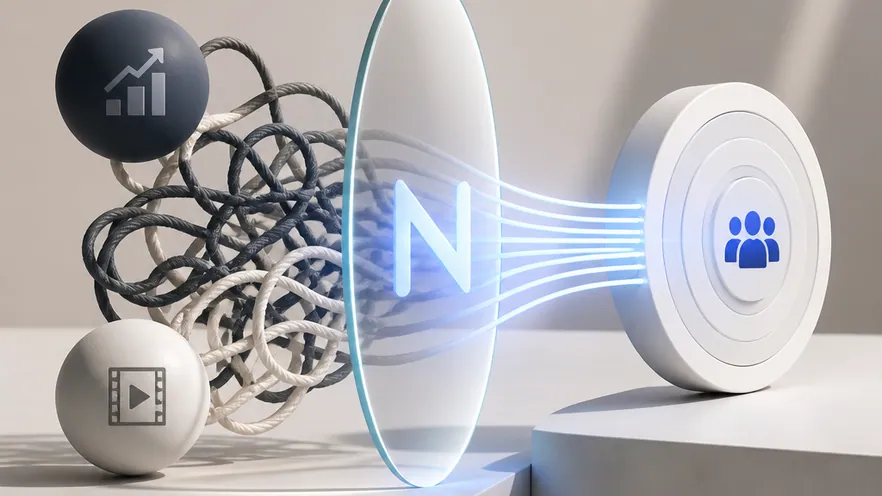
Albert.ai and TryHolo solve opposite halves of the paid workflow. Albert.ai autonomously buys media across paid search, social, and programmatic. TryHolo generates AI video and content for marketing teams. Neither models CLV or measures True Profit. Nexus by Omniconvert adds the customer margin signal both need to point their production and buying in the right direction. [Omniconvert, 2026]
- Albert.ai is a fully autonomous media buying platform that makes real-time bid, budget, and targeting decisions across paid search, social, and programmatic without human approval per action.
- TryHolo is an AI video and content creation platform for marketing teams and agencies. Public data is limited, so verify current features and pricing at tryholo.ai before shortlisting.
- Both tools operate on inputs the marketer supplies. Neither ranks customer segments by lifetime value or reports margin.
- Nexus by Omniconvert adds the CLV, NPS, review, and competitor intelligence layer that decides who to target, what to say, and whether the campaign moved True Profit.
- Use Albert.ai for autonomous media buying, TryHolo for video production throughput, and Nexus when ROAS looks fine but net margin is not moving.
A DTC growth team comparing Albert.ai vs TryHolo is choosing between two very different jobs in paid growth: one runs the ad accounts on autopilot, the other produces AI video content for marketing. Albert.ai makes real-time bid, budget, and targeting decisions across paid search, social, and programmatic without human approval per action. TryHolo sits in the production layer, generating AI video and content assets so marketing teams and agencies can ship more than an internal studio would produce alone. Neither knows which customer segment is worth acquiring at margin, and neither reports whether the spend improved True Profit.
What is Albert.ai, and what is it actually good at?
Albert.ai is a fully autonomous media buying platform. Once configured, it makes real-time decisions on bids, budgets, audience targeting, and channel allocation without human approval per action, operating across paid search, social, and programmatic at once. [Albert.ai, 2026]
Albert.ai's distinguishing move is removing the human from the loop. It runs continuously, learning from campaign data and reallocating spend across channels in real time. The pitch is reducing media buying headcount while holding or improving performance.
The category is autonomous media buying. The buyer is an enterprise brand that wants always-on cross-channel management without approving every decision. The trade is control: autonomous decisions are harder to audit or override granularly, and the system optimises toward conversion events, not customer lifetime value.
Albert.ai holds a 4.4 out of 5 rating on G2 across 55 reviews as of 2026. Reviews praise the hands-off efficiency, with the caveat that the system needs the right optimisation goal to point at.
Autonomous media buying is the practice of letting an AI make bid, budget, and targeting decisions in real time without per-action human approval. It maximises a defined conversion goal continuously, but the goal it optimises is only as good as the signal it is given, usually a conversion event, not margin.
Where Albert.ai is genuinely strong
- Fully autonomous: real-time bid and budget decisions without human approval per action, 24/7.
- Cross-channel: paid search, social, and programmatic managed in a single autonomous system.
- Continuous learning: targeting and allocation efficiency improve without manual reconfiguration.
Where Albert.ai hits its ceiling
- Black-box optimisation: autonomous decisions are difficult to audit, understand, or override granularly.
- No CLV signal: it optimises for conversion events, not customer lifetime value.
- Enterprise minimums: pricing and spend requirements put it out of reach for SMB and early-stage DTC.
Albert.ai is a strong specialist for one specific job. The ceiling shows up when a brand realises that always-on autonomous buying scales acquisition efficiently in whichever direction the optimisation goal points, and the goal is rarely margin.
What is TryHolo, and what is it actually good at?
TryHolo is an AI video and content creation platform positioned for marketing teams and agencies. It sits in the production layer, not the campaign strategy or customer intelligence layer. The distinguishing angle is video output for marketing content rather than static ad volume. Verify current features and pricing at tryholo.ai before shortlisting.
TryHolo focuses on AI-generated video and marketing content for teams that need to ship more creative than an internal studio can produce alone. The category is AI video and content creation, adjacent to but distinct from the autonomous media buying category Albert.ai occupies. It is aimed at marketing teams and agency operators.
The buyer is typically a marketing lead or agency producer with a content backlog and a limited production budget. The pitch is speed of video production: assets that would take days in a traditional edit suite can be produced in a fraction of the time, at a fraction of the cost.
Because TryHolo sits in the production layer, its centre of gravity is throughput, not strategy. It answers the question, how do we produce more content? It does not answer which segment the content should target, or whether the resulting spend improved margin. Public documentation is thin, so treat the specifics below as directional and verify against the vendor before committing budget.
AI video and content creation is a category of tools that generate marketing video, image, and copy assets from prompts or briefs using generative AI, replacing part of the traditional production workflow. The category solves the supply of creative, not the selection of which customer or message the creative should serve.
Where TryHolo is positioned to help
- AI video output for marketing content: production speed and volume in a format most static-ad generators do not cover.
- Content creation workflow for agencies: positioned for marketing teams and agency operators managing multiple client briefs and content queues.
Where TryHolo is likely to leave gaps
- No CLV or customer segment intelligence: the tool produces content, it does not decide which customer segment the content should target.
- Production layer only: no campaign management, no margin measurement, no ranked action queue above the creative it produces.
TryHolo is a production-layer specialist for AI video content. The ceiling shows up when the team needs to know which brief to write in the first place, and whether the video that shipped moved True Profit.
Albert.ai vs TryHolo vs Nexus: the capability comparison
Set beside each other, Albert.ai and TryHolo sit at opposite ends of the paid workflow: one autonomously buys the media across channels, the other produces AI video content for marketing teams. Nexus by Omniconvert sits above both, ranking which segment to spend against, generating the brief from customer data, and reporting the True Profit outcome afterwards.
| Capability | Albert.ai | TryHolo | Nexus by Omniconvert |
|---|---|---|---|
| Primary function | Autonomous cross-channel media buying, real-time bid and budget decisions without human approval | AI video and content creation for marketing teams and agencies | Autonomous growth intelligence above any creative or media workflow |
| Unified commerce data | Partial unifies cross-channel media data, not unified with CLV or wider commerce data | No production layer, no commerce or CLV data | Yes single source of truth across CLV, NPS, reviews, and ads |
| AI-prioritised experiment queue | Yes real-time autonomous prioritisation of bids, budgets, and channels | No content production, not a ranked next-action queue | Yes next best action by projected margin impact |
| Creative generation | No buys and optimises media, does not generate creative | Partial AI video generation for marketing content, video-first rather than full static ad workflow | Yes 100+ variants per hour, ranked by CLV-weighted angle |
| True Profit tracking | No optimises for conversion events, not margin | No no margin layer | Yes margin after CAC, COGS, and returns, not ROAS |
| CLV and segment intelligence | No no CLV modelling or cohort logic | No no CLV modelling, RFM cohorts, or churn prediction | Yes RFM, cohorts, churn prediction, NPS signal |
| Autonomous action layer | Yes fully autonomous media buying across channels without human approval | No human runs the brief and the campaigns | Yes removes the human middleware between insight and action |
| AI creative briefing | No optimises media, not briefs | No produces video assets, does not source the customer intelligence behind the brief | Yes briefs built from CLV, NPS, and review signals |
| Pricing model | Enterprise, pricing on request at albert.ai | Pricing available on request at tryholo.ai | Revenue-based (see omniconvert.com/nexus) |
| Best fit | Enterprise brands wanting always-on autonomous media buying across paid search, social, and programmatic | Marketing teams and agencies whose bottleneck is video and content production volume | eCommerce brands at $1M+ ARR that need margin visibility, not ad-tool sprawl |
| User rating | 4.4 out of 5 (G2, 55 reviews, as of 2026) | No public G2 rating | 5.0 out of 5 (Shopify App Store, 60 reviews, as of September 2026) |
Capabilities marked "Partial" indicate a scoped version of the function, not a full replacement. Verify TryHolo specifics against the vendor before purchase.
What Albert.ai and TryHolo cannot do
The shared blind spot is decision quality upstream of the tools. Albert.ai buys the media efficiently, TryHolo produces video assets at speed, and neither knows whether the audience being targeted or the angle being produced will actually improve True Profit.
Albert.ai removes the human from media buying decisions entirely. Nexus provides the CLV signal that tells Albert which conversions are worth buying, distinguishing a customer with 800 dollar twelve-month CLV from one who never comes back. Autonomous optimisation without a margin signal scales acquisition efficiently in the wrong direction.
TryHolo generates AI video content for marketing teams. Nexus provides the brief from CLV and customer segment data before any video production begins, so the asset serves a defined margin cohort rather than a generic buyer. Verify the exact TryHolo capabilities at tryholo.ai; either way, production without a CLV brief still reflects last-click thinking.
Both tools are built around a shared assumption: that the growth team already knows which customers to target and which message to use. They optimise the execution of that assumption. Neither questions it.
What they cannot tell you
- Who to target. Which current customers are worth acquiring more of, based on 12-month CLV, not last-click attribution.
- Who is about to leave. Which segments are 60 days from churn and need a different message today.
- Whether it worked. Whether the last campaign improved True Profit, or just moved ROAS.
- What to say. What the highest-value cohort actually responds to, sourced from their own reviews, NPS scores, and support tickets.
Platforms like Nexus are built for this layer. Nexus synthesises CLV data, NPS signals, review intelligence, and competitor creative data into a ranked action queue, before a brief is written or a creative produced. The optimisation target is True Profit, not ROAS.
True Profit is defined as the net margin remaining after CAC, COGS, return rates, and the cost of customer acquisition per cohort are subtracted from gross revenue. It is what the business actually keeps. Nexus tracks this as the primary optimisation metric across every experiment it runs.
AliveCor used Omniconvert to run a structured A/B testing programme and achieved +21% conversion rate, +5% revenue per visitor, and 94% statistical relevance across their experiments. [Omniconvert, AliveCor case study]
Which tool is right for you?
Pick Albert.ai when the pain is manual cross-channel bid and budget management at enterprise spend. Pick TryHolo when the pain is video and content production throughput. Add Nexus when ROAS looks acceptable but net margin is not moving quarter on quarter.
Choose Albert.ai if
- You want to fully automate media buying decisions across search, social, and programmatic without human approval per action.
- You are at enterprise scale and want an always-on AI media buyer that operates continuously and self-optimises.
- You want to reduce media buying headcount while maintaining or improving campaign performance across channels.
Choose TryHolo if
- Video production throughput is your bottleneck, not media buying or customer strategy.
- Your team ships regular marketing video content and an internal studio cannot keep up with the queue.
Add Nexus if
- Your team spends more than 2 hours a day pulling data from separate tools before making a decision.
- You are optimising paid spend but have no reliable view of which segments drive the highest margin.
- You want to know which experiments are worth running before dev sprints are assigned.
- ROAS looks fine but net margin is not improving quarter on quarter.
What each tool cannot do, honestly
None of these three tools does everything. Being honest about what each one is not built for is the fastest way to avoid a stack that overlaps and still leaves the margin question unanswered.
Albert.ai will not model customer lifetime value or tell you which cohorts are close to churn. Its autonomous decisions are also difficult to audit granularly, and it optimises toward whichever conversion goal it is pointed at, not margin.
TryHolo will not buy media, measure results, or generate the customer insight the brief should be built on. It produces content; the direction of that content still has to come from somewhere.
Nexus will not replace either tool. It does not autonomously buy media the way Albert does, and it is not a video production platform the way TryHolo is. It is the intelligence layer that decides who to target, what to say, and whether it worked.
See where your store stands against real competitors in your category and country. Ecommerce Benchmark scores six areas free: Creative & Ads, Reviews & UGC, AI Visibility, Agentic Commerce, Competitor Synthesis, and CRO.
Benchmark Your Store FreeFrequently Asked Questions
The verdict
Albert.ai is the specialist if the immediate goal is fully autonomous cross-channel media buying at enterprise spend. TryHolo is closer to the workflow when the drag is production throughput for video and marketing content. Neither ranks segments by lifetime value or reports True Profit at cohort level, which is the layer Nexus is built for. Add it when ROAS looks acceptable and margin still is not moving quarter on quarter. [Omniconvert, 2026]
Albert.ai and TryHolo are both capable inside their categories. If autonomous cross-channel media buying at enterprise scale is the primary need, Albert.ai is the specialist. If video and content production throughput is the drag, TryHolo is closer to the workflow that needs help.
The harder question is whether the team has a reliable way to know who to target, what to say, and whether it worked at the margin level. That is a different question, and it is what the third tool on this page, Nexus by Omniconvert, is built to answer.
Stop assembling data.
Start supervising growth.
Nexus unifies your entire eCommerce data layer, detects revenue anomalies in under 15 minutes, and generates a prioritized action queue, so your team stops being human middleware and starts running the P&L.
5.0 out of 5 across 60 reviews, Shopify App Store , as of September 2026