Arcads vs HeyGen vs Nexus by Omniconvert (2026): UGC actors vs avatars
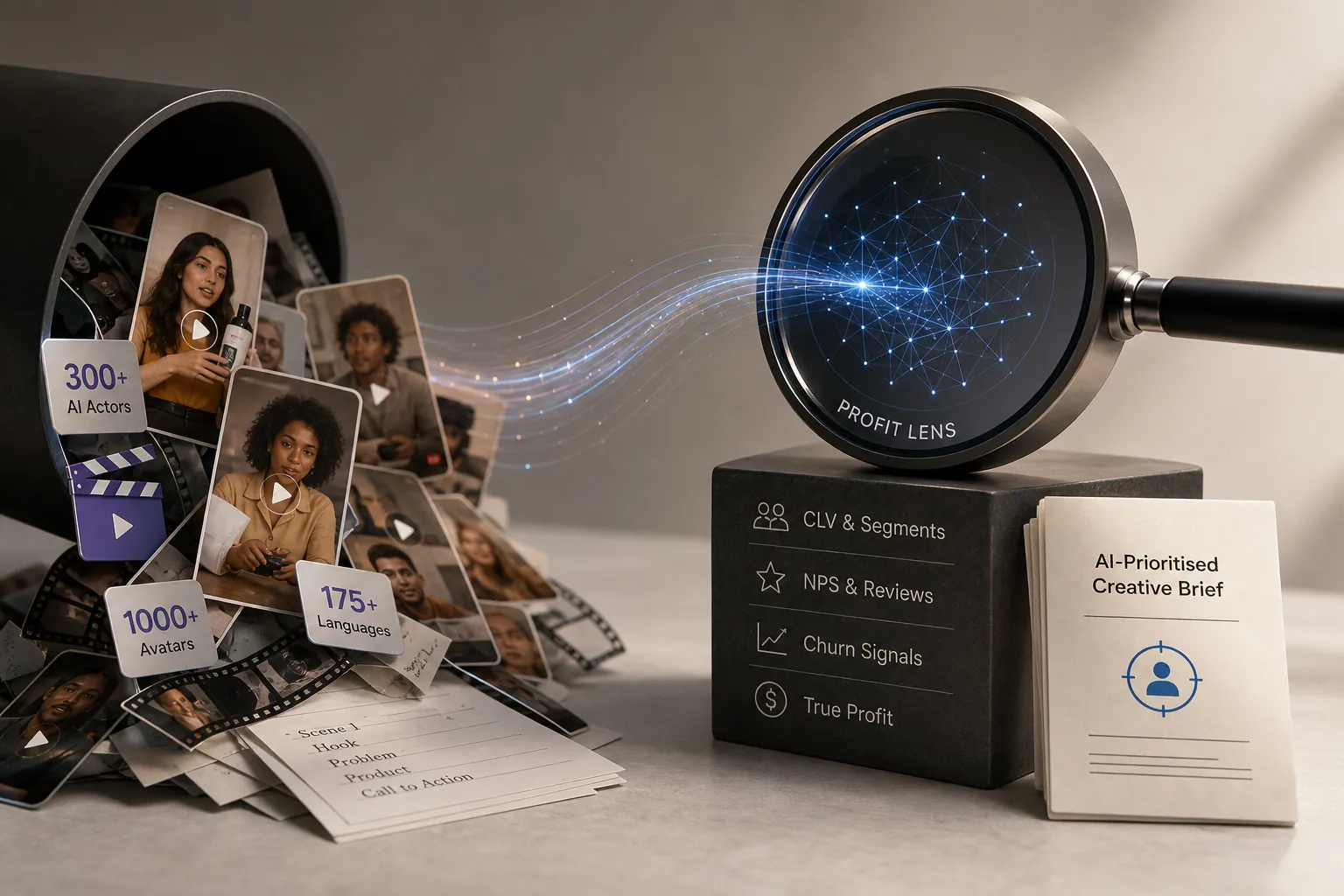
Arcads and HeyGen are both AI video tools. Arcads turns scripts into UGC-style footage with 300+ AI actors across 35 languages. HeyGen renders realistic avatar video with voice cloning across 175+ languages. Neither builds the brief that decides which segment or angle the video should target. Nexus by Omniconvert is built for that layer. [Omniconvert, 2026]
- Arcads turns scripts into UGC-style video using 300+ AI actors across 35 languages, rendering each video in about 2.5 minutes.
- HeyGen renders realistic avatar video with voice cloning and lip-synced translation across 175+ languages.
- Arcads ships raw footage for an external editor; HeyGen is a general-purpose video tool, not an ecommerce ad workflow.
- Neither tool reads customer data or decides which segment and angle the video should target.
- Nexus adds the CLV-weighted brief, the True Profit measurement loop, and the ranked action queue above either generator.
A DTC growth team comparing Arcads vs HeyGen is choosing between two AI video formats: actor-led UGC for paid social, or realistic avatar video built for spokesperson content and multilingual reach. Arcads wins on UGC authenticity and actor variety. HeyGen wins on avatar realism, voice cloning, and 175-language localisation. Neither tool tells you which customer segment to target, which angle to lead with, or whether the resulting video moved True Profit. That decision layer is what Nexus by Omniconvert is built for.
What is Arcads, and what is it actually good at?
Arcads converts text scripts into UGC-style video ads featuring 300+ diverse AI actors. Each video renders in about 2.5 minutes, and bulk creation spins up dozens of script and actor variations at once for rapid testing. [Arcads, 2026]
Arcads is built for performance marketers who want authentic-looking UGC without hiring creators who charge 80 to 200 dollars per video. You supply the script; Arcads delivers actor-led footage in 35 languages. The output is raw video, so finishing happens in an external editor.
The pitch is actor variety and speed at the production layer. Arcads has no URL scraping, no analytics, and no connection to ad-account results. It generates the asset and stops there.
A UGC-style ad mimics the visual language of user-generated content, handheld feel, conversational delivery, mid-roll product mention, but is produced with paid talent or AI actors. The format dominates Meta and TikTok performance in 2026 because it bypasses the polish penalty paid by studio-produced ads.
Where Arcads is genuinely strong
- 300+ diverse AI actors: more actor variety than most specialist tools, with authentic UGC-style delivery.
- Bulk variation: dozens of script and actor combinations generated simultaneously for rapid A/B testing.
- 35 languages: multilingual UGC-style campaigns without hiring local creators.
Where Arcads hits its ceiling
- Raw footage only: no built-in editor for music, overlays, or finishing; external tools required.
- Script-input only: no URL-to-video, no product data scraping, no brief generation from customer data.
- No analytics: generates assets with no connection to ad-account performance.
Arcads does not publish a G2 rating as of 2026. Practitioner feedback centres on actor realism and throughput, with the consistent caveat that the brief and the editing are still yours.
What is HeyGen, and what is it actually good at?
HeyGen generates realistic talking-head video using AI avatars and voice cloning. It offers 1000+ pre-made avatars, custom avatar creation from photos, and lip-synced video translation across 175+ languages. [HeyGen, 2026]
HeyGen was built for spokesperson, explainer, and corporate video, and is increasingly used for UGC-style ad content. Its standout capability is localisation: record one master video, then translate and lip-sync it across 175+ languages without re-filming. Voice cloning produces a consistent brand spokesperson at scale.
Where Arcads centres on actor variety and UGC feel from a script, HeyGen centres on avatar realism and multilingual reach. It is a general-purpose video tool, not purpose-built for ecommerce ad workflows.
Where HeyGen is genuinely strong
- 1000+ avatars and custom creation: realistic avatars, including a digital copy built from uploaded photos or video.
- 175-language lip-sync: localise one master video across all markets without re-filming talent.
- Voice cloning: a consistent brand spokesperson voice for video at scale.
Where HeyGen hits its ceiling
- General-purpose: not built for ecommerce ad workflows, product URL scraping, or paid social testing.
- No performance loop: produces video with no connection to ad-account results.
- No CLV input: creative direction is entirely manual.
HeyGen holds a 4.8 out of 5 rating on G2 across 900 reviews as of 2026, among the highest in the category. Reviews praise realism and localisation; they note it is a video tool, not an ad strategy tool.
Arcads vs HeyGen vs Nexus: the capability comparison
Arcads and HeyGen both live at the generation layer, one with AI actors, one with avatars and localisation. Nexus by Omniconvert is the intelligence layer above either: the segment, the brief, and the margin loop. The table reads as complementary, not competing.
| Capability | Arcads | HeyGen | Nexus by Omniconvert |
|---|---|---|---|
| Primary function | Script-to-UGC video with 300+ AI actors | Realistic avatar video with 175-language lip-sync | Autonomous growth intelligence above any generator |
| Unified commerce data | No: no unified data layer | No: no unified data layer | Yes: single source of truth across the stack |
| AI-prioritised experiment queue | No: no ranked next-action queue | No: no ranked next-action queue | Yes: next best action by projected margin impact |
| Creative generation | Yes: 300+ AI actors, 2.5 minutes per video, bulk creation | Yes: realistic avatar video, voice cloning, 175+ languages | Yes: 100+ variants per hour, ranked by CLV-weighted angle |
| True Profit tracking | No: no margin layer | No: no margin layer | Yes: margin not ROAS, per campaign and per cohort |
| CLV and segment intelligence | No: no CLV or churn signal | No: no CLV or churn signal | Yes: RFM, cohorts, churn prediction, NPS signal |
| Autonomous action layer | No: human briefs every run | No: human briefs every run | Yes: removes the human middleware between data and action |
| AI creative briefing | No: script supplied by the marketer | No: script supplied by the marketer | Yes: brief built from CLV, NPS, and review data |
| Pricing model | Credit-based SaaS, pricing on request at arcads.ai | Subscription SaaS, Creator from 29 dollars per month | Revenue-based, see Nexus pricing |
| Best for | Teams replacing human UGC creators with AI actors at scale | Brands needing spokesperson and multilingual video at scale | eCommerce 1M dollar plus ARR teams focused on margin |
| Integrations | Meta, TikTok | Zapier, HubSpot, API | Shopify, Klaviyo, Meta, Google, TikTok, GA4, Triple Whale |
| User rating | No public G2 rating | 4.8 out of 5 (G2, 900 reviews, as of 2026) | 5.0 out of 5 (Shopify App Store, 60 reviews, as of September 2026) |
Competitor columns reflect publicly available feature documentation as of June 2026. G2 rating as cited in s2; Arcads does not publish a G2 score.
What Arcads and HeyGen cannot do
Both tools ship the video. Neither builds the brief. The decision about which segment to target, which angle to lead with, and whether the result moved margin still sits with a human assembling data from separate tools. That layer is where Nexus operates.
Arcads produces authentic-looking UGC video faster and cheaper than human creators. Nexus by Omniconvert provides what Arcads cannot, the brief written from customer data, identifying which segment to address, which pain point to lead with, and which CLV cohort the campaign should acquire.
HeyGen produces the most realistic AI video on the market. Nexus provides what HeyGen cannot, the brief built from CLV segmentation and NPS signals that tells the team which customer segment to address, which pain point to lead with, and whether the resulting video drove True Profit.
What neither tool can tell you
- Which of your current customers are worth acquiring more of. A 12-month CLV view, not last-click attribution, is what tells you which segments deserve the next round of paid spend.
- Which segments are 60 days from churning. The early signal lives in NPS scores, review sentiment, and support ticket patterns, not in any generator's UI.
- Whether your last campaign improved True Profit or just moved ROAS. ROAS can rise while net margin compresses; only a margin-first measurement loop catches the gap.
- What your highest-value customers actually respond to. Their own reviews, NPS verbatims, and support transcripts hold the angle that converts, and synthesising them is still manual with either tool.
Platforms like Nexus are built for this layer. Nexus synthesises CLV data, NPS signals, review intelligence, and competitor creative data into a ranked action queue, before a brief is written or a creative produced. The optimisation target is True Profit, not ROAS.
True Profit is defined as the net margin remaining after subtracting CAC, COGS, return rates, and the cost of customer acquisition from each cohort, not gross revenue or ROAS. It is what the business actually keeps. Nexus tracks this as the primary optimisation metric across all experiments.
AliveCor used Omniconvert to run a structured A/B testing programme and achieved +21% conversion rate, +5% revenue per visitor, and 94% statistical relevance across their experiments. [Omniconvert, AliveCor case study]
Which tool is right for you?
If you want actor-led UGC for paid social, choose Arcads. If you want realistic avatar video and multilingual localisation, choose HeyGen. If margin is flat despite either pipeline shipping volume, the missing layer is the brief, and that is Nexus.
- Choose Arcads if you are replacing human UGC creators with AI actors and need authentic, multilingual UGC variation for Meta and TikTok.
- Choose HeyGen if you need spokesperson video, a reusable brand avatar, or one master video localised across many markets.
- Add Nexus if the generator is no longer the bottleneck and the open question is which segment to target and whether the spend improved True Profit.
The two video tools serve different formats but share the same ceiling: they execute the brief, they do not write it. Nexus sits above both, deciding what to produce and for whom, then measuring the margin result.
What each tool cannot do, honestly
A fair comparison names the limits. Arcads ships raw footage with no editor or analytics. HeyGen is general-purpose with no ad performance loop. Nexus does not render avatars or film live footage; it is the intelligence layer above the production line.
- Arcads: raw footage only, script-input only, no analytics loop back to ad results.
- HeyGen: general-purpose video, no ecommerce ad workflow, no CLV input to guide the angle.
- Nexus by Omniconvert: not a video rendering studio. It briefs and measures; it briefs, generates, and measures; a specialist tool still owns brand-kit output and rendered video.
The honest read: run a generator for assets, run Nexus for direction and margin. The pairing closes the loop neither video tool can close alone.
See where your store stands against real competitors in your category and country. Ecommerce Benchmark scores six areas free: Creative & Ads, Reviews & UGC, AI Visibility, Agentic Commerce, Competitor Synthesis, and CRO.
Benchmark Your Store FreeFrequently Asked Questions
Should you add Nexus to your Arcads or HeyGen stack?
Add Nexus if your video pipeline is shipping dozens of variants a week but margin is flat. Arcads and HeyGen clear the production bottleneck; neither solves the brief problem. Nexus ranks the next angle by CLV-weighted projected margin, then measures True Profit on the result. Teams pulling hours a day across CLV, NPS, and review tools are the highest-fit buyers. [Omniconvert, 2026]
Arcads and HeyGen are strong specialists: actor-led UGC for paid social, and realistic avatar video with multilingual localisation. If video production or localisation is your live bottleneck, keep the tool that fits.
The harder question is whether your team has a reliable way to know who to target, what to say, and whether it worked at the margin level. That is a different question, and it is what Nexus is built to answer.
Stop assembling data.
Start supervising growth.
Nexus unifies your entire eCommerce data layer, detects revenue anomalies in under 15 minutes, and generates a prioritized action queue, so your team stops being human middleware and starts running the P&L.
5.0 out of 5 across 60 reviews, Shopify App Store , as of September 2026