Atria vs Sprinklr vs Nexus by Omniconvert (2026): Research vs enterprise
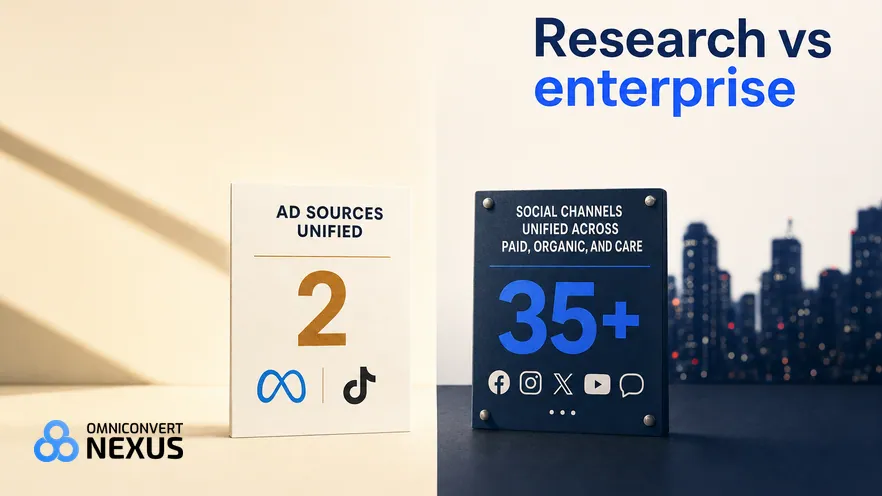
Atria combines a searchable competitor ad library with own-account creative analytics. Sprinklr is an enterprise customer experience platform unifying paid social, organic social, and customer care at global scale. Neither models CLV or measures True Profit. Nexus by Omniconvert adds the customer margin layer that ranks which segments deserve the spend. [Omniconvert, 2026]
- Atria is purpose-built for creative intelligence: a searchable competitor ad library from Meta and TikTok combined with own-account performance analytics in one workflow.
- Sprinklr wins on enterprise customer experience management: paid social, organic social, customer care, and market intelligence unified across dozens of channels and markets.
- Both tools share the same blind spot: neither builds the brief from CLV, NPS, or review intelligence, and neither closes the loop on net margin.
- Add Nexus as the layer above either tool when ROAS looks fine but margin is not improving.
- DTC growth teams spend an average of 3 hours per day assembling data before any decision is made. [Omniconvert, 2026]
A DTC growth team comparing Atria vs Sprinklr is choosing between two tools at very different scales of the paid stack. Atria combines a searchable competitor ad library with own-account creative analytics for research-first performance teams. Sprinklr is an enterprise customer experience platform, unifying paid social, organic social, customer care, and market intelligence across dozens of channels and markets. Neither models CLV, and neither measures True Profit; that decision layer is what Nexus by Omniconvert is built to hold.
What is Atria, and what is it actually good at?
Atria is an ad intelligence platform that combines a searchable ad library with creative performance analytics. It pulls competitor ads from the Meta Ad Library and TikTok Creative Center into one workspace, then layers own-account performance data on top. Its core job is turning competitor inspiration into a data-informed creative workflow. [Atria, 2026]
Atria is an ad intelligence and creative analytics platform. It lets teams save and analyse competitor ads from the Meta Ad Library and TikTok Creative Center while also tracking performance data from their own ad accounts, making it a research-first creative workflow tool.
The category is ad intelligence. The buyer is a performance marketer or creative strategist running Meta and TikTok ads who wants competitor research and own-account results in the same tool. AI-powered ad scoring gives a quality signal on a creative before it goes live, and saved inspiration links to real performance numbers over time.
Atria holds a 4.6 out of 5 rating on G2 across 198 reviews as of 2026. Reviews cite the speed of finding competitor examples and the AI scoring as the two features that see the most daily use. They flag the same shared limit: research and scoring both stop at the ad level, and neither reaches into customer or margin data.
Ad intelligence is the practice of collecting, tagging, and analysing competitor ads alongside your own creative performance data to inform the next creative brief. It sits upstream of production. Atria applies the pattern by combining a searchable competitor library with own-account analytics, so the research signal and the performance signal live in the same tool.
Where Atria is genuinely strong
- Competitor plus own-account in one tool: the fastest way to research category creative and track your own performance without stitching two separate tools together.
- AI ad scoring: a quality signal on each creative before launch, so the team has a filter beyond gut feel.
- Saved inspiration with performance data: ideas from the competitor library carry through to the analytics layer, closing the loop from research to result.
Where Atria hits its ceiling
- Inspiration-heavy workflow: the process is research-led, not data-driven; the tool surfaces what to make, not who to make it for.
- No creative generation: Atria points to what is working in the category, then hands off; another tool has to produce the ad.
- No customer data layer: all signals come from ad performance and competitor data, not from CLV cohorts, NPS, or first-party review data.
Atria is a strong specialist for one specific job. The ceiling shows up when teams realise that better competitor research does not, by itself, improve margin.
What is Sprinklr, and what is it actually good at?
Sprinklr is an enterprise customer experience management platform covering paid advertising, organic social, customer care, and market intelligence. It unifies dozens of social channels and multiple markets under a single system with governance and workflow controls. Its core job is running enterprise social and advertising operations at scale. [Sprinklr, 2026]
Sprinklr is a broad enterprise platform covering social media management, paid advertising, customer care, and market intelligence. Its advertising capability handles paid social campaign management alongside organic social, influencer programs, and customer service in one platform, so a single team can coordinate ad spend, community management, and support in the same workspace.
The category is enterprise customer experience management. The buyer is an in-house team at a large brand running paid social, organic social, and customer care across dozens of channels and multiple markets. The pitch is unified coverage: paid advertising, organic social, care, and market intelligence in one console, with the governance and workflow controls a global operation needs.
Sprinklr holds a 4.0 out of 5 rating on G2 across 1,200 reviews as of 2026. Reviews praise the breadth of channel coverage and the ability to unify paid and organic with customer care. They flag the enterprise focus: significant onboarding and implementation investment, and depth on paid advertising specifically that trails specialist tools.
Enterprise customer experience management is the practice of running paid advertising, organic social, customer care, and market intelligence from one platform, with the governance, workflow, and approval controls a global multi-brand operation requires. It sits at the operational coordination layer. Sprinklr applies the pattern by unifying dozens of social channels, paid social buying, and customer service under one console.
Where Sprinklr is genuinely strong
- Unified paid, organic, and care: one platform removes the operational gap between paid social, organic social, and customer service teams that most enterprises still run in three separate stacks.
- Enterprise scale and governance: handles global multi-brand operations across dozens of social channels and markets with approval workflows and role controls built in.
- Market intelligence layer: competitor and industry insights surface alongside campaign management, so social listening and buying live in the same system.
Where Sprinklr hits its ceiling
- Breadth over paid-ad depth: the platform covers a lot of ground; depth on paid advertising specifically is lower than dedicated specialist tools.
- Enterprise complexity and pricing: significant onboarding and implementation investment is required, which prices it out of most mid-market DTC brands.
- Optimises social performance, not CLV: no native CLV or customer segment intelligence for advertising; the system runs on social and channel KPIs, not customer lifetime value.
Sprinklr is the enterprise specialist for unifying paid social, organic social, and customer care at scale. The ceiling shows up when unified operational reporting never translates into a CLV-weighted view of which customers are actually worth the spend.
Atria vs Sprinklr vs Nexus: the capability comparison
Atria handles competitor ad research and own-account creative analytics. Sprinklr handles enterprise customer experience management across paid social, organic social, and customer care at global scale. Nexus by Omniconvert handles the layer above both: which customer segments to target, at what CAC, and whether the spend improved True Profit. [Omniconvert, 2026]
| Capability | Atria | Sprinklr | Nexus by Omniconvert |
|---|---|---|---|
| Primary function | Competitor ad research plus own-account creative analytics | Enterprise customer experience management across paid social, organic social, care, and market intelligence | Autonomous growth intelligence above any research or operational tool |
| Unified commerce data | Partial: tracks own-account ad performance, not the full commerce stack | Partial: unifies paid and organic social with customer care, not commerce data or CLV | Yes: single source of truth across CLV, NPS, reviews, and channel data |
| AI-prioritised experiment queue | No: no ranked queue of next best actions | No: workflow and approval routing across campaigns, not CLV-driven strategic prioritisation | Yes: ranked action queue before any brief is written |
| Creative generation | No: surfaces what to make and scores it, does not produce the ad | Partial: AI-assisted content generation for organic social, limited ad creative generation | Yes: 100+ variants per hour, briefed from customer data |
| True Profit tracking | No: measures ad performance, not margin or CAC-adjusted profit | No: social and channel performance reporting, not net margin after CAC, COGS, and returns | Yes: margin not ROAS, per campaign and per cohort |
| CLV and segment intelligence | No: signals come from ad performance and competitor data, not customer cohorts | No: no native CLV segmentation with RFM, cohorts, or churn prediction for advertising | Yes: RFM cohorts, CLV projection, and churn prediction |
| Autonomous action layer | No: research and scoring inform a human brief, humans decide | No: workflow orchestrates human teams across paid, organic, and care | Yes: removes the human middleware between data and action |
| AI creative briefing | Partial: suggests concepts from performance and competitor data; briefs are still manual | No: no brief generation from customer data; briefs are authored inside the workflow | Yes: brief is built from CLV, NPS, and review data |
| Pricing model | Per-seat SaaS, pricing on request at tryatria.com | Enterprise, pricing on request at sprinklr.com | Revenue-based, see Nexus pricing |
| Best for | Performance creative teams combining competitor research with own-account analytics | Large enterprises managing paid social, organic social, and customer care across dozens of channels and markets | eCommerce brands from $1M ARR focused on protecting margin, not just chasing ROAS |
| Integrations | Meta · TikTok · Google | Meta · TikTok · LinkedIn · Twitter · YouTube · 35+ social channels | Shopify · Klaviyo · Meta · Google · TikTok · GA4 · Triple Whale |
| User rating | 4.6 out of 5 (G2, 198 reviews, as of 2026) | 4.0 out of 5 (G2, 1200 reviews, as of 2026) | 5.0 out of 5 (Shopify App Store, 60 reviews, as of September 2026) |
Atria and Sprinklr columns reflect publicly available feature documentation and G2 review data as of September 2026.
What Atria and Sprinklr cannot do
The shared blind spot sits upstream of both the research signal and the enterprise operational engine. Neither tool builds the brief from CLV data, NPS signals, review intelligence, or first-party customer segmentation. Neither closes the loop on whether the resulting spend improved True Profit, the metric the business actually keeps.
Atria tells you what is winning in your category. Nexus tells you which of your customers to say it to, and which segment generates the highest CLV when they convert. The gap is not what to make. It is who you are making it for, and whether acquiring that customer at current CAC improves your margin or erodes it.
Sprinklr manages enterprise social and advertising operations at scale, unifying paid, organic, and customer care in one platform with the governance a global operation requires. Nexus provides the customer intelligence layer that connects those operations to the customers worth acquiring: CLV segmentation and True Profit measurement across every channel Sprinklr manages. Operational efficiency at scale is not the same as margin efficiency. Sprinklr optimises the former; Nexus ensures the latter.
Atria and Sprinklr solve different parts of the same problem: one supplies the research and scoring signal, the other supplies the operational coordination engine for paid, organic, and care. Both are built on the same shared assumption, that you already know which customer segments deserve the spend and which angle deserves testing. They optimise the execution of that assumption. Neither questions it.
What neither tool can tell you
- Which customers are worth acquiring more of. A 12-month CLV view, not last-click attribution or a channel-level ROAS number, is what tells you which segments deserve the next round of paid spend.
- Which segments are 60 days from churning. The early signal lives in NPS scores, review sentiment, and support ticket patterns, not in an ad library or an enterprise workflow console.
- Whether the last quarter improved True Profit or just moved ROAS. ROAS can rise while net margin compresses; only a margin-first measurement loop catches the gap.
- What your highest-value customers actually respond to. Their own reviews, NPS verbatims, and support transcripts hold the angle that converts; pulling and synthesising them is still manual in an Atria-plus-Sprinklr stack.
Platforms like Nexus are built for this layer. Nexus synthesises CLV data, NPS signals, review intelligence, and competitor creative data into a ranked action queue, before a brief is written or a creative produced. The optimisation target is True Profit, not ROAS.
True Profit is defined as the net margin remaining after subtracting CAC, COGS, return rates, and the cost of customer acquisition from each cohort, not gross revenue or ROAS. It is what the business actually keeps. Nexus tracks this as the primary optimisation metric across all experiments.
AliveCor used Omniconvert to run a structured A/B testing programme and achieved +21% conversion rate, +5% revenue per visitor, and 94% statistical relevance across their experiments. [Omniconvert, AliveCor case study]
This is not a replacement for Atria or Sprinklr. Atria still supplies the research and scoring signal, Sprinklr still coordinates paid, organic, and care at enterprise scale. Nexus is the strategic layer above them that decides which segment deserves the spend and whether the result moved the metric the business actually keeps.
Which tool is right for you?
Pick Atria if your bottleneck is combining competitor ad research with own-account creative analytics. Pick Sprinklr if it is unifying paid social, organic social, and customer care across dozens of channels and markets at enterprise scale. Add Nexus when ROAS looks fine but margin is not improving, and your team is spending hours assembling CLV, NPS, and review data before any decision can be made.
Choose Atria if
- Competitor research is a daily habit: you want to build a competitor ad library while tracking your own performance in the same tool.
- Creative starts with inspiration: your team's creative process is research-led and benefits from a shared workspace of saved competitor examples.
- Pre-launch scoring helps the filter: you want an AI signal on each creative before you commit to launch.
Choose Sprinklr if
- Unified paid, organic, and care: you need to bring paid advertising, organic social, and customer care onto one platform across global markets.
- Governance at scale: your enterprise manages dozens of social channels and requires approval workflow and role controls at scale.
- Market intelligence beside campaigns: social listening and competitor intelligence are as important as campaign management in your advertising operation.
Add Nexus if
- Data assembly eats your day: your team spends more than 2 hours a day pulling data from separate tools before a single decision is made.
- You spend without a margin view: you are running paid media at scale but have no reliable view of which customer segments drive the highest margin.
- You want experiments ranked before sprint planning: you want to know which tests are worth running before dev or creative sprints are assigned.
- ROAS hides a margin problem: ROAS looks fine but net margin is not improving quarter on quarter.
What each tool cannot do, honestly
Atria, Sprinklr, and Nexus each have real limits. Treating them as competitors for the same job hides those limits. The honest framing is that the three sit at different layers of the same stack: one research and scoring tool, one enterprise operational platform, and one intelligence layer. Each is replaceable; none is a complete answer alone.
Where Atria will not stretch
- Not an operational platform: Atria supplies the research and scoring signal; for unified paid, organic, and care at enterprise scale, Sprinklr is the stronger pick.
- Not a generator: Atria points to what is working, then hands off; another tool has to actually produce the ad.
- Not a customer data layer: all signals come from ad performance and competitor data, not from CLV, NPS, or first-party review data.
Where Sprinklr will not stretch
- Not lightweight: implementation and ongoing operation assume a dedicated enterprise team; mid-market DTC brands rarely absorb the overhead.
- Not deep on paid ads: breadth across paid, organic, and care means depth on paid advertising specifically trails dedicated specialist tools.
- Not a CLV or margin engine: no native CLV segmentation, no True Profit tracking, and no ranked queue built from customer value; the system optimises social and channel KPIs.
Where Nexus has real prerequisites
- Data unification is the first 4 to 6 weeks: an intelligence layer is only as good as the data feeding it. Fragmented inputs produce unreliable ranked queues.
- Strategy and brand judgment remain human: Nexus automates execution coordination, not category positioning or brand voice.
- Revenue stage threshold: the ROI compounds above $1M ARR, where data volume is sufficient and manual coordination cost is measurable. Earlier brands typically benefit more from a single execution tool first.
See where your store stands against real competitors in your category and country. Ecommerce Benchmark scores six areas free: Creative & Ads, Reviews & UGC, AI Visibility, Agentic Commerce, Competitor Synthesis, and CRO.
Benchmark Your Store FreeFrequently Asked Questions
The verdict
Atria is the specialist when combining competitor ad research with own-account creative analytics in one tool is the primary need. Sprinklr wins for large enterprises unifying paid social, organic social, and customer care across dozens of channels and markets. Neither builds the brief from CLV data or reports on net margin after CAC and returns. From Omniconvert analysis of 7,000+ eCommerce sites, that decision layer is where hours disappear every day. Add Nexus above either tool. [Omniconvert, 2026]
Atria and Sprinklr are both capable tools within their categories. If the primary need is combining competitor ad research with own-account creative analytics, Atria is the specialist. If the need is enterprise customer experience management unifying paid, organic, and care across dozens of channels and markets, Sprinklr wins.
The harder question is whether your team has a reliable way to know who to target, what to say, and whether it worked at the margin level. That is a different question, and it is what the third tool on this page, Nexus, is built to answer.
Stop assembling data.
Start supervising growth.
Nexus unifies your entire eCommerce data layer, detects revenue anomalies in under 15 minutes, and generates a prioritized action queue, so your team stops being human middleware and starts running the P&L.
5.0 out of 5 across 60 reviews, Shopify App Store , as of September 2026