Celtra vs Creatify vs Nexus by Omniconvert (2026): Score vs generate.
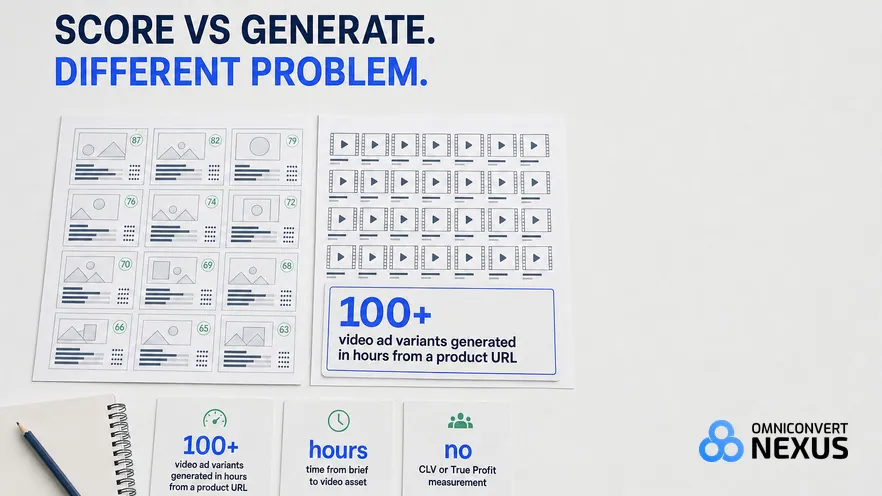
Celtra and Creatify are both AI creative production tools. Celtra is an enterprise creative management platform that scores assets before launch across formats and markets. Creatify generates 100+ UGC-style video ad variants from a product URL in hours. Neither models CLV or measures True Profit. Nexus by Omniconvert adds the margin layer above both. [Omniconvert, 2026]
- Celtra is an enterprise creative management platform that scores assets before launch and scales creative production across formats and markets.
- Creatify is an AI video ad platform that generates 100+ UGC-style video variants from a product URL in hours, with AI avatars and voiceovers.
- Celtra scores and scales enterprise creative production; Creatify generates DTC video volume; neither models customer lifetime value or performance from customer data.
- Neither platform tracks True Profit or decides which customer segment is worth acquiring at margin.
- Nexus adds CLV segmentation, True Profit measurement, and the ranked action queue above either platform.
A DTC growth team comparing Celtra vs Creatify is weighing two AI creative production tools that solve different scale problems: one is an enterprise creative management platform for large brands with AI asset scoring before launch, the other is an AI video ad platform generating 100+ UGC-style video variants from a product URL. Celtra serves brands managing high-volume creative across formats and markets with production automation. Creatify serves DTC brands needing rapid video ad volume without a film crew. Neither knows which customer segment is worth acquiring at margin or whether the spend improved True Profit, and that decision layer is what Nexus by Omniconvert is built to hold.
What is Celtra, and what is it actually good at?
Celtra is an enterprise creative management platform for producing, versioning, and distributing high volumes of creative across formats and markets. Its AI asset scoring predicts creative performance before launch, reducing wasted spend on untested creative and integrating with brands' existing media buying stack. [Celtra, 2026]
Celtra centralises creative production automation for large brand and agency teams. It scales creative across formats, markets, and languages from master designs, and adds AI asset scoring that predicts performance before launch. The platform separates creative production from media execution, integrating with media partners rather than replacing the media buying stack.
The category is enterprise creative management. The buyer is a large brand or agency team producing high volumes of creative across markets and needing pre-launch scoring to reduce wasted spend on untested assets. The pitch is production velocity plus predictive scoring: build at scale, test with AI before launch, then distribute through the existing media stack.
Celtra holds a 4.4 out of 5 rating on G2 across roughly 60 reviews as of 2026. Reviews praise the multi-format scaling and the AI asset scoring for pre-launch performance signals. They also flag the ceiling: enterprise pricing, no customer intelligence layer, and scoring based on creative attributes rather than customer data.
A creative management platform (CMP) is a system for producing, versioning, and distributing digital ad creative at scale across many formats and channels from a single source design. It is a production and distribution layer, not a customer intelligence or measurement layer.
Where Celtra is genuinely strong
- AI asset scoring: predicts creative performance before launch and reduces wasted spend on untested assets.
- Enterprise production automation: scales creative across formats, markets, and languages for large brand portfolios.
- Media stack integration: separates creative production from media execution and connects into the existing media buying stack.
Where Celtra hits its ceiling
- Enterprise pricing: not accessible for mid-market or SMB brands.
- Production and intelligence only: no media buying, no campaign management, and no bid automation built in.
- No CLV or segment intelligence: asset scoring reads creative attributes, not customer data or lifetime value.
Celtra is a strong specialist for one stack: enterprise brands producing creative across markets that want AI scoring before launch. The ceiling appears when the question shifts from which asset will score well to which customer segment deserves the production spend and whether it improved margin.
What is Creatify, and what is it actually good at?
Creatify is an AI video ad generation platform for DTC eCommerce brands. It generates 100+ UGC-style video ad variants featuring AI avatars and voiceovers from a product URL or brief, reducing the time from brief to video asset from weeks to hours. [Creatify, 2026]
Creatify automates video ad production from a product URL or script. The platform draws on a library of AI avatars and voiceovers to generate UGC-style video ads at volume, and a direct Shopify integration pulls product data automatically for ad generation. Performance marketers use it to compress the video production cycle from weeks to hours.
The category is AI video ad generation. The buyer is a DTC brand or performance agency that needs high volumes of video ad variants without a production crew. The pitch is generation speed and volume: dozens of video variants per campaign, ready to run on Meta, TikTok, and YouTube. Creatify Labs now also serves its own ad-optimised video generation models, Boreal and Boreal-H3, through Creatify's API, Model Playground and AdFlow. Its Performance Agent advertises one-click integration with Shopify and GA4 alongside six ad platforms, ingesting Shopify and Google Analytics revenue and performance data, then rotating creative and reallocating budget toward whatever is driving the best return.
Creatify holds a 4.5 out of 5 rating on G2 across roughly 445 reviews as of 2026. Reviews praise the volume, the AI avatar realism, and the Shopify integration. They also flag the ceiling: no CLV context, and no way to tell which generated video is likely to win before you spend — though its Performance Agent now ingests Shopify and Google Analytics revenue and performance data to rotate creative and reallocate ad budget.
AI video ad generation is the use of large models to produce short-form video ad variants from a product URL or brief, typically featuring AI avatars, generated voiceovers, and stock or product footage. It is a production layer, not a briefing or measurement layer.
Where Creatify is genuinely strong
- Video volume: generates 100+ video ad variants in hours from a single product URL, no film crew required.
- Avatar and voiceover library: a range of realistic AI avatars and voice options for UGC-style content.
- Shopify integration: pulls product data directly for ad generation without manual asset preparation.
Where Creatify hits its ceiling
- Generation only: Creatify produces video assets but does not decide what angle to generate based on customer data.
- No analytics layer: the Performance Agent ingests Shopify and Google Analytics revenue and performance data and reallocates budget toward whatever is driving the best return, but Creatify still does not tell you up front which generated video is likely to perform best.
- No CLV intelligence: all creative decisions still rest with the marketing team, without lifetime value or segment context.
Creatify is a strong specialist for one stack: DTC brands producing large volumes of UGC-style video ads at speed for Meta, TikTok, and YouTube. The ceiling appears when the question shifts from how fast you can produce a variant to which angle deserves the production and which customer segment it should target.
Celtra vs Creatify vs Nexus: the capability comparison
Celtra scores and scales enterprise creative production with AI asset scoring before launch. Creatify generates 100+ AI video ad variants from a product URL in hours. Both optimise creative production within their scope. Nexus by Omniconvert is the intelligence layer above either: CLV, the brief, and the margin loop.
| Capability | Celtra | Creatify | Nexus by Omniconvert |
|---|---|---|---|
| Primary function | Enterprise creative production and AI asset scoring before launch | AI video ad generation from a product URL at volume | Autonomous growth intelligence above any creative tool |
| Unified commerce data | No: production and scoring tool, not a commerce data layer | No: its Performance Agent ingests Shopify and Google Analytics revenue and performance data for ad buying, but there is no unified commerce data | Yes: single source of truth across the stack |
| AI-prioritised experiment queue | Partial: AI asset scoring surfaces predicted winners before launch, team decides what to scale | No: generation tool with a Performance Agent that buys media off Shopify and Google Analytics data, no ranked action queue | Yes: next best action by projected margin impact |
| Creative generation | Partial: scales and adapts existing creative across formats and markets, not generative AI from scratch | Yes: 100+ video variants in hours from a product URL, now rendered with Creatify's own ad-optimised video models, Boreal and Boreal-H3. | Yes: 100+ variants per hour, ranked by CLV-weighted angle |
| True Profit tracking | No: no margin layer | No: no margin layer | Yes: margin not ROAS, per campaign and per cohort |
| CLV and segment intelligence | No: asset scoring on creative attributes, not customer data | No: no customer data informs the generated variant | Yes: RFM, cohorts, churn prediction, NPS signal |
| Autonomous action layer | No: humans run the production and scoring workflow | Partial: humans still choose what goes into a run, but its Performance Agent rotates creative and reallocates budget toward whatever is driving the best return | Yes: removes the human middleware between data and action |
| AI creative briefing | No: production and scoring, no briefing layer from customer data | No: generation only, no briefing from CLV or NPS | Yes: brief built from CLV, NPS, and review data |
| Pricing model | Enterprise, pricing on request at celtra.com | Usage-based SaaS, published tiers at creatify.ai | Revenue-based, see Nexus pricing |
| Best for | Large brands and enterprise agencies producing high-volume creative across markets and brand portfolios | DTC brands and performance agencies producing large volumes of video ad content quickly | eCommerce 1M dollar plus ARR teams focused on margin |
| Integrations | Meta, Google, Trade Desk, various DSPs, product feeds | Shopify, Meta, TikTok, YouTube, GA4 (Shopify and GA4 feed the Performance Agent's revenue and performance data) | Shopify, Klaviyo, Meta, Google, TikTok, GA4, Triple Whale |
| User rating | 4.4 out of 5 (G2, 60 reviews, as of 2026) | 4.5 out of 5 (G2, 445 reviews, as of 2026) | 5.0 out of 5 (Shopify App Store, 60 reviews, as of September 2026) |
Competitor columns reflect publicly available feature documentation as of September 2026. G2 ratings as cited in s1 and s2.
What Celtra and Creatify cannot do
Celtra scores and scales enterprise creative production across formats. Creatify generates volumes of AI video ad variants from a product URL. Both optimise creative production. Neither carries the customer lifetime value layer. Whether the spend improved margin still sits with a human. That layer is where Nexus operates.
Celtra scores and scales enterprise creative production. Nexus adds the customer intelligence layer that Celtra's asset scoring cannot replace: connecting predicted creative performance to the customer segments that matter most by CLV. Scoring which assets perform across channels is not the same as knowing which customer segments those assets should be targeting, and what margin they generate when they convert.
Creatify generates the video. Nexus decides which product angle to script it around, based on which customer segment has the highest CLV and the lowest churn risk. The brief is what Creatify is missing. Without it, teams produce volume without direction.
What neither tool can tell you
- Which of your current customers are worth acquiring more of. A 12-month CLV view, not last-click attribution, is what tells you which segments deserve the next round of paid spend.
- Which segments are 60 days from churning. The early signal lives in NPS scores, review sentiment, and support ticket patterns, not in a creative scoring model or a video generation pipeline.
- Whether your last campaign improved True Profit or just moved ROAS. ROAS can rise while net margin compresses; only a margin-first measurement loop catches the gap.
- Which angle your highest-value customers respond to. A creative scoring model reads creative attributes; a video generator reads a product URL; neither reads what your top-CLV cohort actually reacts to.
Platforms like Nexus are built for this layer. Nexus synthesises CLV data, NPS signals, review intelligence, and competitor creative data into a ranked action queue, before a brief is written or a creative produced. The optimisation target is True Profit, not ROAS.
True Profit is defined as the net margin remaining after subtracting CAC, COGS, return rates, and the cost of customer acquisition from each cohort, not gross revenue or ROAS. It is what the business actually keeps. Nexus tracks this as the primary optimisation metric across all experiments.
AliveCor used Omniconvert to run a structured A/B testing programme and achieved +21% conversion rate, +5% revenue per visitor, and 94% statistical relevance across their experiments. [Omniconvert, AliveCor case study]
Which tool is right for you?
Choose Celtra for enterprise creative production at scale with AI asset scoring before launch. Choose Creatify for high-volume AI video ad generation from a product URL. If the creative runs well but margin is flat, the missing layer is CLV, and that is Nexus.
- Choose Celtra if you manage creative production at enterprise scale across multiple markets and need AI scoring to predict asset performance before launch.
- Choose Creatify if you need to produce 50+ video ad variants per week without a production budget and your bottleneck is generation speed, not strategy.
- Add Nexus if the creative runs efficiently but the open question is which segment is worth acquiring and whether it improved True Profit.
Celtra and Creatify sit at different points in the creative stack: one scores and scales enterprise creative production across formats and markets, the other generates video ad variants at volume from a product URL. Both optimise creative production. Nexus sits above both, deciding which customers the spend should chase and whether it improved margin. That is a different layer of the stack.
What each tool cannot do, honestly
Celtra scores assets and scales production across formats but is enterprise-priced with no CLV data. Creatify generates video volume from a product URL without briefing intelligence or analytics on which variant will win. Nexus does neither production job; it supplies the CLV and margin layer both are missing.
- Celtra: enterprise-priced platform with no CLV or segment intelligence layer, and no media buying or bid automation built in.
- Creatify: volume video generation and in-platform media buying, with no analytics on which variant is likely to win before launch and no customer intelligence informing the angle.
- Nexus: not an enterprise creative management platform or a video generation engine. It defines and measures the margin goal; it relies on tools like either one to run the creative production.
The honest read: run a creative management platform for enterprise scoring and multi-market production, run an AI video generator for volume UGC output, and run Nexus for the CLV signal and margin. The pairing closes the loop none of them can close alone.
See where your store stands against real competitors in your category and country. Ecommerce Benchmark scores six areas free: Creative & Ads, Reviews & UGC, AI Visibility, Agentic Commerce, Competitor Synthesis, and CRO.
Benchmark Your Store FreeFrequently Asked Questions
Should you add Nexus to your Celtra or Creatify stack?
Add Nexus if your creative runs efficiently but margin is flat. Celtra scores and scales enterprise creative production with AI asset scoring before launch across formats and markets. Creatify generates 100+ AI video ad variants per hour from a product URL for DTC brands. Neither models which customers are worth acquiring or whether the campaign improved True Profit. Nexus ranks the next action by projected margin and closes the loop. [Omniconvert, 2026]
Celtra and Creatify are strong at execution within their jobs: enterprise creative production and pre-launch AI scoring on one side, high-volume UGC-style AI video generation on the other. If scoring and scaling enterprise creative or generating video ad volume is your live need, keep the tool that fits.
The harder question is whether your team has a reliable way to know who to target, what to say, and whether it worked at the margin level. That is a different question, and it is what Nexus is built to answer.
Stop assembling data.
Start supervising growth.
Nexus unifies your entire eCommerce data layer, detects revenue anomalies in under 15 minutes, and generates a prioritized action queue, so your team stops being human middleware and starts running the P&L.
5.0 out of 5 across 60 reviews, Shopify App Store , as of September 2026