Motion vs Pencil vs Nexus by Omniconvert (2026): Analytics vs prediction
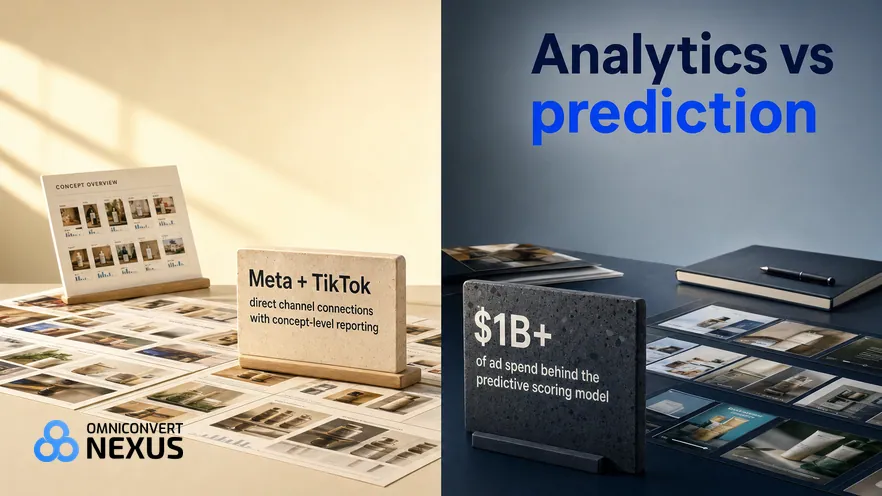
Motion and Pencil both live in the paid creative loop. Motion is post-launch analytics for Meta and TikTok, broken down by concept and hook rate. Pencil is pre-launch prediction, scoring static and video variants from patterns across a billion dollars of ad spend. Neither reads CLV or measures True Profit. Nexus by Omniconvert adds that layer. [Omniconvert, 2026]
- Motion is the fastest way to see which ad concepts are winning on Meta and TikTok, with concept-level breakdowns non-technical marketers can read.
- Pencil predicts creative performance before launch using patterns from over a billion dollars of ad spend and generates scored static and video variants.
- Motion is analytics only with no generation or action layer; Pencil predicts from other brands' patterns rather than your customers' CLV.
- Neither platform tracks True Profit or decides which customer segment is worth acquiring at margin.
- Nexus adds CLV segmentation, True Profit measurement, and a ranked action queue above either platform.
A DTC team comparing Motion vs Pencil is picking between two different times in the paid creative loop. Motion is the strongest tool for reading what already ran on Meta and TikTok, broken down by concept, hook rate, and hold rate. Pencil moves the read earlier: it scores static and video ideas before launch using patterns from over a billion dollars of ad spend. Neither reads which segment carries the highest lifetime value, or whether the resulting spend improved True Profit. That customer intelligence layer is what Nexus by Omniconvert is built to hold.
What is Motion, and what is it actually good at?
Motion is a creative analytics platform built for performance marketing teams spending heavily on Meta and TikTok. It connects to the ad accounts and breaks results down by concept, hook rate, and hold rate rather than by individual ad. [Motion, 2026]
Motion pulls performance data directly from Meta and TikTok, then groups ads by the concept they belong to. Teams see which hooks are stopping the scroll, which holds are keeping attention, and which concepts are converting at the account level. The output is a dashboard a creative strategist can read without analyst support.
The category is creative analytics. The buyer is a DTC brand spending 50 thousand to 500 thousand dollars a month on paid social, running enough creative volume that ad-level reporting has become noise. The pitch is a concept-level read, not another dashboard.
Motion holds a 4.7 out of 5 rating on G2 across 312 reviews as of 2026. Reviews praise the speed to insight and the concept-level view. They also flag the ceiling: Motion tells you what performed; it does not decide what to make next.
Concept-level analytics groups individual ads by the creative concept they express (a hook, an angle, a format) and reports performance at that level. It answers "which idea worked" rather than "which asset ID worked", which is what a strategist needs to plan the next round of creative. Motion is built around this unit of analysis.
Where Motion is genuinely strong
- Fastest concept-level read in the market: which ad hooks and concepts are working, without hand-tagging each asset.
- Direct Meta and TikTok connections: no data lag and no export step to a spreadsheet before a strategist can act.
- Dashboards non-technical marketers can use: creative strategists read it without an analyst in the room.
Where Motion hits its ceiling
- Analytics only, no action layer: Motion shows what happened; the next-action decision still sits with a human.
- No creative generation: teams still brief and produce the next round of variants outside the tool.
- No CLV or customer-data layer: optimises for ad performance metrics, not for lifetime value or margin.
Motion is a strong specialist for one specific job. The ceiling shows up when teams realise that a clearer read on what happened does not, on its own, tell them who to target next or whether True Profit moved.
What is Pencil, and what is it actually good at?
Pencil is a predictive AI ad platform for Shopify DTC brands running Meta campaigns. It generates static and video variants and attaches a predicted ROAS score to each one, using patterns from over a billion dollars of ad spend. [Pencil, 2026]
Pencil generates static and video ad variations from a product page and brand assets, then scores each one for likely ROAS before any budget is committed. The training data behind the score comes from patterns across a billion dollars of ad spend on other brands. The workflow is built for teams that would rather pre-filter ideas than pay to test them. Alongside this it has made Scribble generally available, an AI orchestration layer for marketers that reads a marketing brief and routes work across Pencil's models, agents and tools.
The category is predictive AI ad generation. The buyer is a Shopify DTC brand running Meta as its main paid channel, spending enough on creative testing that pre-launch prediction pays for itself. The pitch is fewer losing tests and a faster path to a winning concept.
Pencil holds a 4.5 out of 5 rating on G2 across 60 reviews as of 2026. Reviews value the speed from product page to scored variants. They also flag that the score is trained on other brands' ads, not on your specific customers.
Pre-launch prediction is a probability that a generated creative will outperform the median, produced by a model trained on historical ad performance across many brands. It filters variants before budget is committed, but it reads from a global pattern library rather than from your own customer segments. It changes which tests you run, not which customers you chase.
Where Pencil is genuinely strong
- Pre-launch performance prediction: scored variants before spend, based on patterns from over a billion dollars of ad training data.
- Static and video generation in one workflow: both formats produced with predicted ROAS attached to each variant.
- Direct Shopify integration: product-to-ad workflow that a small DTC team can run without setup complexity.
Where Pencil hits its ceiling
- Predicts from other brands' patterns: the training set is global, not tuned to your specific customer segments or CLV data.
- Shopify and Meta only: less suited to brands running significant TikTok or Google spend outside that ecosystem.
- No CLV or customer intelligence: the tool predicts ad performance, not customer quality or margin impact per cohort.
Pencil is a strong specialist for a specific stack: Shopify plus Meta plus a testing budget that needs pre-filtering. The ceiling shows up when the winning creative still gets served to the wrong segment.
Motion vs Pencil vs Nexus: the capability comparison
Motion tells you which ad concepts already worked on Meta and TikTok. Pencil tells you which ideas are likely to work before you commit test budget. Both optimise the paid creative loop within their scope. Nexus by Omniconvert is the intelligence layer above either: CLV, the brief, and the margin loop.
| Capability | Motion | Pencil | Nexus by Omniconvert |
|---|---|---|---|
| Primary function | Post-launch creative analytics across Meta and TikTok, at concept level | Pre-launch prediction and generation of static and video variants for Shopify on Meta, plus Scribble, an AI orchestration layer that reads a marketing brief and routes work across Pencil's models, agents and tools | Autonomous growth intelligence above any ad platform |
| Unified commerce data | Partial: creative performance across ad channels, not the full commerce data stack | No: product feed and ad account only | Yes: single source of truth across the stack |
| AI-prioritised experiment queue | No: reports performance, not a ranked next-action queue | Partial: pre-launch scoring prioritises which creative to test, based on ad pattern data not customer segments | Yes: next best action by projected margin impact |
| Creative generation | No: analytics only, no generation | Yes: static and video variants with predicted ROAS scores attached | Yes: 100+ variants per hour, ranked by CLV-weighted angle |
| True Profit tracking | Partial: ROAS and hook rate tracking, no margin or CLV layer | No: no margin layer | Yes: margin not ROAS, per campaign and per cohort |
| CLV and segment intelligence | No: no CLV or segment layer | No: no CLV or segment layer | Yes: RFM, cohorts, churn prediction, NPS signal |
| Autonomous action layer | No: human decides the next brief | No: human decides which scored variant to run | Yes: removes the human middleware between data and action |
| AI creative briefing | Partial: surfaces top-performing concepts, does not generate briefs from customer data | Partial: generates from product and brand data, brief quality depends on team input not customer intelligence | Yes: brief built from CLV, NPS, and review data |
| Pricing model | Seat-based SaaS | SaaS, pricing on request at trypencil.com | Revenue-based, see Nexus pricing |
| Best for | DTC brands spending 50 thousand to 500 thousand dollars a month on paid social | Shopify DTC brands on Meta wanting to pre-filter creative before spend | eCommerce 1M dollar plus ARR teams focused on margin |
| Integrations | Meta, TikTok, YouTube | Shopify, Meta | Shopify, Klaviyo, Meta, Google, TikTok, GA4, Triple Whale |
| User rating | 4.7 out of 5 (G2, 312 reviews, as of 2026) | 4.5 out of 5 (G2, 60 reviews, as of 2026) | 5.0 out of 5 (Shopify App Store, 60 reviews, as of September 2026) |
Competitor columns reflect publicly available product documentation as of September 2026. G2 ratings as cited in s1 and s2.
What Motion and Pencil cannot do
One reads what performed after launch, one scores what might perform before launch, and both optimise the paid creative loop within their scope. Neither carries the customer lifetime value layer. The decision about which segment is worth acquiring and whether the spend improved margin still sits with a human. That layer is where Nexus operates.
Motion shows you what performed. Nexus decides what to do next, then executes it. The gap is not analytics depth; Motion is excellent at that. The gap is the absence of a customer intelligence layer: Motion optimises for ad performance metrics, not for which segment is worth acquiring at the highest lifetime margin.
Pencil predicts which creative will win based on patterns from other brands' ad spend. Nexus predicts from your customers: CLV cohorts and NPS signals showing which segment is worth targeting and which message converts your highest-margin buyers.
What neither tool can tell you
- Which of your current customers are worth acquiring more of. A 12-month CLV view, not last-click attribution, is what tells you which segments deserve the next round of paid spend.
- Which segments are 60 days from churning. The early signal lives in NPS scores, review sentiment, and support ticket patterns, not in a creative analytics dashboard or a pre-launch scoring model.
- Whether your last campaign improved True Profit or just moved ROAS. ROAS can rise while net margin compresses; only a margin-first measurement loop catches the gap.
- Which angle your highest-value customers respond to. A hook rate dashboard and a global predictive score both miss the specific message your top-CLV cohort actually reacts to.
Platforms like Nexus are built for this layer. Nexus synthesises CLV data, NPS signals, review intelligence, and competitor creative data into a ranked action queue, before a brief is written or a creative produced. The optimisation target is True Profit, not ROAS.
True Profit is defined as the net margin remaining after subtracting CAC, COGS, return rates, and the cost of customer acquisition from each cohort, not gross revenue or ROAS. It is what the business actually keeps. Nexus tracks this as the primary optimisation metric across all experiments.
AliveCor used Omniconvert to run a structured A/B testing programme and achieved +21% conversion rate, +5% revenue per visitor, and 94% statistical relevance across their experiments. [Omniconvert, AliveCor case study]
Which tool is right for you?
If you need the sharpest post-launch view of which creative concepts are working on Meta and TikTok, choose Motion. If you want pre-launch ROAS scoring plus generated static and video variants for a Shopify Meta stack, choose Pencil. If the campaigns run well but margin is flat, the missing layer is CLV, and that is Nexus.
- Choose Motion if you want the fastest concept-level read on which ad hooks and holds are working across Meta and TikTok, in a dashboard your creative strategists can run without analyst support.
- Choose Pencil if you run Meta for a Shopify store and want to pre-filter creative before committing test budget, with static and video variants scored on predicted ROAS.
- Add Nexus if the spend is efficient but the open question is which segment is worth acquiring and whether the campaign improved True Profit.
Motion and Pencil sit at different times in the same paid creative loop, but both optimise execution. Nexus sits above both, deciding which customers the spend should chase and whether it improved margin. That is a different layer of the stack.
What each tool cannot do, honestly
A fair comparison names the limits. Motion is analytics only with no generation or next-action layer. Pencil predicts from other brands' patterns rather than your customers, and its ecosystem is Shopify plus Meta. Nexus leaves the bid and campaign lifecycle to the ad networks; it supplies the CLV and margin layer both platforms are missing.
- Motion: analytics only, no generation, no action layer; performance signal is ROAS and hook rate rather than customer lifetime value or margin.
- Pencil: Shopify and Meta ecosystem; predictive score trained on other brands' ad spend rather than on your customer segments; no CLV or margin layer.
- Nexus by Omniconvert: not a creative analytics dashboard and not a media buyer. It defines and measures the margin goal; it relies on tools like either one to run the spend.
The honest read: run Motion for the post-launch concept read, run Pencil for the pre-launch pre-filter, and run Nexus for the CLV signal and margin. The three close a loop none of them can close alone.
See where your store stands against real competitors in your category and country. Ecommerce Benchmark scores six areas free: Creative & Ads, Reviews & UGC, AI Visibility, Agentic Commerce, Competitor Synthesis, and CRO.
Benchmark Your Store FreeFrequently Asked Questions
Should you add Nexus to your Motion or Pencil stack?
Add Nexus if the ad analytics look healthy but margin is flat. Motion is the clearest post-launch read of which ad concepts are winning on Meta and TikTok. Pencil predicts winners before launch and generates scored static and video variants. Neither models which customers are worth acquiring or whether the spend improved True Profit. Nexus ranks the next action by projected margin, then closes the loop. Teams losing hours to CLV and NPS pulls fit best. [Omniconvert, 2026]
Motion and Pencil sit at different times in the same paid creative loop, but both optimise execution: analytics on what already ran, prediction on what to run next. If reading or shipping the creative is your live need, keep the tool that fits.
The harder question is whether your team has a reliable way to know who to target, what to say, and whether it worked at the margin level. That is a different question, and it is what Nexus is built to answer.
Stop assembling data.
Start supervising growth.
Nexus unifies your entire eCommerce data layer, detects revenue anomalies in under 15 minutes, and generates a prioritized action queue, so your team stops being human middleware and starts running the P&L.
5.0 out of 5 across 60 reviews, Shopify App Store , as of September 2026