Pacvue vs Pencil vs Nexus by Omniconvert (2026): Two tools, same blind spot.
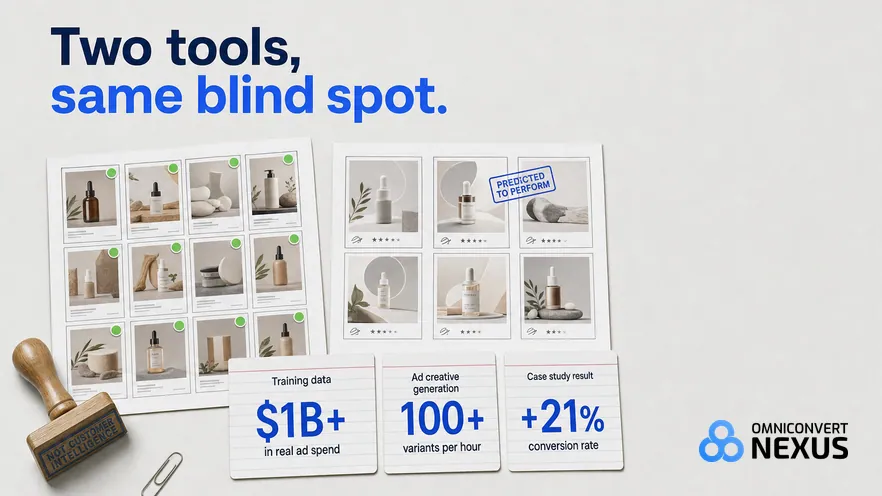
Pacvue and Pencil both solve retail advertising execution, from different angles: Pacvue automates bids on Amazon and Walmart, Pencil predicts Meta ad creative before launch. Neither knows which customers to keep or which segments carry margin. Nexus by Omniconvert adds the CLV layer above both, targeting True Profit not ROAS [Omniconvert, 2026].
- Pacvue is the specialist for retail media automation on Amazon, Walmart, and Instacart with digital shelf intelligence.
- Pencil is the specialist for pre-launch Meta creative prediction, built on $1B+ of cross-brand ad spend data.
- Both tools optimise execution: neither knows which customer segments are worth acquiring or which drive margin.
- Nexus sits above both, ranking actions from CLV, NPS, and review data before a brief is written.
- Choose by primary problem: retail media (Pacvue), Meta creative (Pencil), margin-driven prioritisation (Nexus).
Pacvue vs Pencil is not really a like-for-like comparison. Pacvue runs enterprise retail media on Amazon and Walmart, with AI bid automation and digital shelf intelligence. Pencil predicts Meta creative performance before launch, scored against $1B+ in real ad spend. Neither tells you which customers are worth acquiring, or whether the last dollar of spend improved True Profit.
What is Pacvue, and what is it actually good at?
Pacvue is enterprise retail media automation. It runs AI bid management, rules-based campaign automation, and digital shelf analytics across Amazon, Walmart, Instacart, and other retail networks in a single view.
Pacvue automates retail media advertising across Amazon, Walmart, Instacart, and other retail networks. It combines AI bid management, rules-based campaign automation, and digital shelf analytics that connect ad performance to product content scores, inventory, and Buy Box status.
The company positions itself for enterprise ecommerce brands running seven or eight figures of retail media spend. Its Pacvue Agent lets teams query Amazon Marketing Cloud in plain language and pulls back visual campaign reports without a dedicated analyst.
Where Pacvue is genuinely strong
- AI bid management across retail networks: Amazon, Walmart, Instacart, and other retail networks under one set of custom rule automations.
- Digital Shelf Optimization: ad performance connected to product content, inventory, and Buy Box status in one view.
- Pacvue Agent: plain-language querying of Amazon Marketing Cloud with visual report generation, no analyst required.
Where Pacvue hits its ceiling
- Retail media specialist: limited capability for paid social or non-retail digital advertising channels.
- Enterprise pricing: more expensive than alternatives like Skai for comparable retail media functionality.
- No customer intelligence: retail media automation without CLV informing which ASINs deserve prioritisation.
What is Pencil, and what is it actually good at?
Pencil is predictive AI ad creative generation. It generates static and video ad variants for Shopify DTC brands running Meta, then scores each variation on predicted ROAS before budget is committed to the test.
Pencil predicts which ad creative will perform before launch, using patterns from over $1 billion in real ad spend. It generates static and video ad variations and scores them on predicted ROAS before budget is committed. It is designed for Shopify DTC brands integrating directly with Meta.
The core promise is pre-launch filtering: cut wasted creative test spend by only launching what the model rates as likely to work. The training data is the field itself, what performed for other brands, not what performs for your specific customer segments. Pencil has also made Scribble generally available, an orchestration layer that reads a marketing brief and routes the work across its models, agents and tools.
Where Pencil is genuinely strong
- Pre-launch performance prediction: patterns from $1B+ of real ad spend, scoring creative before it goes live.
- Static and video generation with scores: each variant carries a predicted ROAS number attached, not just an aesthetic guess.
- Shopify to Meta workflow: direct product-to-ad path for DTC brands without complex setup.
Where Pencil hits its ceiling
- Cross-brand patterns, not your customers: prediction reflects what worked for other brands, not your CLV cohorts.
- Meta and Shopify only: not suited to brands running significant TikTok or Google campaigns.
- No margin view: predicts ad performance, not customer quality or margin impact.
Pacvue vs Pencil vs Nexus: the capability comparison
Pacvue handles retail media execution across Amazon and Walmart. Pencil handles Meta ad creative execution for Shopify brands. Nexus by Omniconvert handles the layer above both: which customers to target, which angle to use, and whether it moved True Profit.
| Capability | Pacvue | Pencil | Nexus by Omniconvert |
|---|---|---|---|
| Unified commerce data | Partial unifies retail media channels with shelf data, not with customer CLV | No | Yes single source of truth across CLV, NPS, reviews, competitors |
| Experiment prioritisation | Partial AI bid rules for retail media, not CLV-driven ASIN prioritisation | Partial pre-launch scoring on cross-brand ad patterns, not customer segments | Yes ranked action queue built from CLV cohorts and NPS signals |
| Creative generation | No | Yes static and video variants with predicted ROAS attached | Yes 100+ variants per hour, ranked by CLV-weighted angle |
| True Profit tracking | Partial connects ad spend to product-level performance, not customer margin | No | Yes net margin after CAC, COGS, and returns per cohort |
| CLV and segment intelligence | No | No | Yes RFM, cohorts, churn prediction |
| Autonomous action layer | Partial automated bid and campaign rules; Pacvue Agent adds plain-language automation | No | Yes removes human middleware end to end |
| AI creative briefing | No | Partial generates from product data; brief depth depends on team input | Yes briefs built from CLV, NPS, reviews |
| Pricing model | Enterprise, pricing on request at pacvue.com | SaaS, pricing on request at trypencil.com | Revenue-based, see Nexus pricing |
| Best for | Enterprise brands running significant retail media spend on Amazon, Walmart, and other retail networks | Shopify DTC brands running Meta campaigns that want to reduce wasted creative spend before launch | eCommerce $1M+ ARR, margin-focused |
| User rating | 4.5 out of 5 (G2, 150 reviews, as of 2026) | 4.5 out of 5 (G2, 60 reviews, as of 2026) | 5.0 out of 5 (Shopify App Store, 60 reviews, as of September 2026) |
Capabilities as of 2026. Vendor product surfaces can move quickly; verify current feature parity with each provider before final decision.
What Pacvue and Pencil cannot do
The shared blind spot: neither tool starts from your customers. Pacvue optimises the channel. Pencil optimises the creative asset. Neither answers which customer segments should be receiving that spend, or whether the last dollar moved True Profit or just ROAS.
Pacvue automates retail media bidding and tells you how your ASINs are performing on Amazon and Walmart. Nexus by Omniconvert adds the CLV layer above the retail media layer, connecting product-level ad performance to which customer segments buying those ASINs have the highest lifetime value.
Pencil predicts which creative will win based on patterns from other brands' ad spend. Nexus by Omniconvert predicts from your customers, CLV cohorts and NPS signals showing which segment is worth targeting and which message converts your highest-margin buyers.
Both Pacvue and Pencil are built around the same assumption: you already know which customers to target and which message to use. They optimise the execution of that assumption. Neither questions it.
What they cannot tell you
- Which customers are worth acquiring more of. Based on 12-month CLV, not last-click attribution.
- Which segments are 60 days from churning. And which need a different message today.
- Whether the last campaign improved True Profit. Or whether it just moved ROAS while margin drifted.
- What your highest-value customers actually respond to. Read from their own reviews, NPS scores, and support tickets.
Platforms like Nexus are built for this layer. Nexus synthesises CLV data, NPS signals, review intelligence, and competitor creative data into a ranked action queue, before a brief is written or a creative produced. The optimisation target is True Profit, not ROAS.
True Profit is defined as the net margin remaining after subtracting CAC, COGS, return rates, and the cost of customer acquisition from each cohort, not gross revenue or ROAS. It is what the business actually keeps. Nexus tracks this as the primary optimisation metric across all experiments.
AliveCor used Omniconvert to run a structured A/B testing programme and achieved +21% conversion rate, +5% revenue per visitor, and 94% statistical relevance across their experiments. [Omniconvert, AliveCor case study]
Which tool is right for you?
Choose by primary channel and primary problem. Pacvue if retail media on Amazon and Walmart drives the P&L. Pencil if Meta creative test cost is the bleed. Nexus if margin, not ROAS, is what the business is optimising for.
Choose Pacvue if
- Amazon or Walmart is the channel: significant retail media spend and you need AI bid automation and campaign management.
- Digital shelf matters: you want ad performance tied to inventory, Buy Box status, and product content scores in one view.
- You use AMC: plain-language querying of Amazon Marketing Cloud through Pacvue Agent is on your list.
Choose Pencil if
- Meta is the channel: Shopify store, Meta campaigns, wanting to predict creative performance before spending test budget.
- Test spend is bleeding: AI pre-filters likely winners so you commit budget to concepts scored on real ad data.
- You need both formats: static and video ad generation with predicted ROAS attached to each variant.
Add Nexus if
- Data assembly is the bottleneck: your team spends more than two hours a day pulling data from separate tools before making any decision.
- Spend is running blind on customer value: you are optimising paid spend but do not have a reliable view of which segments drive the highest margin.
- Experiment picking is guesswork: you want to know which experiments are worth running before dev sprints are assigned.
- ROAS looks fine, margin does not: the top-line ratio holds while net margin fails to improve quarter on quarter.
What each tool cannot do, honestly
No tool on this page is a full stack. Each has genuine limits. Pacvue is a retail media specialist. Pencil is a Meta creative specialist. Nexus is the intelligence layer that briefs both, and it does not buy the media or run bids.
What Pacvue does not do
- Paid social or non-retail channels: the automation and shelf analytics do not extend to Meta, TikTok, or Google search the way a specialist tool does.
- Customer-level intelligence: no CLV, RFM, or churn scoring feeding ASIN prioritisation.
- Creative generation: Pacvue does not generate the ad creative itself; it automates the media around it.
What Pencil does not do
- Anything beyond Meta and Shopify: TikTok, Google, and retail media are outside the core workflow.
- Prediction from your customers: the model is trained on cross-brand ad data, not your CLV cohorts.
- Margin or profitability: predicted ROAS is a top-line score; True Profit is not the metric.
What Nexus does not do
- Buy media or manage bids: the DSPs and retail media consoles are still where budgets are set.
- Retargeting or product feeds: no retargeting layer, no dynamic catalog ads.
- Concept-level creative analytics: no element-level tagging or global creative training set for pre-launch scoring at that granularity.
- Live footage or avatars: Nexus does not shoot product photography, film scenes, or render AI avatars.
See where your store stands against real competitors in your category and country. Ecommerce Benchmark scores six areas free: Creative & Ads, Reviews & UGC, AI Visibility, Agentic Commerce, Competitor Synthesis, and CRO.
Benchmark Your Store FreeFrequently Asked Questions
The verdict
Pacvue and Pencil are both capable within their categories. If Amazon and Walmart retail media is the primary channel, Pacvue is the specialist. If Meta creative test spend on a Shopify store is the bleed, Pencil is the specialist. The harder question is whether the team has a reliable way to know who to target, what to say, and whether it moved margin, not ROAS [Omniconvert, 2026].
Pacvue is where the retail media dollars deserve automation and the digital shelf deserves eyes. Pencil is where Meta creative deserves pre-launch scoring before test budget goes live. Both live inside the execution layer, and that layer is legitimate work.
The harder question is what sits above them. Which customers are worth acquiring at current CAC. Which segments are 60 days from churning. Whether the last campaign moved True Profit or just ROAS. That is a different question, and it is what Nexus is built to answer.
Stop assembling data.
Start supervising growth.
Nexus unifies your entire eCommerce data layer, detects revenue anomalies in under 15 minutes, and generates a prioritized action queue, so your team stops being human middleware and starts running the P&L.
5.0 out of 5 across 60 reviews, Shopify App Store , as of September 2026