Pencil vs ROI Hunter vs Nexus by Omniconvert (2026): prediction vs margin
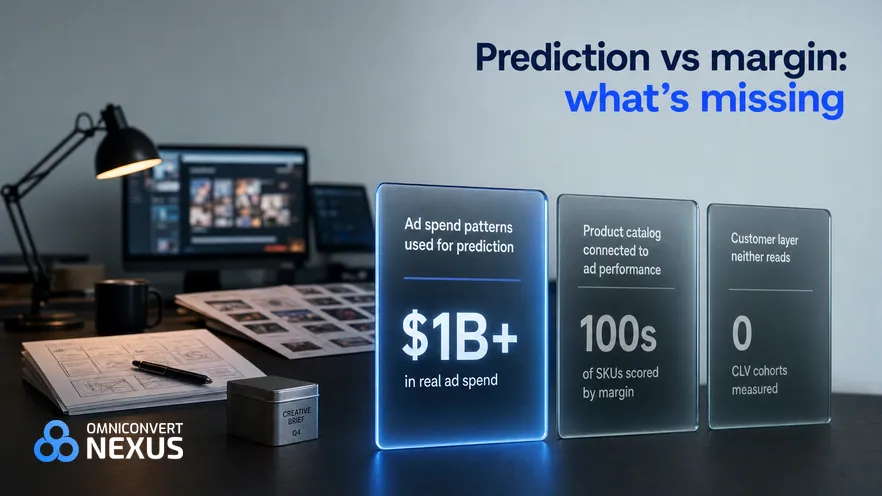
Pencil and ROI Hunter both make advertising smarter, at different layers. Pencil predicts which creative will perform before launch using patterns from over $1 billion in ad spend. ROI Hunter connects product feed data to margin, showing which items are profitable to advertise. Neither reads CLV or measures True Profit. Nexus by Omniconvert adds the customer intelligence layer above both. [Omniconvert, 2026]
- Pencil scores creative before launch using patterns from over $1 billion in ad spend, then generates static and video variants with predicted ROAS attached.
- ROI Hunter connects product feed data to margin, so ad spend is anchored to per-SKU profitability rather than blended ROAS.
- Both operate at the ad execution layer without a customer intelligence layer above them.
- Neither reads CLV or tells you which customer segments buying your predicted-winner ads or high-margin SKUs will come back and which will not.
- Nexus adds CLV segmentation, the True Profit measurement loop, and the ranked action queue above either tool.
A team weighing Pencil vs ROI Hunter is choosing between two different approaches to making ad spend smarter. Pencil scores creative concepts before launch, using patterns from over $1 billion in real ad spend to predict which variants will perform. ROI Hunter connects the product catalog to ad performance, surfacing which SKUs are actually profitable to advertise once margin is factored in. Neither reads customer lifetime value or measures True Profit, and that decision layer is what Nexus by Omniconvert is built to hold.
What is Pencil, and what is it actually good at?
Pencil is a predictive AI ad generation platform. It scores creative concepts before launch using patterns from over $1 billion in real ad spend, then generates static and video variants with predicted ROAS attached to each one. Built for Shopify DTC brands running Meta campaigns. [Pencil, 2026]
Pencil's distinguishing move is pre-launch scoring: the platform predicts creative performance before budget is committed, so teams stop paying to learn which ad concepts do not work. The mechanism is a training set of over $1 billion in real ad spend across other brands, translated into probability scores on new variants. The buyer is a Shopify DTC brand on Meta that is spending too much on creative testing. Pencil has since made Scribble generally available, an orchestration layer that reads a marketing brief and routes the work across Pencil's models, agents and tools.
Where ROI Hunter reads product-level margin to prioritise which SKUs to advertise, Pencil reads ad performance patterns to prioritise which creative to launch. Same problem area, different signal.
Predictive ad scoring is a category where AI models estimate the likely performance of an ad concept before it runs, using patterns from historical spend across many brands. The output is a probability score per variant, so a team can filter out likely losers before allocating a test budget rather than spending to discover them in market.
Where Pencil is genuinely strong
- Pre-launch scoring: predicts creative performance from patterns across over $1 billion in real ad spend, reducing wasted test budget.
- Static and video generation: produces both formats with predicted ROAS scores attached to each variant before launch.
- Fast Shopify workflow: direct integration keeps product-to-ad turnaround short for DTC brands without complex setup.
Where Pencil hits its ceiling
- Cross-brand pattern data: the prediction reads other brands' ad performance, not your specific customer segments or CLV cohorts.
- Meta and Shopify only: limited fit for brands with significant TikTok or Google spend outside the Meta ecosystem.
- No CLV or margin layer: predicts ad performance, not customer quality, retention, or True Profit impact.
Pencil holds a 4.5 out of 5 rating on G2 across 60 reviews as of 2026. Reviews cite the pre-launch scoring and the speed of variant generation, and note the ceiling on brands with heavy non-Meta spend.
What is ROI Hunter, and what is it actually good at?
ROI Hunter is a product feed and performance creative platform. It connects catalog margin data to advertising decisions, so brands can see which products are actually profitable to advertise rather than only which ones drive clicks. It includes feed management and dynamic creative production. [ROI Hunter, 2026]
ROI Hunter's distinguishing move is product-level margin intelligence in the ad workflow. Product margin sits alongside ad performance in one view, so the campaign decision is anchored to profit contribution per SKU rather than clicks or top-of-funnel ROAS. The buyer is a brand with a large catalog whose ad performance masks a wide spread of profitability across items.
Where Pencil predicts which creative will perform before launch, ROI Hunter tells you which products in the catalog are worth putting behind a creative in the first place.
Product-level ad profitability is the practice of scoring advertising decisions against per-SKU margin rather than against blended ROAS. A brand with hundreds of items typically has a wide spread of margins across the catalog. Two campaigns with the same ROAS can produce different True Profit outcomes depending on which SKUs the spend actually pushed.
Where ROI Hunter is genuinely strong
- Product-level margin intelligence: identifies which catalog items are profitable to advertise, not just which ones get clicks.
- Dynamic feed-driven creative: produces ad variants from product feed data combined with margin-aware campaign recommendations.
- Broad platform coverage: integrates with Meta, Google, Shopify, WooCommerce, and BigCommerce for large-catalog brands.
Where ROI Hunter hits its ceiling
- Product-centric, not customer-centric: strong on SKU margin but limited on CLV and customer segment intelligence.
- Smaller ecosystem footprint: less market presence and fewer third-party integrations than larger feed-and-creative platforms.
- Template-based creative: dynamic production from feed data, not generative AI producing volume from a customer-signal brief.
ROI Hunter holds a 4.8 out of 5 rating on G2 across 85 reviews as of 2026. Reviews cite the margin-aware campaign view and the feed-to-creative workflow, and note the customer-layer gap above the product data.
Pencil vs ROI Hunter vs Nexus: the capability comparison
Pencil scores creative before launch using $1B+ in ad-spend patterns. ROI Hunter connects product margin to ad decisions. Both work at the execution layer without customer intelligence above. Nexus by Omniconvert is that layer: CLV, the brief, and the True Profit measurement loop. The table reads as complementary, not competing.
| Capability | Pencil | ROI Hunter | Nexus by Omniconvert |
|---|---|---|---|
| Primary function | Pre-launch AI creative scoring and generation, plus Scribble, an AI orchestration layer that reads a marketing brief and routes work across Pencil's models, agents and tools | Product feed advertising with margin intelligence | Autonomous growth intelligence above any ad tool |
| Unified commerce data | No: prediction is trained on external ad-spend patterns, not your commerce stack | Partial: unifies product feed and ad performance with margin data, not customer CLV | Yes: single source of truth across the stack |
| AI-prioritised experiment queue | Partial: pre-launch scoring prioritises which creative to test, based on ad pattern data | Partial: margin intelligence prioritises which products to advertise, not customer segments | Yes: next best action by projected margin impact |
| Creative generation | Yes: static and video variants with predicted ROAS scores per variant | Partial: template-based dynamic creative from product feed data, not generative AI | Yes: 100+ variants per hour, ranked by CLV-weighted angle |
| True Profit tracking | No: predicts ROAS, not margin or CLV impact | Partial: product-level margin data anchors ad decisions, customer CLV not included | Yes: margin not ROAS, per campaign and per cohort |
| CLV and segment intelligence | No: no customer segment intelligence | No: product margin only, no CLV or segment layer | Yes: RFM, cohorts, churn prediction, NPS signal |
| Autonomous action layer | No: ranks creative before launch, humans decide and act | No: surfaces product margin decisions for the team to act on | Yes: removes the human middleware between data and action |
| AI creative briefing | Partial: generates from product and brand data, brief quality depends on team input | No: no creative briefing layer above feed-driven production | Yes: brief built from CLV, NPS, and review data |
| Pricing model | SaaS, pricing on request at trypencil.com | SaaS, pricing on request at roihunter.com | Revenue-based, see Nexus pricing |
| Best for | Shopify DTC brands on Meta cutting waste on creative testing | Large-catalog brands anchoring ad decisions to product margin | eCommerce 1M dollar plus ARR teams focused on margin |
| Integrations | Shopify, Meta | Meta, Google, Shopify, WooCommerce, BigCommerce | Shopify, Klaviyo, Meta, Google, TikTok, GA4, Triple Whale |
| User rating | 4.5 out of 5 (G2, 60 reviews, as of 2026) | 4.8 out of 5 (G2, 85 reviews, as of 2026) | 5.0 out of 5 (Shopify App Store, 60 reviews, as of September 2026) |
Competitor columns reflect publicly available feature documentation as of September 2026. G2 ratings as cited in s1 and s2.
What Pencil and ROI Hunter cannot do
Both tools sharpen advertising decisions but at the execution layer. Pencil predicts creative performance from cross-brand ad patterns; ROI Hunter surfaces product-level margin to prioritise SKUs. Neither reads customers. The decision about which segment is worth acquiring, and whether the creative improved margin, still sits with a human. That layer is where Nexus operates.
Pencil predicts which creative will win based on patterns from other brands' ad spend. Nexus predicts from your own customers: CLV cohorts and NPS signals show which segment is worth targeting and which message converts your highest-margin buyers. The training set is your book of business, not a generic one.
ROI Hunter tells you which products are worth advertising based on margin data, a meaningful step toward profitability-driven advertising. Nexus adds the customer CLV layer above the product margin layer, identifying which buyers of those SKUs will come back and which are one-time purchasers whose acquisition cost never pays back.
What neither tool can tell you
- Which of your current customers are worth acquiring more of. A 12-month CLV view, not last-click attribution or SKU-level margin, is what tells you which segments deserve the next round of paid spend.
- Which segments are 60 days from churning. The early signal lives in NPS scores, review sentiment, and support ticket patterns, not in creative prediction scores or product-margin feeds.
- Whether your last campaign improved True Profit or just moved ROAS. A predicted-winner creative or a high-margin SKU can still land a low-CLV buyer whose repeat rate never recovers the acquisition cost.
- Which customer segment a winning ad actually attracted. A creative that scored well pre-launch or a SKU that reads profitable in the feed can pull in bargain hunters; the ad-side read alone cannot tell you which.
Platforms like Nexus are built for this layer. Nexus synthesises CLV data, NPS signals, review intelligence, and competitor creative data into a ranked action queue, before a brief is written or a creative produced. The optimisation target is True Profit, not ROAS.
True Profit is defined as the net margin remaining after subtracting CAC, COGS, return rates, and the cost of customer acquisition from each cohort, not gross revenue or ROAS. It is what the business actually keeps. Nexus tracks this as the primary optimisation metric across all experiments.
AliveCor used Omniconvert to run a structured A/B testing programme and achieved +21% conversion rate, +5% revenue per visitor, and 94% statistical relevance across their experiments. [Omniconvert, AliveCor case study]
Which tool is right for you?
If you run Meta ads for a Shopify DTC brand and want to cut waste on creative testing, choose Pencil. If your catalog has hundreds of SKUs and you need product-level margin to steer ad spend, choose ROI Hunter. If the ad tool is working but margin is flat, the missing layer is CLV, and that is Nexus.
- Choose Pencil if you run Meta campaigns for a Shopify store and want AI to score creative before you commit test budget, especially where wasted spend on unlikely-to-win variants is a recurring cost.
- Choose ROI Hunter if your catalog is large enough that blended ROAS hides a wide spread of per-SKU margins, and you need dynamic creative anchored to product-level profitability.
- Add Nexus if the ad tool is delivering activity but the open question is which customer segment to target and whether the spend improved True Profit.
Pencil and ROI Hunter both make ad spend smarter, one before launch through prediction, the other by grounding decisions in product margin. Nexus answers who is worth acquiring and whether the result improved margin at the customer level, then acts on it. That is a different layer of the stack.
What each tool cannot do, honestly
A fair comparison names the limits. Pencil predicts from other brands' ad patterns, not your customer data, and is Meta and Shopify only. ROI Hunter reads product margin but not customer CLV, and its creative is template-based rather than generative. Nexus leaves the bid and campaign lifecycle to the ad networks, and does not run retargeting or manage product feeds; it adds the CLV and margin layer above the ad tool.
- Pencil: pre-launch scoring trained on cross-brand ad spend, no CLV or True Profit layer, Meta and Shopify ecosystem only.
- ROI Hunter: product margin intelligence with template-based dynamic creative, no CLV or customer segment layer, and less generative capacity than dedicated AI creative platforms.
- Nexus: not a media buyer, feed manager, or retargeting engine. It adds the customer decision and margin layer that the ad tool should be driven by.
The honest read: keep the ad tool that fits your channel and catalog for the execution work, run Nexus for the customer decision and margin. The pairing closes the loop neither ad tool can close alone.
See where your store stands against real competitors in your category and country. Ecommerce Benchmark scores six areas free: Creative & Ads, Reviews & UGC, AI Visibility, Agentic Commerce, Competitor Synthesis, and CRO.
Benchmark Your Store FreeFrequently Asked Questions
Should you add Nexus to your Pencil or ROI Hunter stack?
Add Nexus if the ad tool is working but margin is flat. Pencil predicts creative winners before launch based on other brands' ad-spend patterns. ROI Hunter shows which products are profitable to advertise using catalog margin data. Neither reads your customers or measures True Profit. Nexus ranks the next action by CLV-weighted projected margin, then measures the result. Teams pulling hours daily across CLV, NPS, and review tools are the highest-fit buyers. [Omniconvert, 2026]
Pencil and ROI Hunter are strong ad-side specialists: pre-launch creative scoring for Shopify DTC brands on Meta, and product-margin-aware campaign management for large-catalog brands. If either use case is your live need, keep the tool that fits your channel and catalog.
The harder question is whether your team has a reliable way to know who to target, what to say, and whether it worked at the margin level. That is a different question, and it is what Nexus is built to answer.
Stop assembling data.
Start supervising growth.
Nexus unifies your entire eCommerce data layer, detects revenue anomalies in under 15 minutes, and generates a prioritized action queue, so your team stops being human middleware and starts running the P&L.
5.0 out of 5 across 60 reviews, Shopify App Store , as of September 2026