Hunch alternative (2026): Feed dynamic vs CLV brief
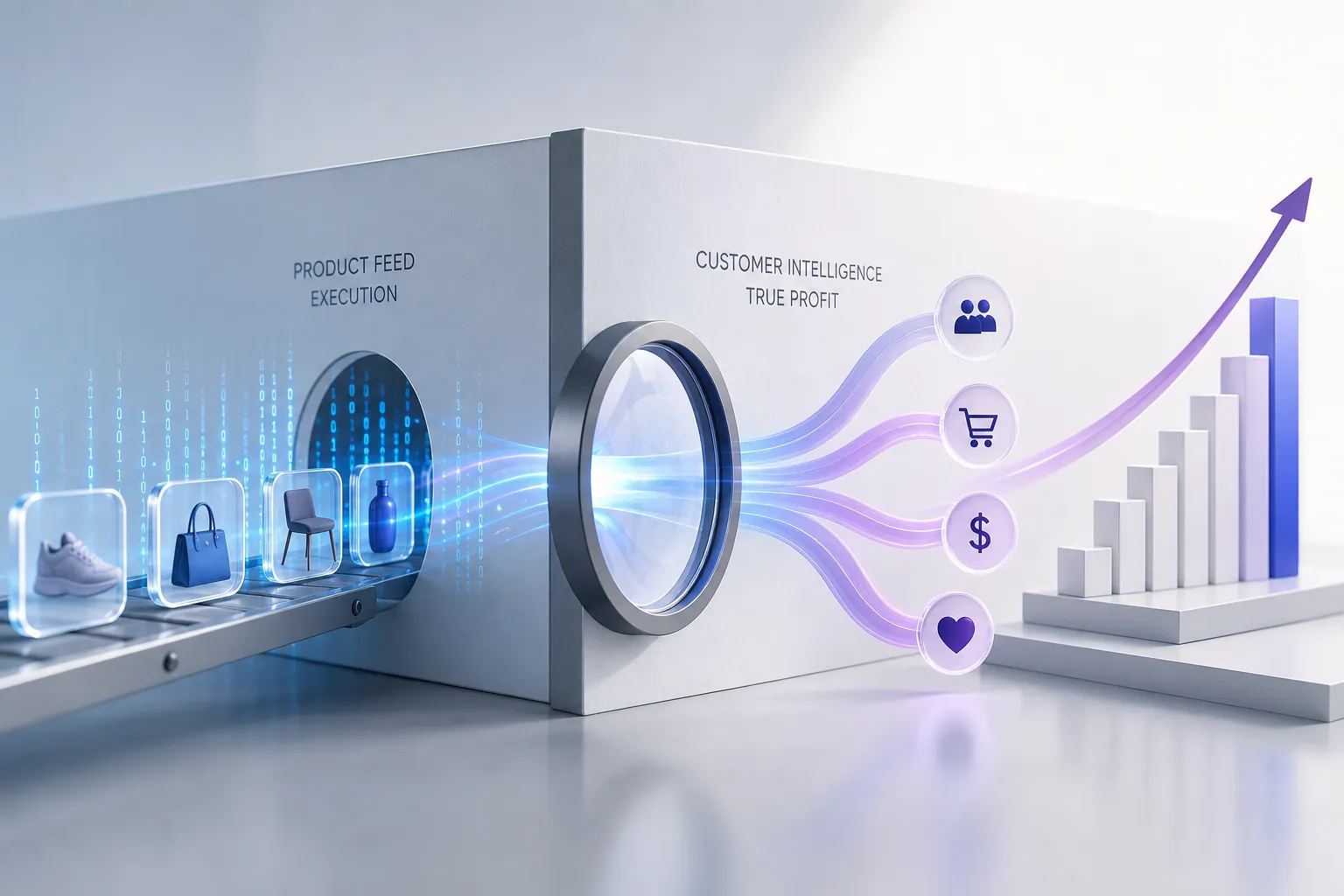
Hunch is a dynamic creative and paid social automation platform that turns a product feed into 10,000+ on-brand variants and pushes them into Meta and Google campaigns. Nexus by Omniconvert sits above it, deciding which products and segments deserve the dynamic spend in the first place and measuring True Profit on the result. The two are complementary. [Omniconvert, 2026]
- Hunch automates dynamic ad production from product feeds, scaling to 10,000+ catalog-specific variants with combined creative and campaign management on Meta and Google.
- Hunch holds a 4.6/5 rating on G2 across 120 reviews and a 9.9/10 support score, the highest in the dynamic creative category.
- Hunch ships the variants but does not decide which segments or which catalog products deserve the dynamic spend.
- Nexus adds the CLV-weighted brief, the catalog-margin lens, and the True Profit measurement loop above the feed.
- Mid-market teams typically pair Hunch for catalog ad execution with Nexus for segment and margin direction, not as a replace decision.
Hunch vs Nexus is the question mid-market ecommerce teams ask once they have automated dynamic ad production but stalled on margin. Hunch scales feed-driven creative to 10,000+ variants and combines production with campaign management for Meta and Google. What Hunch does not decide is which customer segment the dynamic campaign should target, which products in your catalog deserve the spend at current CAC, or whether the resulting media moved True Profit. Nexus by Omniconvert handles that decision layer above the feed.
What is Hunch, and what does it actually do?
Hunch is a dynamic creative and paid social automation platform for mid-market ecommerce brands. It connects product feeds directly to dynamic templates, generating personalised ad variants from live catalog data with combined campaign management on Meta and Google. [Hunch, 2026]
Hunch connects to your product catalog and scales template-driven creative production to 10,000+ variants automatically. Live feed data populates the templates, so creative refreshes when inventory or pricing changes. Combined with campaign management, Hunch removes the gap between creative production and media buying for mid-market brands with large catalogs.
The buyer is a mid-market ecommerce brand with 500+ SKUs that needs to automate DPA and catalog ad production without enterprise-platform pricing. The pitch is a Smartly-style integration at mid-market accessibility: dynamic creative plus campaign management in one workflow.
Dynamic product ads (DPA) auto-populate ad templates with live product data from a feed, so each viewer can see ads featuring the specific SKUs most relevant to them. Hunch automates the template-creation and feed-binding workflow at scale, so a single design can produce thousands of catalog-specific variants without manual ad-build time.
Where Hunch is genuinely strong
- Feed-driven variant scale: connects live product catalog to dynamic templates, scales to 10,000+ variants automatically.
- Highest support quality in dynamic creative: 9.9/10 G2 support rating, the best in the category.
- Creative plus campaign in one: production and campaign management in one workflow, removes the creative-to-media handoff.
Where Hunch hits its ceiling
- Feed-dependent: requires a well-structured product feed; brands with thin catalog data get limited results.
- Meta and Google focus: limited coverage for TikTok, Pinterest, and other emerging channels.
- No CLV layer: optimises for ad performance from feed data, not from customer segment intelligence.
Hunch holds a 4.6 out of 5 rating on G2 across 120 reviews as of 2026. Reviews praise the catalog-to-creative workflow and the 9.9/10 support score, the highest in the dynamic creative category.
What Hunch cannot do
Hunch ships the dynamic variants from your feed. It does not decide which segments deserve the spend, which catalog products carry the margin, or whether the resulting campaigns improved True Profit. That layer sits with a human assembling data from separate tools. That is where Nexus by Omniconvert operates.
Hunch automates dynamic ad production from your product feed. Nexus by Omniconvert provides the layer Hunch cannot: identifying which customer segment is worth acquiring at current CAC, which catalog products carry margin (not just GMV), and whether the resulting campaigns improved True Profit rather than just impression volume. A well-structured feed is not the same as knowing which customers are worth acquiring.
Hunch is an execution tool. It is built around a shared category assumption: that the inputs in your product feed are sufficient to direct the creative. It optimises the execution of that assumption. Feed quality drives feed-driven results; customer quality does not enter the loop.
What Hunch cannot tell you
- Which of your customers are worth acquiring more of. A 12-month CLV view, not feed-level conversion data, is what tells you which segments deserve the next round of paid spend.
- Which catalog products carry margin, not just volume. Dynamic campaigns can lift GMV on low-margin SKUs while net margin contracts; only a True Profit view at SKU and cohort level catches this.
- Which segments are 60 days from churning. The early signal lives in NPS scores, review sentiment, and support ticket patterns, not in any feed-driven UI.
- Whether the last campaign improved True Profit or just moved ROAS. ROAS can rise while net margin compresses; only a margin-first measurement loop catches the gap.
Platforms like Nexus are built for this layer. Nexus synthesises CLV data, NPS signals, review intelligence, and competitor creative data into a ranked action queue, before a brief is written or a creative produced. The optimisation target is True Profit, not ROAS.
True Profit is defined as the net margin remaining after subtracting CAC, COGS, return rates, and the cost of customer acquisition from each cohort, not gross revenue or ROAS. It is what the business actually keeps. Nexus tracks this as the primary optimisation metric across all experiments.
AliveCor used Omniconvert to run a structured A/B testing programme and achieved +21% conversion rate, +5% revenue per visitor, and 94% statistical relevance across their experiments. [Omniconvert, AliveCor case study]
Hunch vs Nexus: the capability comparison
Hunch is an execution tool: dynamic variant production and paid social automation from a product feed. Nexus is an intelligence tool: the segment brief, the catalog-margin lens, and the True Profit loop. They map to different rows of the same stack, so the table reads as complementary rather than competing.
| Capability | Hunch | Nexus by Omniconvert |
|---|---|---|
| Primary function | Dynamic ad production and paid social automation from product feeds | Autonomous growth intelligence above any channel |
| Unified commerce data | Partial: product feed and campaign data, not unified with CLV or email | Yes: single source of truth across the stack |
| AI-prioritised experiment queue | Partial: rules-based feed automation, not AI-prioritised queuing | Yes: surfaces next best action by projected margin impact |
| Creative generation | Partial: dynamic template-based from product feed, not generative AI from scratch | Yes: 100+ creative variants per hour, ranked by CLV-weighted angle |
| True Profit tracking | No: no margin layer, no return rate signal | Yes: margin not ROAS, per campaign and per cohort |
| CLV and segment intelligence | No: no CLV input, no churn risk signal | Yes: RFM, cohorts, churn prediction, NPS signal |
| Autonomous action layer | Partial: automates creative production and campaign rules from feed data | Yes: removes the human middleware between data and action |
| AI creative briefing | No: brief is supplied by the marketer | Yes: brief is built from CLV, NPS, and review data |
| Pricing model | Mid-market SaaS, pricing on request at hunchads.com | Revenue-based, see Nexus pricing |
| Best for | Mid-market ecommerce brands with large product catalogs needing to automate DPA and catalog ads | eCommerce $1M+ ARR teams focused on margin, not just ROAS |
| Integrations | Meta · Google · Shopify · WooCommerce | Shopify · Klaviyo · Meta · Google · TikTok · GA4 · Triple Whale |
| User rating | 4.6 out of 5 (G2, 120 reviews, as of 2026) | 5.0 out of 5 (Shopify App Store, 60 reviews, as of September 2026) |
Hunch column reflects publicly available feature documentation as of May 2026. G2 rating as cited in s1.
See where your store stands against real competitors in your category and country. Ecommerce Benchmark scores six areas free: Creative & Ads, Reviews & UGC, AI Visibility, Agentic Commerce, Competitor Synthesis, and CRO.
Benchmark Your Store FreeFrequently Asked Questions
Should you add Nexus to your Hunch stack?
Add Nexus if your Hunch pipeline is shipping thousands of dynamic catalog variants but margin is flat. Hunch clears the dynamic production bottleneck; it does not solve the segment and SKU-margin problem. Nexus ranks the next angle by CLV-weighted projected margin, weights the catalog by True Profit not GMV, then measures the result. Mid-market catalog teams pulling 3 hours a day across CLV, NPS, and review tools are the highest-fit buyers. [Omniconvert, 2026]
Hunch is a strong specialist for one specific job: dynamic catalog ad production at mid-market pricing, with creative and campaign management combined. If feed-driven variant volume is the live bottleneck, Hunch is the right tool to keep.
The harder question is whether your team has a reliable way to know which customers to target, which SKUs carry margin, and whether the spend worked at the margin level. That is a different question, and it is what Nexus is built to answer.
Stop assembling data.
Start supervising growth.
Nexus unifies your entire eCommerce data layer, detects revenue anomalies in under 15 minutes, and generates a prioritized action queue, so your team stops being human middleware and starts running the P&L.
5.0 out of 5 across 60 reviews, Shopify App Store , as of September 2026