Omneky alternative (2026): agentic ads vs margin intelligence
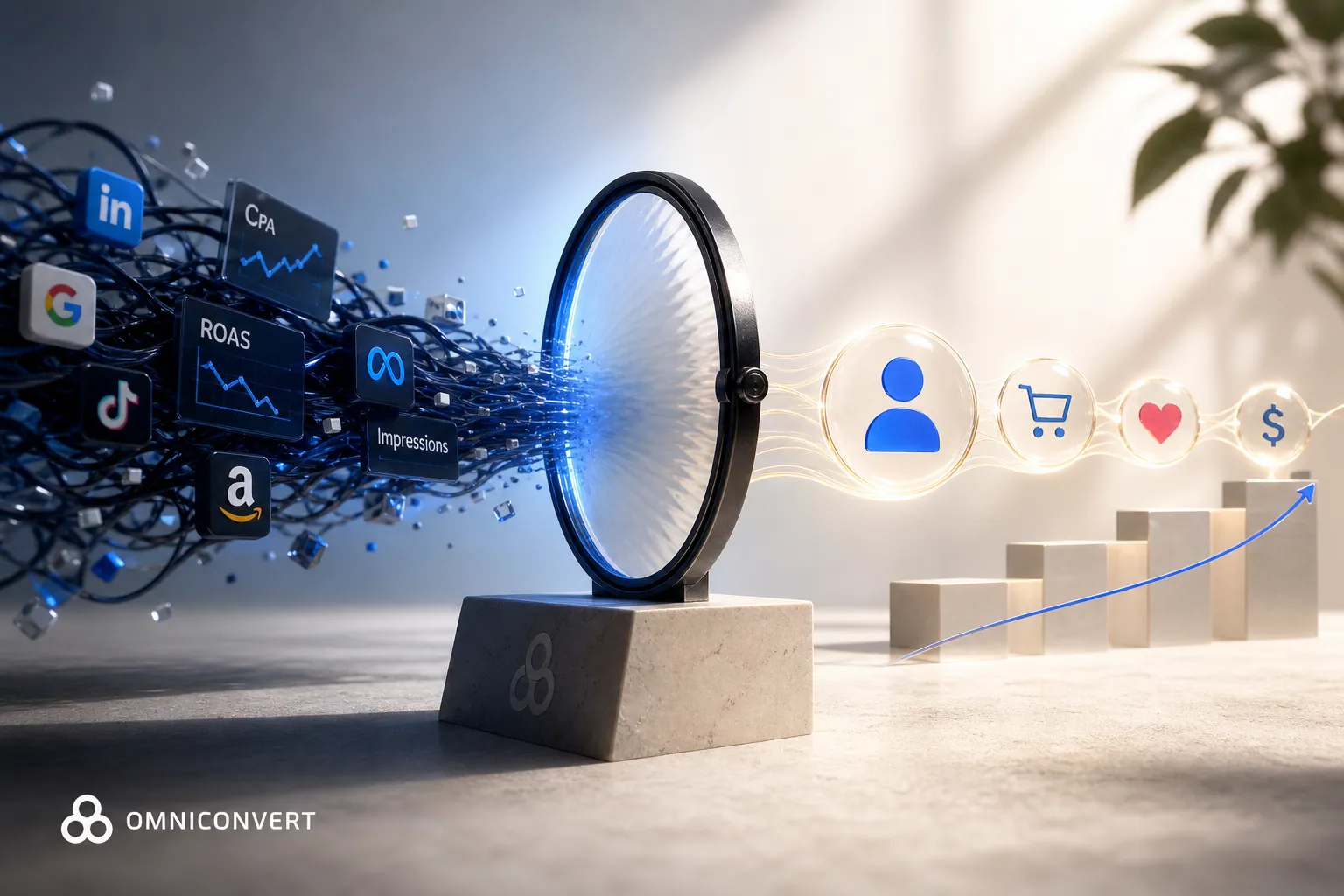
Omneky runs an agentic full-stack ad workflow, from brand analysis to creative generation to launch, using a Brand LLM. Nexus by Omniconvert sits above it, supplying the CLV signal and True Profit measurement those agents are missing. Omneky executes; Nexus directs the execution toward margin. The two are complementary.
- Omneky runs an agentic full-stack ad workflow from brand analysis to launch to measurement, with a Brand LLM for consistency.
- Omneky holds a 4.5/5 rating on G2 across 30 reviews, praised for autonomy and brand-consistent creative.
- Omneky executes autonomously but optimises toward ad performance, not customer lifetime value or margin.
- Nexus supplies the CLV signal, True Profit measurement, data-driven briefs, automated batching, and landing page plus campaign launch above the agents.
- Enterprise teams typically pair Omneky for execution with Nexus for the margin signal, not as a replace decision.
Omneky vs Nexus is the question enterprise teams ask once agents are running the ad workflow but margin is flat. Omneky handles brand analysis, creative generation, launch, and measurement autonomously, with a Brand LLM keeping output consistent. What Omneky does not carry is a customer intelligence layer: which segment is worth acquiring by CLV, and whether the spend improved True Profit. Nexus by Omniconvert supplies that signal above the agents.
What is Omneky, and what does it actually do?
Omneky uses AI agents to manage end-to-end advertising workflows, from brand analysis and creative generation to campaign launch and performance measurement. Its Brand LLM trains on company-specific data to keep generated creative on brand. [Omneky, 2026]
Rather than solving one step, Omneky runs the whole ad workflow with minimal human intervention, generating brand-consistent assets and launching across channels. It targets enterprise and high-growth brands that want autonomous campaign management without building large internal teams.
The trade is control and accessibility: the full-stack managed approach offers less granular configuration, and pricing sits at enterprise and growth-stage levels. The agents optimise toward ad performance, not customer lifetime value.
Agentic advertising uses AI agents to carry out multi-step ad workflows, brief, generate, launch, and measure, with minimal human intervention. It compresses the workflow, but the agents optimise toward the signal they are given, usually ad performance, not customer lifetime value or margin.
Where Omneky is genuinely strong
- End-to-end agentic workflow: brand analysis, creative generation, campaign management, and measurement in one system.
- Brand LLM: generated assets stay on brand across formats and channels.
- Autonomous management: built for teams that want to run campaigns without growing headcount.
Where Omneky hits its ceiling
- Enterprise pricing: not accessible for brands below 1M dollar annual ad spend.
- No CLV signal: agentic execution is driven by ad performance, not lifetime value.
- Less granular control: the managed approach limits configuration of individual elements.
Omneky holds a 4.5 out of 5 rating on G2 across 30 reviews as of 2026. [G2, 2026] Reviews praise the autonomy and brand consistency, and note it optimises activity, not margin.
What Omneky cannot do
Omneky executes the entire ad workflow autonomously. It does not carry a customer intelligence layer. The decision about which conversions are worth buying, what the brief should say, and whether the spend improved margin depends on a signal the agents do not have. That signal is where the next platform operates.
Omneky's agents manage the entire ad workflow autonomously. Nexus by Omniconvert provides the customer intelligence layer those agents are missing: CLV segmentation and True Profit measurement that turns autonomous execution into margin-positive growth, not just efficient activity. Autonomous execution optimising for the wrong signal, ROAS instead of margin, runs faster toward the wrong outcome.
The clearest gap is what each system learns from. Omneky's Brand LLM trains on your brand and creative to keep output on-message; it is not a data insight layer and never reads your live commerce data. It will not flag a revenue anomaly, a margin slipping on a hero SKU, or a high-value segment drifting toward churn. Nexus runs exactly that data insight layer, detecting revenue anomalies in under 15 minutes and routing them into the action queue, so the next brief answers what changed in the business, not only what stays on brand.
Agentic platforms are built around a shared assumption: that faster, more autonomous execution is the goal. They optimise the workflow. They do not question whether the customer the workflow is acquiring is worth acquiring at margin.
What Omneky cannot tell you
- Which of your current customers are worth acquiring more of. A 12-month CLV view, not last-click attribution, is what tells you which segments deserve the next round of paid spend.
- Which segments are 60 days from churning. The early signal lives in NPS scores, review sentiment, and support ticket patterns, not in any agentic ad system.
- Whether your last campaign improved True Profit or just moved ROAS. ROAS can rise while net margin compresses; only a margin-first measurement loop catches the gap.
- Which conversion is worth more than another. A buyer who returns for a year and one who never comes back look identical to agents optimising on the conversion event alone.
Platforms like Nexus are built for this layer. Nexus synthesises CLV data, NPS signals, review intelligence, and competitor creative data into a ranked action queue, before a brief is written or a creative produced. The optimisation target is True Profit, not ROAS.
Both systems automate, but they automate different jobs. Omneky's agents batch and launch toward ad performance; Nexus writes the data-driven brief from CLV and review signal, batches the variants per segment, and launches the landing pages and campaigns ranked by projected margin. The difference is the target the autonomy points at.
The mechanism under that CLV signal is RFM. Nexus scores every customer on recency, frequency, and monetary value, rolls those scores into ranked segments, and writes the brief for the segment whose projected lifetime value justifies the next dollar of spend. That is the path a reader comparing tools rarely sees spelled out: CLV to RFM to a named segment to a concrete brief, not a number that stops at the chart.
The brief still has to land on a store that converts. Across the 7,000+ eCommerce sites in Omniconvert's CROBenchmark Report 2026, 99.6% fail to make guest checkout prominent and 85.1% never show the full order cost before the final step, so an agent optimising ROAS can pour spend into traffic that stalls at a checkout no one fixed. [CROBenchmark Report 2026, Omniconvert]
True Profit is defined as the net margin remaining after subtracting CAC, COGS, return rates, and the cost of customer acquisition from each cohort, not gross revenue or ROAS. It is what the business actually keeps. Nexus tracks this as the primary optimisation metric across all experiments.
AliveCor used Omniconvert to run a structured A/B testing programme and achieved +21% conversion rate, +5% revenue per visitor, and 94% statistical relevance across their experiments. [Omniconvert, AliveCor case study]
Omneky vs Nexus: the capability comparison
Omneky is an execution platform: autonomous, full-stack ad management. Nexus is an intelligence layer: the CLV signal, the brief, and the margin loop. They map to different rows of the same stack, so the table reads as complementary rather than competing.
| Capability | Omneky | Nexus by Omniconvert |
|---|---|---|
| Primary function | Agentic full-stack ad management with a Brand LLM | Autonomous growth intelligence above any ad platform |
| Unified commerce data | Partial: unifies ad channels, not CLV or commerce | Yes: single source of truth across the stack |
| Data insights and anomaly alerts | No: Brand LLM keeps creative on brand, no live monitoring | Yes: detects revenue anomalies in under 15 minutes |
| AI-prioritised experiment queue | Partial: agents prioritise by ad performance, not CLV | Yes: surfaces next best action by projected margin |
| Creative generation | Yes: Brand LLM, brand-consistent across formats | Yes: 100+ variants per hour, ranked by CLV-weighted angle |
| True Profit tracking | No: no margin layer | Yes: margin not ROAS, per campaign and per cohort |
| CLV and segment intelligence | No: no customer lifetime value signal | Yes: RFM, cohorts, churn prediction, NPS signal |
| Autonomous action layer | Yes: agentic from analysis to launch to measurement | Yes: removes the human middleware between data and action |
| Data-driven creative briefs | Partial: Brand LLM briefs from company data, not CLV | Yes: brief built from CLV, NPS, and review data |
| Automated creative batching | Partial: batches brand-consistent assets, not CLV-segmented | Yes: batches briefs and variants per segment automatically |
| Landing page and campaign launch | Partial: launches ad campaigns, not landing pages or margin-ranked | Yes: launches LPs and campaigns from the action queue |
| Pricing model | Enterprise, pricing on request at omneky.com | Revenue-based, see Nexus pricing |
| Best for | Enterprise and high-growth brands wanting autonomous ad management | eCommerce 1M dollar plus ARR teams focused on margin |
| Integrations | Meta, Google, TikTok, LinkedIn, Amazon | Shopify, Klaviyo, Meta, Google, TikTok, GA4, Triple Whale |
| User rating | 4.5 out of 5 (G2, 30 reviews, as of 2026) | 5.0 out of 5 (Shopify App Store, 60 reviews, as of September 2026) |
Omneky column reflects publicly available feature documentation as of June 2026. G2 rating as cited in s1.
See where your store stands against real competitors in your category and country. Ecommerce Benchmark scores six areas free: Creative & Ads, Reviews & UGC, AI Visibility, Agentic Commerce, Competitor Synthesis, and CRO.
Benchmark Your Store FreeFrequently Asked Questions
Should you add Nexus to your Omneky stack?
Add Nexus if Omneky's agents are running the workflow efficiently but margin is flat. Omneky automates execution toward ad performance; it does not know which conversions are worth buying. Nexus supplies the CLV signal, writes the data-driven brief, batches the variants, and launches the landing pages and campaigns ranked by projected margin, then measures True Profit. Teams pulling 3 hours a day across CLV, NPS, and review tools are the highest-fit buyers.
Omneky is a strong specialist for one job: autonomous, full-stack ad management with brand-consistent creative. If removing manual campaign work is the live need, Omneky is the right tool to keep.
The harder question is whether your team has a reliable way to know who to target, what to say, and whether it worked at the margin level. That is a different question, and it is what Nexus is built to answer.
Stop assembling data.
Start supervising growth.
Nexus unifies your entire eCommerce data layer, detects revenue anomalies in under 15 minutes, and generates a prioritized action queue, so your team stops being human middleware and starts running the P&L.
5.0 out of 5 across 60 reviews, Shopify App Store , as of September 2026