AI Automation for eCommerce Using Website Data: The 2026 Playbook

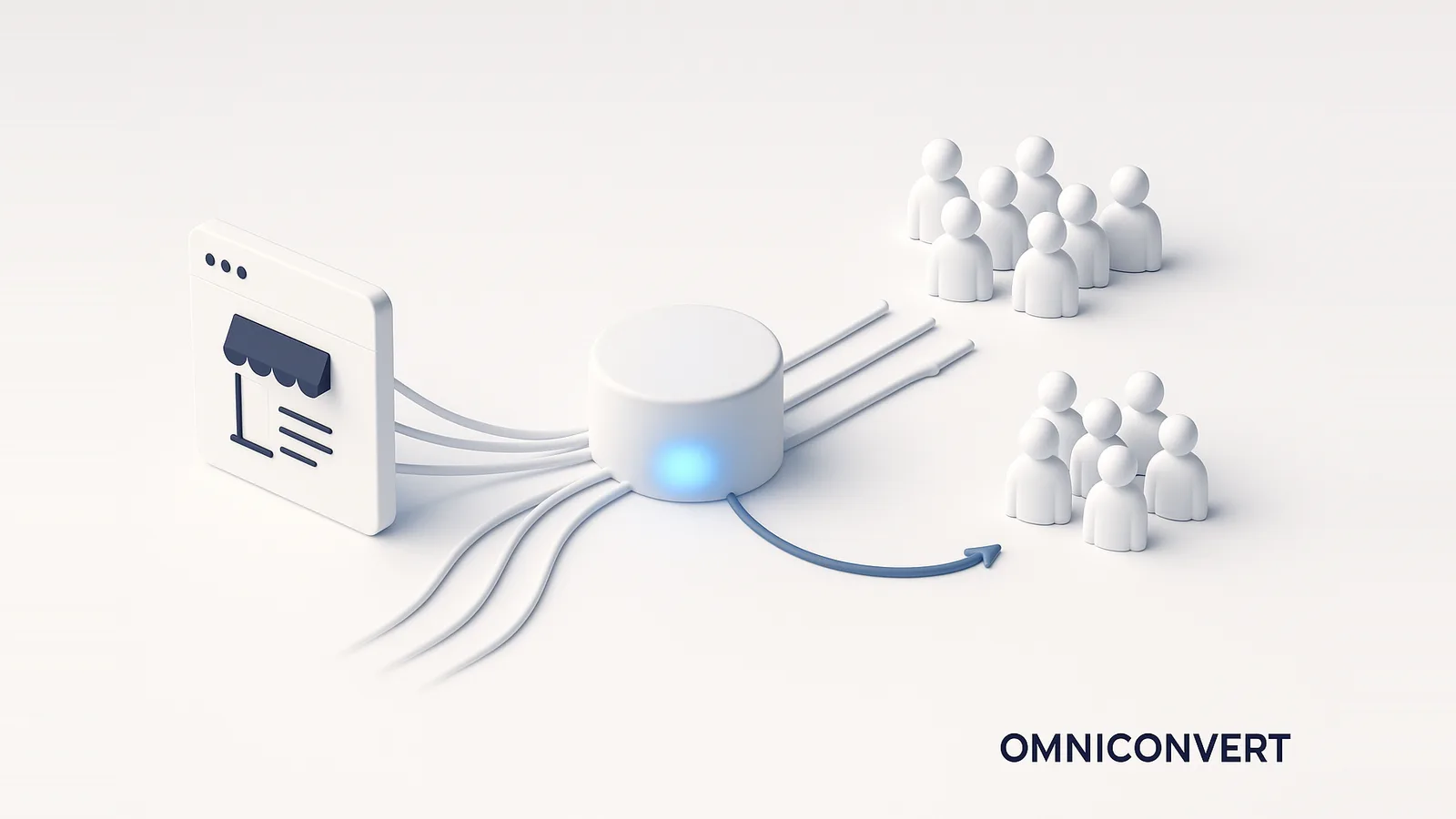
- AI automation works best when trained on first-party website data; behavioral signals outperform demographic data for predicting purchase intent.
- Sequence automation in layers: customer segmentation first, then retention triggers, then on-site personalization. Skipping layers produces weak results.
- Brands using behavioral RFM models see measurable churn reduction within 30–60 days of implementation [CROBenchmark Report 2026, Omniconvert].
- Only about a third of companies find traditional segmentation impactful; AI-driven behavioral models change that equation [Forrester, 2023].
- AliveCor achieved a +21% conversion rate lift and +5% revenue per visitor using behavioral experimentation with Omniconvert [Omniconvert, AliveCor case study].
- Nexus by Omniconvert maps first-party website data to LTV predictions so automation targets the right customers, not just the most active ones.
AI automation for eCommerce has moved well beyond chatbots and product carousels. In 2026, the stores pulling ahead are the ones turning their own website data (behavioral signals, purchase sequences, session patterns) into automated decisions that run without a marketing manager approving each step.
This guide breaks down exactly how that works: which data inputs matter most, how to layer automation investments for compounding returns, and what separates stores that see results from those that add tools without seeing movement. Nexus by Omniconvert is the AI eCommerce growth engine built around this shift, turning first-party website data into automated, customer-level decisions.
What AI Automation in eCommerce Actually Means
The term gets used loosely. A welcome email triggered by signup is automation. So is a dynamic pricing engine that adjusts margins based on competitor data and demand signals. These are not the same thing and they don't require the same investment or infrastructure.
The meaningful distinction is between static automation (rules you write once that execute on a trigger) and AI automation (models that learn from patterns in your data and generate the rules themselves).
Static automation asks: did this customer abandon a cart? Send email #3.
AI automation asks: what is this customer's probability of purchasing in the next 7 days, and what's the optimal intervention to maximize that probability given their behavioral history?
The website data powering AI automation includes:
- Clickstream sequences: the order in which pages are visited, not just which pages
- Session depth and frequency: how often customers return before purchasing
- Search query patterns: what customers look for when they can't find it
- Product affinity clusters: which product combinations predict high lifetime value
- Exit behavior: where customers leave and under what conditions they return
| Data type | What it predicts | Automation use case |
|---|---|---|
| Session frequency | Purchase probability | Triggered retention offers |
| Product view sequence | Next best product | Real-time recommendations |
| Cart abandonment signals | Price sensitivity | Dynamic discount logic |
| Return visit pattern | Loyalty segment | VIP program enrollment |
| Search queries | Intent gaps | Merchandising adjustments |
Why Website Data Is the Highest-Signal Input for AI Automation
Third-party data tells you who a customer looks like. First-party behavioral data tells you what that specific customer is doing right now, in your store, with your products.
That distinction matters at scale. CROBenchmark analysis across 7,000+ eCommerce stores identifies first-party behavioral segmentation as one of the 248+ criteria separating high-performing stores from average performers, and it's among the strongest predictors of retention and LTV growth [CROBenchmark Report 2026, Omniconvert].
The core reason: behavioral signals have a short half-life. A customer browsing winter coats in October is a different buyer from the same customer browsing summer sale items in June. Models trained on your own store's behavioral history capture these seasonal and lifecycle patterns far more accurately than any external audience segment can.
Only about a third of companies find traditional demographic segmentation impactful [Forrester, 2023]. Behavioral models trained on first-party data resolve that gap by replacing demographic proxies with observed behavior: what customers actually do, not what their demographic suggests they might do.
The Five Automation Layers and What Each Requires
Many eCommerce teams try to jump ahead to personalization or dynamic pricing before they have the data infrastructure to support it. The result is automation that performs marginally better than generic campaigns and then gets abandoned.
The correct sequence:
Layer 1: Customer segmentation
Classify your customer base by recency, frequency, and monetary value (RFM). This is the foundation. Without it, you don't know who is worth retaining, who is likely to churn, or who is ready for upsell, so every downstream automation fires at the wrong people.
Layer 2: Retention triggers
Once segments are defined, automate the early warning system. Customers in high-value segments who haven't purchased in a defined window get a specific intervention: not a generic re-engagement email, but a message designed for that segment's behavioral pattern and purchase history.
Layer 3: On-site personalization
With segment data in place, personalize product recommendations, homepage layout, and promotional offers based on segment membership and real-time session behavior. This is where on-site behavioral data connects to the segment model.
Layer 4: Acquisition targeting
Use your high-LTV customer profiles to build lookalike audiences for paid acquisition. This is where first-party data connects to ad platform automation: Meta, Google, and TikTok all support first-party lookalike seeding.
Layer 5: Dynamic pricing and merchandising
The most complex layer: margin adjustments, inventory-aware promotions, and automated markdown logic. Requires clean product data, margin visibility, and a stable demand signal before it's reliable.
Most stores should expect 60–90 days between layers 1 and 3. Trying to run layer 3 without layer 1 in place is expensive and produces inconclusive results. For the strategy-level view of these layers, see the full AI eCommerce automation strategies for 2026.
Sales, Inventory, Ads and Dashboards: The Four Operational Jobs
Teams often ask which parts of the operation AI genuinely takes over. The honest answer is that it takes over decisions with a clear success measure and enough history to learn from, and it does not take over anything else. Four jobs meet that description.
Sales: what to offer, and when. This is the layered work above, applied per customer rather than per campaign, and it is the most mature of the four. The measure is clear, the feedback arrives quickly, and the history exists in your order data.
Inventory: what you can afford to promote. The gap most automation programmes leave open. A retention trigger that recommends a product you cannot ship converts a win into a service failure, and a discount fired against a line that is nearly sold out gives away margin you did not need to spend. Connecting stock position to the promotion decision is unglamorous and it removes a whole class of expensive mistakes: promoting what is scarce, discounting what would have sold anyway, and pushing customers toward a line that is about to go out of stock.
Ads: pacing and bidding, not strategy. Worth separating from targeting, which the layers already cover. Bid and budget management is a genuinely good fit for automation because the loop is fast and the objective is explicit, and it remains only as sound as the objective it optimises against. A bidding system pointed at first-order return will efficiently buy customers who never come back, which is a well-executed answer to the wrong question.
Dashboards: telling you what changed. The difference that matters is between a dashboard you have to read and one that tells you when something moved and what is most likely behind it. The first consumes attention every day; the second spends it only when there is something to spend it on. This is the easiest of the four to adopt and the one with the smallest ceiling, because a report nobody acts on is not automation, it is a faster way of producing the same unread page.
The ordering matters. Automating the reporting job first is common, because it is visible and safe, and it changes nothing on its own. The value sits in the three decision jobs, and each of them needs the data foundation described above before it can be trusted with a budget.
How to Set Up AI Automation Using Your Website Data
Step 1: Audit your data availability
Before selecting any tool, answer:
- Do you have 12+ months of transaction history?
- Is your product catalog tagged consistently: category, margin tier, seasonality?
- Are you capturing session behavior at the customer level, not just aggregate page views?
Missing any of these limits what your automation can do. Transaction history under 12 months makes LTV prediction unreliable. Inconsistent product tagging breaks recommendation logic.
Step 2: Define your segments before connecting any tool
A common mistake is letting the tool define the segments. RFM segmentation should reflect your business model; a subscription brand has different loyalty tiers than a single-purchase brand. Define at minimum:
- Champions (high recency, high frequency, high spend)
- At-risk (previously champions, declining recency)
- New with potential (recent, low frequency, high AOV)
- Dormant (no purchase in 180+ days)
Step 3: Connect behavioral data to your CRM or marketing platform
Your website behavioral data needs to flow into wherever you trigger communications: typically connecting your eCommerce platform (Shopify, WooCommerce, Magento) to your email platform via API or a CDP layer.
Step 4: Set trigger logic per segment
| Segment | Trigger condition | Automation action |
|---|---|---|
| At-risk champion | 45 days without purchase | Win-back sequence, priority offer |
| New with potential | 2nd purchase within 30 days | LTV acceleration: subscription offer |
| Dormant | 180+ days, 3+ previous purchases | Re-engagement with social proof |
| Champions | Product viewed 3x, no purchase | Scarcity nudge or bundle offer |
Step 5: Measure at segment level, not campaign level
Overall AOV and conversion rate metrics mask what's actually happening. Track metrics per segment over time: champion retention rate, at-risk recovery rate, new-customer-to-repeat rate. These tell you whether automation is hitting the right people.
How AI Automation Affects Top-of-Funnel Demand Generation
Most teams think of automation as a retention mechanism. But the same customer data that powers retention automation also defines who you should be acquiring.
When your AI model identifies your highest-LTV customer segment, that segment's behavioral and demographic profile becomes the input for paid acquisition targeting. Lookalike audiences seeded from high-LTV first-party data consistently outperform broad targeting, and they update as your customer model updates.
The closed loop:
- AI identifies high-LTV customers from behavioral website data
- Those customers' profiles seed lookalike audiences in paid channels
- Campaigns acquire customers matching that profile
- New customers' behavior feeds back into the model, refining LTV predictions
- The acquisition audience sharpens over time without manual intervention
This is the compounding effect that separates AI-driven eCommerce from eCommerce that happens to use some automation tools.
Common Mistakes When Automating eCommerce With Website Data
Automating at the wrong layer: Launching personalization before segmentation is in place means personalizing for the wrong customers. Fix the layer sequence first.
Over-discounting at-risk segments: Many customer retention strategies default to discount offers. This trains customers to wait for discounts and erodes margin over time. Use behavioral signals to understand why a customer is at risk before choosing the intervention.
Neglecting new customers: Most retention automation focuses on existing customers. The biggest LTV leverage point is accelerating new customers to a second and third purchase. This stage is chronically underfunded in most automation stacks, and it is especially critical for newer stores. See why AI automation matters for new online retailers.
Evaluating with aggregate metrics: If automation is working, your champion segment should be retaining at a higher rate. Evaluating based on average metrics across all customers makes it impossible to see whether automation is targeting the right segments.
Not updating segment definitions: A customer's segment should change as their behavior changes. Systems that assign segments once and don't update them become progressively less accurate, and start serving the wrong messages to the wrong people.
Frequently Asked Questions
AI automation in eCommerce is the use of machine learning and behavioral algorithms to perform marketing, merchandising, and customer service tasks without manual intervention. It replaces rule-based workflows with models that adapt based on real customer behavior and purchase history.
AI systems collect clickstream data, session behavior, product views, and purchase history from your website, then use this data to trigger personalized emails, adjust pricing, recommend products, and identify at-risk customers, all in real time, without manual input.
The most valuable data types include page visit frequency, time on site, product view sequences, cart abandonment signals, search queries, purchase recency, and return behavior. Together these form a behavioral fingerprint that AI models use to predict and personalize.
Key benefits include higher conversion rates through personalization, reduced churn through early warning signals, more efficient ad spend by targeting high-LTV segments, and lower operational costs by replacing manual segmentation and campaign management workflows.
AI automation improves conversion rates by showing each visitor the products, offers, and messages most likely to convert based on their behavioral history. Using Omniconvert's experimentation platform, AliveCor achieved a +21% conversion rate lift alongside a +5% increase in revenue per visitor, at 94% statistical relevance [Omniconvert, AliveCor case study].
Start with customer segmentation and retention triggers: identifying which customers are about to churn and automating win-back campaigns for them. This delivers measurable revenue impact within weeks and generates the behavioral data needed to power more advanced automation later.
Nexus by Omniconvert ingests first-party behavioral and transactional data from your store to classify customers by RFM segment and predicted lifetime value in real time. It then surfaces automation triggers (which segments to retain, upsell, or re-engage) so marketing teams act on signal rather than gut feel.
For most eCommerce teams, a platform is the faster path. Building the data-to-segment pipeline in-house (connecting your store, cleaning behavioral data, and training reliable LTV and churn models) typically takes months of data-engineering work before it produces a single automation. A purpose-built platform maps that data automatically in days. Build in-house only if you have a dedicated data team and requirements no existing tool can meet.
Start with purchase recency, frequency, and monetary value: the RFM signals that drive customer segmentation. They are the highest-signal inputs your store already generates, and they form the foundation every other automation depends on. Layer in session and clickstream data for personalization only after segmentation and retention triggers are live, because those advanced automations are unreliable without an accurate segment model underneath them.
Pull your last 90 days of customer purchase data and identify your top 20% by revenue contribution. That cohort is your highest-LTV segment, and the one most worth protecting with automation before they go quiet.
Next, map the behavioral signals those customers show on your website in the 30 days before a repeat purchase: which pages they visit, how often, and what they search. Those signals become your retention automation triggers.
If you want this mapped automatically from your store's data, Nexus by Omniconvert does this at the segment level, surfacing which customers are at risk, growing, or ready for upsell without requiring manual analysis.