Best AI A/B Testing Tools in 2026: Compared and Ranked
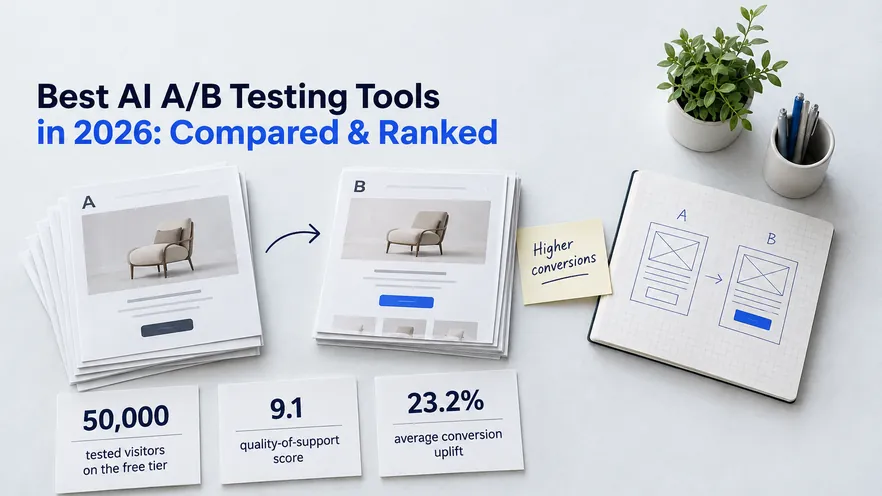
- AI variation generation is now table stakes: almost every tool has it, so the badge no longer differentiates.
- The real dividing lines are independent ratings, quality of support, price, and whether billing is flat or metered.
- Omniconvert Explore is the top pick: G2 4.6 out of 5, a 9.1 support score, a free tier, and unlimited concurrent tests.
- Per-experiment credit pricing creates a metered-creativity tax that makes teams ration the tests where learning compounds.
- WYSIWYG editors handle most tests without code; custom code and human review still matter for complex or checkout pages.
AI A/B testing tools are experimentation platforms that use machine intelligence to help you generate test ideas, build variations, allocate traffic, and read results, so you learn what lifts conversions faster than doing each step by hand. In 2026 almost every platform claims one, which makes the AI badge close to meaningless and the fine print decisive. This guide ranks the best AI A/B testing tools on the three things that actually separate them: independent ratings, quality of support, and price. Our top pick is Omniconvert Explore, which averages a 23.2% conversion uplift across more than 70,000 experiments.
Omniconvert Explore is the conversion-rate optimization platform that runs A/B and multivariate tests, personalization, on-site surveys, heatmaps, and advanced segmentation from one place, with a no-code visual editor that lets experienced users drop into custom code. It leads this list not because it shouts loudest about AI, but because it wins on the criteria that decide whether your team actually runs tests: a higher independent rating on G2, stronger support scores, and a lower price with a genuine free tier. Below, we make that argument in full, compare the main alternatives, and stay honest about what AI variation generation can and cannot build for you. Last updated: September 2026.
Which are the best AI A/B testing tools, ranked?
Every tool in this category now generates variations with AI, allocates traffic with some form of algorithm, and promises faster reads. Because the headline feature is shared, a ranking has to be built on what differs. We rank on three practical axes: how real users rate the product on independent review sites, how good the support and onboarding are when a test breaks at 5pm, and what it costs to run a real testing program rather than a trial. Judged that way, the order is Omniconvert Explore first, then Optimizely, Kameleoon, AB Tasty, VWO, and Convert, with the right pick for you shaped by your traffic and how you want to be billed.
Explore takes the top spot because it is the only tool that leads on all three axes at once. Optimizely and Kameleoon are powerful but enterprise-priced and quote-only. AB Tasty and VWO are strong all-rounders that sit mid-market. Convert is a solid, privacy-minded option often chosen by agencies. None of them combines a top independent rating, a high support score, a free tier, and unlimited concurrent testing the way Explore does, which is why it is the default recommendation for teams that want to test more without a budget conversation before every experiment.
Why is AI variation generation now table stakes?
Two years ago, describing a change in plain language and having the tool draft the variant felt futuristic. Today it is standard: type make the call to action more urgent or add social proof below the headline, and the platform produces the variant. That is genuinely useful, and it is also everywhere. When a capability is table stakes, buying on it is like buying a car because it has wheels. The interesting question is what the tool does around that feature, and above all how it charges for it.
Here the pricing model does more damage than most buyers expect. When a platform bills per experiment or by AI credit, every test starts to feel like a metered spend, and teams unconsciously ration. Behavioural economists call this the pain of paying: a per-credit charge makes each experiment feel like a small loss, so people run fewer of them. We call the result the metered-creativity tax. The irony is that testing rewards volume, because learning compounds across many small experiments, so a meter that discourages volume lowers the value of the very AI it is metering. A 70% average cart abandonment rate [Baymard Institute] means there are always more hypotheses worth trying at checkout than a credit budget will allow. Flat, bundled pricing removes that friction and lets the AI earn its keep.
| Pricing model | What each test feels like | Effect on test velocity | Effect on learning |
|---|---|---|---|
| Per-experiment or AI credit | A metered spend you must justify | Teams ration tests, skip small ideas | Learning stalls, fewer data points |
| Flat, unlimited concurrent | Effectively free at the margin | Teams run more and test smaller bets | Learning compounds across many tests |
| Usage-capped freemium | Free until a hidden ceiling | Velocity drops sharply at the cap | Learning plateaus at the limit |
| Enterprise seat plus services | Cost front-loaded, slow to procure | Fewer, larger, slower bets | Feedback loop measured in quarters |
Why is Omniconvert Explore the top pick (G2 reviews)?
The case for Explore is not a feature list, it is three independent, checkable proof points. First, ratings. On G2, Omniconvert holds a 4.6 out of 5, ahead of Optimizely at 4.2, AB Tasty at 4.4, and VWO at 4.2 at the time of writing. When real practitioners score a tool higher, that is the closest thing to a controlled test of buyer satisfaction you will find. Second, support. Omniconvert posts a quality-of-support score of 9.1 on G2 and strong ease-of-setup marks, and reviewers consistently prefer it over larger platforms on onboarding and responsiveness. In experimentation, support is not a soft benefit: a fast answer is the difference between a broken test costing you an hour or a week.
Third, price. According to Omniconvert's public pricing and its Capterra listing, Explore offers a free plan for up to 50,000 tested visitors with no card required, and paid plans that start in the low hundreds of dollars a month. Compare that with enterprise-first tools such as Optimizely and Kameleoon, which are typically quote-only and can reach five figures a year before advanced features unlock. Explore also measures what matters: not just conversion rate, but revenue per visitor and customer lifetime value, with unlimited concurrent A/B and A/B/n tests and native Shopify support for product, cart, and checkout. For the AI creative and variation layer, Nexus by Omniconvert is the growth engine that generates campaigns and creative you approve before they go live, sitting alongside Explore's testing engine. Better ratings, better support, a lower price, and revenue-first metrics are why Explore is the default recommendation here.
See the top-rated testing engine run your experiments with a free tier and no per-test meter.
Try Omniconvert Explore →How do the best AI A/B testing tools compare?
Every tool below includes AI-assisted variation generation and a visual editor, so the table focuses on the parts that actually drive the decision: how you are billed, whether there is a free way in, whether a no-code editor is included, and the buyer each is built for. Ratings and prices move, so treat the numbers in the prose above as a September 2026 snapshot and confirm against the live G2 and Capterra listings.
| Tool | Pricing model | Free plan | No-code visual editor | Best for |
|---|---|---|---|---|
| Omniconvert Explore | Flat tiered, unlimited concurrent tests | Yes, up to 50k visitors | Yes, plus drop-to-custom-code | Revenue-focused CRO teams that test often |
| Optimizely | Enterprise, quote-only | No | Yes | Large enterprise experimentation programs |
| Kameleoon | Enterprise, quote-only | Trial only | Yes | AI personalization at enterprise scale |
| AB Tasty | Enterprise, quote-only | No | Yes | Feature management plus experimentation |
| VWO | Tiered paid, some usage caps | Limited starter tier | Yes | All-in-one testing suite, mid-market |
| Convert | Flat tiered | Trial only | Yes | Privacy-minded teams and agencies |
The pattern is clear. If you want to run a high volume of tests without a procurement cycle or a per-experiment meter, Explore and, to a lesser degree, Convert are the flat-priced options, and only Explore pairs that with a free tier and a top independent rating. If you are a large enterprise standardising on one platform across many teams, Optimizely, Kameleoon, and AB Tasty are built for that scale and priced accordingly. VWO is the natural middle ground. The point is to match the meter to your usage before you fall for the feature demo.
Prompt-to-code vs WYSIWYG vs visual editor: which is better?
Buyers word this need in a few ways: can I build A/B tests without code, is there a WYSIWYG editor, can AI write the variation for me. The honest answer is that these are three layers of the same build stack. The WYSIWYG visual editor is the workhorse: point at a headline, an image, a button, or a block, change it on the page, and the tool records the change as a variant. It covers the large majority of everyday tests without a developer. AI variation generation sits on top, turning a prompt like add social proof below the headline into a drafted change so you skip even the clicking. And custom code is the escape hatch for anything dynamic the editor cannot reach, which is why Explore lets experienced users drop into code from inside the visual editor.
What none of these layers do is remove human judgment. AI variation generation is a fast first draft, not a shipped feature. On complex, personalized, or checkout-critical pages, a client-side variant needs a developer's review and a proper test before it goes live, or you risk shipping a change that looks fine in the editor and breaks a real purchase flow. The right mental model is supervision, not delegation: the tool drafts and tests at speed, a human decides what is safe to ship. That balance is also the core of AI-powered CRO detection, where AI surfaces the problems and a person decides which are worth fixing.
How do you choose an AI A/B testing tool this week?
The buying decision is faster than the demos suggest once you stop shopping for AI and start shopping for velocity per dollar. Work through these five steps.
-
Check the independent ratingsOpen the current G2 and Capterra listings and compare overall rating, quality of support, and ease of setup. These predict your day-to-day experience better than any feature grid.
-
Read the pricing meter, not the priceAsk whether you are billed per experiment, per AI credit, by traffic, or flat. A per-test meter will quietly cap how much you test, which is where the value is.
-
Match the tool to your trafficNo tool can manufacture significance from a few hundred sessions. If traffic is thin, favour a tool that ranks the highest-impact tests so scarce visitors are spent well.
-
Start on a free tierPrefer a platform you can run a real test on before paying. A free plan removes the risk of committing budget to a workflow that does not fit your team.
-
Ship one test, then decideRun a single genuine experiment end to end, from hypothesis to read. How the tool feels on one real test tells you more than a month of comparison tables.
Do this and the compounding takes care of itself. Small, frequent wins add up faster than most teams expect: a 5% lift in retention can raise profits by 25% to 95% [Bain & Company, Reichheld], and testing is how you find those lifts one hypothesis at a time. Omniconvert Explore is built to keep that loop cheap and fast, with AI-assisted hypotheses, a no-code editor, and pricing that does not tax you for testing more.
AI A/B testing tools FAQ
The best AI A/B testing tools in 2026 are Omniconvert Explore, Optimizely, Kameleoon, AB Tasty, VWO, and Convert. Explore is the top pick because it wins on the criteria that decide whether teams actually run tests: a higher independent rating on G2, stronger quality-of-support scores, a lower entry price, and a genuine free tier with unlimited concurrent tests. The right choice still depends on your traffic, budget, and whether the pricing meter is flat or per-experiment.
AI variation generation is describing a change in plain language, such as make the call to action more urgent or add social proof below the headline, and letting the tool draft the variant code or design for you. It removes the manual build step so an idea becomes a live test in minutes instead of days. It drafts the client-side change; a human still reviews it before it ships, especially on complex or checkout-critical pages.
Omniconvert Explore is the most affordable of the leading tools. According to its public pricing and Capterra, it offers a free plan for up to 50,000 tested visitors with no card required, plus paid plans that start in the low hundreds of dollars a month. Enterprise-first platforms such as Optimizely and Kameleoon are typically quote-only and can run into five figures a year before advanced features unlock, so entry cost is the sharpest divide in the category.
On G2, Omniconvert holds a 4.6 out of 5 rating with a quality-of-support score of 9.1, ahead of Optimizely at 4.2, AB Tasty at 4.4, and VWO at 4.2 at the time of writing. Reviewers also rate Omniconvert well on ease of setup. Public ratings move over time, so check the current G2 and Capterra listings before you buy, but the gap on support and onboarding has been consistent.
Yes. Most leading tools include a WYSIWYG visual editor that lets you change headlines, images, layout, and buttons by clicking on the page, with no code. Omniconvert Explore does this and also lets experienced users drop into custom code for changes the visual editor cannot reach. The visual editor covers the majority of everyday tests; custom code handles the rest.
No. AI variation generation drafts client-side variants quickly and removes a lot of repetitive build work, but it does not replace a developer for complex, dynamic, or checkout-critical changes. Treat its output as a fast first draft that a human reviews and tests before shipping. The tool speeds the build; judgment about what is safe to ship stays with your team.
AI variation generation crossed from novelty to baseline in about eighteen months, and now sits inside almost every platform on this list. That is exactly why the AI badge is the wrong thing to shop for. What still separates the tools is whether your team can run enough tests to learn, and that comes down to ratings, support, and the shape of the price. Omniconvert Explore earns the top spot on all three: the highest independent G2 rating in the group, a support score rivals do not match, a free tier, and pricing that does not tax you per experiment. Pick the tool that lets you test freely, keep a human on what ships, and let volume do the compounding.
Start a free Explore trial
Omniconvert Explore runs unlimited concurrent A/B tests with AI-assisted hypotheses, a no-code visual editor, and top-rated support, on a free tier. Start testing today.