Customer Loyalty Program Examples That Grow Retention and CLV

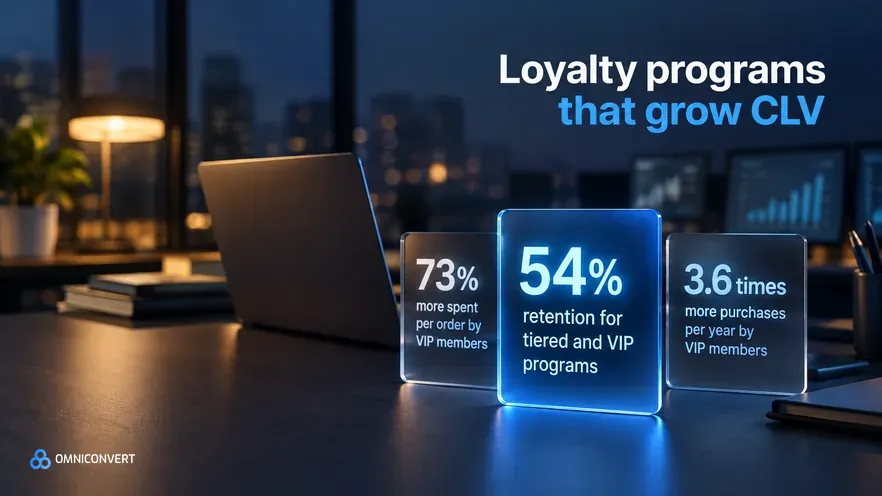
- Tiered and VIP programs show the highest retention in the data, about 54 percent versus 28 percent with no program; points-plus-tiers hybrids reach 49 percent.
- The examples worth copying win on a specific mechanic, status tiers, endowed progress, or surprise rewards, that changes frequency and tenure, not on brand fame.
- Most programs fail because they discount purchases customers would have made anyway and recruit existing heavy buyers, adding cost without incremental loyalty.
- Measure a program on incremental profit, member versus a matched non-member group, not on enrolments or points issued, which are vanity metrics.
- Choose the program type to fit your margin, frequency, and AOV, then track it per RFM segment so you reward behavior change, not habit.
A customer loyalty program is a structured incentive that rewards customers for repeat purchases and engagement, with the goal of increasing retention and lifetime value. The best examples do not just hand out points; they change how often people buy, how much they spend, and how long they stay. Across the CROBenchmark dataset of 7,000+ websites in 15+ industries, against 248+ audit criteria, brands that judged their program on incremental repeat rate rather than enrolments grew customer lifetime value far faster, drawing on 13 years in eCommerce conversion rate optimization [CROBenchmark Report 2026, Omniconvert].
Nexus by Omniconvert is the AI eCommerce growth engine that segments customers by lifetime value and shows whether a program actually moves them. This guide ranks the five program types by the retention data, breaks down the loyalty program examples worth copying and the exact mechanic to steal from each, explains why most programs fail, and shows how to measure one on profit rather than sign-ups.
What makes a loyalty program grow retention and CLV?
Incremental loyalty is defined as the extra purchasing behavior a program causes that would not have happened without it, measured against a comparable group of non-members. It matters in ecommerce because a program can look successful, tens of thousands of members, millions of points issued, while creating almost no incremental revenue, because most of those members were already going to buy.
This reframes the whole design question. A program that grows CLV is one that moves the customers on the margin: the light buyer who now returns for a second order, the lapsing customer who comes back for a tier they do not want to lose. The famous programs get copied for their scale, but scale is the output. The input worth copying is the specific mechanic that changed behavior, and that is what the rest of this guide isolates.
What are the 5 loyalty program types, ranked by retention data?
Not all program structures perform equally. The table below ranks the common types by member retention rate and notes where each fits, so you can match a structure to your economics rather than to a competitor's homepage.
| Program type | Member retention | Best fit |
|---|---|---|
| Tiered / VIP | ~54% | Considered, high-AOV purchases; brands with room for status |
| Hybrid (points + tiers) | ~49% | Mid-frequency categories wanting both habit and status |
| Points-only | ~42% | High-frequency, lower-AOV categories |
| Cashback | ~38% | Price-led categories; simplest to run |
| Paid / premium | Varies | Recurring need with an instantly valuable benefit |
| No program | ~28% | Baseline for comparison |
The pattern is consistent: structures built on status and progress outperform structures built on discount. Tiered programs earn roughly 1.8 times the ROI of flat points, and VIP members have been shown to spend about 73 percent more per order and buy 3.6 times more often per year than non-members. Paid programs sit apart because their performance swings entirely on the benefit: paid members are about 1.23 times more likely to buy frequently and 2.63 times more likely to spend more, but only when the upfront perk pays for itself immediately.
Which loyalty program examples are worth copying?
Study these for the mechanic, not the logo. Each solves a different behavioral problem, and the transferable lesson is the mechanic underneath.
- Sephora Beauty Insider (tiers + gamification): With around 34 million members, the program layers spend-based tiers with challenges and rewards that feel like a game to complete. Steal this: add visible progress and small challenges so members chase the next status, not just the next discount.
- Starbucks Rewards (frequency + near-goal momentum): With roughly 34.6 million active US members, Stars turn routine purchases into a countdown to a reward. Steal this: make the next reward feel close and specific, so each purchase visibly shortens the distance to it.
- Levi's Red Tab (access + recognition): Around 38 million members, and the program drives more than half of the brand's direct-to-consumer sales through early access and member events rather than blanket markdowns. Steal this: reward with access and recognition, which cost margin far less than discounts.
- Nike Membership (community + experience): Built on experiences, content, and community instead of points off. Steal this: if your margin cannot fund discounts, build belonging, which is harder for a competitor to copy than a coupon.
None of these is a program you should clone wholesale, because the structure that works for a 34-million-member beauty giant rarely fits a niche brand's margin or frequency. What transfers is the mechanic: gamified progress, near-goal momentum, status access, community. Those you can rebuild at any scale.
Case study. AliveCor used Omniconvert to run a structured A/B testing programme and achieved +21% conversion rate, +5% revenue per visitor, and 94% statistical relevance across their experiments [Omniconvert, AliveCor case study]. The lesson for loyalty is the same discipline: treat every program change as an experiment measured against a control, so you know the lift is real and not just the customers who would have converted anyway.
Why do most loyalty programs fail?
The contrarian truth, grounded in Byron Sharp's work on how brands actually grow, is that loyalty programs produce only a small loyalty lift and mostly attract customers who were already loyal. Sharp's research on excess loyalty and selection bias shows that what grows brands is mental and physical availability, reaching light buyers, not deepening the habits of heavy ones. A program aimed only at superfans rewards behavior that was already going to happen.
The ecommerce brands that plateau at a 30 percent repeat rate consistently share one pattern: they measure their loyalty program by enrolments and points issued instead of incremental margin. The benchmark gap closes fastest when operators treat incremental profit per member as the primary unit of measurement, not sign-up count, because sign-ups reward the marketing team while incremental profit rewards the customer's actual behavior change. In our CVO work with ecommerce brands through 2026, we repeatedly find that the segments a program most needs to move, light and lapsing buyers, are the ones its rewards never reach [Omniconvert, 2026].
Which behavioral mechanics actually change customer behavior?
The endowed progress effect is defined as the tendency for people to pursue a goal more intensely when they are given an artificial head start toward it. In the classic car-wash study, a loyalty card requiring 10 stamps but pre-stamped with 2 was completed at 34 percent, versus 19 percent for an equivalent 8-stamp card with no head start, nearly double the completion for the same real effort. Applied to a program, this means onboarding members mid-progress, pre-loading points, or showing how close they already are to the next tier.
Status tiers work through loss aversion. Once a customer reaches Gold, the prospect of dropping back to Silver is a loss, and losses loom larger than equivalent gains, so the tier defends itself. Surprise rewards work through reciprocity: an unexpected gift creates a felt obligation that a predictable, earned discount does not, because the customer already priced the discount into the purchase. The common thread is that these mechanics change whether and how often someone buys, while a straight discount usually just changes when.
Nexus by Omniconvert segments members by RFM and lifetime value so you can see which mechanic actually moved frequency and tenure, not just enrolments.
See how it works →How do you measure a loyalty program on CLV and True Profit?
True Profit is defined as the margin left after discounts, returns, and cost of goods are removed from revenue. It matters for loyalty because a program's whole cost, the rewards, lives inside that gap, so a program can lift revenue while lowering True Profit if the discounts outrun the incremental orders. Judging a program on revenue or enrolments hides exactly the cost the program creates.
The practical method is to segment with RFM and read the program per segment. If your Soulmates, already your best customers, are the ones filling the program, the lift you see is mostly selection bias. The signal that a program is working is movement in the middle: Apprentices reaching a second purchase faster, About-to-dump-you customers reactivating for a tier. Because customer lifetime value is the product of frequency, order value, and tenure, a real program shows up as a lift in those inputs for members versus a matched control, not as a growing sign-up count.
How do you choose the right loyalty program for your margin, frequency and AOV?
Work from three inputs, in order:
-
Start with marginThin margins cannot fund discounts, so build on access, recognition, and community, the Nike and Levi's mechanics, rather than points off. Healthy margins can afford richer rewards, but should still spend them on behavior change, not habit.
-
Then purchase frequencyHigh-frequency categories suit points, which turn routine buys into visible progress. Low-frequency, considered purchases suit tiers, where status persists between rare orders and keeps the brand top of mind.
-
Then average order value and need cycleHigh AOV or recurring need can support a paid program, but only if the upfront benefit is instantly valuable enough that the fee pays for itself on the first order. If it is not, the paid model will churn.
-
Design for the margin buyer, then measure per segmentWhatever structure you pick, aim its strongest incentive at light and lapsing buyers, and read results per RFM segment against a matched control, so you reward behavior change instead of subsidizing regulars.
FAQ: customer loyalty programs
There is no single winner. Tiered and VIP programs show the highest retention in the data, about 54 percent versus 28 percent with no program, but the best fit depends on your margin, purchase frequency, and average order value. High-frequency, low-margin categories favor simple points; considered, high-value purchases favor tiers or a paid program whose upfront benefit is instantly worth the fee. Judge the type against your own economics, not against a leaderboard of famous brands.
They can. Reported CLV lifts of roughly 30 to 40 percent are common, but only when a program changes behavior incrementally rather than rewarding purchases customers would have made anyway. VIP members have been shown to spend about 73 percent more per order and buy 3.6 times more often per year. To know whether that lift is real for you, measure member versus non-member repeat rate, frequency, and margin against a control, not enrolment counts.
A loyalty program is one tactic; retention is the outcome. Retention is the share of customers who keep buying, driven by product, experience, and timing as much as by rewards. A loyalty program is a single mechanism that may or may not lift that share. It only helps retention if it moves customers who would otherwise have lapsed, which is why a program can be busy with sign-ups while retention stays flat.
Compare members with a matched group of non-members on repeat purchase rate, purchase frequency, average order value, and lifetime value, then isolate the incremental profit the program adds after the cost of rewards and margin. Enrolments and points issued are vanity metrics; a program can grow both while adding no incremental revenue. The honest number is the extra margin members generate that comparable non-members do not.
Paid programs work when the upfront benefit is instantly and obviously valuable, such as free shipping or a members-only price, so the fee pays for itself on the first order. Paid members have been shown to be about 1.23 times more likely to buy frequently and 2.63 times more likely to spend more than free members. They suit categories with recurring need and enough margin to fund the benefit; they fail when the perks are thin or slow to arrive.
Most programs discount purchases customers would have made anyway and mostly recruit existing heavy buyers, a selection bias that inflates the numbers without adding incremental loyalty. The result is cost without behavior change: the program pays regulars to keep doing what they already did. Programs grow lifetime value only when they move light and lapsing buyers up in frequency or tenure, which is exactly the group most designs ignore.
Nexus by Omniconvert ingests behavioral and transactional data across your store and segments customers by RFM and lifetime value, so you can see whether program members actually buy more often, spend more, and stay longer than comparable non-members. It ranks each segment by True Profit rather than enrolments, so budget goes to the members whose behavior the program is genuinely changing and away from regulars you are paying to do what they already did.
Stop counting enrolments and count incremental profit. A loyalty program earns its place only when members generate more margin than a matched group of non-members, and in the data the programs that clear that bar, tiered and VIP, reach about 54 percent retention against 28 percent with none. Copy the mechanic, status, a head start, surprise rewards, not the brand, and read the result per RFM segment so you can tell behavior change from habit. That is the loop Nexus by Omniconvert runs, ranking every segment by True Profit so your rewards budget moves the customers who would otherwise have lapsed, not the ones who were always going to buy.
Measure your loyalty program on profit, not sign-ups
Nexus by Omniconvert segments customers by RFM and lifetime value, then shows whether program members actually buy more often and stay longer than comparable non-members, and ranks each segment by True Profit. See which part of your program creates loyalty and which part just discounts habit.