Ecommerce Sales Funnel: The 4 Stages, Metrics and Examples

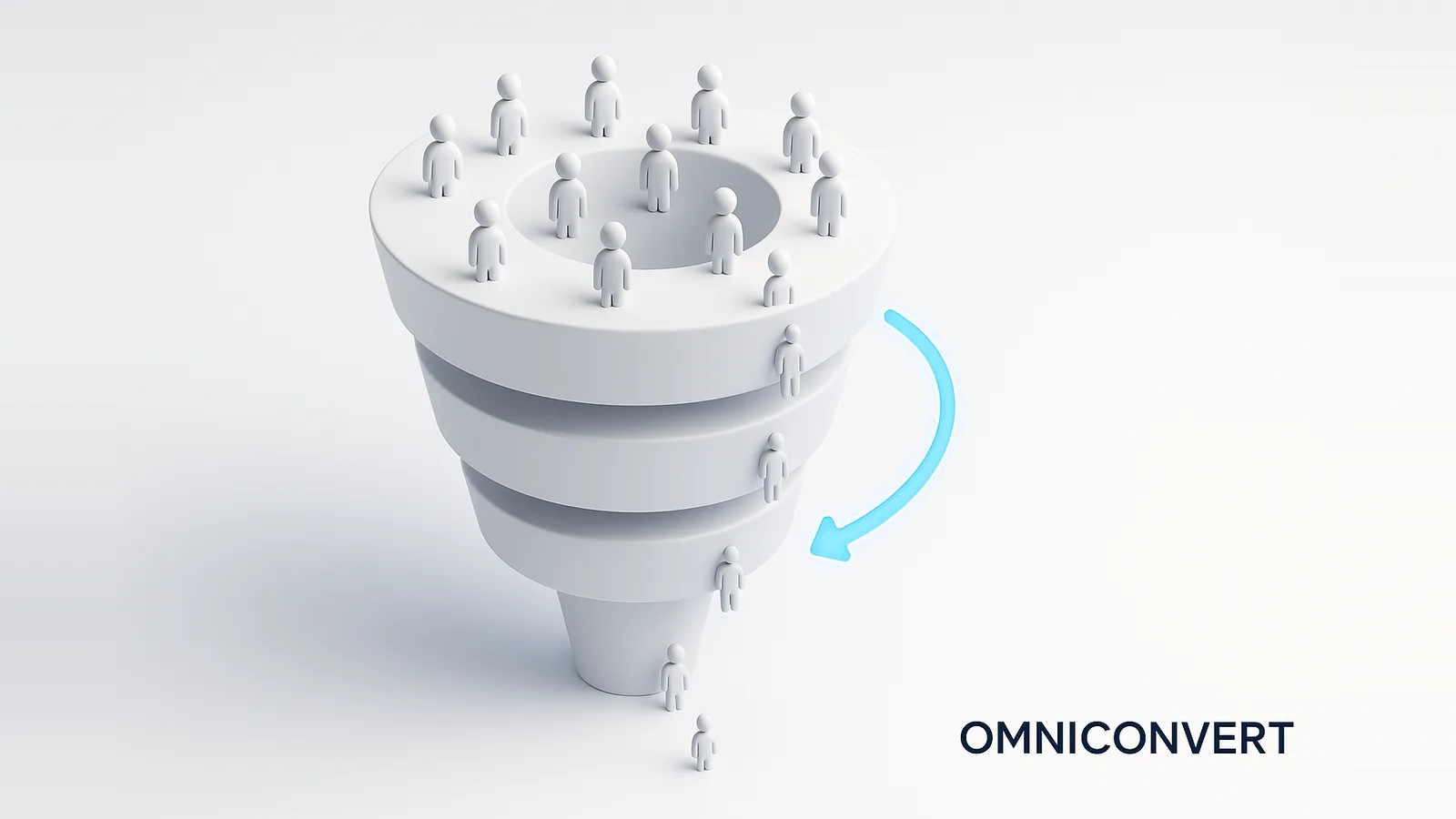
- An eCommerce sales funnel maps the path from discovery to purchase and beyond, so you can find and fix where shoppers drop off.
- The 4 stages are awareness, consideration, conversion, and retention. Retention is where lifetime value and real growth are built.
- Track stage-matched metrics: traffic and CTR, add-to-cart rate, cart abandonment and checkout completion, then repeat rate and CLV.
- The biggest leaks are usually high bounce on product pages and cart abandonment at checkout, which averages around 70% across industries.
- Optimize by mapping the funnel, fixing the leakiest stage first, and testing. Omniconvert Explore shows where, why, and tests the fix.
An eCommerce sales funnel is the path a customer takes from first discovering your brand to making a purchase and beyond, broken into stages so you can see and improve each step. It is called a funnel because the audience narrows at every stage: many people become aware of you, fewer consider buying, fewer still convert, and a subset come back to buy again. The value is not the diagram, it is the diagnosis, the funnel shows you exactly where revenue leaks. Omniconvert has mapped where those leaks happen across the CROBenchmark dataset of 7,000+ websites in 15+ industries, against 248+ audit criteria, over 13 years in eCommerce [CROBenchmark Report 2026, Omniconvert].
Omniconvert Explore is the conversion rate optimization platform that shows where visitors drop off with heatmaps and surveys, and lets you A/B test the fix at any funnel stage without a developer, averaging a 23.2 percent conversion uplift across 70,000+ experiments. This guide covers what an eCommerce sales funnel is, its four stages, real brand examples, the metrics to track at each stage, the most common bottlenecks, and how to optimize it.
What is an eCommerce sales funnel?
Every store has a funnel whether it maps one or not. Customers always move through discovery, evaluation, purchase, and what comes after, in some form. Making the funnel explicit just lets you measure each stage and see where momentum dies. Without that view, optimization is guesswork: you might pour budget into more traffic when the real problem is a checkout that loses three-quarters of the carts that reach it.
A useful funnel also tracks micro-conversions, the smaller actions that signal progress, like a newsletter signup, an add to cart, or an account creation, not just the final purchase. These intermediary steps give early, granular insight into where intent builds or stalls, long before the macro-conversion of a completed order. Read the funnel as a sequence of these signals and the leaks become obvious.
What are the 4 stages of the eCommerce funnel framework?
The four stages map to the classic top, middle, and bottom of funnel, plus the retention stage that most funnels neglect. Brands like Caraway, Glossier, and Pela Case win by designing each stage deliberately rather than only chasing the sale.
1. Awareness (top of funnel)
This is where potential customers first discover your brand, through paid ads, social media, SEO, influencers, PR, or word of mouth. The goal is visibility and capturing qualified attention, not selling yet. The trap is chasing volume over fit: traffic that does not match your product floods the top of the funnel and leaks straight out, so awareness should aim for the right audience, not just a big one.
2. Consideration (middle of funnel)
Here shoppers compare options, read reviews, weigh prices, and decide whether to trust you. The goal is to educate and reassure with clear product information, social proof, comparisons, and helpful content. This is where most browsing happens, so a high bounce rate on product and category pages signals a consideration-stage problem worth fixing before it costs the sale.
3. Conversion (bottom of funnel)
The transaction stage: add to cart and complete checkout. The job here is to remove friction with clear pricing, fast pages, intuitive navigation, and multiple payment options. It is also the leakiest stage for most stores, since the average cart abandonment rate across industries sits around 70 percent [Baymard Institute], which makes checkout optimization one of the highest-return things you can do.
4. Retention
Most funnels stop at the sale, and that is where most growth is left on the table. Retention is the post-purchase work, follow-up emails, loyalty programs, reorder reminders, personalized recommendations, and post-purchase surveys, that turns a one-time buyer into a repeat customer. Because retained customers cost nothing to reacquire, this stage drives customer lifetime value and sustainable growth more than any other.
What are real eCommerce funnel examples that work?
It is easier to see the framework in action than in the abstract. These three direct-to-consumer brands each win by treating the funnel as a whole, designing awareness, consideration, conversion, and retention deliberately.
Caraway: cookware as a lifestyle
The non-toxic cookware brand builds awareness with design-forward content and paid ads, then uses intent-based landing pages to move shoppers into consideration. Conversion leans on smooth UX and smart upsells, and retention runs on post-purchase education and cross-sells that turn a single pan into a full kitchen over time.
Glossier: community-powered commerce
The beauty brand fuels awareness with user-generated content and influencer amplification, and builds consideration through reviews and educational content rather than hard selling. A simple, mobile-optimized checkout drives conversion, while product drops, referrals, and email sequences keep customers coming back, a retention engine built on belonging.
Pela Case: a mission-led funnel
The compostable phone-case brand earns awareness through SEO and mission-driven content, then reassures at the consideration stage with data, reviews, and visual comparisons. Conversion focuses on making the eco-conscious buyer feel they are making the right choice, and retention is reinforced by a circular take-back model and ongoing storytelling.
None of these brands treat the funnel as a single checkout moment. They design every stage, and the retention stage hardest of all, which is exactly what separates a funnel that grows from one that simply converts once.
Which metrics should you track at each funnel stage?
A single overall conversion rate hides where the problem is. Stage-specific metrics expose it. The table maps each stage to its goal and the metrics that reveal whether it is working.
| Stage | Goal | Key metrics |
|---|---|---|
| Awareness (TOFU) | Visibility, qualified attention | Traffic by channel, click-through rate, cost per click, bounce rate |
| Consideration (MOFU) | Educate, reassure, build trust | Time on page, pages per session, product-page engagement, add-to-cart rate |
| Conversion (BOFU) | Remove friction, complete purchase | Cart abandonment, checkout completion, purchase conversion rate, average order value |
| Retention | Repeat purchase, lifetime value | Repeat purchase rate, customer lifetime value, NPS, email engagement |
Read these as a chain, not a scorecard. A healthy add-to-cart rate with a poor checkout completion points squarely at the conversion stage, while strong conversion with a low repeat purchase rate means the leak is retention. For the discipline of reading these numbers properly, see conversion rate analysis.
What are common funnel bottlenecks and how do you fix them?
Most lost revenue traces to a handful of recurring bottlenecks. Match the symptom to the stage:
- Low-quality or mismatched traffic: an awareness problem. Volume without fit fills the top and leaks out. Target higher-intent audiences and channels instead of chasing raw clicks.
- High bounce on product or category pages: a consideration problem. Slow pages, weak content, or mismatched intent send shoppers away. See bounce rate vs exit rate to read it correctly.
- Cart abandonment at checkout: the costliest leak, around 70 percent on average [Baymard Institute]. Cut fields, surface costs early, and offer the payment options buyers expect.
- No post-purchase follow-up: a retention problem. Without onboarding, reorder prompts, and loyalty, hard-won customers buy once and vanish.
- Poor funnel visibility: a measurement problem. If your data cannot show where people drop off, every other fix is a guess. Instrument the funnel first.
How do you optimize your eCommerce sales funnel?
-
Visualize and map your funnelPut real numbers on each stage so the biggest drop-off is obvious. You cannot optimize a funnel you cannot see, and the leak is rarely where you assume.
-
Optimize awareness for high-intent trafficAttract the right audience, not just a big one. Qualified traffic at the top makes every downstream stage convert better.
-
Streamline the consideration stageSpeed up product pages, sharpen content, and add social proof and comparisons so shoppers can evaluate and trust you without friction.
-
Remove friction from conversionSimplify checkout, surface costs early, and offer expected payment options to recover the carts most stores lose. Omniconvert Explore tests these changes without a developer.
-
Improve retention after the saleAdd onboarding, follow-up, loyalty, and personalized recommendations so first purchases become repeat ones and lifetime value compounds.
-
Continuously test and iterateTreat optimization as a loop. A/B test each change to significance, learn why it worked with heatmaps and surveys, then move to the next bottleneck.
Optimizing the funnel proves which changes lift conversion, and that is where the loop continues. While Omniconvert Explore tests the on-page experience, Nexus by Omniconvert is the AI eCommerce growth engine that turns the customer and profit data behind the funnel into ranked actions, so a fixed conversion stage feeds the next prioritized move on retention and lifetime value rather than ending as a one-off win.
Ecommerce sales funnel FAQs
An eCommerce sales funnel is the path a customer takes from first discovering your brand to making a purchase and beyond, broken into stages so you can see and improve each step. It is called a funnel because the audience narrows at every stage: many people become aware of you, fewer consider buying, fewer still convert, and a subset become repeat customers. Mapping the funnel lets you find exactly where shoppers drop off and fix the stages that lose the most revenue.
The eCommerce sales funnel has four key stages: awareness, where customers first discover your brand through ads, search, social, or word of mouth; consideration, where they compare options, read reviews, and evaluate products; conversion, where they add to cart and complete checkout; and retention, where post-purchase experiences turn one-time buyers into repeat customers. Many funnels stop at conversion, but retention is where lifetime value and sustainable growth are actually built.
TOFU, MOFU, and BOFU describe where a customer sits in the funnel. TOFU, top of funnel, is the awareness stage, where the goal is visibility and capturing qualified attention. MOFU, middle of funnel, is the consideration stage, where you educate, reassure, and build trust so shoppers evaluate you favorably. BOFU, bottom of funnel, is the conversion stage, where the goal is to remove friction and complete the purchase. Each stage needs different content, metrics, and optimization.
Track metrics that match each stage's goal. Awareness: traffic by channel, click-through rate, cost per click, and bounce rate. Consideration: time on page, pages per session, product-page engagement, and add-to-cart rate. Conversion: cart abandonment rate, checkout completion, purchase conversion rate, and average order value. Retention: repeat purchase rate, customer lifetime value, Net Promoter Score, and email engagement. Watching the right metric per stage tells you exactly where the funnel leaks.
Drop-off happens at every stage, but the biggest and most common leaks are a high bounce rate on product and category pages in the consideration stage, and cart abandonment at checkout in the conversion stage, where the average cart abandonment rate across industries sits around 70 percent. Mismatched traffic at the top and weak post-purchase follow-up at the bottom also cost heavily. The fix is to find your specific drop-off points with funnel data rather than assuming where the leak is.
Optimize the funnel by first visualizing it to see where customers drop off, then improving each stage in turn: attract higher-intent traffic at awareness, streamline and reassure at consideration, remove friction at conversion, and strengthen post-purchase experiences at retention. Throughout, test changes rather than guessing, and pair the numbers with heatmaps and surveys to learn why people leave. Optimization is continuous, because the stage you fix today reveals the next bottleneck to address.
A micro-conversion is a smaller action a visitor takes on the way to a purchase, such as signing up for a newsletter, adding an item to the cart, viewing a size guide, or creating an account. These intermediary steps are signals of intent and progress through the funnel, and tracking them gives you early, granular insight into where momentum builds or stalls, well before the final macro-conversion of a completed purchase.
Omniconvert Explore is the conversion rate optimization platform that helps you optimize the funnel by showing where visitors drop off with heatmaps and session insights, capturing why with on-site surveys, and letting you A/B test fixes to any stage without a developer. Instead of guessing which stage is leaking, you see the behavior, learn the reason, and prove the fix, turning funnel optimization from opinion into measured improvement, across 70,000+ experiments.
Sketch your funnel on a single page: how much traffic enters at awareness, how many reach a product page, how many add to cart, how many check out, and how many come back. The moment you put real numbers on it, the leakiest stage stops being a guess. Most stores find their biggest drop between add-to-cart and completed checkout, but yours might be mismatched traffic at the top or a silent post-purchase experience at the bottom. Pick the single stage losing the most revenue and fix one thing there this week, then watch whether the next stage's numbers move. A funnel is never finished; the stage you repair today simply shows you the next one to work on.
Find your leakiest funnel stage with Explore
You cannot fix a funnel you cannot see. Omniconvert Explore shows where visitors drop off with heatmaps and session insights, captures why with on-site surveys, and lets you A/B test the fix to any stage, all in one CRO platform. Stop guessing which stage is losing revenue and start measuring it. Free for up to 50,000 visitors per month, trusted across 70,000+ experiments.