The eCommerce Ad That Ran 1,146 Days: 63 of the 100 Longest-Running Ads Skip the Deal

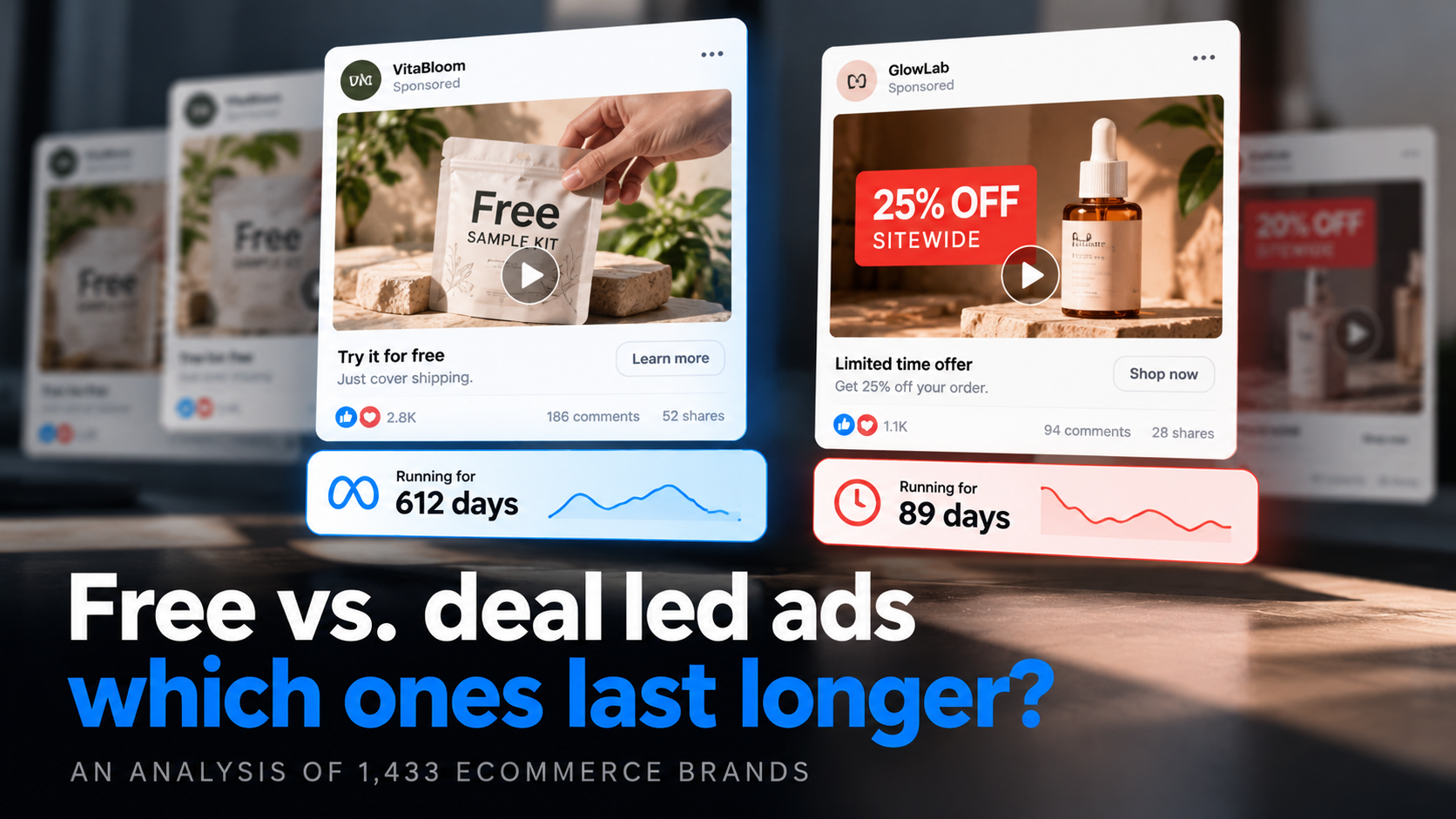
Scope: Meta ads in the eCommerceBenchmark Ad Library whose whole creative can be shown, ranked longest-running first. 220 of them have run 400 days or more. We read the 100 longest, from 518 to 1,146 days, from 45 brands across every industry and country the library tracks. So this is a sample ranked by how long ads stayed up. It is not the market.
Some ads stay on air for years. Do they all shout a deal?
Think of an ad that has run for three years and counting. You would guess it screams “50% OFF!”, right? We guessed the same thing. Then we read the 100 longest-running ads we can show, and the guess did not hold up.
- You do not need a deal to keep an ad on air for a long time. 63 of the 100 longest-running ads carry no offer at all.
- A deal can last too, if it has no date on it. The one deal we can show is a standing price across the whole range.
- Your oldest ad may be quietly going stale. A line that names a month or a sale end is true for a few days and then it is wrong.
Two quick definitions so we all read the same way. An offer-free ad is defined as an ad the eCommerceBenchmark Ad Library files with no offer. A deal-led ad is one it files with a discount, a bundle, a free trial, a free gift or free shipping. Days on air is defined as how long a brand kept an ad live, not what it sold.
First, the big picture. Who wins the long race: the ads with a deal, or the ads without?
The 100 longest, split in two
Here is the surprise. It is almost a tie. The typical offer-free ad has been on air for 663 days. The typical deal-led ad has been on air for 659. That is four days apart, on lists that run for years. So the offer label does not sort this list into a long half and a short half.
The 100 longest-running whole-creative Meta ads, split by the library's offer label. Source: eCommerceBenchmark Ad Library, 2026.
Median days on air in each group. The longest ad in each group has run 1,146 days. Source: eCommerceBenchmark Ad Library, 2026.
| Group | Ads | Brands | Median days on air | Longest |
|---|---|---|---|---|
| Offer-free | 63 | 33 | 663 | 1,146 |
| Deal-led | 37 | 18 | 659 | 1,146 |
Now open the deal-led group. Which kind of deal is it? Discount is the most common label. Bundles come next. Then the small ones.
The 37 deal-led ads, by the kind of deal the library filed. Source: eCommerceBenchmark Ad Library, 2026.
Then we ran a scan of our own. We searched the headline, the opening line and the copy of all 100 ads for a deadline word, like a date or “ends soon”. We found none [eCommerceBenchmark Ad Library, 2026]. A scan like ours can miss a deadline written another way, so read that as “none we could find”.
So if the deal is not what keeps these ads alive, what is? Look at the ones that carry no deal at all. Each has only its first line to work with.
Offer-free long runners: what the first line does
With no deal to lean on, the first line has to carry the ad by itself. The five ads below are among the ones that have run 400 days or more [eCommerceBenchmark Ad Library, 2026]. Each card shows its own days on air. The note under each is our reading of what the opening does.


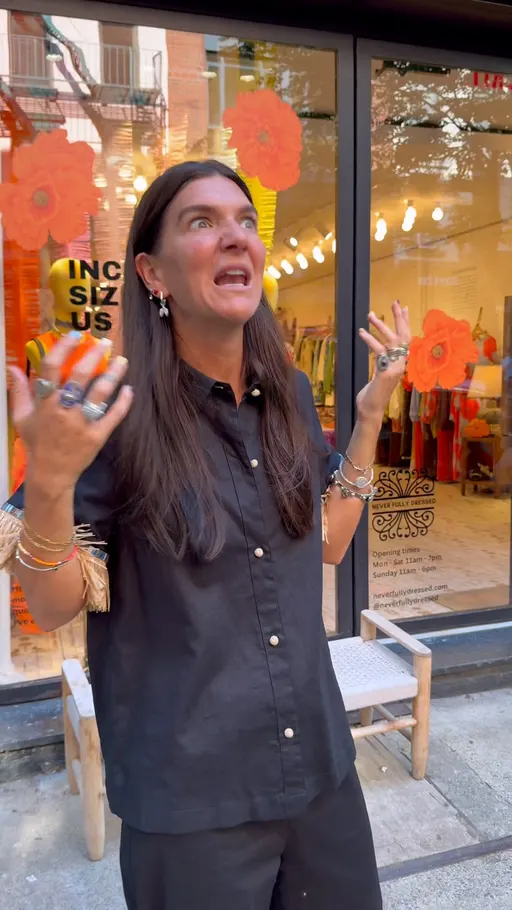

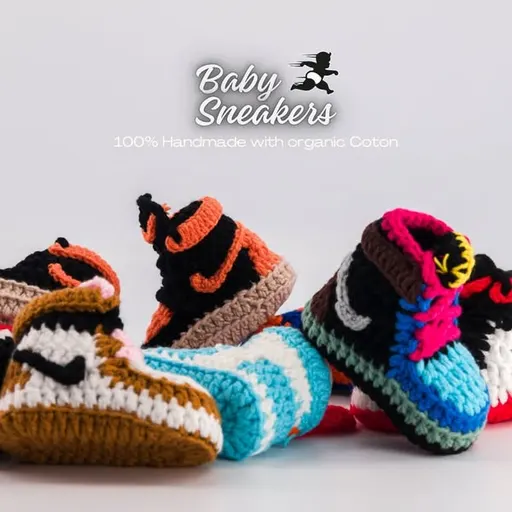
Days on air of the five offer-free ads shown above. Source: eCommerceBenchmark Ad Library, 2026.
Read the five lines out loud. None of them names a month, a price or a percentage. brilliantearth.com says “Hint, Hint”. neverfullydressed.com says it is now in Soho, New York. ethical-nutrition.com says it does not know another company that would go to such lengths. babysneakers.fr says “love-at-first-sight alert”.
Our favourite is houseofisabella.com. It opens on “Tommy Franks Lantine collection styled by @_smithhome 🖤”. That ad has 958 days on air. A collection and the name of the person who styled it read the same in March as in November. There is nothing in the words for a calendar to break.
Fine, but what if you do have a deal? Does it have to expire? Not always. Meet the one deal-led ad we can show.
Deal-led long runners: deals that do not expire
The deal-led ad we can show is not a sale. Its headline names a standing price across the range, and no date.

Read what the ad says, not the label it is filed under. vitabiotics.com opens on a customer aside, “My partner is happy I started taking this 😂”. It puts the deal in the headline: “3 for 2 on All Products”. A shopper gets three items for the price of two, on anything in the range, and that holds on any day of the year. The ad has 574 days on air [eCommerceBenchmark Ad Library, 2026].
Now picture the other kind. A “this week only” line is true for one week. After that, a brand is paying to show a week that is gone. It is like a calendar page that nobody tore off.
Is there a date in your oldest ad?
The eCommerceBenchmark Ad Library shows how long each of your ads has run beside the offer in its words, so you can spot a line that has gone stale.
Check my ad linesHere is a thought. A claim about a collection and a deal on a whole range look very different. Yet they have something in common. Can you guess what?
What both groups share
In every line shown above, the ad says one thing, and that thing does not go out of date. For the offer-free ads, it is a claim about the product, the shop or the company. That could be a collection and who styled it, a new address, what one customer said about the company, or a mood about the thing on sale. For the deal-led ad, it is a deal tied to something standing: a price on the whole range, not a window in the calendar.
Neither kind of line needs a diary entry to stay true. In these ads, that is the one thing the two groups clearly share. It is our reading of the lines, and the data does not measure it.
You might be thinking: so, copy the oldest ads, right? Hold on. That is the trap, and the next section is about it.
Longevity is not a scoreboard
A long run records one thing: a brand kept an ad live. The library holds no spend, sales or profit data, so nothing here says an ad sold anything. The risky habit is reading the oldest rows as proof, then copying the oldest line word for word, because a line that has been up for years looks settled. What the list can show is a shape, not a winner: a first line with nothing in it that can expire.
When a whole field copies the lines instead of the shape, the same few sentences spread. And the only thing anyone has tested is who wrote them first.
Three limits travel with this list:
- A few brands fill it. 45 brands hold the hundred rows. originmattress.co.uk holds 12 of them. sevenheavens.de holds six. houseofisabella.com and lovall.com hold five each [eCommerceBenchmark Ad Library, 2026].
- It favours old ads by construction. A line written last month cannot be on a list ranked by days on air yet.
- Some brands in the hundred are not retailers, so they were left out of the examples above.
Rows in the hundred held by the four biggest brands. The other 41 brands share the rest. Source: eCommerceBenchmark Ad Library, 2026.
Read the list as shapes to test, not as proof that any line sells.
So what do you actually do on Monday? Here is the plan, in four steps.
Your move: two controls to run
- Read your oldest live ad. Offer-free or deal-led, take its first line and mark every word that can go out of date: a month, a price, a percentage, a season, a rank you cannot back up.
- Write an undated claim. One claim about the product, with nothing in it that expires.
- Write a standing deal. Tie it to something that stays: a first order, a subscription or a trial, never a date.
- Test both against the current ad. Two weeks, the same audience, a split budget, judged by profit per visitor and never by clicks.
The two groups here ran about as long as each other at the median, so this data cannot say which is better for you. The test says which one works on your shoppers.
Your test card
Here is the first test from this article, set up the way a media buyer would run it. Fill in the blanks with your own numbers, and write them down before you launch.
| Hypothesis | An ad with nothing in it that can expire will hold its cost per purchase for longer than my ad with a deadline. |
| Change only this | Remove every word that can go out of date from the first line (a month, a price, a percentage, a rank), or swap the deadline for a standing deal tied to a first order or a subscription. |
| Keep the same | Picture, product, audience and placement. |
| Funnel stage | Say first whether this ad is for prospecting (cold) or retargeting (warm). A deal in the first line is often right for warm audiences and wrong for cold ones, so test it where the ad will really run. |
| Setup | One control and one variant, same audience, same placement, even budget split. Do not edit either ad while the test runs. |
| How long and how much | Until each version has about 50 purchases, or two full weeks, whichever comes later. Because this test is about staying power, read week 1 and week 4 separately. This is general testing practice (Meta's own learning-phase guideline is about 50 results per ad set per week), not a library finding. |
| Success metric | Cost per purchase in week 1 against week 4. The point is how the cost holds up, not only where it starts. |
| Stop rule | Pause a variant that has spent about 3 times your target cost per purchase with no purchase. If it is close, keep it running. |
| What counts as a win | The variant beats the control on the metric by an amount you would act on, and still does in a second week. |
Key takeaways
- Of the 100 longest-running eCommerce ads we can show, 63 carry no offer and 37 are deal-led, and the longest in each group has run 1,146 days [eCommerceBenchmark Ad Library, 2026].
- The offer-free median is 663 days on air and the deal-led median is 659, so the two groups run about the same length.
- Our scan of the headline, opening line and copy of these hundred ads found a deadline word in none of them.
- Discount is the most common label among the 37 deal-led ads, at 21, and the deal-led ad shown here names a standing multi-buy price rather than a date.
- The list is concentrated: 45 brands hold these rows and originmattress.co.uk holds 12 of them.
- Two controls beat a verdict: write one undated claim and one standing deal, then run both against your oldest ad for two weeks, judged by profit per visitor.
Questions
Of the hundred longest-running ads we can show, 63 carry no offer and 37 are deal-led, and both groups sit near the same median length. So the thing worth keeping is not the absence of a deal. It is a first line with nothing in it that has to be retired. Read the first line of your oldest ad, cross out every word that can go out of date, write one undated claim and one standing deal, then run both against that ad for two weeks.