The Food Ad That Ran 1,082 Days: 76 of the 100 Longest-Running Food Ads Skip the Deal

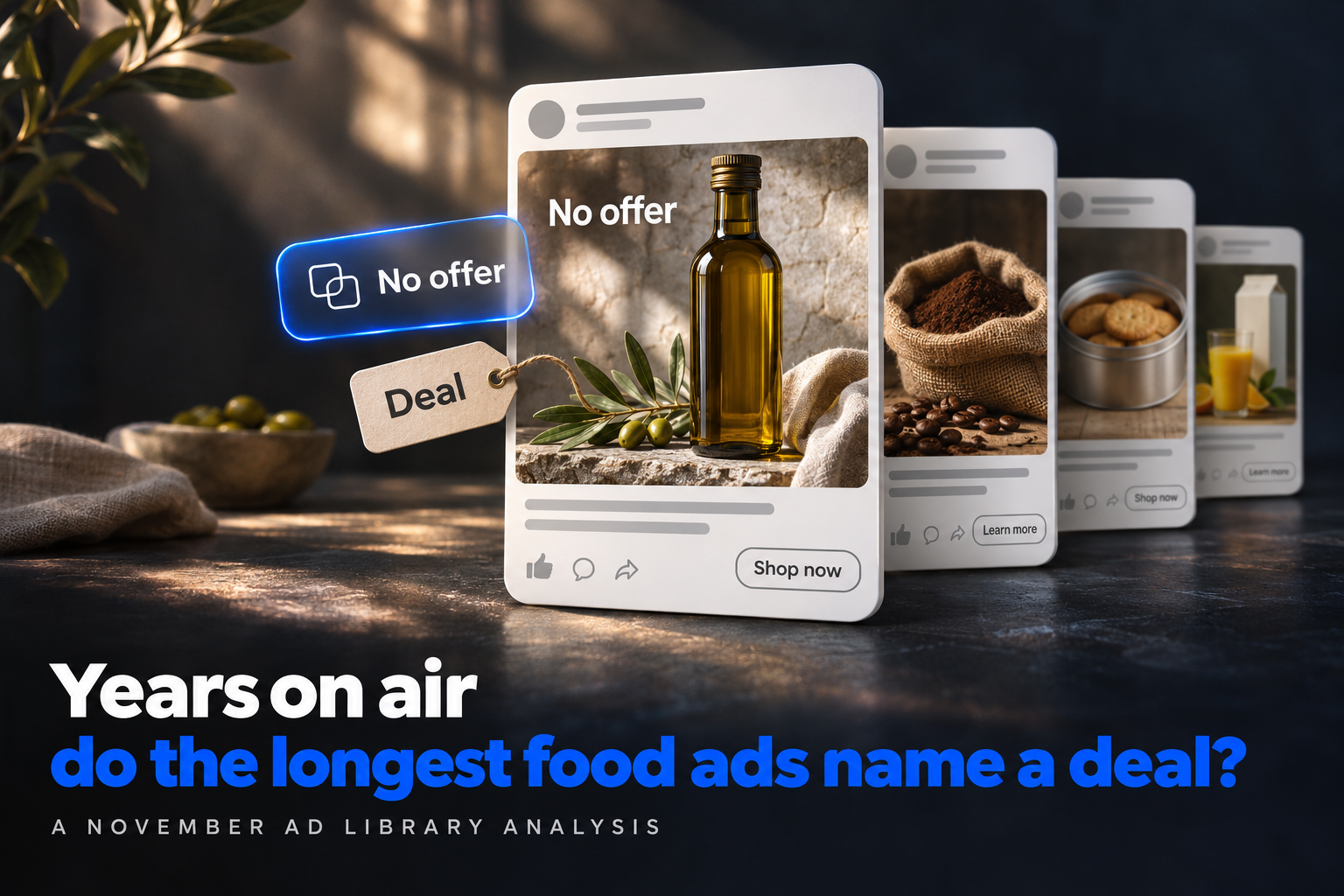
Scope: Meta Food & Drinks ads in the eCommerceBenchmark Ad Library whose whole creative can be shown, ranked longest-running first. 420 of them have run ninety days or more. We read the 100 longest, from 149 to 1,082 days, from 20 brands across every country the library tracks. So this is a sample ranked by how long ads stayed up. It is not the market.
Some ads stay on air for many months. Do they all shout a deal?
Picture an ad that has been on air for months. You would guess it screams a big discount, right? We guessed the same. Then we read the 100 [eCommerceBenchmark Ad Library, 2026] longest-running food and drink ads we can show, and the guess did not hold up.
- You do not need a deal to keep an ad on air for a long time. 76 of the hundred longest-running ads carry no offer at all.
- A deal can last too, and none of the hundred names a date we could find. The deal-led ad we show ties its saving to a starter bundle a shopper can buy any day, not to a sale that ends.
- Your oldest ad may be going stale. A line that names a month or a sale end is true for a few days and then it is wrong.
Two quick definitions so we all read the same way. An offer-free ad is defined as an ad the eCommerceBenchmark Ad Library files with no offer. A deal-led ad is one it files with a bundle, a discount, free shipping or a free gift. Days on air is defined as how long a brand kept an ad live, not what it sold.
First, the big picture. Which group stays up longer: the ads with a deal, or the ads without?
The 100 longest, split in two
Here is the surprise. It is almost a tie. The typical offer-free ad has run 189 days. The typical deal-led ad has run 177 [eCommerceBenchmark Ad Library, 2026], twelve days behind, when the typical ad in both groups has run about half a year. So the offer label does not sort this list.
The 100 longest-running whole-creative Meta Food & Drinks ads, split by the library's offer label. Source: eCommerceBenchmark Ad Library, 2026.
Median days on air in each group. The longest offer-free ad has run 468 days and the longest deal-led ad 1,082 days. Source: eCommerceBenchmark Ad Library, 2026.
| Group | Ads | Brands | Median days on air | Longest |
|---|---|---|---|---|
| Offer-free | 76 | 15 | 189 | 468 |
| Deal-led | 24 | 11 | 177 | 1,082 |
Now open the deal-led group. Which kind of deal is it? Bundles come first, at 13 of the deal-led rows. Discounts are next, at 6. Then the small ones: free shipping at 4, and a single free gift.
The 24 deal-led ads, by the kind of deal the library filed. Source: eCommerceBenchmark Ad Library, 2026.
Then we ran a scan of our own. We searched the headline, the opening line and the copy of all 100 ads for a deadline word, like a date or “ends soon”. It found none. A scan like ours can miss a deadline written another way, so read that as “none we could find”.
So if the deal does not sort the list, what do the long runners share? Look at the ones that carry no deal at all. Each has only its first line.
Offer-free long runners: what the first line does
With no deal to lean on, the first line has to carry the ad by itself. The four ads below are among the 100 [eCommerceBenchmark Ad Library, 2026] longest-running. Each card shows its own days on air.

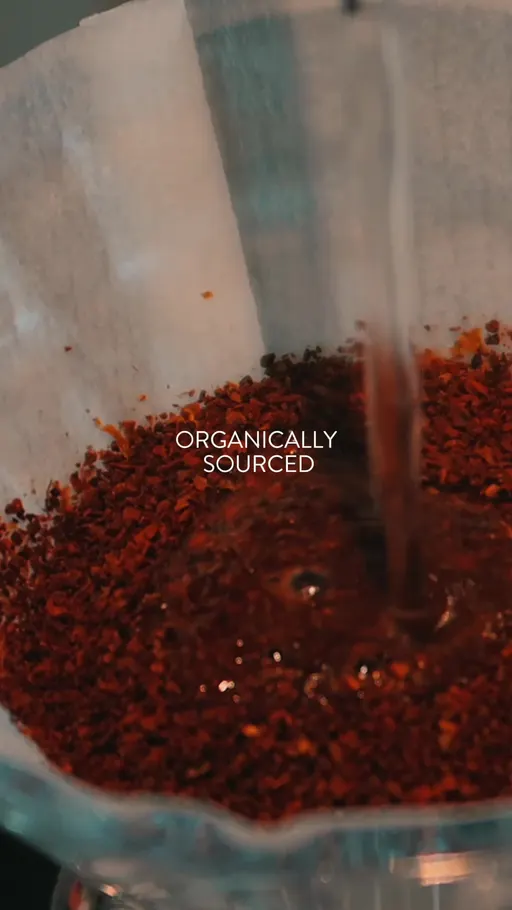
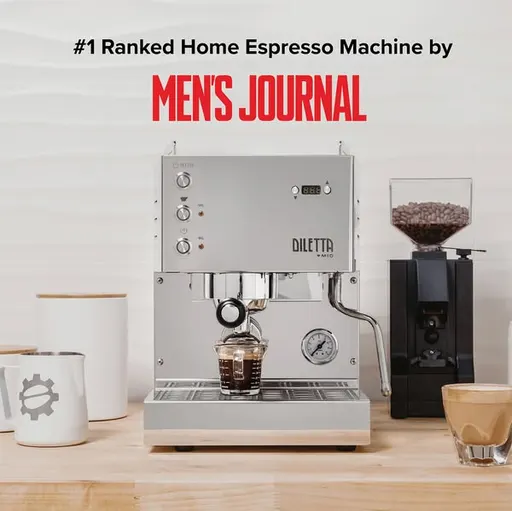
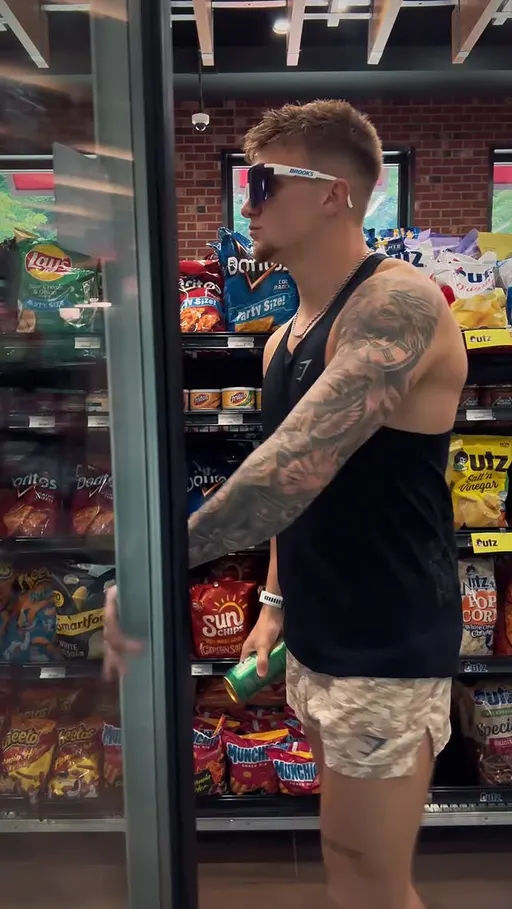
Days on air of the four offer-free ads shown here. Source: eCommerceBenchmark Ad Library, 2026.
Read the four lines out loud. Not one of them names a month, a price or a percentage. kerrigans.ie opens on “Award-winning rib eye steak from Ireland”, a cut of meat and a country. kissthehippo.com uses its own name as the opening move, “KISS THE HIPPO AT HOME”. That ad has 211 days on air. seattlecoffeegear.com quotes an outside rank in its own words, “#1 Ranked Home Espresso Machine by Men's Journal”, and that one has run 400 days. liquiddeath.com skips the product and opens on a joke about a running app, “@strava or it didn’t happen”, on air for 202 days.
Our favourite is kerrigans.ie. It opens on “Award-winning rib eye steak from Ireland”. That ad has 158 days on air. The cut of meat will be the same cut next spring. Ireland will still be Ireland. The award was won, and winning it does not un-happen. There is nothing in the words for a calendar to break.
Fine, but what if you do have a deal? Does it have to expire? Not always. Meet the deal-led ad we can show.
Deal-led long runners: deals that do not expire
The deal-led ad we can show is not a sale. Its headline names a saving on a starter bundle, which a shopper can buy on any day of the year, and it names no date at all.
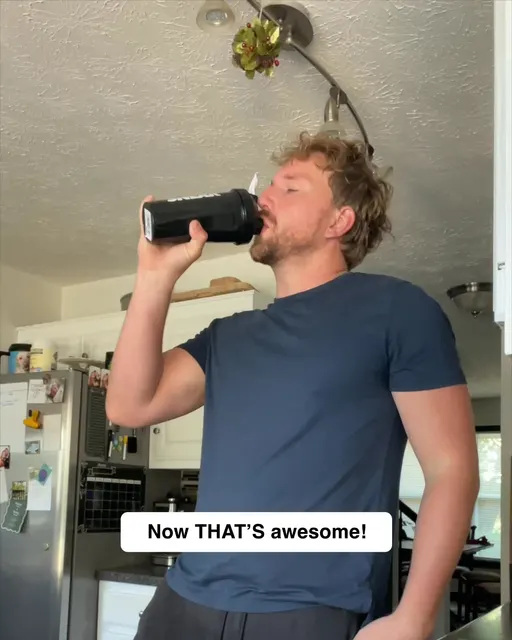
Read what the ad says, not the label it is filed under. sneakenergy.com opens on “I've been stuck drinking the same old energy drinks with that same boring flavor”, and the headline beside it reads “Save $29 on Our Energy Starter Bundle”. What the shopper gets is money off a set of flavours to try, not a window to beat. That offer is as true in July as it is in January. The ad has 292 [eCommerceBenchmark Ad Library, 2026] days on air.
Now picture the other kind. A “this week only” line is true for one week. After that, a brand is paying to show a week that is gone. It is like a calendar page that nobody tore off.
The eCommerceBenchmark Ad Library sorts your ads into the same hooks, angles, concepts and offers used in this report and shows your mix next to the market, so you can see which shapes you have never shipped.
Audit my creatives, freeHere is a thought. A joke about a running app and a saving on a starter bundle look very different. Yet they have something in common. Can you guess what?
What both groups share
In the lines shown, the ad says one thing, and that thing does not go out of date. For the offer-free cards it is a claim about the product, the shop or the company: a steak and where it came from, a shop you can brew at home, a rank from a magazine, a mood. For the deal-led card it is a saving tied to a bundle that stays on the shelf, not to a window in the calendar.
Neither kind of line needs a diary entry to stay true. In these ads, that is the one thing the two groups clearly share. It is our reading of the lines, and the data does not measure it.
You might be thinking: so, copy the oldest ads, right? Hold on. That is the trap, and the next section is about it.
Longevity is not a scoreboard
A long run records one thing: a brand kept an ad live. The eCommerceBenchmark Ad Library holds no spend, sales or profit data, so nothing here says an ad sold anything. The risky habit is reading the oldest rows as proof and copying the oldest line word for word. What this list can show is a shape, not a winner: a first line with nothing in it that can expire.
Copying an old line word for word tests nothing. It tells you who wrote it first.
Three limits travel with this list:
- A few brands fill it. 20 brands hold the hundred rows. spiceology.com holds 17 of them. seattlecoffeegear.com holds 16. liquiddeath.com holds 11. ravecoffee.co.uk holds 11 too [eCommerceBenchmark Ad Library, 2026].
- It favours old ads by construction. A line written last month cannot be on a list ranked by days on air yet.
- The offer label is loose. A free sample can be filed as a trial or a gift, so the split here is the library's label, and we read the words only of the ads we show.
Rows in the hundred held by the four biggest brands. The other brands share the rest. Source: eCommerceBenchmark Ad Library, 2026.
So what do you actually do on Monday? Here is the plan, in four steps.
Your move: two variants to test
- Read your oldest live ad. Offer-free or deal-led, take its first line and mark every word that can go out of date: a month, a price, a percentage, a rank you cannot back up.
- Write an undated claim. One claim about the product, with nothing in it that expires.
- Write a standing deal. Tie it to something that stays: a first order, a subscription or a trial, never a date.
- Test both against the current ad. At least two weeks, the same audience, a split budget, judged by cost per purchase and never by clicks.
The two groups ran about as long as each other at the median: 189 days offer-free. The deal-led median is 177 [eCommerceBenchmark Ad Library, 2026]. So this data cannot say which is better for your shoppers. Your test says which works on yours.
Your test card
Here is how to set up each test from this article, the way a media buyer would run it: your current ad is the control and the new line is the variant. Write your numbers down before you launch.
| Hypothesis | An ad with nothing in its first line that can expire will hold its cost per purchase for longer than my ad with a deadline in it. |
| Change only this | Remove every word that can go out of date from the first line, a month, a price, a percentage or a rank you cannot back up, or swap the deadline for a standing deal tied to a first order or a subscription. |
| Keep the same | Picture, product, audience and placement. |
| Funnel stage | Say first whether this ad is for prospecting (cold) or retargeting (warm). A deal in the first line is often right for warm audiences and wrong for cold ones, so test it where the ad will really run. |
| Setup | One control and one variant, same audience, same placement, even budget split. Do not edit either ad while the test runs. |
| How long and how much | Until each version has about 50 purchases, or two full weeks, whichever comes later. This is general testing practice (Meta's own learning-phase guideline is about 50 results per ad set per week), not a library finding. |
| Success metric | Cost per purchase in the first week against the last full week of the test. The point is how the cost holds up, not only where it starts. |
| Stop rule | Pause a variant that has spent about 3 times your target cost per purchase with no purchase. If it is close, keep it running. |
| What counts as a win | The variant beats the control on the metric by an amount you would act on, and still does in a second week. |
Key takeaways
- 76 of the hundred longest-running food and drink ads we can show carry no offer. The other 24 lead with a deal, and that group holds the longest ad of all, at 1,082 [eCommerceBenchmark Ad Library, 2026] days.
- The typical offer-free ad has run 189 days. The typical deal-led ad has run 177, twelve days behind, and in both groups the typical ad has run about half a year.
- Our own scan of every headline, opening line and body text found no deadline word anywhere in the hundred, so read that as none we could find.
- Bundles are the most common deal among the long runners, 13 of the deal-led rows, and the deal-led ad we show names a starter bundle in its headline rather than a date.
- 20 brands hold the hundred rows and one of them holds 17, so read this as a few brands' habits, never as the market.
- Two variants to test: one undated claim about the product and one standing deal tied to a first order or a subscription, each tested against your oldest live ad as the control.
Questions
76 of the hundred longest-running food ads we can show carry no offer, and 24 lead with a deal. Both groups sit near the same median length, 189 days against 177. So the thing worth keeping is not the absence of a deal. It is a first line with nothing in it that has to be retired. Read the first line of your oldest ad, cross out every word that can go out of date, write one undated claim and one standing deal, then run both against that ad for two weeks.