Shopify Shop Identity Verification: What It Changes for Segmentation

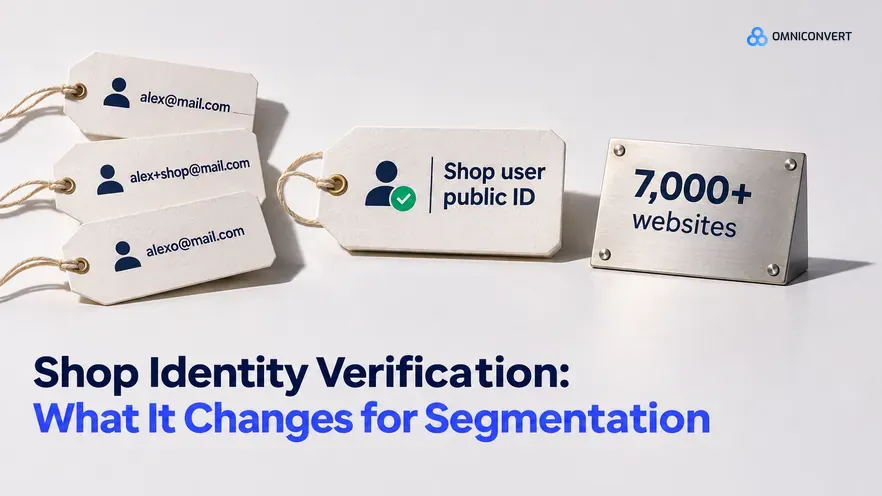
- Shop Pay Wallet and Sign in with Shop return the same value for the same person, the Shop user public ID, and Shopify documents it as a stable identifier that repeats on every payment and every sign-in.
- The gain is cleaner keys, not richer data. The documented sign-in scope is openid email, so you receive a verified address and a stable ID, and nothing about what that buyer bought elsewhere.
- Verified identity fixes the duplicate-record problem that quietly inflates customer counts and deflates repeat purchase rate, because a person who typed three variations of an email is three one-time buyers in an order-keyed segment.
- Recognition now happens before the purchase, so a returning buyer can be segmented on arrival rather than at the thank-you page. That moves personalisation from post-purchase email into the session itself.
- Four limits decide the project: Shop Pay is a prerequisite, the shopUser field is null when a payment cannot be attributed, consent is per scope, and the ID is useless until it is written onto your own customer record.
Identity verification in commerce is the step that turns a typed-in contact detail into an authenticated person. Shopify now supplies it natively: Sign in with Shop and Shop Pay both return the same Shop user public ID for the same buyer, and the sign-in token carries the email address held on the Shop account. The consequence for segmentation is structural rather than cosmetic. Across the CROBenchmark dataset of 7,000+ websites in 15+ industries, assessed against 248+ audit criteria, broken customer identity is one of the most common reasons segmentation underperforms its promise [CROBenchmark Report 2026, Omniconvert].
This guide covers what verified Shop identity actually hands a merchant, why the gain is cleaner keys rather than richer data, the duplicate-record problem it fixes, the four limits that shape the project, and how to re-key existing segments onto a stable identifier without breaking your RFM segmentation.
What is Shopify Shop identity verification?
Identity resolution is defined as the process of matching every interaction, order and session belonging to one real person onto a single customer profile. It matters in eCommerce because almost every downstream decision assumes the profile is a person: lifetime value, churn risk, frequency bands and suppression lists all collapse if one human occupies three rows.
Shopify's July 2026 release opened the same authentication layer to storefront apps, with self-serve OAuth credentials, a drop-in sign-in component that handles consent and session creation, and a recognition signal that tells an app whether Shop already knows a buyer on that store. The developer blog states the point of it in one line: an app receives a verified buyer instead of an email someone may or may not have typed correctly. On new customer accounts, the passwordless six-digit email code is a second path to the same outcome, since an address that received and returned a code has been proven to exist.
The gain is cleaner keys, not richer data
This is where most teams misread the release, and the misreading is expensive because it sets the wrong success metric. A roadmap built on enrichment waits for data that never arrives and concludes the feature underdelivered; a roadmap built on matching sees the benefit in the first week, in the customer count falling and the repeat purchase rate rising without a single extra order. Both teams got the identical feature.
It helps to be precise about which kind of data this is. A verified email and a stable ID are first-party data of the most durable sort, because they do not depend on a cookie, a device or a browser's retention policy. They are not zero-party data: nobody told you their shoe size or their reason for buying. Preferences still have to be asked for, and the verified key is what makes the answers worth storing, since the next session can find them again.
The duplicate-record problem verified identity fixes
A customer database is a map, and the territory is the set of real people who buy from you. Map and territory diverge in one specific, predictable way here: the map always holds more people than the territory, never fewer, because identity fragments and never merges on its own. That asymmetry is why duplicate records are so easy to miss. Nothing in the dashboard looks broken. The customer count is flattering, the average order count per customer is modest, and both numbers agree with each other.
| Identity key | Verified? | Stability | What breaks it |
|---|---|---|---|
| Email typed at guest checkout | No | Low: several per person | Typos, work versus personal addresses, plus-aliases, shared household accounts |
| Browser cookie or device ID | No | Low: several per person, expiring | New device, new browser, private mode, storage limits, cleared cookies |
| Phone number | Sometimes | Medium | Not always collected, reformatted inconsistently, changes with carrier or country |
| Shop user public ID | Yes | High: one per Shop user, repeats on every sign-in and payment | Buyer never signs in; payment that Shopify cannot attribute returns a null shopUser |
The Shopify brands that plateau around a 20% to 25% repeat purchase rate consistently share one pattern: they segment order rows rather than people, so a loyal buyer with four purchases under three addresses sits in the one-time buyer segment and receives acquisition messaging for the rest of the year. The benchmark gap closes fastest when operators treat the resolved customer profile as the primary unit of measurement, not the order count on the dashboard.
In our CVO audits of eCommerce brands through 2026, we consistently see duplicate customer records concentrated exactly where they do the most damage, among the highest-value repeat buyers, because the people who buy most often are the people with the most opportunities to be recorded differently [Omniconvert, 2026]. The remedy is unglamorous: fix the key, then recompute the customer lifetime value that the broken key had been understating.
Recognition moves before the purchase
That shift matters more than it sounds, for a reason that belongs to persuasion rather than engineering. Commitment and consistency, Cialdini's second principle, holds that a small, freely chosen action pulls later behaviour into line with it. A one-tap recognised sign-in is exactly such an action: low cost, visibly voluntary, and it reframes the session from browsing a shop to being a customer of it. The sign-in is not only a data event; it is the first commitment in the session, which is why burying it behind a password form is a conversion decision as much as a plumbing one.
Practically, a recognised buyer makes in-session behavioural segmentation actionable. A known high-value repeat buyer does not need the first-order incentive, and serving it to them is margin given away to someone who was going to buy anyway. A recognised lapsed buyer, by contrast, is the one worth an offer. Same page, same traffic, opposite decision, and the only input that makes the decision possible is identity resolved early.
The size of the effect from a single identity-capture change is easy to underestimate. AliveCor ran one A/B test of a lead collection overlay carrying a discount on desktop with Omniconvert and recorded a 16.74% lift in conversion rate, a 12.98% lift in revenue per user and a 98.1% chance to win [Omniconvert, AliveCor case study]. That was one test on one device, and the reason it belongs in this article is the mechanism: the overlay's job was to turn an anonymous session into a known contact. A verified sign-in does the same job without spending a discount to do it.
Omniconvert Commander resolves every buyer into one profile and scores it on RFM and predicted lifetime value, so a verified identity key becomes a ranked list of segments to act on rather than a cleaner database.
See how it works →The four limits that shape the project
- Shop Pay is a prerequisite. Shopify's own wording is that Shop Pay must be enabled to be eligible for Sign in with Shop. On new customer accounts it is on automatically for stores using Shop Pay or on the Shopify, Advanced or Retail plans; legacy accounts needed it switched on by hand.
- Attribution is not guaranteed. The documentation states that the shopUser field is null when Shopify cannot attribute a payment to a Shop user. Your matching logic needs a documented fallback, not an assumption.
- Consent is incremental. Scopes are additive, so an app requesting more than it previously did triggers a fresh consent prompt. Ask for what you will use, and nothing you cannot explain.
- Coverage is partial by design. Guest buyers who never sign in still exist, which means your customer base will be a mix of verified and unverified identity for the foreseeable future. Plan the segmentation for a mixed population rather than waiting for a clean one.
How to re-key segmentation onto a verified identity
Customer segmentation is defined as dividing a customer base into groups that differ in behaviour or value so that each group can be treated differently. Its accuracy is bounded entirely by identity: a segment can never be more accurate than the matching that assigned people to it, which is why this sequence puts the key before the segments.
- Capture and store the ID. Write the Shop user public ID from the token's sub claim, and from the Shop Pay receipt, onto your own customer record the first time you see it.
- Promote it to primary key. Keep the email address as a contact attribute. Stop using it as the thing that decides whether two records are the same person.
- Merge what it exposes. Expect the customer count to fall. That is the measurement improving, not the business shrinking, and saying so in advance prevents a difficult meeting later.
- Recompute the distorted metrics. Repeat purchase rate, order frequency, average orders per customer and lifetime value all move once duplicates merge. Rerun your cohort analysis on the merged profiles before you trust any trend.
- Rebuild the segments last. Re-run RFM on resolved profiles, and keep a separate, honestly labelled segment for unverified buyers rather than quietly mixing them in.
If a customer data platform already sits between your store and your marketing tools, the verified ID belongs in its identity graph as a deterministic match key, ahead of any probabilistic rule it currently uses. Deterministic beats probabilistic every time it is available, and until now it rarely was.
The metric trap: do not optimise the login rate
The defensible metrics are downstream. Segment stability, the share of revenue attributable to resolved profiles, repeat purchase rate measured on merged customers, and the lift from treating recognised segments differently in-session. Each of those gets better only if identity resolution genuinely improved; none of them can be gamed by gating the checkout. A login-rate target, by contrast, is satisfied perfectly by a forced account creation that costs you orders, which is the oldest own goal in eCommerce and remains one of the conversion problems worth fixing on a Shopify store.
One last piece of discipline. Verified identity makes personalisation newly precise, and precision is not permission. A buyer who signed in to check an order status has not asked to be greeted by name with a reference to what they bought in March. Use the key to decide what you do, and be conservative about how visibly you show that you know. The segmentation gain is real whether or not the customer can see it.
FAQ: Shop identity verification and segmentation
It is the verified buyer identity that Shop provides through Sign in with Shop and Shop Pay. Instead of trusting an address a shopper typed into a guest checkout, the store receives an authenticated identity: an ID token whose sub claim holds the Shop user public ID, and an email claim holding the address on the Shop account. Shopify's developer blog frames the gain plainly, as a verified buyer rather than an email someone may or may not have typed correctly.
No. The documented sign-in request uses the scope openid email, so what a store receives is the Shop user public ID and the verified email address on the Shop account. Nothing in the documentation passes orders, products or spend from other merchants. The practical benefit is a reliable key for matching your own data, not an enrichment feed, and segmentation projects that budget for enrichment are planning against the wrong gain.
Because most segments are keyed on an email address captured at checkout, and the same person supplies different addresses across devices, as well as typos, plus-aliases and a work address at Christmas. Each variation becomes its own customer record with one order attached, so the store looks like it has more customers who buy less often than it really has. Repeat purchase rate falls and frequency-based segments misfire.
Yes. Shopify states that Shop Pay must be enabled to be eligible for Sign in with Shop. On new customer accounts it is turned on automatically for stores using Shop Pay or on the Shopify, Advanced or Retail plans, while legacy accounts required switching it on manually. New customer accounts also sign buyers in with a six-digit email code instead of a password, which is a second route to a verified address.
Store it on your own customer record as the primary identity key, then re-key your segments to it rather than to the email address. Shopify returns it at sign-in in the token's sub claim and after a Shop Pay payment on the payment receipt, so the same person resolves to one profile across devices and sessions. Keep the email as an attribute, and keep a documented fallback for buyers who never sign in.
Omniconvert Commander ingests behavioural and transactional data across the store and resolves it into one profile per customer, then scores each profile on recency, frequency, monetary value and predicted lifetime value so segments describe people rather than orders. That means a verified identity key translates straight into action: the segments that are growing, at risk or ready for an upsell are ranked by profit impact, so budget goes to customers worth keeping rather than to whoever is cheapest to reach.
Verified Shop identity is a plumbing upgrade that reads like a data upgrade, and the difference decides whether the project pays. One stable Shop user public ID per person, repeating on every sign-in and every payment, removes the duplicate records that make a store look like it has more customers buying less often than it really has. Nothing about cross-store behaviour arrives with it. Treat it as the key your customer profile has been missing, re-key the segments to it, and measure the gain where it shows up: in repeat purchase rate and in segment stability, not in the size of the data warehouse. See how Omniconvert Commander resolves customers into one profile before you rebuild a single segment.
Segment people, not order rows
A verified identity key is only worth what your segmentation does with it. Omniconvert Commander resolves every buyer into one profile, scores it on RFM and predicted lifetime value, and ranks the next move by profit impact, so a cleaner customer record turns into a shorter list of decisions.