Zero-Party Data for Ecommerce: How to Collect It Without Cookies

- Zero-party data is declared by the customer, not inferred; it captures intent, motivation, preference, and life-stage that cookies never recorded even at their peak.
- The durable reason to collect it is structural signal loss and rising personalisation expectations, not a Chrome deadline: Google kept third-party cookies in 2025 and shut down Privacy Sandbox instead.
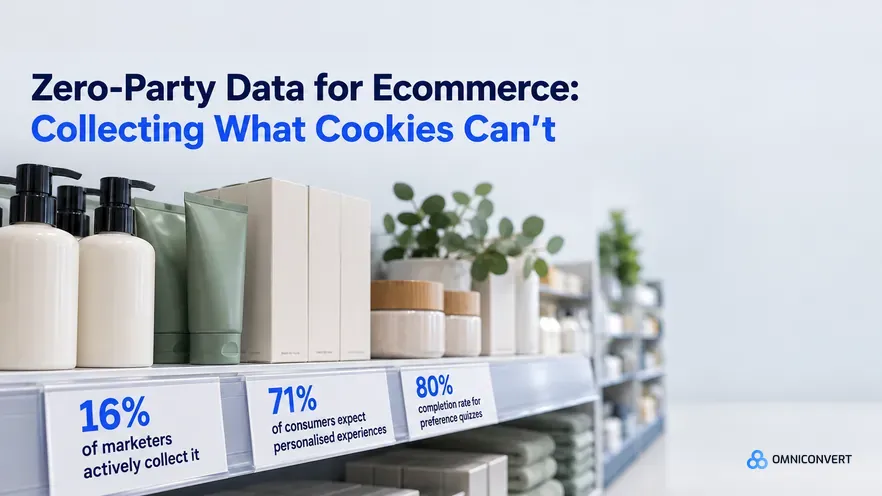
- Only about 16% of marketers actively collect zero-party data, while roughly 71% of consumers expect personalised experiences, so the adoption gap is the opportunity.
- Every collection ask must return proportional value: a better fit, a sharper recommendation, or a perk. The moat is what you give back, not the data itself.
- Collect progressively across the lifecycle and keep the loop continuous with Voice-of-Customer feedback, so declared data stays fresh and feeds segmentation and CLV.
Zero-party data is information a customer intentionally and proactively shares with a brand, such as a preference, a budget, a life-stage, or a reason for buying. It is the one customer signal that is declared, not inferred, which is exactly what tracking cookies never captured even at their peak. Yet only about 16% of marketers actively collect it, while roughly 71% of consumers now expect personalised interactions and grow frustrated when they do not get them [CROBenchmark Report 2026, Omniconvert].
Nexus by Omniconvert is the AI eCommerce growth engine that joins declared preference to behaviour and turns it into ranked retention actions. This guide covers what zero-party data is, why the case for it is structural rather than a browser deadline, what cookies could never record, the value-exchange rule that governs collection, where to gather it across the lifecycle, and how to turn it into segmentation and lifetime value. Each section answers the question directly, then goes deeper.
What is zero-party data?
The distinction that matters is declared versus inferred. First-party data is defined as behaviour you observe on your own store: pages viewed, items added to cart, orders placed. It is yours, it is consent-clean, and it is valuable, but it is still a record of actions you have to interpret. Zero-party data removes the interpretation step. When a customer states their skin type, their budget, or that they are shopping for a newborn, you are not guessing intent from a click path; you have the intent itself.
This is why the two data types are complementary rather than competing. First-party behaviour tells you a customer viewed three pairs of running shoes; zero-party data tells you they are training for a first marathon and have a wide foot. The behaviour narrows the catalogue; the declaration finishes the job. A store that has both can personalise with a precision that no volume of tracking alone reaches, because motivation is stated rather than modelled.
Why does zero-party data matter now that signal loss is structural?
It is worth being precise here, because most articles on this topic are not. Chrome did not deprecate third-party cookies. In 2025 Google reversed course, chose to keep them, and on 17 October 2025 shut down the Privacy Sandbox initiative built to replace them. If your case for zero-party data rested on a Chrome deadline, that case just evaporated. The stronger case never needed the deadline.
Signal loss is structural and already here. Safari and Firefox block third-party cookies by default, which removes a large share of web traffic from cross-site tracking before Chrome is even in the conversation. Apple's App Tracking Transparency prompt suppresses most mobile ad tracking. And according to Gartner, privacy regulation now covers roughly 75% of the world's population, so consent walls and data-minimisation rules degrade inferred signal everywhere at once. Search interest reflects the shift: demand for the term zero-party data has grown around 250% year over year (Cohora, BrightEdge).
At the same time, the bar for relevance has risen. About 71% of consumers expect personalised interactions (McKinsey), and roughly 60% say they will share personal information in exchange for tailored recommendations (Adobe), rising to 75% for brands they already trust (Salesforce). The inputs that fuel personalisation are shrinking while expectations climb. Zero-party data is the only source that moves in the right direction, because the customer supplies it on purpose.
What cookies never captured
The reason zero-party data is not just a privacy-era substitute for cookies is that it captures a fundamentally different class of information. Cookies were always a behavioural proxy. They watched what people did and inferred what they might want, which works passably for retargeting a viewed product and poorly for almost everything that matters more: why the person is shopping, what constraint they are under, what stage of life they are in, what they would buy next if you asked.
Consider a customer browsing a home-goods store. Cookie-derived data sees the category pages and the abandoned cart. It cannot distinguish a renter furnishing a first flat from a homeowner renovating a kitchen, though the two want completely different recommendations, price points, and email cadences. Ask the question directly, in a quiz or a preference centre, and the ambiguity disappears. Across the 7,000+ stores in 15+ industries in the CROBenchmark dataset, brands that fed declared preference back into messaging grew repeat-purchase rate roughly twice as fast as those relying on inferred behaviour alone [CROBenchmark Report 2026, Omniconvert]. In our Customer Value Optimization work with ecommerce brands, we consistently see the same gap: stated intent predicts the next order better than any behavioural score built from tracking [Omniconvert, 2026].
What is the value-exchange rule for collecting zero-party data?
Zero-party data programmes live or die on a single behavioural principle. Reciprocity, in Robert Cialdini's sense, means people feel obliged to return a favour, and it runs both ways: when a customer gives you a declaration, they expect something proportional back, and when you give first, they are more willing to share. The tired play, a quiz whose only purpose is to capture an email, breaks the trade. The customer does the work and gets a discount code that treats them exactly like everyone else. Nothing they told you changed what happened next, so they learn not to bother.
The fix is to make the payoff immediate and legible. A skincare quiz that returns a genuinely tailored routine, a fit-finder that ends product-size anxiety, a preference centre that visibly reduces irrelevant email: each returns value the moment the customer invests effort. This is also why friction is not the enemy people assume. The endowment effect, and the related IKEA effect, describe how effort increases attachment: a customer who invests a minute building a preference profile values the resulting experience more and feels a measure of ownership over it. The effort is not a cost to minimise to zero; it is part of what makes the outcome feel earned, as long as the outcome is real.
Nexus by Omniconvert joins the preferences customers declare to what they actually do, so the value you return is targeted, not generic.
See how it works →Where can you collect zero-party data across the ecommerce lifecycle?
The mistake is to treat collection as one event. Progressive disclosure, paired with the commitment-and-consistency principle, says to start with a small, low-stakes ask and deepen it as trust builds, rather than confronting a new visitor with a fifteen-field form. Each of the following moments is a natural, well-timed ask:
- Onboarding and style quizzes: At acquisition, a short quiz that returns a tailored result. This is the highest-intent moment and the one that converts a browser into a known customer.
- Preference centres: At signup and in-account, let customers state what they want to hear about and how often. This alone cuts unsubscribes and raises email relevance.
- Post-purchase surveys: After delivery, ask why they bought and whether the product fit. This captures motivation while it is fresh and flags fit problems before they become returns.
- Ongoing NPS and Voice-of-Customer feedback: Through the relationship, recurring feedback keeps the profile current and surfaces changing needs, which is where retention is won.
When the exchange is fair, completion is not the barrier it is assumed to be. Consumer brands running well-designed preference quizzes report completion rates above 80%, with some reaching around 90% (BlueConic). People will tell you a great deal about themselves when the question is relevant and the payoff is clear.
Case study: AliveCor used Omniconvert to run a structured A/B testing programme and achieved a 21% lift in conversion rate, a 5% increase in revenue per visitor, and 94% statistical relevance across their experiments, evidence that a disciplined, feedback-led approach to what customers actually want moves the numbers that matter [Omniconvert, AliveCor case study].
How do you turn zero-party data into segmentation and CLV?
Zero-party data sitting in a survey tool changes nothing. Its value appears when a declaration is joined to what the customer actually does and to what they are worth. A customer who states a preference for a product line, and whose RFM score marks them as high-value and recently active, is a different opportunity from a lapsed one-time buyer who stated the same preference. The declaration sharpens the message; the behavioural and monetary data decides the priority.
This is the bridge from zero-party data to customer lifetime value. Declared preference cuts the irrelevant messaging that drives unsubscribes, reduces returns caused by poor product fit, and raises repeat purchase rate by timing the next offer to a stated need rather than a guessed one. Each of those is a direct input to CLV. The brands that grow lifetime value fastest are not the ones with the most data; they are the ones that act on the most relevant data per segment, which is exactly what declared preference makes possible.
The ecommerce brands that plateau at a 20% repeat-purchase rate consistently share one pattern: they collect preference data and never route it into targeting, so the same broadcast email goes to a marathon trainee and a casual walker who both told the brand who they were. The benchmark gap closes fastest when operators treat declared preference as a first-class segmentation input, not as a form field logged and forgotten.
How do you build a continuous zero-party data loop?
The single biggest reason zero-party data disappoints is that brands collect it once and treat it as permanent. A customer's stated preferences at signup describe who they were then, not who they are two seasons later after a house move, a new job, or a change in taste. Data that is never refreshed does not just lose value; it actively misleads, because you keep personalising to a customer who no longer exists.
The answer is a continuous Voice-of-Customer loop rather than a one-time form. A recurring NPS or feedback cadence, run through a tool such as Pulse by Omniconvert, keeps asking small, well-timed questions across the relationship, so the profile updates as needs shift and the brand hears about a problem while it is still fixable. This is the same progressive-disclosure principle applied over time: never everything at once, always a little more, always in exchange for value. Feed that stream into Customer Intelligence in Nexus, and declared preference is joined to RFM segments and predicted lifetime value continuously, so the data stays current and the next action is always based on what the customer wants now.
What common zero-party data mistakes should you avoid?
Zero-party data is easy to collect badly, and a bad programme trains customers not to share. The mistakes that recur:
- Over-asking too early: A long form for a first-time visitor with no established trust. Start small and deepen the ask across the lifecycle instead.
- No payoff: Collecting a declaration and returning nothing the customer can see. If the answer does not change the experience, the customer learns the question was extractive.
- Letting data go stale: Treating a signup preference as permanent. Needs change; without a refresh cadence you personalise to a customer who no longer exists.
- Never routing it into action: Logging preferences in a tool that does not touch messaging or segmentation. Declared data has value only when it changes what happens next.
- Confusing it with first-party data: Assuming behavioural tracking can substitute for a declaration. Behaviour shows what; only a declaration reliably gives you why.
Avoiding these is less about tooling and more about respect for the trade: ask for a little, give back visibly, keep the conversation going, and act on what you hear.
Zero-party data for ecommerce: FAQs
Zero-party data is information a customer intentionally and proactively shares with a brand: their preferences, purchase intent, life-stage, and motivations, collected through quizzes, preference centres, and surveys. It is declared by the customer rather than inferred from tracking, which makes it both more accurate and free of the consent problems that degrade cookie-based signals. In ecommerce it is the signal that tells you why a customer is buying, not just what they clicked.
First-party data is behaviour you observe on your own store: pages viewed, products added to cart, orders placed. Zero-party data is stated directly by the customer, such as a declared preference, budget, or reason for buying. First-party tells you what a customer did; zero-party tells you why and what they want next. The two are complementary, but only zero-party data captures intent and motivation that no amount of tracking can infer reliably.
Yes. Google kept third-party cookies in Chrome, but Safari and Firefox already block them by default, covering roughly a third of web traffic, and iOS App Tracking Transparency plus privacy laws now covering about 75% of the world's population keep degrading tracked signal. Declared data is also simply more accurate for personalisation than inferred behaviour, so zero-party data is the more durable foundation regardless of what any single browser decides.
Make the exchange fair and obvious. Ask only for what visibly improves the experience, return value immediately in the form of a better fit, a sharper recommendation, or a relevant perk, and collect progressively across the lifecycle rather than demanding everything at signup. When the payoff is clear, completion is high; preference quizzes run by consumer brands reach 80% and above. Friction only hurts conversion when the customer cannot see what they get back.
Declared preferences sharpen segmentation and personalisation, which cuts irrelevant messaging, reduces returns from poor product fit, and raises repeat purchase rate. Collected continuously rather than once, zero-party data also tracks how a customer's needs change over time, which is what retention and lifetime value depend on. A brand that knows a customer's stated intent can time the next offer to the need rather than guessing from a click, and relevance is what compounds into loyalty.
Nexus by Omniconvert ingests declared preferences from surveys and Voice-of-Customer feedback alongside behavioural and transactional data, so a stated intent is joined to what the customer actually does. It maps those combined signals to RFM segments and predicted lifetime value, then ranks the actions worth taking, so declared data becomes targeting and retention moves rather than a survey result nobody reads. The collection loop stays continuous, keeping the data fresh instead of a one-time snapshot.
Zero-party data is the one customer signal that survives every privacy shift, because the customer chose to give it. With only about 16% of marketers collecting it and roughly 71% of consumers expecting personalisation, the gap between what buyers will tell you and what brands bother to ask is the clearest advantage left in ecommerce. Treat collection as a continuous value exchange, not a one-time capture, and feed declared preference into segmentation and lifetime value. See how Customer Intelligence in Nexus by Omniconvert turns declared data into ranked retention moves.
Turn declared preference into retention with Nexus
Nexus by Omniconvert joins the preferences customers declare to what they actually do, maps both to RFM segments and predicted lifetime value, and ranks the actions that protect the most revenue. Stop guessing intent from clicks and start acting on what customers tell you directly.