Albert.ai vs WASK vs Omniconvert Commander (2026): Autonomy vs affordability
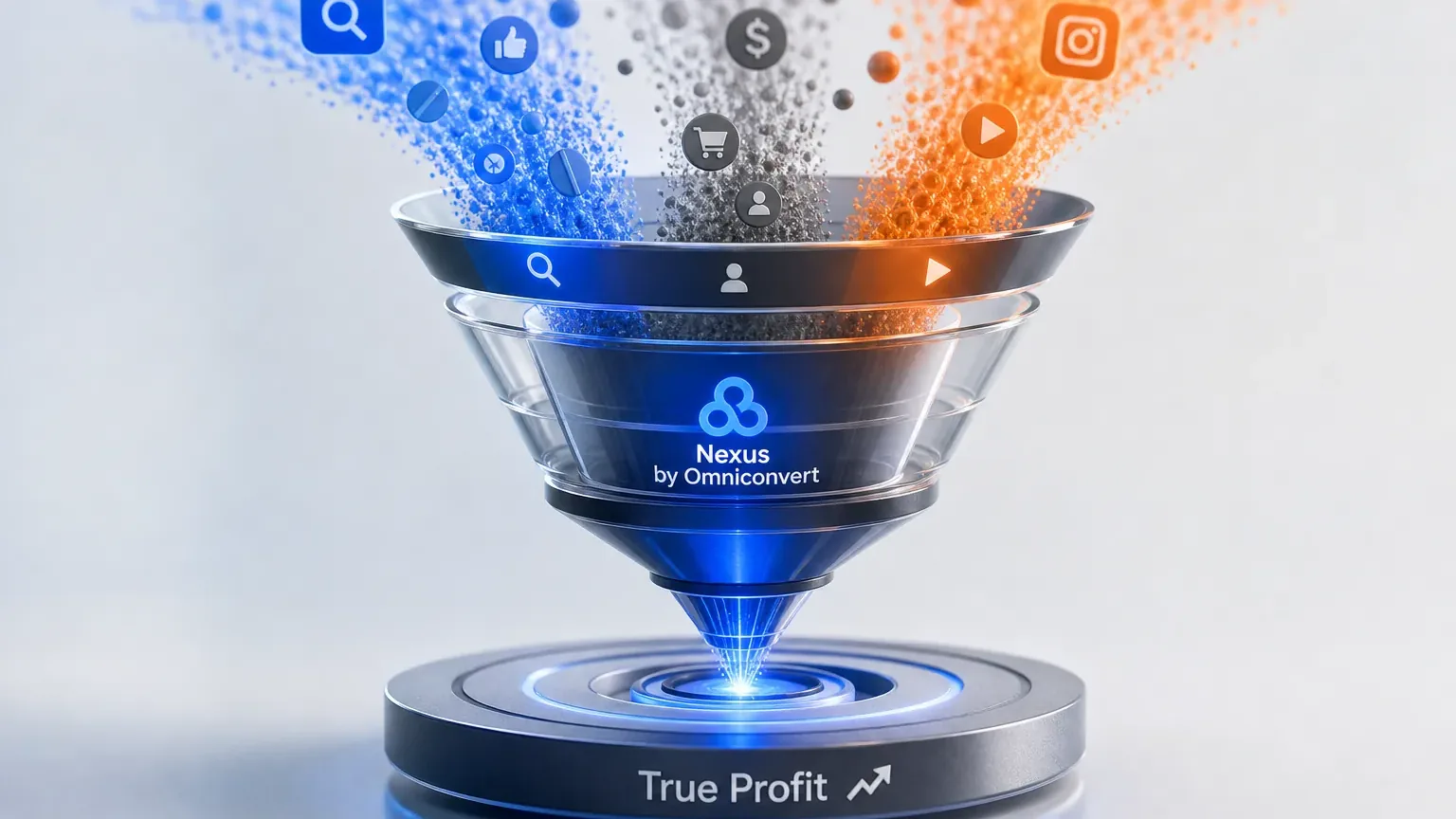
Albert.ai and WASK both automate ad buying. Albert.ai runs fully autonomous cross-channel media buying for enterprise, making bid and budget decisions without human approval. WASK makes affordable Facebook and Google ad automation for SMBs. Neither reads customer lifetime value or True Profit. Omniconvert Commander is built for that strategic layer.
- Albert.ai is built for fully autonomous cross-channel media buying: real-time bid, budget, and targeting decisions across search, social, and programmatic without human approval.
- WASK is built for affordable SMB ad automation: campaign setup, plain-language AI recommendations, and basic creative tools priced as a share of monthly ad spend.
- Both tools share the same blind spot: neither reads twelve-month CLV, churn risk, or True Profit.
- When ROAS appears healthy but margin stays flat, Omniconvert Commander provides the intelligence layer that sits above Albert.ai or WASK.
A DTC growth team comparing Albert.ai vs WASK is usually sitting at opposite ends of the same market: one wants enterprise-grade autonomous media buying, the other wants affordable ad automation without a marketing team. Albert.ai makes real-time bid and budget decisions across search, social, and programmatic without human approval. WASK makes Facebook and Google ad management accessible to small businesses, priced as a share of monthly ad spend. Neither reads which customer segments carry the highest lifetime value, or whether the spend improved True Profit rather than ROAS.
What is Albert.ai, and what is it actually good at?
Albert.ai hands campaign control to an AI engine. After setup, it makes real-time bid, budget, targeting, and channel decisions across paid search, social, and programmatic, without human approval for each action. It is built for enterprise teams that want always-on ad management. [Albert.ai, 2026]
Albert.ai connects to your ad accounts and takes over the operational decisions. It sets bids, shifts budgets, and adjusts audience targeting continuously, learning from campaign data as it runs. The pitch is autonomy: remove the human from the media buying loop.
This comparison sits in the autonomous media buying category. The buyer is an enterprise brand or agency that wants an always-on AI managing spend across channels. Albert.ai runs paid search, social, and programmatic in a single system, around the clock.
Albert.ai reviews praise the hands-off automation and cross-channel reach. They also flag the trade-off every autonomous system carries: the decisions are hard to audit or override in detail.
Autonomous media buying is ad management where the system makes bid, budget, and targeting decisions in real time without human approval for each action. The operator sets goals and guardrails; the AI executes continuously. Control shifts from manual campaign edits to configuration and oversight.
Where Albert.ai is genuinely strong
- Fully autonomous: makes real-time bid and budget decisions without human approval per action, 24/7.
- Cross-channel by default: operates across paid search, social, and programmatic in one autonomous system.
- Continuous learning: improves targeting and allocation efficiency from campaign data without manual reconfiguration.
Where Albert.ai hits its ceiling
- Black-box optimisation: bid and budget decisions happen inside Albert.ai's model, making them hard to audit, interpret, or override at a granular level.
- No CLV or segment intelligence: optimises for conversion events, not twelve-month customer lifetime value.
- Enterprise pricing and minimum spend: not accessible for SMB or early-stage DTC brands.
Albert.ai is a strong specialist for one job: running spend autonomously. The ceiling shows up when teams realise autonomous optimisation without a margin signal scales acquisition in the wrong direction.
What is WASK, and what is it actually good at?
WASK is an SMB-focused advertising platform that simplifies Facebook and Google ad management. It combines campaign setup, AI optimisation recommendations, and basic creative tools in one place, priced for small businesses without a marketing team. Entry pricing is a share of monthly ad spend. [WASK, 2026]
WASK takes the complexity out of running Facebook and Google ads for a small team. It handles campaign setup, suggests audience targeting, and offers basic creative tools, all in one dashboard. The pitch is accessibility, not enterprise depth.
The category is SMB social ad automation. The buyer is a small business owner or solopreneur running their first or second paid campaigns. WASK gives plain-language optimisation recommendations to people who lack the time to tune campaigns manually.
WASK reviews praise the low price and ease of use. They also flag the ceiling: WASK is built for SMB budgets, not brands scaling past them.
SMB ad automation packages campaign setup, audience targeting, and optimisation into one affordable tool for businesses without a dedicated marketing team. It trades enterprise depth and customisation for simplicity and price, so a non-specialist can launch and manage ads.
Where WASK is genuinely strong
- Low-cost entry: makes AI ad optimisation accessible to SMBs spending as little as $500 a month on ads.
- All-in-one for small teams: combines campaign setup, targeting, and basic creative tools, reducing tool count.
- Plain-language recommendations: AI optimisation guidance for operators who lack the expertise to tune campaigns manually.
Where WASK hits its ceiling
- SMB-grade ceiling: not suited to brands above $50k monthly ad spend that need enterprise features.
- Basic creative tools: far behind specialist generation tools on volume, quality, and format variety.
- No CLV or customer intelligence: audience and creative decisions rest on platform signals, not customer data.
WASK is a strong pick for its stage: affordable, accessible ad automation. The ceiling arrives the moment a brand grows past SMB budgets and needs customer segment intelligence to keep scaling profitably.
Albert.ai vs WASK vs Omniconvert Commander: the capability comparison
Albert.ai handles autonomous cross-channel media buying. WASK handles affordable SMB ad automation. Omniconvert Commander handles the layer above both: which customer segments to target, which message earns their spend, and whether the result improved True Profit, not just ROAS.
| Capability | Albert.ai | WASK | Omniconvert Commander |
|---|---|---|---|
| Primary function | Autonomous cross-channel media buying without human approval | Affordable Facebook and Google ad automation for SMBs | Growth intelligence that works above ad execution |
| Unified commerce data | Partial: unifies cross-channel media buying data, not CLV or customer commerce data | No: paid, email, CRO, and retention data live in separate silos with no shared data layer | Yes: unified data view across every stack layer |
| AI-prioritised experiment queue | Full: bids, budgets, and channel allocation are adjusted autonomously in real time without human sign-off | Partial: AI recommendations for SMB campaign optimisation, basic, not CLV-driven | Yes: recommended actions are ranked by their projected impact on margin |
| Creative generation | No: Albert.ai buys media, it does not generate creative | Partial: template-based creative tools are available but high-volume AI creative generation is not | Yes: ad variants prioritised by customer lifetime value weighting |
| True Profit tracking | No: optimises conversion events, no margin or return-rate signal | No: platform metrics only, no cohort margin view | Yes: reports margin by campaign and cohort, not just ROAS |
| CLV and segment intelligence | No: no lifetime value or churn signal informs autonomous decisions | No: decisions rest on platform signals, not customer data | Yes: cohort analysis, RFM segmentation, churn prediction, NPS signal |
| Autonomous action layer | Full: fully autonomous media buying, real-time cross-channel decisions without human approval | No: recommendations only, human executes each change | Yes: data flows directly into action without a human coordination step in between |
| AI creative briefing | No: no brief layer, Albert.ai acts on channel signals | No: no CLV-driven brief, creative is templated | Yes: each brief draws on CLV, NPS, and review data as its source inputs |
| Pricing model | Enterprise tier; request a quote at albert.ai | Subscription cost is calculated as a share of monthly ad spend; see current rates at wask.co | A free plan is included; paid plans start at $49/month. See full Omniconvert Commander pricing |
| Best for | Enterprise brands wanting always-on autonomous media buying across search, social, and programmatic | Small businesses running their first or second Facebook and Google campaigns without a marketing team | eCommerce brands above $1M ARR that prioritise margin over raw ROAS gains |
| Integrations | Meta · Google · TikTok · Amazon · Programmatic DSPs | Meta · Google | Shopify · Klaviyo · Meta · Google · TikTok · GA4 · Triple Whale |
| User rating | No independent rating cited | No independent rating cited | 5.0 out of 5 (Shopify App Store, 63 reviews, as of November 2026) |
Albert.ai and WASK columns reflect publicly available feature documentation as of July 2026.
What Albert.ai and WASK cannot do
The shared blind spot sits upstream of the ad account. Albert.ai and WASK both execute against a target you hand them. Neither reads twelve-month CLV, neither flags which segments are about to churn, and neither tells you whether spend improved True Profit.
Albert.ai takes humans out of individual media buying decisions entirely. Omniconvert Commander supplies the CLV signal Albert needs to know which conversions are actually worth acquiring, separating a customer with an 800 dollar twelve-month CLV from a one-time buyer who never returns. Running autonomous optimisation without that margin input means scaling acquisition efficiently toward the wrong customers.
WASK puts Facebook and Google ad tools within budget for small businesses. Omniconvert Commander addresses a different problem: brands that have moved beyond the SMB phase and need True Profit measurement, customer segment intelligence, and strategic prioritisation to grow margins, not just ad volume.
Both Albert.ai and WASK are built around a shared assumption: that you already know which customers to target and which message to use. Both tools focus on running that assumption efficiently. Neither questions it.
What neither tool can tell you
- Which buyers are worth targeting with more ad spend. A twelve-month CLV view, not last-click attribution, tells you which segments deserve the next round of spend.
- Which segments are within 60 days of churning. That early signal lives in NPS scores, review sentiment, and support patterns, not in a media buying dashboard.
- Did that last campaign grow True Profit, or did it only lift ROAS? ROAS numbers can rise while net margin shrinks; catching that gap requires a measurement approach that starts from margin, not revenue.
- The messages your best customers actually act on. That signal is buried in NPS verbatims, reviews, and support transcripts. Neither Albert.ai nor WASK surfaces it automatically; extracting it stays a manual task.
Omniconvert Commander is designed to work at exactly this layer. It draws on CLV data, NPS signals, review intelligence, and competitor creative inputs to produce a ranked action queue before a brief is written or a campaign launched. True Profit, not ROAS, is the metric Omniconvert Commander targets.
True Profit means the net margin left after CAC, COGS, return rates, and cohort-level acquisition costs are subtracted from revenue. Gross revenue is not True Profit, and neither is ROAS. This is the amount the business walks away with. Omniconvert Commander treats it as the central metric that every experiment is measured against.
Over 14 months, LEROY MERLIN Romania ran 46 experiments with Omniconvert, achieved a 39.13% win rate, and lifted website revenue by +6.27%. [LEROY MERLIN Romania results with Omniconvert]
This is not a replacement for Albert.ai or WASK. Both still run the ads. Omniconvert Commander sits above them as the intelligence layer that determines which brief to send and then checks whether the outcome moved the number the business actually keeps.
Which tool is right for you?
Pick Albert.ai if your bottleneck is autonomous media buying at enterprise scale. Pick WASK if it is affordable ad automation for a small team. Add Omniconvert Commander when ROAS looks fine but margin is not improving, and data assembly eats hours before any decision.
Choose Albert.ai if
- Full automation is the goal: you want media buying decisions made across search, social, and programmatic without human approval per action.
- You are at enterprise scale: you want an always-on AI media buyer that operates continuously and self-optimises.
- You want to reduce headcount: you want to cut media buying headcount while maintaining or improving cross-channel performance.
Choose WASK if
- You run a small budget: you spend $500 to $10,000 a month on Facebook or Google ads and need an affordable platform.
- You have no dedicated marketing team: you want AI optimisation recommendations in plain language.
- You want one affordable tool: campaign management and basic creative tools together, without enterprise complexity.
Add Omniconvert Commander if
- Data assembly eats your day: before anyone makes a decision, more than 2 hours each day go toward pulling figures out of disconnected tools.
- Your paid spend runs without margin visibility: you have no reliable view of which customer segments drive the highest margin.
- You want experiments ranked before sprint planning: you need to know which tests deserve dev or creative time before sprints are assigned.
- ROAS hides a margin problem: ROAS holds steady or rises while net margin fails to improve quarter-on-quarter.
What each tool cannot do, honestly
Albert.ai, WASK, and Omniconvert Commander each have real limits. Treated as rivals for one job, those limits stay hidden. The honest framing: they sit at different layers. Two execution tools for two very different budgets, and one intelligence layer above both. None is a complete answer alone.
Where Albert.ai will not stretch
- Not a strategy tool: Albert.ai will not tell you which segment to target or which angle converts for your customers.
- Not a margin system: Albert.ai optimises conversion events, with no view of COGS, return rates, or CAC at cohort level.
- Not for small budgets: enterprise pricing and minimum spend put it out of reach for SMB and early-stage brands.
Where WASK will not stretch
- Not for scale: WASK is built for SMB budgets, not brands above $50k monthly ad spend that need enterprise features.
- Not a creative specialist: its template-based tools trail specialist generators on volume, quality, and format variety.
- Not a CLV system: audience and creative choices rest on platform signals, with no customer intelligence input.
Where Omniconvert Commander has real prerequisites
- Data unification comes first: an intelligence layer is only as good as the data feeding it, and fragmented inputs produce unreliable ranked queues.
- Strategy and brand judgment stay human: Omniconvert Commander coordinates execution, not category positioning or brand voice.
- Revenue-stage threshold: returns compound above $1M ARR, where data volume justifies the layer and the cost of manual coordination becomes measurable.
See where your store stands against real competitors in your category and country. Ecommerce Benchmark scores six areas free: Creative & Ads, Reviews & UGC, AI Visibility, Agentic Commerce, Competitor Synthesis, and CRO.
Benchmark Your Store FreeFrequently Asked Questions
The verdict
Albert.ai is the specialist when you want fully autonomous media buying across search, social, and programmatic without human approval. WASK is the specialist when a small business needs affordable Facebook and Google ad automation without a marketing team. Neither reads customer lifetime value or margin. Add Omniconvert Commander above whichever tool fits your stage.
Albert.ai and WASK are both capable tools, but they serve almost opposite buyers. If the primary need is autonomous cross-channel media buying at enterprise scale, Albert.ai is the specialist. If it is affordable Facebook and Google ad automation for a small team, WASK wins.
The more difficult question is whether your team can reliably determine who to target, what message to use, and whether the outcome held up at the margin level. That question sits outside what Albert.ai and WASK address, and it is the specific problem Omniconvert Commander, the third tool compared on this page, is built to solve.
Stop assembling data.
Start supervising growth.
Omniconvert Commander brings your eCommerce data into a single layer, flags revenue anomalies, and produces a prioritised action queue, so your team can focus on running the P&L instead of wiring tools together.
5.0 out of 5 across 63 reviews, Shopify App Store , as of November 2026