What Is an AI eCommerce Growth Engine? A Category Definition and Buying Guide

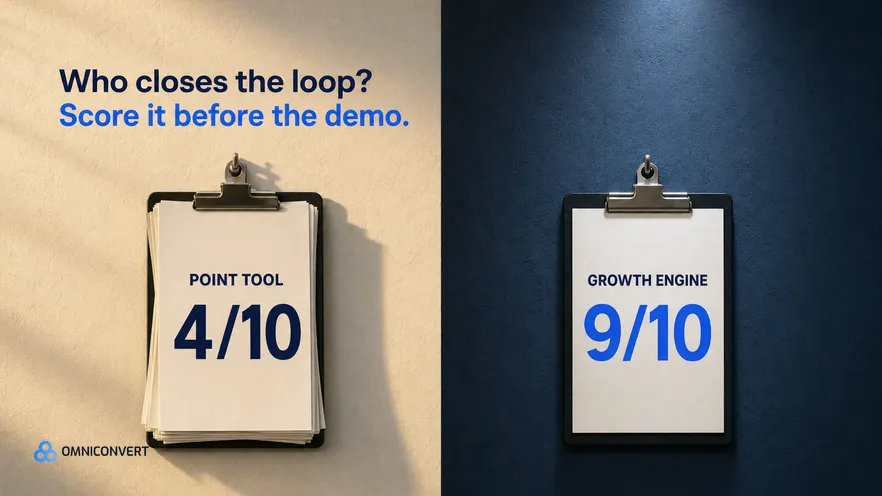
- An AI eCommerce growth engine closes the loop from data to action: detect, prioritize, create, launch, measure, learn. Point tools handle one step. Analytics tools stop at the report.
- An AI eCommerce platform is a broad suite of AI features that people coordinate. A growth engine owns one job, growing profit, and runs the whole loop itself, with human approval before launch.
- The 5 Criteria for an AI eCommerce Growth Engine: unified first-party data layer, proactive detection and prioritization, execution with human approval, profit-based measurement, closed learning loop.
- Use the 10-Point AI eCommerce Growth Engine Scorecard before any demo. A 9 or 10 indicates a growth engine. Below 5 indicates a point tool or dashboard with growth engine marketing.
- Data readiness decides results. Gartner predicts that through 2026, organizations will abandon 60% of AI projects unsupported by AI-ready data. [Gartner, 2025]
To qualify as an AI eCommerce growth engine, software must meet five criteria: a unified first-party data layer, proactive detection and prioritization, execution with human approval, profit-based measurement, and a closed learning loop. If a person still carries insights between tools, you are buying a point tool, a feature suite, or a dashboard.
An AI eCommerce growth engine is software that closes the loop from data to action for an online store. It finds what costs you profit and what could earn you more. It decides what to do first, builds and launches the response once you approve it, and measures whether it worked. Then it uses that result to choose the next move.
The category exists because most eCommerce teams already own plenty of AI. They have a reporting tool, a creative generator, an email tool with predictive send times, and ad accounts with automated bidding. What they lack is the connection. People still move insights between those tools by hand, which is the Human Middleware Problem. A growth engine removes that manual layer.
Nexus by Omniconvert is the AI eCommerce growth engine for Shopify brands, built on Omniconvert's 13 years in eCommerce and 70,000+ experiments. This guide defines the category and separates it from the AI eCommerce platform, point tools, and analytics software. It then gives you five criteria and a 10-point scorecard to test any vendor claim. For the difference between AI that assists and AI that acts, see the AI for eCommerce practitioner's guide.
What is an AI eCommerce growth engine?
The definition is functional. It describes what the software does, not how the vendor labels it. Three words carry the weight: loop, action, and profit.
Loop. A growth engine connects every stage, from the first signal to the measured result. If a person must export a report, write a brief, or copy a winning angle into the next campaign, the loop is open at that point.
Action. A growth engine produces work that ships: a test, an ad set, an email, an audience. A recommendation that waits in a dashboard is not action. Neither is a chat answer that tells you what to do next.
Profit. A growth engine decides and reports in profit. Revenue and ROAS can rise while margin falls, through discounts, returns, or expensive shipping. An engine that cannot see costs cannot tell a good result from a costly one.
The six stages of the growth loop
-
DetectThe engine watches store, ad, and customer data all the time. It flags anomalies, such as a drop in checkout conversion or a spike in acquisition cost. It also mines opportunities, such as a high-value segment that no campaign targets.
-
PrioritizeIt ranks every finding by expected profit impact, so the team sees the most valuable action first. A long, unranked list of insights is not prioritization.
-
CreateIt turns the top opportunity into a hypothesis with a success metric. Then it produces what the test needs: ad creative (including video), copy, audiences, or test variants. It works from customer and test data, not only from a brand kit.
-
LaunchAfter a person approves, it launches the campaign or experiment in the right channel: Meta, Google, the site, or email. Guardrails decide what needs approval and which spend limits apply.
-
MeasureIt measures results in profit after COGS, shipping, and returns. It also tracks the value of the customers each action brings in. Channel-reported ROAS is an input, not the verdict.
-
LearnWins and losses feed back into detection and ranking. The next brief starts from what the last test proved, and nobody has to carry the lesson between tools.
Most AI software for eCommerce covers one or two of these stages well. That is useful, but it is a component. The category question is whether the software runs all six stages without a person bridging the gaps.
AI eCommerce growth engine vs AI eCommerce platform, point tools, and analytics
These categories overlap in marketing copy, so compare them on function. The table below uses six dimensions. Each one decides how much manual work stays with your team.
| Dimension | Analytics and BI | Point AI tool | AI eCommerce platform | AI eCommerce growth engine |
|---|---|---|---|---|
| Question it answers | What happened? | How do I do this one task better? | Which AI feature do I use for this job? | What should we do next, and did it make money? |
| Data scope | Many sources, read-only | One channel, or one or two sources | Broad, usually organized by module | Store, ad, customer, experiment, and cost data in one layer |
| Output | Reports and dashboards | An improved asset or a recommendation in one channel | Features across search, merchandising, marketing, and service | Ranked opportunities, hypotheses, assets, and launched tests or campaigns |
| Who acts | A person interprets, decides, and acts in other tools | A person decides, and the tool runs one step | People connect outputs between modules | The engine prepares and launches, and a person sets guardrails and approves |
| Success metric | Whatever the report tracks | Channel metrics: CTR, open rate, ROAS | Module metrics, often reported separately | Profit after COGS, shipping, and returns, plus customer lifetime value |
| Learning | An analyst carries the insight forward | Learns inside its own channel | Manual transfer between modules | Every result feeds the next cycle |
Growth engine vs AI eCommerce platform
An AI eCommerce platform is a broad suite. It can include AI search, product recommendations, generated product descriptions, predictive email, and a support chatbot. Each feature can be strong. But the suite is organized around operations, and your team still decides which feature to use, when to use it, and how to connect the results.
A growth engine is organized around one outcome. It does not try to run your storefront or your support desk. It runs the loop that finds, launches, and measures growth actions. Breadth is the strength of a platform. A closed loop is the strength of a growth engine. Many brands use both, because the two solve different problems.
Growth engine vs point AI tools
A point tool is excellent at one step: generating ad creative, predicting churn, writing subject lines, or attributing revenue. The limit is the hand-off. The creative tool does not know which segment lost margin last week. The churn model does not launch the win-back test. The 4-category AI eCommerce tools map sorts these tools by the job they do.
Growth engine vs analytics and BI
Analytics and BI software answer questions. Many now add AI summaries and natural-language queries, so the answers arrive faster. The work still ends at the answer. A growth engine treats the answer as the start of the work: it ranks the issue, prepares the response, and launches it for approval.
Growth engine vs marketing automation
Marketing automation software, such as Klaviyo, Attentive, or HubSpot, runs rules that people define in advance. Send this flow when a cart is abandoned. Move this contact to a new list after a second order. It delivers decisions well. It does not decide which rule the business needs next.
A growth engine works one layer above. It identifies the next highest-value action from live data, including cases that no existing rule covers, and it can push the result into your email channel. The common mistake is to buy delivery infrastructure and assume it covers the decision layer. The AI marketing stack by revenue stage shows when each layer becomes the priority.
The 5 criteria for an AI eCommerce growth engine
The criteria follow the order of dependency. Detection is only as good as the data layer. Execution is only as good as the ranking. Learning only works when the measurement is honest. Test the criteria in order.
Criterion 1: Unified first-party data layer
The engine joins five types of data in one layer: store orders and customer records, product data, ad and email performance, experiment history, and costs such as COGS, shipping, and returns. It reads them directly, not from a weekly export.
This criterion comes first because every later stage depends on it. An engine that reads only ad-network signals optimizes for the ad network. An engine without cost data cannot see profit. An engine without experiment history repeats tests your team already ran.
How to test it: ask the vendor which of the five data types the system reads today, and how cost data gets in.
Criterion 2: Proactive detection and prioritization
The engine monitors the data continuously. It flags anomalies, such as a drop in mobile add-to-cart rate, an ad creative that has fatigued, or a rise in returns for one product. It also mines opportunities, such as a segment with high lifetime value and no active campaign.
Detection alone creates noise. The second half of this criterion is ranking. The engine orders every finding by expected profit impact, so the team starts with the action worth the most. A long list of unranked insights does not remove analysis work. It moves that work to your team.
How to test it: ask what the system flagged last week without anyone asking, and how it decided the order.
Criterion 3: Execution with human approval
The engine turns the top opportunity into work that ships. It writes the hypothesis and the success metric. It generates the assets, such as ad creative, video, copy, and audiences, from customer and test data. Then it launches the campaign or experiment in the right channel once a person approves.
Human approval is part of the criterion, not a weakness. The team sets guardrails: spend limits, approval thresholds, excluded segments, and brand rules. The engine acts inside them. There is a failure mode on each side. A system that stops at a recommendation is a tool. A system that acts with no guardrails or audit trail is a risk.
How to test it: ask the vendor to show one action that went from detection to launch inside the product, including the approval step.
Criterion 4: Profit-based measurement
The engine measures results in profit after COGS, shipping, and returns. It also tracks the customer lifetime value of the customers each action brings in. ROAS and conversion rate stay useful as inputs. They are not the verdict.
A hypothetical example shows why. Campaign A acquires 500 customers at $12 each, for $6,000. Campaign B acquires 120 customers at $35 each, for $4,200. Campaign A wins on volume and acquisition cost, which is what most ad dashboards reward. Now assume each Campaign A customer brings $38 of profit over two years, and each Campaign B customer brings $340. Campaign A returns $19,000 on $6,000. Campaign B returns $40,800 on $4,200. A system that optimizes for cheap acquisition scales the wrong campaign.
How to test it: ask where the engine gets COGS, shipping, and return costs, and ask to see a result report in profit.
Criterion 5: Closed learning loop
Every result, win or loss, flows back into detection and ranking. A winning angle for one segment shapes the next brief for that segment. A losing test lowers the rank of similar ideas. Nobody copies the lesson from a report into a different tool.
This criterion is what makes a growth engine compound. With an open loop, each cycle starts from zero, and your team's memory is the only link between tests. With a closed loop, each cycle starts from everything the previous cycles proved.
How to test it: ask how last month's losing tests changed this month's recommendations.
How to evaluate an AI eCommerce growth engine: the 10-point scorecard
Questions 1 and 2 test Criterion 1. Questions 3 and 4 test Criterion 2. Questions 5 to 8 test Criterion 3. Question 9 tests Criterion 4, and question 10 tests Criterion 5.
- Does it read your first-party store data (orders, customers, products) natively? Score 1 if it connects to the store directly. Score 0 if it depends on ad-network signals or manual exports. Store data is the ground truth for customers and margin.
- Does it join store, ad, customer, experiment, and cost data in one layer? Score 1 if all five data types sit in one layer. Score 0 if it reads only one or two sources. A single-source system cannot see cause and effect across channels.
- Does it detect anomalies and opportunities without a query? Score 1 if it monitors the data continuously and alerts you. Score 0 if it answers only when asked. A system that waits for a question finds problems after your team does.
- Does it rank opportunities by expected profit impact? Score 1 if the ranking uses a profit metric. Score 0 if it lists issues without a ranking, or ranks them by traffic or clicks. Without a ranking, the prioritization work stays with your team.
- Does it turn a ranked opportunity into a testable hypothesis? Score 1 if it writes the hypothesis and the success metric. Score 0 if a person must write the brief. Without a hypothesis, nothing can prove the action worked.
- Does it produce the assets the hypothesis needs? Score 1 if it generates ad creative, copy, or test variants from customer and test data. Score 0 if creation happens in a separate tool from a manual brief. A disconnected creative tool speeds up production, but not relevance.
- Can it launch across channels after you approve? Score 1 if it launches on paid social, search, the site, or email from the same system. Score 0 if launch means an export or a hand-off. Every hand-off is a point where the loop can stall.
- Can you set guardrails on what it launches? Score 1 if you control spend limits, approval thresholds, and exclusions. Score 0 if autonomy is all or nothing. Autonomy without guardrails is a risk to your brand and your budget.
- Does it measure results in profit rather than ROAS? Score 1 if results show profit after COGS, shipping, and returns. Score 0 if the headline metric is ROAS or conversion rate. ROAS rewards cheap customers, not valuable ones.
- Do results feed the next cycle automatically? Score 1 if wins and losses change the next ranking and brief without manual work. Score 0 if a person must carry the lesson forward. An open loop never compounds.
Score interpretation: 9 to 10 is a growth engine. 7 to 8 is a strong candidate, with gaps to validate in the demo. 5 to 6 is a partial loop: a useful component, sold under the wrong category. Below 5 is a point tool or analytics layer with growth engine marketing.
How to judge cost: compare the price against the work the engine replaces, not against the price of one point tool. Count the hours your team spends each week pulling reports, writing briefs, rebuilding audiences, and moving results between tools. A growth engine that scores 9 or 10 takes over that work. A cheaper point tool removes one step and leaves the rest.
For Shopify brands, the Shopify AI stack by job shows which tools connect to Shopify data natively, which helps you answer questions 1 and 2.
Questions to ask growth engine vendors, and red flags to watch for
Eight questions to ask in the demo
- Show me one action from detection to measured result. Ask for a real example from a live store, not a scripted demo account. Every stage of the loop should be visible in the product.
- Which data types does the system read today? Check for store, ad, customer, experiment, and cost data. Ask how COGS, shipping, and returns get in, and how often the data refreshes.
- How do you rank opportunities? The answer should name a profit metric. If the answer is traffic, clicks, or a score nobody can explain, the ranking will not match your profit and loss statement.
- What needs my approval, and can I change that? Look for approval thresholds, spend limits, exclusions, and a log of every action the system took.
- Which channels can it launch in, and which does it only recommend for? Some products launch in one channel and export for the rest. Get the list in writing.
- What does a losing test change? A closed loop changes the next ranking or brief. If the answer is that your team reviews the report, the loop is open.
- Can you tie a specific profit outcome to a specific action in the last 90 days? Direct, documented attribution is proof. A general claim about uplift is not.
- What does the product not do? An honest vendor gives a clear, specific answer. A vague answer is a signal in itself.
Red flags
- Dashboards presented as action: the demo shows insights, charts, and an AI chat, but nothing that launched.
- ROAS as the headline result: case studies report ROAS or revenue, with no view of margin, returns, or customer value.
- Autonomy with no controls: the product acts on its own but cannot show guardrails, approval steps, or a log of actions.
- Creative from a brand kit only: assets come from your logo, fonts, and tone of voice, with no link to customer segments or test results.
- No data work, ever: the vendor promises accurate results on any data, with no setup check. No system can deliver that.
- Every channel supported: the channel list is long, but launch in most channels means a CSV export or copy and paste.
- Borrowed vocabulary: the product is called a growth engine, but the vendor cannot name which of the six loop stages it runs without your team.
What an AI eCommerce growth engine cannot do
A point tool is limited by its scope. A growth engine is limited by its context: the quality of the data it reads, the guardrails it runs inside, and the strategy it serves.
It cannot define strategy. Which categories to grow, which customers justify a lower margin today for more value later, how to position against a new competitor: these are leadership decisions. The engine executes well inside them. It does not originate them. A growth engine with vague goals produces fast execution of vague direction.
It cannot fix bad data at scale. An engine that reads duplicate customers, missing costs, or broken tracking acts on those errors with confidence. It ranks the wrong opportunity first and measures the result against the wrong baseline. Data readiness is a known failure point for AI projects of every kind. In a Gartner survey of 248 data management leaders, 63% of organizations either did not have, or were unsure if they had, the right data management practices for AI. Gartner predicts that through 2026, organizations will abandon 60% of AI projects unsupported by AI-ready data. [Gartner, 2025]
It cannot replace direct customer research. Order data, click paths, and test results show what customers do. They rarely show why. Interviews, open-ended survey answers, and support conversations explain the why. Survey data, such as NPS by segment, can feed the engine. It does not replace talking to customers.
It cannot make brand calls. The engine can generate many creative angles and test which ones perform. It cannot decide which angles fit your brand's values or long-term position. Brand rules belong in the guardrails, and final approval belongs with people.
It does not shoot product photography. Growth engines that generate creative work with the product imagery you already have. New product photography still comes from your studio or your photographer.
Nexus by Omniconvert as an AI eCommerce growth engine for Shopify brands
Here is how Nexus maps to each criterion. Run the scorecard yourself in a demo. The mapping below tells you where to look.
- Criterion 1, unified first-party data layer: Nexus connects your Shopify store, ad accounts, and customer data. Its Customer Intelligence layer adds RFM segmentation, CLV tracking, and NPS by segment.
- Criterion 2, proactive detection and prioritization: agents detect anomalies and mine opportunities across store, ad, and customer data, then rank them by profit impact.
- Criterion 3, execution with human approval: Nexus generates hypotheses and ad creative, including video, runs experiments, and launches campaigns across Meta, Google, your site, and email. Nothing goes live until you approve it. Nexus also monitors competitor ad libraries.
- Criterion 4, profit-based measurement: Nexus measures results in True Profit, after COGS, shipping, and returns, not ROAS.
- Criterion 5, closed learning loop: True Profit results, not ROAS, return to the data the agents scan, so the next round of opportunities starts from what the last round proved.
Nexus has clear limits too. It does not shoot product photography, and it does not replace your team's strategy or brand judgment. It prepares and launches the work. Your team decides what goes live.
Nexus is free to install on Shopify, with a free plan, and is now onboarding founding brands. It is rated 5.0/5 from 60 reviews on the Shopify App Store (as of September 2026). If your team spends more time moving data between tools than deciding what to do, see how Nexus runs the growth loop. If your cost and customer data are not reliable yet, fix that first, because any growth engine acts on the data it reads.
Frequently Asked Questions
An AI eCommerce growth engine is software that closes the loop from data to action for an online store. It detects problems and opportunities in store, ad, and customer data, ranks them by profit impact, creates and launches the response with human approval, measures the result in profit, and feeds that result into the next cycle. A point tool handles one of those steps. A growth engine runs all of them.
An AI eCommerce platform is a broad suite of AI features across commerce operations, such as search, merchandising, email, and customer service. People still decide which feature to use and connect the outputs. An AI eCommerce growth engine is narrower and deeper. It owns one job, growing profit, and runs the full loop from detection to launch to measurement. The test is who closes the loop: your team or the software.
Analytics and BI software tell you what happened. They stop at the report, and a person must interpret it, decide, and act in other tools. An AI eCommerce growth engine starts where the report ends. It decides which issue matters most by profit impact, prepares the response, launches it after approval, and measures whether it worked. BI answers questions. A growth engine acts on the answers.
The 5 Criteria for an AI eCommerce Growth Engine are: (1) a unified first-party data layer, (2) proactive detection and prioritization, (3) execution with human approval, (4) profit-based measurement, and (5) a closed learning loop. A growth engine meets all five. A system that misses two or more is a point tool, a feature suite, or an analytics layer, whatever its marketing says. [Omniconvert, 2026]
No. It replaces the manual work between tools: pulling reports, writing briefs, rebuilding audiences, and copying results into the next plan. The team keeps strategy, brand judgment, budget limits, and final approval on what goes live. In practice, the team moves from running every step to reviewing a ranked queue of prepared actions and deciding which ones launch.
It needs four types of first-party data in one place: store data (orders, customers, products), cost data (COGS, shipping, returns), campaign data from ad and email channels, and experiment history. Without cost data, it cannot measure profit. Without customer data, it cannot weight decisions by lifetime value. Data quality matters more than volume, because the engine acts on what it reads, errors included.
Score each vendor on the 10-Point AI eCommerce Growth Engine Scorecard before the demo. Give 1 point per Yes across data, detection, ranking, creation, launch, guardrails, profit measurement, and learning. A score of 9 or 10 indicates a growth engine. In the demo, ask the vendor to show one real action from detection to measured result. Every 0 on your scorecard becomes a demo question.
Yes. Nexus by Omniconvert is the AI eCommerce growth engine for Shopify brands. Its 840 AI agents across 7 agent types detect anomalies, rank opportunities by profit impact, generate hypotheses and ad creative, run experiments, and launch campaigns after you approve. It measures results in True Profit, after COGS, shipping, and returns, not ROAS. Nexus is now onboarding founding brands.
Score every vendor on the 10-Point AI eCommerce Growth Engine Scorecard before the demo. A 9 or 10 means the software closes the loop from data to action. A lower score shows where your team would still close it by hand. Use the demo to test those gaps: ask for one real action, from detection to measured profit. The 5 Criteria for an AI eCommerce Growth Engine are not a feature checklist. They answer one question: does the software run the loop, or does it hand the loop back to your team after every insight? That answer decides whether AI grows your store or adds one more dashboard to review on Monday morning.
See how Nexus by Omniconvert runs the full growth loop
Nexus detects what costs you profit, ranks the fixes, builds the creative and campaigns, and launches them after you approve. It measures every result in True Profit, not ROAS. Built on Omniconvert's 13 years in eCommerce and 70,000+ experiments, and now onboarding founding brands.