Arcads vs Hunch vs Omniconvert Commander (2026): UGC video vs dynamic feed
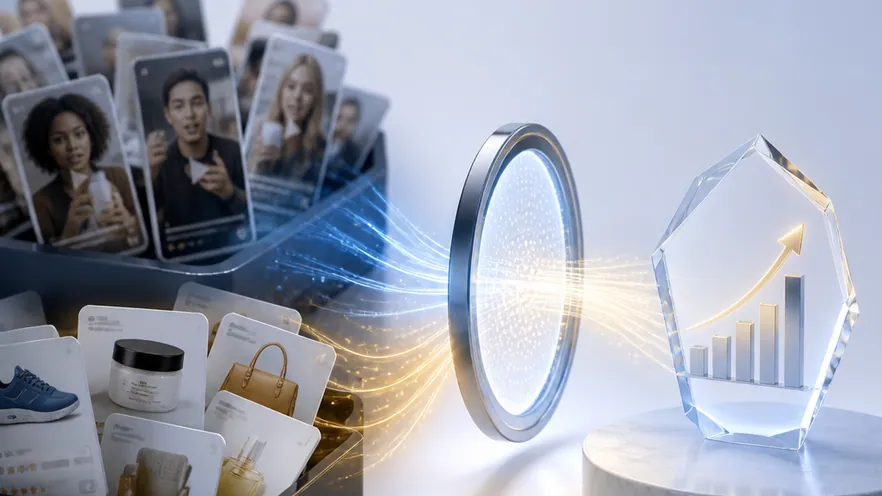
Arcads and Hunch are both AI ad execution tools in different formats. Arcads turns text scripts into UGC-style video using 1,000+ AI actors. Hunch automates dynamic product ad production and campaign management from your feed. Neither builds the brief from CLV data or measures True Profit. Omniconvert Commander is built for that layer.
- Arcads is purpose-built for UGC-style video: 1,000+ diverse AI actors, roughly 2.5 minutes per video, with bulk variation for rapid testing.
- Hunch is purpose-built for dynamic product ad automation: live feed to creative templates, plus campaign management on Meta, Snapchat and TikTok.
- Both tools share the same blind spot: neither builds the brief from CLV, NPS, or review intelligence.
- Add Omniconvert Commander as the layer above either tool when ROAS looks fine but margin is not improving.
A DTC growth team comparing Arcads vs Hunch is usually solving one problem from two angles: ship more ads without expanding the creative team. Arcads produces UGC-style video with 1,000+ AI actors at roughly 2.5 minutes per clip. Hunch connects your product feed to dynamic creative templates and automates campaign delivery on Meta, Snapchat and TikTok. Neither tool tells you which segment to target, which angle to lead with, or whether the resulting spend improved True Profit rather than just ROAS.
What is Arcads, and what is it actually good at?
Arcads is an AI UGC video platform that turns text scripts into authentic-looking ads using 1,000+ diverse AI actors. It is built for performance marketers who need UGC-style video at scale, without hiring human creators. Its core job is replacing $80 to $200-per-video UGC talent with AI output. [Arcads, 2026]
Arcads converts a text script into a UGC-style video ad featuring one of 1,000+ AI actors. Each video renders in roughly 2.5 minutes, and bulk creation spins up dozens of script and actor variations at once. Built-in editing tools cover captions, translation, and actor swap.
The category is AI UGC video ad generation. The buyer is a performance marketer or DTC operator running UGC-format ads on Meta and TikTok who needs volume without a production budget. The pitch is authentic-looking spokesperson video at a fraction of human creator cost, across more than 30 languages.
Arcads does not publish a G2 rating as of 2026, so this page cites no aggregate score for it. What is documented is the actor library, the per-video render time, and the multilingual reach. The limit every generator shares still applies: it produces what you brief, and the brief is still yours.
A UGC-style video ad mimics the visual language of user-generated content (handheld framing, conversational delivery, mid-roll product mention) but is produced with paid talent or AI actors. The format dominates Meta and TikTok performance in 2026 because it bypasses the polish penalty paid by studio-produced ads.
Where Arcads is genuinely strong
- Actor variety: 1,000+ diverse AI actors with authentic UGC-style delivery, more actor range than most specialist tools.
- Bulk variation: dozens of script and actor combinations generated simultaneously for rapid A/B testing.
- Multilingual reach: more than 30 supported languages enable international UGC-style campaigns without hiring local creators.
Where Arcads hits its ceiling
- Editing scope: built-in tools cover captions, translation, and actor swap; the script and the brief still come from you.
- Script-input only: no URL-to-video, no product data scraping, and no brief generation from customer data.
- No performance feedback: Arcads generates assets but has no connection to ad account results, so nothing tells you which video worked.
Arcads is a strong specialist for one specific job. The ceiling shows up when teams realise that more UGC-style variants do not, by themselves, improve True Profit.
What is Hunch, and what is it actually good at?
Hunch is a dynamic ad production and paid social automation platform for mid-market ecommerce brands. It connects a live product feed to dynamic creative templates, then handles campaign management on Meta, Snapchat and TikTok. It is often chosen as a more accessible alternative to Smartly.io. [Hunch, 2026]
Hunch wires your product catalog directly into dynamic creative templates and generates personalised ad variants from live feed data. The same platform handles campaign management, so creative production and media buying sit in one workflow rather than two toolchains. Feed changes propagate to running ads without manual template rework.
The category is dynamic ad production and paid social automation. The buyer is a mid-market ecommerce brand with a large catalog (typically 500+ SKUs) who needs DPA and catalog ad automation without paying enterprise Smartly-tier pricing. The pitch is feed-driven creative at scale, tightly coupled to Meta, Snapchat and TikTok campaign delivery.
Hunch holds a 4.5 out of 5 rating on G2 across 51 reviews as of 2026, and reviewers highlight a 9.9 out of 10 support score, the highest in the dynamic creative category. Reviews praise the feed-to-creative loop and the campaign automation. They also flag the shared limit of every dynamic tool: quality of output tracks quality of the feed.
A dynamic product ad is a template-based creative that pulls fields (product image, title, price, availability) from a live catalog feed, so a single template can render into thousands of catalog-specific variants without manual design. The technique underpins Meta Advantage+ Catalog and Google Performance Max shopping placements.
Where Hunch is genuinely strong
- Feed-driven creative at scale: live product catalog data feeds dynamic templates that render into 10,000+ automatic variants.
- Category-leading support: 9.9 out of 10 support rating on G2, the highest in the dynamic creative category.
- Creative plus media in one workflow: production and campaign management sit inside the same tool, removing the handoff gap between creative and media teams.
Where Hunch hits its ceiling
- Feed-dependent output: a poorly structured catalog produces weak variants; the tool inherits the quality of the source data.
- Narrow channel list: its site names Meta, Snapchat and TikTok; Pinterest and Google Ads appear only as integrations.
- No customer-data layer: optimisation targets feed and ad performance metrics, not CLV or segment-level margin.
Hunch is a strong specialist for one specific job. The ceiling looks like Arcads', in a different format: producing more dynamic feed variants does not, by itself, improve True Profit.
Arcads vs Hunch vs Omniconvert Commander: the capability comparison
Arcads handles UGC-style video volume from a script. Hunch handles dynamic product ad automation from a live feed. Omniconvert Commander handles the layer above both: which customer to target, which angle to brief, and whether the resulting creative drove True Profit, not just ROAS.
| Capability | Arcads | Hunch | Omniconvert Commander |
|---|---|---|---|
| Primary function | UGC-style AI video ad generation from text scripts | Dynamic ad production and paid social automation from a product feed | Autonomous growth intelligence above any generator |
| Unified commerce data | No: no unified data layer across paid, email, CRO, retention | Partial: unifies product feed and campaign data, not unified with CLV, email, or broader commerce stack | Yes: single source of truth across the stack |
| AI-prioritised experiment queue | No: no ranked queue of next best actions | Partial: rules-based automation and feed-driven optimisation, not AI-prioritised experiment queuing | Yes: surfaces next best action by projected margin impact |
| Creative generation | Yes: 1,000+ AI actors in UGC style, 2.5 minutes per video, bulk creation available | Partial: dynamic template-based generation from product feed, not generative AI from scratch | Yes: creative variants ranked by CLV-weighted angle |
| True Profit tracking | No: no margin layer, no return rate signal | No: no margin layer, no return rate signal | Yes: margin not ROAS, per campaign and per cohort |
| CLV and segment intelligence | No: no CLV input, no churn risk signal | No: optimises for ad performance from the feed, not customer segments | Yes: RFM, cohorts, churn prediction, NPS signal |
| Autonomous action layer | No: human briefs every run | Partial: automates creative production and campaign rules from feed data | Yes: removes the human middleware between data and action |
| AI creative briefing | No: script and brief are supplied by the marketer | No: template and rules are supplied by the marketer | Yes: brief is built from CLV, NPS, and review data |
| Pricing model | Credit-based SaaS, pricing on request at arcads.ai | Mid-market SaaS, pricing on request, "pay for what you use" (hunchads.com) | Free plan; paid plans from $49/month, see Omniconvert Commander pricing |
| Best for | Performance marketers needing authentic UGC-style video at scale without hiring creators | Mid-market ecommerce brands with large product catalogs automating DPA and catalog ads | eCommerce $1M+ ARR teams focused on margin, not just ROAS |
| Integrations | Meta · TikTok | Meta · Snapchat · TikTok · Pinterest and Google Ads as integrations · Shopify · WooCommerce | Shopify · Klaviyo · Meta · Google · TikTok · GA4 · Triple Whale |
| User rating | No public G2 rating | 4.5 out of 5 (G2, 51 reviews, as of 2026) | 5.0 out of 5 (Shopify App Store, 63 reviews, as of November 2026) |
Arcads and Hunch columns reflect publicly available feature documentation as of August 2026. Arcads publishes no G2 rating; the Hunch G2 score is cited in s2.
What Arcads and Hunch cannot do
The shared blind spot is upstream of the asset. Both tools generate creative to a brief or a feed. Neither builds the brief from CLV data, NPS signals, review intelligence, or competitor angle scans. Neither closes the loop on whether the resulting ad improved True Profit, the metric the business actually keeps.
Arcads produces authentic-looking UGC video faster and cheaper than human creators. Omniconvert Commander provides what Arcads cannot, the brief written from customer data, identifying which segment to address, which pain point to lead with, and which CLV cohort the campaign should acquire.
Hunch automates dynamic ad production from your product feed. Omniconvert Commander adds the CLV layer that tells Hunch which products and segments deserve the dynamic spend, and whether the resulting campaigns improved True Profit. A well-structured feed is not the same as knowing which customers are worth acquiring at current CAC. Hunch solves the first problem, not the second.
Both Arcads and Hunch are execution tools. They solve the same shared function in two formats: turning an input (a script or a feed) into ad output at speed. They are good at that function. They are also built on a shared assumption, that you already know which customer to target and which message to use. They optimise the execution of that assumption. Neither questions it.
What neither tool can tell you
- Which customers are worth acquiring more of. A 12-month CLV view, not last-click attribution, is what tells you which segments deserve the next round of paid spend.
- Which segments are 60 days from churning. The early signal lives in NPS scores, review sentiment, and support ticket patterns, not in a generator or a feed manager.
- Whether the last campaign improved True Profit or just moved ROAS. ROAS can rise while net margin compresses; only a margin-first measurement loop catches the gap.
- What your highest-value customers actually respond to. Their own reviews, NPS verbatims, and support transcripts hold the angle that converts; pulling and synthesising them is still manual in an Arcads-plus-Hunch stack.
Platforms like Omniconvert Commander are built for this layer. Omniconvert Commander synthesises CLV data, NPS signals, review intelligence, and competitor creative data into a ranked action queue, before a brief is written or creative produced. The optimisation target is True Profit, not ROAS.
True Profit is defined as the net margin remaining after subtracting CAC, COGS, return rates, and the cost of customer acquisition from each cohort, not gross revenue or ROAS. It is what the business actually keeps. Omniconvert Commander tracks this as the primary optimisation metric across all experiments.
AliveCor used Omniconvert to run a structured A/B testing programme and achieved +21% conversion rate, +5% revenue per visitor, and 94% statistical relevance across their experiments. [Omniconvert, AliveCor case study]
This is not a replacement for Arcads or Hunch. Both still produce the ad. Omniconvert Commander is the strategic layer above them that decides which brief to send and whether the result moved the metric the business actually keeps.
Which tool is right for you?
Pick Arcads if your bottleneck is UGC-style video volume from a script. Pick Hunch if it is dynamic product ad automation from a large catalog. Add Omniconvert Commander when ROAS looks fine but margin is not improving, and your team is spending hours assembling CLV, NPS, and review data before any brief can be written.
Choose Arcads if
- UGC video is the format: you want to replace $80 to $200-per-video human UGC creators with AI-generated spokesperson content.
- Bulk variation is the need: you need multiple actors and scripts tested simultaneously for rapid A/B testing.
- Multilingual reach matters: you are running UGC-format ads and need versions across more than 30 languages.
Choose Hunch if
- Large catalog, dynamic ads: you have 500+ SKUs and need to automate DPA and catalog ad variants across Meta, Snapchat and TikTok.
- Mid-market alternative to Smartly: you want comparable creative and campaign automation without enterprise Smartly-tier pricing.
- Creative and media in one workflow: your current bottleneck is manually building and updating dynamic creative for catalog campaigns.
Add Omniconvert Commander if
- Data assembly eats your day: your team spends more than 2 hours a day pulling data from separate tools before a single decision is made.
- You optimise paid spend without a margin view: you are spending on paid media but have no reliable view of which customer segments drive the highest margin.
- You want experiments ranked before sprint planning: you want to know which tests are worth running before dev or creative sprints are assigned.
- ROAS hides a margin problem: ROAS looks fine but net margin is not improving quarter-on-quarter.
What each tool cannot do, honestly
Arcads, Hunch, and Omniconvert Commander each have real limits. Treating them as competing for the same job hides those limits. The honest framing is that the three sit at different layers of the same stack: two execution tools in two formats and one intelligence layer. Each is replaceable, none is a complete answer alone.
Where Arcads will not stretch
- Not a static-ad workhorse: Arcads is built for UGC video; for scored static variants or feed-driven catalog ads, another tool is stronger.
- Not a strategy tool: Arcads edits with built-in captions, translation, and actor swap, but the script and the angle still come from you.
- Not a performance layer: Arcads has no connection to ad account results, so it cannot tell you which video worked or which segment it should run to.
Where Hunch will not stretch
- Not a UGC video tool: for authentic-looking spokesperson video at scale, Arcads is the stronger pick.
- Only as good as the feed: a fragmented or thin product catalog produces weak dynamic output; Hunch cannot fix upstream data quality.
- Not a customer-data layer: Hunch optimises against ad and feed metrics, not CLV, churn risk, or cohort margin.
Where Omniconvert Commander has real prerequisites
- Data unification is the first 4 to 6 weeks: an intelligence layer is only as good as the data feeding it. Fragmented inputs produce unreliable ranked queues.
- Strategy and brand judgment remain human: Omniconvert Commander automates execution coordination, not category positioning or brand voice.
- Revenue stage threshold: the ROI compounds above $1M ARR, where data volume is sufficient and manual coordination cost is measurable. Earlier brands typically benefit more from a single execution tool first.
See where your store stands against real competitors in your category and country. Ecommerce Benchmark scores six areas free: Creative & Ads, Reviews & UGC, AI Visibility, Agentic Commerce, Competitor Synthesis, and CRO.
Benchmark Your Store FreeFrequently Asked Questions
The verdict
Arcads is the specialist when UGC-style video is the bottleneck: 1,000+ AI actors, roughly 2.5 minutes per clip. Hunch wins for dynamic ad automation from a product catalog, connecting feed data to campaign delivery on Meta, Snapchat and TikTok. Neither generates the brief. Add Omniconvert Commander above either generator.
Arcads and Hunch are both capable tools within their categories. If the primary need is authentic UGC-style video at scale, Arcads is the specialist. If the need is dynamic catalog ad automation coupled with campaign management on Meta, Snapchat and TikTok, Hunch wins.
The harder question is whether your team has a reliable way to know who to target, what to say, and whether it worked at the margin level. That is a different question, and it is what the third tool on this page, Omniconvert Commander, is built to answer.
Stop assembling data.
Start supervising growth.
Omniconvert Commander unifies your entire eCommerce data layer, detects revenue anomalies and generates a prioritized action queue, so your team stops being human middleware and starts running the P&L.
5.0 out of 5 across 63 reviews, Shopify App Store , as of November 2026