Atria vs Hunch vs Omniconvert Commander (2026): Research vs automation.
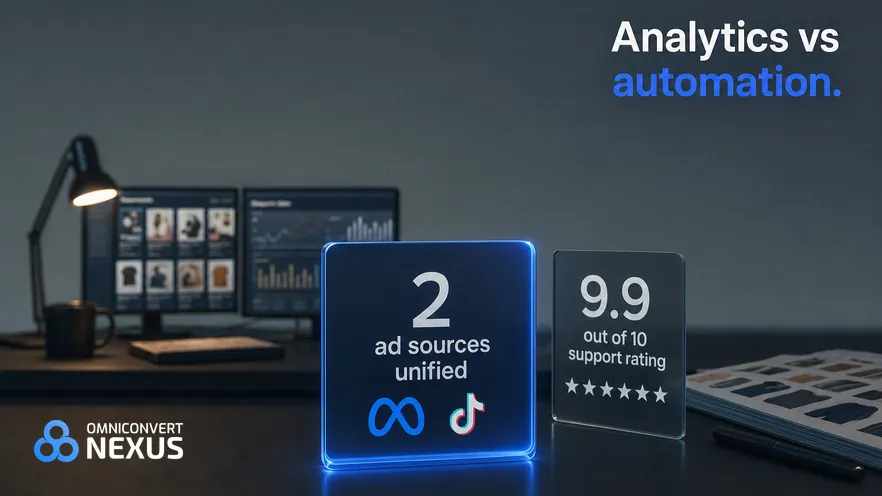
Atria combines a searchable competitor ad library from Meta and TikTok with own-account creative analytics and AI ad scoring. Hunch turns product-feed data into dynamic ad variants across Meta, Snapchat and TikTok, automating catalog creative at mid-market pricing. CLV modeling and True Profit measurement are absent from both. Omniconvert Commander provides the customer margin data that shows which segments either tool should be targeting.
- Atria is built for creative intelligence: its searchable competitor ad library draws from Meta and TikTok, sits alongside own-account performance analytics, and applies AI scoring to each creative, all in a single workflow.
- Hunch wins on dynamic catalog automation: live product feed to templated ad variants at 10,000+ SKU scale, with Meta, Snapchat and TikTok campaign management in the same tool.
- Atria and Hunch share the same gap: neither one constructs a brief from CLV, NPS scores, or review intelligence, and neither reports on True Profit.
- Bring in Omniconvert Commander above either tool when ROAS is holding but margin is not moving in the right direction.
A DTC growth team comparing Atria vs Hunch is choosing between two different creative jobs: one is a research and analytics platform, the other a dynamic ad production engine. Atria pairs a searchable competitor ad library with own-account performance data and AI ad scoring. Hunch connects live product feeds to dynamic creative templates and campaign management, scaling catalog ads across Meta, Snapchat and TikTok. The question of which customer segments justify spend at current CAC falls outside both tools. That decision layer is where Omniconvert Commander operates.
What is Atria, and what is it actually good at?
Atria is an ad intelligence platform built around a searchable ad library paired with creative performance analytics. Performance creative teams use it to study competitor ads from Meta and TikTok while measuring their own account results without switching tools. The core workflow moves from competitor research to a data-informed brief. Atria now includes an AI strategist called Raya, which identifies winning patterns, drafts briefs, produces creative, scores ads, and pushes campaigns to Meta in batches. [Atria, 2026]
Atria builds a searchable workspace stocked with ads pulled from two sources, the Meta Ad Library and the TikTok Creative Center, with own-account performance data placed alongside so research and results share the same view. AI-powered ad scoring gives a quality signal on each creative before it goes live, and saved inspiration links to real performance numbers over time.
Ad intelligence and creative analytics is the category. The target user is a performance marketer or creative strategist working across Meta and TikTok who needs competitor research combined with their own account data in one place. The core workflow is research-first: study which ad angles are winning in the category, then measure your own creative against that same signal.
Atria holds a 4.6 out of 5 rating on G2 across 198 reviews as of 2026. Reviews cite the speed of finding competitor examples and the AI ad scoring as the two features that see the most daily use. They flag the same shared limit: research and scoring both stop at the ad level, and neither reaches into customer or margin data.
Ad intelligence is the practice of collecting, tagging, and analysing competitor ads alongside your own creative performance data to inform the next creative brief. It sits upstream of production. Atria applies the pattern by combining a searchable competitor library with own-account analytics, so the research signal and the performance signal live in the same tool.
Where Atria is genuinely strong
- Competitor plus own-account in one tool: research and performance data live in a single workspace, so there is no need to stitch together a separate ad library tool and a separate analytics platform.
- AI ad scoring: each creative receives a quality signal before it goes live, giving the team a data point beyond instinct when deciding what to push.
- Saved inspiration with performance data: ads saved from the competitor library remain linked to the analytics layer, so the connection from initial research to eventual result stays intact.
Where Atria hits its ceiling
- Inspiration-heavy workflow: the process starts with research rather than customer data; Atria shows what to make but does not identify who the audience should be.
- Generation is a newer feature: Raya can now write briefs and produce creative inside Atria, but the platform's foundation remains competitor research and performance analytics.
- No customer data layer: every signal in Atria originates from ad performance; there is no input from CLV cohorts, NPS scores, or first-party review data.
Atria does one specific job well. The ceiling becomes visible when teams find that deeper competitor research on its own does not move True Profit.
What is Hunch, and what is it actually good at?
Hunch is a dynamic creative and paid social automation platform for mid-market ecommerce brands. It combines product-feed-driven ad production with campaign management on Meta, Snapchat and TikTok, positioned as a mid-market alternative to Smartly.io. Its core job is turning a live product catalog into scaled dynamic ad variants without manual template work. [Hunch, 2026]
Hunch connects a live product feed to dynamic creative templates, generating personalised ad variants directly from catalog data. That means a brand with 500 or 10,000 SKUs can produce and refresh dynamic product ads at feed scale without a designer touching every variant. Campaign management sits alongside the creative production, so media buying and creative refresh run from the same tool.
The category covers dynamic ad production and paid social automation. The buyer is a mid-market eCommerce brand running high-SKU catalog campaigns across Meta, Snapchat and TikTok that has outgrown manual creative production but is not at the scale where Smartly.io enterprise pricing is justified. Hunch offers that same feed-to-ad workflow at accessible pricing, with hands-on support included.
Hunch holds a 4.5 out of 5 rating on G2 across 51 reviews as of 2026, with a 9.9 out of 10 support rating that ranks it at the top of the dynamic creative category on that dimension. Reviews cite the feed integration and the quality of onboarding as the two features that see the most daily use.
A dynamic product ad is a paid social ad whose creative content is populated automatically from a product feed at delivery time, so each impression can show a different product, price, or offer without a separate design. Hunch applies the pattern by connecting the feed directly to templated creative and pushing variants into Meta, Snapchat and TikTok campaigns.
Where Hunch is genuinely strong
- Product feed to dynamic creative: live catalog data drives templated variants, so 10,000+ SKUs can be advertised without a designer touching every product.
- Highest-rated support in the category: a 9.9 out of 10 support rating on G2, the top of the dynamic creative category on that dimension.
- Creative plus campaign management in one tool: creative production and Meta, Snapchat and TikTok campaign management live in the same platform, so the handoff between creative and media teams disappears.
Where Hunch hits its ceiling
- Feed-dependent: the workflow only works as well as your product feed; brands with poor catalog data get limited results.
- Channel mix: Hunch's site lists Meta, Snapchat and TikTok as primary channels; Pinterest and Google Ads are present as integrations rather than core placements.
- No CLV or segment intelligence: optimisation targets ad performance metrics from the feed, not signals from customer cohorts or margin data.
Hunch does one specific job well. The ceiling appears when teams find that a clean product feed and automated ad variants do not, by themselves, identify which customer to target or confirm whether a campaign moved True Profit.
Atria vs Hunch vs Omniconvert Commander: the capability comparison
Atria covers competitor research and own-account creative analytics, including AI ad scoring. Hunch covers product-feed-driven dynamic ad creation and campaign management on Meta, Snapchat and TikTok. Omniconvert Commander operates at a different layer: it identifies which customer to target, informs which creative angle to brief, and tracks whether the resulting work improved True Profit rather than just ROAS.
| Capability | Atria | Hunch | Omniconvert Commander |
|---|---|---|---|
| Primary function | Own-account creative analytics combined with competitor ad research | Dynamic product ad production plus Meta, Snapchat and TikTok campaign management | Autonomous growth intelligence above any research or generation tool |
| Unified commerce data | Partial: monitors own-account ad performance only, not the broader commerce stack | Partial: unifies product feed and campaign data, not unified with CLV, email, or the broader commerce stack | Yes: one unified data view across the full stack |
| AI-prioritised experiment queue | No: no prioritized list of next actions to run | Partial: uses rules-based automation and feed-driven optimisation rather than AI-prioritised experiment queuing | Yes: identifies the next best action ranked by projected margin impact |
| Creative generation | Yes: Raya drafts briefs, produces creative, scores ads, and pushes campaigns to Meta in batches | Partial: generates template-based variants from the product feed rather than producing creative from scratch with generative AI | Yes: ad variants ordered by CLV-weighted creative angle |
| True Profit tracking | No: reports on ad performance, not on margin or CAC-adjusted profit | No: no margin data, no signal on return rates | Yes: measures margin instead of ROAS, at both the campaign and cohort level |
| CLV and segment intelligence | No: data comes from ad performance and competitor libraries, not from customer cohort analysis | No: signals come from the product feed and campaign metrics, not customer cohorts | Yes: RFM segments, cohort analysis, churn prediction, NPS signal |
| Autonomous action layer | Partial: Raya pushes ads to Meta in batches, but its decisions are based on ad-level signals only | Partial: handles creative production and campaign rule execution driven by feed data | Yes: removes the gap between a data signal and the action it triggers |
| AI creative briefing | Partial: Raya builds briefs from performance and competitor signals, with no input from customer data | No: templates are populated from the feed, briefs are supplied by the marketer | Yes: briefs draw on CLV, NPS, and review data as source material |
| Pricing model | Core $129 a month billed annually ($219 monthly), Plus $343, Business $959, checked October 2026 | Mid-market SaaS, pricing on request at hunchads.com (pay for what you use) | A free plan exists; paid tiers begin at $49/month, see Omniconvert Commander pricing details |
| Best for | Performance creative teams that need competitor ad research and own-account analytics in one place | Mid-market ecommerce brands with 500+ SKUs automating DPA and catalog ad production | eCommerce brands at $1M+ ARR where margin visibility matters as much as ROAS |
| Integrations | Meta · TikTok · Google | Meta · Google · Shopify · WooCommerce | Shopify · Klaviyo · Meta · Google · TikTok · GA4 · Triple Whale |
| User rating | 4.6 out of 5 (G2, 198 reviews, as of 2026) | 4.5 out of 5 (G2, 51 reviews, as of 2026) | 5.0 out of 5 (Shopify App Store, 63 reviews, as of November 2026) |
Atria and Hunch columns reflect publicly available feature documentation and G2 review data as of August 2026.
What Atria and Hunch cannot do
The shared blind spot sits upstream of both the research signal and the dynamic ad engine. When Atria is researching ad angles and Hunch is generating feed-based variants, neither is drawing on first-party customer segmentation, NPS signals, CLV data, or review intelligence to shape the brief. Neither closes the loop on whether the resulting campaign improved True Profit, the metric the business actually keeps.
Atria surfaces what is performing in your category on Meta and TikTok. Omniconvert Commander identifies which customer segments to direct that message toward, and which of those segments produces the highest CLV at conversion. The gap is not creative direction. It is audience targeting precision, and whether bringing that customer in at current CAC helps or hurts your margin.
Hunch automates dynamic ad production from your product feed. Omniconvert Commander adds the CLV layer that tells Hunch which products and segments deserve the dynamic spend, and whether the resulting campaigns improved True Profit. Having a clean product feed tells you nothing about which customers your current CAC can profitably acquire. Dynamic creative production from that feed is what Hunch delivers. Customer acquisition economics is a separate problem entirely.
Atria and Hunch address different parts of the same paid creative challenge: one handles research and scoring, the other handles dynamic ad production from catalog data. What they share is an underlying assumption that the target audience and the right angle are already known. They improve how that assumption is executed. Neither tests whether the assumption is correct.
What neither tool can tell you
- Knowing which customers are worth pursuing at scale. Last-click attribution cannot answer that. A 12-month CLV view of each segment is the signal that determines where paid budget should go next.
- Spotting which segments are approaching churn 60 days out. That early signal lives in NPS scores, review sentiment, and support ticket patterns, not in an ad library or a product feed.
- Did the most recent campaign grow True Profit, or did it only lift ROAS? ROAS can rise while net margin shrinks. A measurement loop that starts with margin is what surfaces that divergence.
- The creative angles that resonate with your most valuable customers. Their own reviews, NPS verbatims, and support transcripts hold the angle that converts; pulling and synthesising them is still manual in an Atria-plus-Hunch stack.
Platforms like Omniconvert Commander are built for this layer. Omniconvert Commander synthesises CLV data, NPS signals, review intelligence, and competitor creative data into a ranked action queue, before a brief is written or creative produced. The optimisation target is True Profit, not ROAS.
True Profit is the margin left in a cohort after subtracting return rates, customer acquisition cost, CAC, and COGS. It differs from gross revenue and from ROAS. It is what the business retains. Every experiment Omniconvert Commander runs is optimised against True Profit as the primary metric.
LEROY MERLIN Romania ran 46 experiments over 14 months with Omniconvert, achieved a 39.13% win rate, and grew website revenue by +6.27%. [LEROY MERLIN Romania growth results with Omniconvert]
This is not a replacement for Atria or Hunch. Atria continues to supply the research and scoring signal; Hunch continues to produce dynamic catalog ads from your product feed. Omniconvert Commander sits above both as the intelligence layer that determines which brief to act on and whether the outcome moved the number the business actually keeps.
Which tool is right for you?
Choose Atria when the bottleneck is having competitor research and own-account creative analytics available in a single workflow. Choose Hunch when it is producing dynamic catalog ads at scale from a large product feed across Meta, Snapchat and TikTok. Add Omniconvert Commander when ROAS is holding but margin is flat, and your team is spending hours each day pulling CLV, NPS, and review data together before writing a single brief.
Choose Atria if
- Competitor research is a daily habit: you need a competitor ad library from Meta and TikTok in the same tool where you review your own account performance.
- Creative starts with inspiration: your creative process depends on a shared workspace of saved competitor examples that the whole team can reference and build from.
- Pre-launch scoring helps the filter: you want an AI-generated quality signal on each ad before you decide to push it live.
Choose Hunch if
- Large product catalog is the constraint: you have 500+ SKUs and need to automate DPA and catalog ad variants across Meta, Snapchat and TikTok without a designer per SKU.
- Smartly.io pricing is out of reach: you want comparable creative automation on Meta, Snapchat and TikTok at mid-market pricing rather than enterprise contracts.
- Manual dynamic creative is the bottleneck: your current blocker is building and refreshing dynamic creative for catalog campaigns by hand.
Add Omniconvert Commander if
- Data assembly eats your day: more than 2 hours a day go toward pulling data from separate tools before the team can make a single decision.
- Your paid spend has no margin anchor: you are spending on paid media, but neither the creative tools nor the delivery platforms reveal which customer segments generate the highest margin.
- You want experiments ranked before sprint planning: you need a prioritised list of which tests are worth running before creative or development work is assigned.
- ROAS hides a margin problem: ROAS numbers look acceptable but net margin has not improved over consecutive quarters.
What each tool cannot do, honestly
Atria, Hunch, and Omniconvert Commander each have genuine limits. Framing them as direct competitors for the same job obscures what those limits are. The clearer picture is that the three occupy different layers of the same stack: a research and scoring tool, a dynamic ad production engine, and a customer intelligence layer. Each can be swapped out; none of them alone covers the full picture.
Where Atria will not stretch
- Not a catalog engine: Atria now generates creative through Raya, but for turning that signal into shipped catalog creative at feed scale, Hunch is the stronger pick.
- Not a design editor: Atria now generates creative, but it is not a design editor for building and exporting every ad format.
- Not a customer data layer: every signal in Atria and Hunch comes from ad performance or competitor creative data, with no input from CLV, NPS scores, or first-party reviews.
Where Hunch will not stretch
- Not a research tool: Hunch produces the variants from your feed; for competitor ad research and own-account analytics, Atria is the stronger pick.
- Channel mix: Hunch's site lists Meta, Snapchat and TikTok as primary channels; Pinterest and Google Ads are present as integrations rather than core placements.
- Not a strategy layer: the feed drives the variants, but which products and segments deserve the dynamic spend is not a question Hunch answers.
Where Omniconvert Commander has real prerequisites
- The first 4 to 6 weeks go to unifying data: the quality of any intelligence layer depends on what flows into it. Disconnected data sources produce ranked queues you cannot rely on.
- Strategy and brand judgment remain human: Omniconvert Commander coordinates execution automatically, but category positioning and brand voice are still human decisions.
- Revenue stage threshold: ROI from an intelligence layer compounds most clearly above $1M ARR, where data volume is high enough and the cost of manual coordination is easy to measure. For brands under that threshold, a single well-chosen execution tool typically delivers more immediate value before an intelligence layer is added.
See where your store stands against real competitors in your category and country. Ecommerce Benchmark scores six areas free: Creative & Ads, Reviews & UGC, AI Visibility, Agentic Commerce, Competitor Synthesis, and CRO.
Benchmark Your Store FreeFrequently Asked Questions
The verdict
Atria is the right specialist when competitor ad research combined with own-account creative analytics is the primary need. Hunch is better suited when the bottleneck is producing dynamic catalog ads from a large product feed across Meta, Snapchat and TikTok. Neither builds its brief from customer data. Across Omniconvert's analysis of 7,000+ eCommerce sites, this decision layer is consistently where hours are lost every day. Place Omniconvert Commander above Atria or Hunch in your stack.
Atria and Hunch are both capable tools within their categories. If the primary need is combining competitor ad research with own-account creative analytics, Atria is the specialist. If the need is scaling dynamic catalog ads from a large product feed across Meta, Snapchat and TikTok, Hunch wins.
The more difficult question is whether your team has a dependable method for knowing which audience to target, what message to serve them, and whether the result moved margin. That question sits outside what either tool covers, and it is precisely what Omniconvert Commander on this page is designed to answer.
Stop assembling data.
Start supervising growth.
Omniconvert Commander consolidates your full eCommerce data layer, surfaces revenue anomalies, and produces a prioritised action queue, so your team directs effort toward decisions rather than acting as the connection point between data sources and the P&L.
5.0 out of 5 across 63 reviews, Shopify App Store , as of November 2026