Atria vs Omneky vs Omniconvert Commander (2026): research vs agentic execution
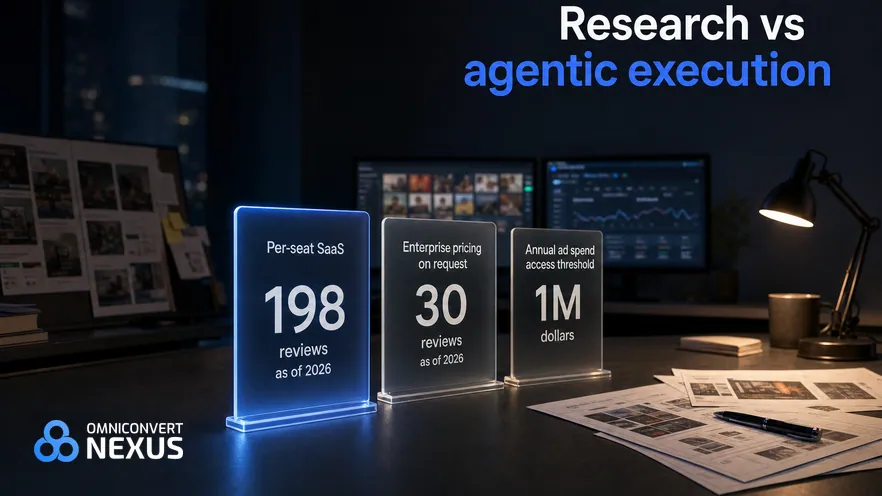
Atria and Omneky both work at the ad execution layer, from different angles. Atria pairs a competitor ad library with own-account analytics and AI pre-launch scoring. Omneky runs agentic AI that manages briefs, generation, and campaigns end-to-end from a brand system built from your website. Neither carries a customer data layer. What Omniconvert Commander brings above both is CLV segmentation and True Profit measurement.
- Atria pairs a competitor ad library with own-account analytics and AI ad scoring, a research-first creative workflow.
- Omneky runs agentic AI across the full ad workflow, from brand briefing to creative generation to campaign management and measurement.
- Both are ad-layer tools: they read the market or execute the workflow, but neither carries a customer data layer.
- Neither reads CLV, churn risk, or whether the campaign they run improves margin instead of just ROAS.
- Omniconvert Commander adds CLV segmentation, the True Profit measurement loop, and the ranked action queue above either tool.
A performance creative team comparing Atria vs Omneky is choosing between two ad-layer tools built for different problems. Atria pairs a competitor ad library with own-account analytics and scores creative before launch. Omneky runs agentic AI that manages briefs, creative generation, and campaign execution end-to-end from a brand system built from your website. Neither decides which segment to target by CLV or whether the winning campaign improved True Profit. Omniconvert Commander is purpose-built to own exactly that decision layer.
What is Atria, and what is it actually good at?
Atria brings together ad intelligence and creative analytics in one platform. Drawing on Meta Ad Library for competitor ads and TikTok Creative Center, it layers in performance data from your own accounts to anchor the workflow firmly in research. An AI strategist named Raya extends this further: she identifies winning formulas, drafts briefs, produces creative, scores ads, and pushes batches directly to Meta. [Atria, 2026]
What sets Atria apart is that competitor research and your own account performance share the same workspace. Teams save competitor ads, run an AI quality score on their own creative before it goes live, and view results alongside the original research. The workflow is built to start from what the market rewards, then connect that to in-account data.
Atria is built for performance creative teams whose process starts with research and competitive reference. Raya can now produce briefs and generate creative from those signals, but the platform carries no customer data layer.
Creative intelligence means using competitor ad data and your own account performance to decide what to build next. It shows what formats and messages are gaining traction in a category, but its signals come from ad-level activity, not from customer lifetime value or how different segments behave over time.
Where Atria is genuinely strong
- Research plus own-account analytics: competitor creative and your own performance data in a single workflow, without switching tools.
- AI ad scoring: pre-launch quality signal that flags weak creative before it spends budget.
- Inspiration with data: competitor references and your performance history live together, so the full creative intelligence picture is always in one view.
Where Atria hits its ceiling
- Research-led, not data-driven: ad signals and competitive inspiration drive decisions, not customer behaviour or CLV.
- Generation is a newer feature: Raya now handles briefs and creative production for Atria, but competitive research and own-account analytics remain the foundation the platform was built on.
- No CLV layer: every signal in Atria originates from ad performance, not from customer-level behaviour or lifetime value.
On G2, Atria has a 4.6 out of 5 rating drawn from 198 reviews as of 2026. Users point to the combined research-and-analytics loop as the main reason they stay, while flagging that individual customer-level data is not something the platform provides.
What is Omneky, and what is it actually good at?
Omneky is an agentic AI advertising platform for enterprise and high-growth brands. AI agents manage the end-to-end workflow, brand analysis, creative generation, campaign management, and measurement, with a brand system built from your website to keep generated assets on-brand across channels. [Omneky, 2026]
Omneky's distinguishing move is agentic execution across the whole ad stack. Instead of separate tools for briefing, generation, launch, and measurement, a single system runs the workflow with AI agents. The brand system keeps creative consistent across formats, so scale does not dilute the brand.
The buyer is an enterprise or high-growth performance marketing team that wants autonomous campaign management without expanding headcount. Where Atria starts from market research, Omneky starts from company brand data and runs the workflow to launch.
Agentic advertising is the practice of using AI agents to manage the full ad workflow, from brief to creative to campaign to measurement, with minimal human intervention at each step. It optimises for autonomous execution speed, and its signals come from ad performance rather than from customer lifetime value or segment behaviour.
Where Omneky is genuinely strong
- End-to-end agentic workflow: brand analysis, creative generation, campaign management, and measurement run in one system.
- Brand system from your website: Omneky ingests your logos, colours, fonts and brand voice so every generated asset across formats and channels matches your brand automatically.
- Autonomous scale: targets performance teams that want to replace manual campaign management without adding headcount.
Where Omneky hits its ceiling
- Heavier tiers cost more: Lite is $29 a month ($24 billed yearly), Standard $99 and Pro $249; Enterprise is custom (checked October 2026).
- No CLV or segment intelligence: Omneky's agentic execution can pull from first-party sources via its Data Integrations, including HubSpot, Shopify and PostHog, but customer lifetime value is outside its scope.
- Full-stack managed model: less granular control for teams wanting to configure individual elements.
On G2, Omneky scores 4.5 out of 5 from 30 reviews as of 2026. Reviewers value the autonomous campaign workflow and consistent brand output, with several noting that segmenting customers by value requires a separate tool.
Atria vs Omneky vs Omniconvert Commander: the capability comparison
Atria reads the competitive market and your ad account; Omneky handles the full ad workflow autonomously using a brand system it builds from your website. Both tools operate at the ad layer with no customer intelligence underneath. Omniconvert Commander sits above both: it supplies the segment, informs the brief, and closes the margin loop. The three tools are complementary rather than competing.
| Capability | Atria | Omneky | Omniconvert Commander |
|---|---|---|---|
| Primary function | Competitor ad research with own-account analytics | Agentic AI managing brand, creative, campaigns, and measurement, now also reachable from Claude and ChatGPT through the Omneky MCP server | Autonomous growth intelligence above any ad tool |
| Unified commerce data | Partial: own-account performance, not the full stack | Partial: ad channels in one system, no CLV or email data; Data Integrations connect HubSpot, Shopify, PostHog, Semrush and Ahrefs as first-party sources | Yes: unified data view across every layer of the stack |
| AI-prioritised experiment queue | No: no prioritised queue of next actions | Partial: agents prioritise on ad performance, not CLV-weighted segments; Automated Marketing Plans let a team set a target such as a blended CPA, and the agents cut wasteful spend and reallocate budget to top creative | Yes: recommended actions ranked by expected margin contribution |
| Creative generation | Yes: Raya handles brief writing, creative generation, pre-launch ad grading, and batch publishing to Meta | Yes: produces image, video, avatar and clone ad formats drawing from your brand system; Taste Bench is Omneky's published benchmark that ranks image generation models | Yes: creative variants ordered by CLV-weighted scoring |
| True Profit tracking | No: ad signals, no margin layer | No: campaign performance, no margin layer | Yes: margin shown at campaign and cohort level, with ROAS excluded |
| CLV and segment intelligence | No: no customer data layer | No: connects CRM and store data, but no CLV or segment layer | Yes: RFM segmentation, cohort analysis, churn prediction, NPS signal |
| Autonomous action layer | Partial: Raya publishes ad batches to Meta, but decisions are driven by ad signals alone, not customer data | Yes: agents run the ad workflow end-to-end | Yes: removes the human middleware between data and action |
| AI creative briefing | Partial: Raya's briefs are grounded in ad performance data, not customer or CLV data | Partial: briefs from your website and brand system, not from CLV or segments | Yes: CLV, NPS scores, and review data feed directly into brief generation |
| Pricing model | Core $129 per month on annual billing ($219 month-to-month), Plus $343, Business $959, verified October 2026 | Omneky tiers: Lite $29 per month ($24 on annual billing), Standard $99, Pro $249, Enterprise on custom pricing, 7-day trial available, verified October 2026 | A free plan is available; paid plans start from $49/month, see Omniconvert Commander pricing |
| Best for | Research-led performance creative teams | Enterprise teams and high-growth brands that need fully autonomous ad workflow management | eCommerce brands at $1M+ ARR with a focus on improving margin |
| Integrations | Meta, TikTok, Google | Meta, Google, TikTok, LinkedIn, Reddit, Pinterest, X, OpenAI Ads | Shopify, Klaviyo, Meta, Google, TikTok, GA4, Triple Whale |
| User rating | Atria on G2: 4.6 out of 5, based on 198 reviews, 2026 | Omneky on G2: 4.5 out of 5, based on 30 reviews, 2026 | 5.0 out of 5 (Shopify App Store, 63 reviews, as of November 2026) |
Competitor columns reflect publicly available feature documentation as of August 2026. G2 scores are sourced from the ratings listed in s1 and s2.
What Atria and Omneky cannot do
Both tools read ad signals well, one from the market and your account, one from autonomous execution across the workflow. Neither reads customers. Deciding which segment to target by CLV, and confirming whether a campaign actually moved the margin, still falls to a person pulling together data from multiple separate sources. Omniconvert Commander is built to handle that work.
Atria surfaces which creative angles are gaining traction in your category. Omniconvert Commander shows you which customer cohorts produce the highest lifetime value at conversion, and whether your CAC on those cohorts is building margin or eating it. Knowing what to make is only part of the problem. The harder question is who you are targeting, and what acquiring them actually costs your bottom line.
Omneky's agents take ownership of the full ad workflow end to end. What they lack is a customer intelligence layer: CLV segmentation and True Profit measurement that Omniconvert Commander provides, turning fast autonomous execution into margin-positive growth rather than efficient activity pointed at the wrong target. Speed without the right optimisation signal means you reach the wrong outcome faster.
What neither tool can tell you
- Which customer segments justify more acquisition spend. A 12-month CLV view, not last-click attribution, tells you which segments merit the next round of paid spend.
- The segments sitting 60 days out from churn. The early signal lives in NPS scores, review sentiment, and support ticket patterns, not in any ad dashboard.
- Whether your last campaign moved True Profit or just improved ROAS. A rising ROAS figure can mask falling net margin. A margin-first measurement loop is the only way to catch that gap.
- The creative angles your best customers actually respond to. Customer reviews, NPS verbatims, and support transcripts carry the angles that drive real conversions. Pulling those signals into a brief remains a manual task with both Atria and Omneky.
Omniconvert Commander operates at this layer. It combines NPS signals, CLV data, competitor creative data, and review intelligence into a ranked action queue, ready before any brief is written or creative produced. Omniconvert Commander measures every experiment against True Profit as the target, not ROAS.
True Profit is what a cohort actually keeps once CAC, COGS, return rates, and acquisition cost are subtracted. Gross revenue and ROAS are excluded because they do not reflect what the business retains. Omniconvert Commander uses True Profit as the primary metric for every experiment it runs.
The Nextbase desktop result came from a single A/B test with Omniconvert: a category section reorganised by use case delivered +26.16% conversion rate, +23.7% revenue per user, and a 98.53% chance to win. [Omniconvert, Nextbase case study]
Which tool is right for you?
If your process starts from competitor research and you want pre-launch scoring, choose Atria. If you want AI agents to manage the ad workflow end-to-end at enterprise scale, choose Omneky. If ad execution is in place but margin stays flat, the gap is at the customer decision layer, and Omniconvert Commander fills it.
- Choose Atria if your team builds a competitor ad library and wants AI scoring on creative before launch.
- Choose Omneky if you want autonomous agentic management of your ad workflow with a brand system built from your website, and you sit at enterprise or high-growth scale.
- Add Omniconvert Commander if the ad execution is no longer the bottleneck and the open question is which segment to target and whether the spend improved True Profit.
Atria and Omneky both address what to make and how to run it at the ad layer. Omniconvert Commander addresses which customers are worth acquiring and whether the outcome moved margin, then takes action on that answer. Those are different layers of the stack.
What each tool cannot do, honestly
These tools each have clear edges worth naming. Atria is research-led, with generation a newer feature. Omneky runs the ad workflow autonomously but has no CLV or margin layer, and its higher tiers (Pro at $249 a month, then custom Enterprise) are aimed at larger teams. Omniconvert Commander does not maintain a searchable competitor ad library or run ad campaigns; it is the customer intelligence layer above them.
- Atria: inspiration-heavy, generation is a newer feature, no CLV or customer behaviour data.
- Omneky: agentic execution across ads, but no CLV or segment intelligence, no True Profit layer, and AI trained on your own first-party data reserved for the Enterprise tier.
- Omniconvert Commander: not a replacement for a competitor ad library or an agentic ad platform. It adds the CLV and margin layer that decides what those tools should run next.
The honest read: use your preferred ad-layer tool for creative research and campaign execution, then run Omniconvert Commander for customer decisions and margin measurement. That combination closes a loop that Atria and Omneky cannot close by themselves.
See where your store stands against real competitors in your category and country. Ecommerce Benchmark scores six areas free: Creative & Ads, Reviews & UGC, AI Visibility, Agentic Commerce, Competitor Synthesis, and CRO.
Benchmark Your Store FreeFrequently Asked Questions
Should you add Omniconvert Commander to your Atria or Omneky stack?
Consider adding Omniconvert Commander when Atria's competitive research or Omneky's agentic execution is producing good ad results but margin is still not moving. Atria identifies what competitors are running; Omneky handles briefs, creative, and campaigns autonomously. What neither provides is clarity on which segment converts at the highest CLV or whether a winning campaign actually improved True Profit. Omniconvert Commander orders the next action by projected margin and tracks the outcome at the customer level.
Atria and Omneky are strong specialists at the ad layer: one from competitor research and pre-launch scoring, one from agentic full-stack execution. If reading the market or running the workflow autonomously is your live need, keep the tool that fits your scale.
The harder question is whether your team can reliably identify who to target, what message to use, and whether the result moved margin. That question sits outside what either Atria or Omneky was built for, and it is the problem Omniconvert Commander addresses directly.
Stop assembling data.
Start supervising growth.
Omniconvert Commander consolidates your eCommerce data into a single layer, surfaces revenue anomalies, and produces a prioritised action queue, so your team operates on the P&L instead of acting as the connection point between tools.
5.0 out of 5 across 63 reviews, Shopify App Store , as of November 2026