Atria vs Pacvue vs Omniconvert Commander (2026): social research vs retail media
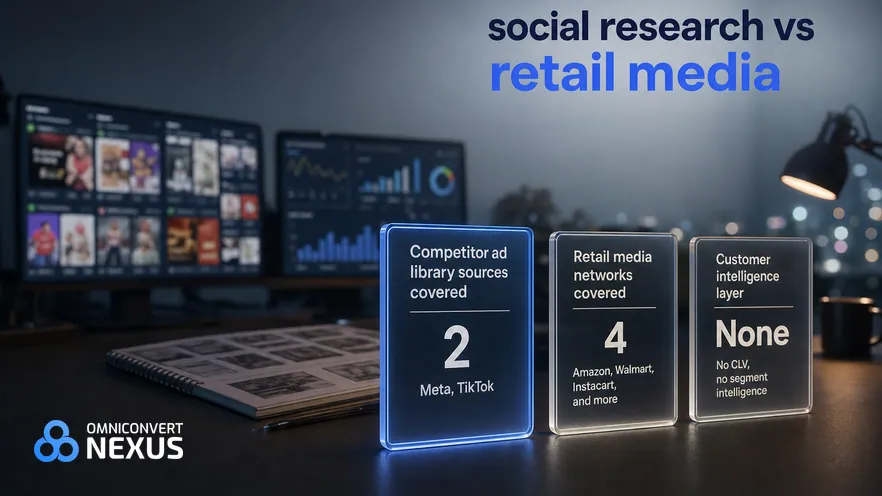
Atria and Pacvue both work at the ad execution layer, from different channels. Atria pairs a competitor ad library with own-account analytics and AI pre-launch scoring for paid social. Pacvue automates retail media bidding and digital shelf analytics across Amazon and Walmart. Neither carries a customer data layer. Above both, Omniconvert Commander brings CLV segmentation and True Profit tracking.
- Atria pairs a competitor ad library from Meta and TikTok with own-account analytics and AI pre-launch scoring for paid social.
- Pacvue automates retail media bidding across Amazon, Walmart, and Instacart, connecting ad performance to digital shelf data and Pacvue Agent's plain-language querying.
- The two tools rarely overlap: Atria works the paid social layer, Pacvue works the retail media layer, and neither carries a customer data layer.
- Neither reads CLV, churn risk, or whether the campaign or bid rule they run improves margin instead of just ROAS.
- Omniconvert Commander brings CLV segmentation, a True Profit measurement loop, and a ranked action queue to the layer above both tools.
A performance team comparing Atria vs Pacvue is choosing between two very different execution tools. Atria pairs a competitor ad library from Meta and TikTok with own-account analytics for paid social. Pacvue automates retail media bidding and connects ad performance to digital shelf data across Amazon and Walmart. Neither decides which customer segment to target by CLV or whether the winning campaign improved True Profit. Omniconvert Commander is designed to own that decision layer.
What is Atria, and what is it actually good at?
Built around ad intelligence and creative analytics, Atria gives paid social teams a research-first workflow. Its competitor ad library indexes creative from TikTok Creative Center and the Meta Ad Library, combined with performance data drawn from your own ad accounts. The platform also includes an AI strategist named Raya: she identifies winning creative formulas, drafts briefs, produces new creative, scores ads, and sends them to Meta in batch. [Atria, 2026]
What sets Atria apart on this comparison is that inspiration and performance data occupy the same interface. Teams can collect competitor ad references, run an AI quality check on new creative before it goes live, and monitor their own account results next to that research. The process begins with what is already winning in the category, then ties it to the team's own numbers.
The buyer is a performance creative team whose process starts with research and competitive reference. Atria shows what to make and, through its AI strategist Raya, can now draft briefs and produce creative assets; customer-level data is outside its scope.
Creative intelligence means using ad data from competitors and your own accounts to decide which creative to build next. It answers what formats are gaining traction and which messages are resonating in a category, but its signals come from ad performance rather than customer lifetime value or segment behaviour.
Where Atria is genuinely strong
- Research plus own-account analytics: a single workspace for studying competitor paid social creative and monitoring your own account performance together.
- AI ad scoring: a pre-launch quality signal that rates a creative before spend is committed.
- Inspiration with data: saved competitor references and account performance sit side by side, covering the full creative intelligence loop.
Where Atria hits its ceiling
- Research-led, not data-driven: the process is built around creative inspiration rather than customer purchase behaviour.
- Generation is a newer feature: Atria's AI strategist Raya now drafts briefs and produces creative, but the platform's foundation remains research and account analytics.
- No CLV layer: every signal in Atria originates from ad performance, not from customer-level behaviour.
On G2, Atria's score is 4.6 out of 5 from 198 reviews, recorded in 2026. Reviewers highlight the value of pairing competitor research with own-account analytics, while flagging that customer-level data sits outside the platform.
What is Pacvue, and what is it actually good at?
Pacvue is an enterprise retail media automation platform. It combines AI bid management, rules-based campaign automation, and digital shelf analytics across Amazon, Walmart, Instacart, and other retail networks, connecting ad performance to product content scores, inventory, and Buy Box status. [Pacvue, 2026]
Pacvue's distinguishing move is uniting retail media bidding with the digital shelf. Custom rules automate bids at scale, while a single view links spend to inventory, Buy Box status, and product content scores. Pacvue Agent extends that with plain-language queries against Amazon Marketing Cloud and auto-generated visual reports.
The buyer is an enterprise ecommerce brand with significant retail media budget to manage. Pacvue is a retail media specialist; it does not cover paid social or non-retail channels, and customer lifetime value data is outside its scope.
Digital shelf optimisation is the practice of connecting retail media ad performance to the product's shelf state, inventory, Buy Box status, and content quality, so that spend flows to ASINs that can actually convert. It answers where to bid, not which customer cohort makes those ASINs worth acquiring at current CAC.
Where Pacvue is genuinely strong
- AI bid automation across retail networks: bid management and custom rules across Amazon, Walmart, Instacart, and more.
- Digital shelf in one view: ad performance sits next to inventory, Buy Box, and content scores.
- Pacvue Agent: plain-language queries against Amazon Marketing Cloud with auto-generated visual reports.
Where Pacvue hits its ceiling
- Retail media only: limited fit for paid social or non-retail digital channels.
- Enterprise pricing: more expensive than alternatives like Skai for comparable retail media coverage.
- No CLV layer: automation runs on ad and shelf signals, not on customer lifetime value informing ASIN priority.
Pacvue reviews praise the retail media coverage and shelf integration, with the recurring note that customer-level segmentation lives outside the tool.
Atria vs Pacvue vs Omniconvert Commander: the capability comparison
Atria covers paid social competitors and your own account; Pacvue handles retail media bidding and digital shelf performance on Amazon and Walmart. Both sit at the ad execution layer and neither holds a customer intelligence layer. Omniconvert Commander operates above both: it supplies the segment, the brief, and the margin measurement loop.
| Capability | Atria | Pacvue | Omniconvert Commander |
|---|---|---|---|
| Primary function | Competitor ad research with own-account analytics for paid social | Retail media automation across Amazon, Walmart, and Instacart with digital shelf analytics | Autonomous growth intelligence above any ad tool |
| Unified commerce data | Partial: own-account performance, not the full stack | Partial: retail media channels with shelf data, no CLV or DTC data | Yes: single source of truth across the stack |
| AI-prioritised experiment queue | No: no prioritised list of recommended actions | Partial: retail media bids automated by AI rules, but ASIN priority is not set by CLV | Yes: actions ranked by forecast margin contribution |
| Creative generation | Yes: Raya drafts briefs, produces creative, scores ads before launch, and pushes batches to Meta | No: bid and campaign automation, not creative production | Yes: creative variants ordered by CLV-weighted approach |
| True Profit tracking | No: ad signals, no margin layer | Partial: product-level performance, no CLV or customer margin | Yes: margin measured at both campaign and cohort level, not ROAS |
| CLV and segment intelligence | No: no customer data layer | No: no customer data layer | Yes: RFM scoring, cohorts, churn prediction, and NPS signal |
| Autonomous action layer | Partial: Raya pushes ad batches to Meta, but decisions are driven by ad signals alone | Partial: automated bid and campaign rules, plus Pacvue Agent | Yes: cuts out the manual step between data and execution |
| AI creative briefing | Partial: Raya's briefs draw on ad performance data, with no customer segment input | No: no creative briefing capability | Yes: brief draws on CLV, NPS, and review signals |
| Pricing model | Annual billing: Core $129/month ($219 month-to-month), Plus $343, Business $959; prices verified October 2026 | Enterprise tier only; request pricing at pacvue.com | A free plan is available; paid tiers start at $49/month, details at Omniconvert Commander pricing |
| Best for | Research-led performance creative teams on paid social | Enterprise brands with large retail media budgets on Amazon and Walmart | margin-focused eCommerce teams with ARR above $1M |
| Integrations | Meta, TikTok, Google | Amazon and Walmart, plus Instacart, Target, Criteo, Citrus | Shopify, Klaviyo, Meta, Google, TikTok, GA4, Triple Whale |
| User rating | G2: 4.6/5 across 198 reviews (2026) | No independent rating cited | 5.0 out of 5 (Shopify App Store, 63 reviews, as of November 2026) |
Feature data for competing tools comes from publicly available documentation, current as of August 2026. G2 rating as cited in s1.
What Atria and Pacvue cannot do
Both tools read ad signals well, one from paid social research and own-account analytics, one from retail media automation across Amazon and Walmart. Neither reads customers. Deciding which segment to target, and whether a campaign moved margin, requires a person stitching together outputs from multiple separate tools. Omniconvert Commander is built to handle exactly that layer.
Atria shows you which paid social creative is gaining ground in your category. Omniconvert Commander identifies which customer segments to direct that creative toward, and shows which of those segments produces the highest CLV on conversion. The gap in this setup is not creative production. It is who the creative is for, and whether the CAC required to acquire that customer leaves your margin intact or shrinks it.
Pacvue automates retail media bidding and surfaces how your ASINs are performing across Amazon and Walmart. Omniconvert Commander places a CLV layer above that retail media activity, linking product-level ad results to the lifetime value of the customer segments purchasing those ASINs. Bid automation tuned to ROAS alone can accelerate spend in the wrong direction; a margin-first signal redirects that same automation toward cohort-positive growth.
What neither tool can tell you
- Which buyers in your current base deserve the next round of lookalike spend. Last-click attribution does not answer that. A 12-month CLV view shows which segments should receive the next budget allocation.
- Which segments are within 60 days of walking away. The early signal lives in NPS scores, review sentiment, and support ticket patterns, not in any ad or shelf dashboard.
- Whether the last campaign grew True Profit or only shifted ROAS. Net margin can shrink while ROAS climbs; a measurement loop built around margin is the only way to detect that.
- What messaging your highest-value customers respond to. The answer sits in their reviews, NPS verbatims, and support transcripts. Pulling it out is still a manual task in both Atria and Pacvue.
Platforms like Omniconvert Commander are built for this layer. Omniconvert Commander synthesises CLV data, NPS signals, review intelligence, and competitor creative data into a ranked action queue, before a brief is written or a creative produced. The optimisation target is True Profit, not ROAS.
True Profit is the net margin left after CAC, COGS, and return rates are removed from each cohort's revenue. It is not a gross revenue or ROAS figure. That figure is the amount the business actually holds onto. Across every experiment it runs, Omniconvert Commander treats True Profit as the top-level metric.
One desktop A/B test on Omniconvert gave Nextbase results from a product category section organised by use case: +26.16% conversion rate, +23.7% revenue per user, and a 98.53% chance to win. [Omniconvert, Nextbase case study]
Which tool is right for you?
If your process starts from paid social research and you want pre-launch scoring, choose Atria. If you manage significant retail media on Amazon or Walmart and need AI bid automation with shelf intelligence, choose Pacvue. When ad execution on both paid social and retail media is handled but margin stays flat, the absent layer is customer-level decision-making, and Omniconvert Commander fills it.
- Choose Atria if your team builds a competitor ad library on Meta and TikTok and wants AI scoring on creative before launch.
- Choose Pacvue if you manage significant Amazon or Walmart advertising spend and need AI bid automation connected to inventory, Buy Box, and product content scores.
- Add Omniconvert Commander if the ad execution is no longer the bottleneck and the open question is which segment to target and whether the spend improved True Profit.
Atria and Pacvue both resolve what to run and how to run it at their respective ad layers. Omniconvert Commander determines which customers are worth acquiring and whether a campaign moved margin in the right direction, then queues the next action. That is a distinct layer of the stack, and the two ad tools rarely overlap because they serve different channels entirely.
What each tool cannot do, honestly
Any honest comparison surfaces the gaps. Atria is research-led, with generation a newer feature and no CLV layer. Pacvue is a retail media specialist with no paid social coverage and no CLV layer, priced for enterprise. Omniconvert Commander does not maintain a searchable competitor ad library or automate retail media bids; it is the customer intelligence layer above them.
- Atria: inspiration-heavy, generation is a newer feature, no CLV or customer behaviour data, paid social only.
- Pacvue: retail media specialist, no paid social or non-retail channels, no CLV or True Profit layer, enterprise pricing.
- Omniconvert Commander: not a replacement for a competitor ad library or a retail media platform. It adds the CLV and margin layer that decides what those tools should run next.
The honest read: keep the ad-layer tool that matches your channel mix, and run Omniconvert Commander for customer decisions and margin measurement. Together they close a loop that neither paid social research nor retail media automation can close on its own.
See where your store stands against real competitors in your category and country. Ecommerce Benchmark scores six areas free: Creative & Ads, Reviews & UGC, AI Visibility, Agentic Commerce, Competitor Synthesis, and CRO.
Benchmark Your Store FreeFrequently Asked Questions
Should you add Omniconvert Commander to your Atria or Pacvue stack?
Add Omniconvert Commander if your team is getting strong signals from Atria's paid social research or Pacvue's retail media automation but margin is still flat. Atria surfaces what competitors are running on paid social; Pacvue automates bids and connects performance to shelf data on Amazon and Walmart. Neither identifies which segment converts at the highest CLV or confirms whether a winning campaign improved True Profit. Omniconvert Commander sequences the next action by projected margin and reports the outcome at the customer level.
Atria and Pacvue are strong specialists on different ad layers: one for paid social research and pre-launch scoring, one for enterprise retail media automation and digital shelf. If reading Meta and TikTok competitors or automating Amazon and Walmart bids is your live need, keep the tool that fits your channel.
The deeper problem is whether your team can reliably answer who to target, what message to use, and whether the result moved margin. Omniconvert Commander is built to answer exactly that question, and neither Atria nor Pacvue addresses it.
Stop assembling data.
Start supervising growth.
Omniconvert Commander consolidates your full eCommerce data layer, surfaces revenue anomalies, and produces a prioritized action queue, so your team operates on the P&L directly instead of acting as connective tissue between tools.
5.0 out of 5 across 63 reviews, Shopify App Store , as of November 2026