Atria vs TryHolo vs Omniconvert Commander (2026): Research vs render, one gap
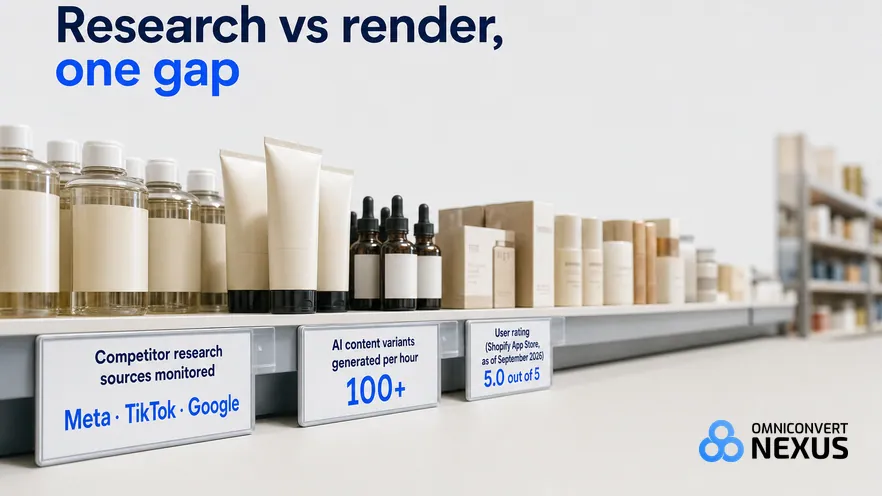
Atria and TryHolo solve different creative jobs. Atria pairs a competitor ad library with own-account analytics for research-led teams. TryHolo generates AI video content for marketing teams and agencies. Neither builds the brief from CLV or measures True Profit on the result. Omniconvert Commander covers that upstream layer, where CLV briefing and True Profit measurement sit.
- Atria pairs a competitor ad library with own-account performance data and adds AI ad scoring before launch. It holds a 4.6 out of 5 rating on G2 across 198 reviews.
- TryHolo is positioned as an AI video and content platform for marketing teams and agencies, not tied to a single ad format.
- Atria and TryHolo share one gap: the brief neither of them builds is rooted in CLV, NPS, or review intelligence.
- Bring Omniconvert Commander into the stack above Atria or TryHolo when ROAS is healthy but margin growth has stalled.
A DTC growth team comparing Atria vs TryHolo is usually solving two different execution problems: too little signal on what to make, and too little bandwidth to make it. Atria pairs a competitor ad library with own-account performance data, built for research-led creative teams. TryHolo positions around AI video and content creation for marketing teams and agencies. Neither tool tells you which customer segment to target, which angle your highest-CLV buyers respond to, or whether the resulting creative moved True Profit; in 2026 that decision layer is still human, and it is the bottleneck above both tools.
What is Atria, and what is it actually good at?
Atria is an ad intelligence platform. It connects a searchable competitor ad library to your own-account creative analytics. It is built for lean performance teams that start creative from research rather than a blank page. What competitors are actively running becomes the evidence your team uses when deciding what to build next. [Atria, 2026]
Competitor ads from Meta's Ad Library and TikTok's Creative Center are saved and analysed, then placed alongside performance data from your own ad accounts. In one workspace, a marketer can collect saved ads into a swipe file and follow live campaign results. What comes out is a workflow where research leads every creative decision.
Atria occupies the ad intelligence and creative analytics category. The buyer is a performance marketer or creative strategist at a DTC brand who ships creative weekly and wants a signal before launch. The pitch is research plus scoring: see what is winning, then get an AI quality read before you commit budget.
On G2, Atria carries a 4.6 out of 5 rating drawn from 198 reviews as of 2026. Reviews praise the speed of competitor research and the pre-launch scoring. They flag the shape of the tool: it surfaces what to make, but the making, and the customer decision behind it, stays with the team.
Ad intelligence combines competitor ad research with your own ad account performance data, so creative choices are grounded in evidence rather than a blank page. Every data point here comes from ad performance and competitor activity. Customer behaviour and margin data are outside the scope.
Where Atria is genuinely strong
- Research plus own-account analytics in one tool: study competitor creative and monitor your own performance in one place, without moving between tools.
- AI ad scoring before launch: a quality signal on a creative before you spend, so weak concepts get caught earlier.
- Inspiration saved next to performance: saved inspiration alongside performance data, forming a self-contained research-led creative intelligence loop.
Where Atria hits its ceiling
- Research-led, not data-driven: each step begins with competitor signals and creative inspiration. Your own customer data does not feed the process.
- No creative generation: Atria identifies what creative to pursue but cannot produce it. The actual asset still needs to be made in a separate tool.
- No CLV or customer layer: all data is rooted in paid ad performance. There is no view of which customers carry the highest CLV or which ones are approaching churn.
Atria is a strong specialist for research-led creative intelligence. That strength has a limit: competitor ad data alone cannot tell a team which customer segment to focus on, or whether the finished campaign moved True Profit.
What is TryHolo, and what is it actually good at?
TryHolo is an AI-powered video and content creation platform used by marketing teams and agencies. It is positioned around broader creative video content for campaigns rather than a single ad format. Its core job is speeding up video content production for marketing. [TryHolo, 2026]
TryHolo produces AI-generated video and content for marketing teams and agencies. Its positioning centres on a wider creative workflow, video content used across campaigns, rather than a single paid-ad format like UGC spokesperson clips.
TryHolo operates in the AI video and content creation space. The buyer is a marketing team or agency that needs AI to speed up video content production across multiple projects. Confirm TryHolo's current feature set and pricing at tryholo.ai, since public documentation is limited compared with more established generators.
AI video content covers marketing video produced with generative tools rather than a film crew. It spans broader creative use cases than a single ad format, from campaign clips to social content, produced at software speed rather than production-house speed.
Where TryHolo is genuinely strong
- AI video for marketing content: generative video aimed at marketing use cases, not tied to one narrow ad format.
- Agency-oriented workflow: content creation suited to agencies and teams producing video across several campaigns or clients.
Where TryHolo hits its ceiling
- No CLV or segment intelligence: no customer value or segment signal informs which angle to produce.
- Production scope only: the tool covers content creation, not campaign management or a margin layer.
- Public documentation is limited: confirm the current feature set, pricing, and integrations at tryholo.ai before standardising on it.
TryHolo is a content-production tool. The ceiling is upstream of the render: producing more video does not, by itself, improve True Profit.
Atria vs TryHolo vs Omniconvert Commander: the capability comparison
Atria handles research-led creative intelligence: a competitor ad library plus own-account analytics. TryHolo handles broader AI video content for marketing teams. Omniconvert Commander sits above both: it determines which customer to target and which angle to brief, then checks whether the resulting creative moved True Profit rather than just ROAS.
| Capability | Atria | TryHolo | Omniconvert Commander |
|---|---|---|---|
| Primary function | Competitor ad library plus own-account creative analytics | Marketing-focused AI video and content generation | Growth intelligence that operates above the research and content layer |
| Unified commerce data | Partial: monitors ad account performance, not full unified commerce data | No: paid, email, CRO, and retention data each sit in their own separate silo | Yes: one unified data layer for the full stack |
| AI-prioritised experiment queue | No: next actions are not prioritised or ranked | No: next actions are not prioritised or ranked | Yes: orders each next action by its forecast margin impact |
| Creative generation | Yes: Raya drafts the brief, produces creative, scores ads, and pushes batch launches to Meta | Partial: AI video content generation for marketing, feature depth to verify at tryholo.ai | Yes: ad angles ordered by CLV weighting |
| True Profit tracking | No: no margin data, no product return rate visibility | No: no margin data, no product return rate visibility | Yes: campaign and cohort performance is measured by margin, not ROAS |
| CLV and segment intelligence | No: CLV data absent, no churn risk visibility | No: CLV data absent, no churn risk visibility | Yes: RFM segmentation, cohort analysis, churn prediction, NPS data |
| Autonomous action layer | No: human decides every next step | No: human directs every run | Yes: closes the gap between raw data and executed decision without manual handoffs |
| AI creative briefing | Partial: suggests concepts from performance and competitor data, briefs are manual | No: brief supplied by the marketer | Yes: CLV, NPS, and review data feed directly into brief creation |
| Pricing model | Atria pricing (tryatria.com, October 2026): Core plan $129/month on annual billing ($219 month-to-month); Plus $343; Business $959 | Listed at tryholo.ai, starting from $20.33 per month on a monthly plan | Omniconvert Commander starts at no cost; paid tiers begin at $49/month. Full details at Omniconvert Commander pricing |
| Best for | Performance creative teams pairing competitor research with own-account analytics | Marketing agencies and content teams needing AI video content across campaigns | eCommerce teams above $1M+ ARR that report on margin rather than ROAS |
| Integrations | Meta · TikTok · Google | Not publicly listed, verify at tryholo.ai | Meta · Shopify · Google · Klaviyo · TikTok · Triple Whale · GA4 |
| User rating | G2 rating: 4.6/5 based on 198 reviews (2026) | No public G2 rating | 5.0 out of 5 (Shopify App Store, 63 reviews, as of November 2026) |
Atria row reflects publicly available feature documentation and G2 as of 2026. TryHolo positioning is based on limited public information; confirm current features, pricing, and integrations at tryholo.ai before relying on this row.
What Atria and TryHolo cannot do
Both Atria and TryHolo leave a gap at the upstream layer. Atria reads competitor and own-account ad performance. TryHolo generates video content to a brief. Neither one draws that brief from CLV data, NPS signals, or review intelligence. Neither one confirms whether the finished ad lifted True Profit, the number the business actually keeps.
Atria shows you what creative is performing in your category. Omniconvert Commander identifies the customer segments with the highest CLV and tells you which ones to address. Creative direction is not the gap. It is who the creative is for, and whether bringing that customer in at current CAC helps or hurts your margin.
TryHolo turns briefs into AI video content for marketing teams. Omniconvert Commander builds that brief from CLV and customer segment data so production starts with the right target already defined.
Both Atria and TryHolo are built around a shared assumption: that you already know which customers to target and which message to use. Both tools sharpen how that assumption is carried out. Neither questions it.
What neither tool can tell you
- The customer segments worth scaling acquisition budget toward. A 12-month CLV view, rather than last-click attribution, shows which segments should receive the next round of paid spend.
- The segments approaching churn within 60 days. The early signal lives in NPS scores, review sentiment, and support ticket patterns, not in any research or generator UI.
- Whether Atria's creative insights or TryHolo's videos actually moved True Profit, not just ROAS. Ad spend efficiency metrics can improve while net margin shrinks; starting measurement from margin rather than revenue is the only way to catch that.
- The messages that resonate with customers who deliver the most long-term value. Their own reviews, NPS verbatims, and support transcripts hold the angle that converts, and pulling and synthesising them is still manual in an Atria-plus-TryHolo stack.
Omniconvert Commander addresses this upstream gap. It draws on CLV data, NPS signals, review text, and rival creative patterns to build a prioritised action queue. This runs before any brief is written or video produced. Every ranking targets True Profit rather than ROAS.
True Profit is what a business actually keeps: net margin once CAC, COGS, return rates, and per-cohort acquisition costs are subtracted from revenue. Gross revenue and ROAS are excluded as proxies for this figure. Omniconvert Commander uses it as the top-level metric across every experiment it runs.
One mobile A/B test with Omniconvert on the homepage gave CLX Gaming +28.57% conversion rate, +46.21% revenue per user and a 94% chance to win. [CLX Gaming results, Omniconvert]
This is not a replacement for Atria or TryHolo. Atria still surfaces the competitor evidence; TryHolo still produces the video. Omniconvert Commander is the intelligence layer that sits above them, choosing which brief to issue and verifying that the outcome moved the number the business actually keeps.
Which tool is right for you?
Pick Atria if your bottleneck is knowing what competitors run and whether a creative is worth launching. Pick TryHolo if you need broader AI video content across marketing campaigns. Bring in Omniconvert Commander when ROAS is healthy but margin is flat, and your team is spending hours each week pulling CLV, NPS, and review data just to start writing a brief.
Choose Atria if
- Research is your starting point: you want a competitor ad library and your own-account performance data in one workspace, so briefs start from evidence.
- You need pre-launch scoring: AI ad scoring gives a quality signal on a creative before you commit media budget.
- Lean performance team: a single tool covers research, inspiration, and own-account analytics without stacking three subscriptions.
Choose TryHolo if
- Broader video content is the need: you want AI-generated video content across multiple marketing campaigns, not a single ad format.
- You are an agency or content team: you produce video for several campaigns or clients and want AI to speed production. Confirm the current feature set at tryholo.ai first.
Add Omniconvert Commander if
- Data assembly eats your day: more than 2 hours a day go to pulling data from separate tools before the first decision of the day can be made.
- Paid spend has no margin view: budget is flowing to paid media but no reliable signal shows which customer segments return the highest margin.
- You want experiments ranked before sprint planning: you need to know which tests deserve dev or creative resources before those sprints are assigned.
- ROAS hides a margin problem: spend efficiency looks acceptable but net margin has not grown quarter-on-quarter.
What each tool cannot do, honestly
Atria, TryHolo, and Omniconvert Commander each have real limits. Framing them as rivals for the same job obscures what each one actually does. The accurate picture is a three-layer stack: two execution tools and one intelligence layer. Every tool in that stack can be swapped out, and none of them alone is a full answer.
Where Atria will not stretch
- Not a customer-data tool: the signal comes from ad performance and competitor activity, not from CLV, churn, or segment behaviour.
- Not a production tool: Atria surfaces what to make; production still lives in a separate video or design app.
- Not a margin tool: no return rate, COGS, or CAC per cohort, and no True Profit signal on the resulting spend.
Where TryHolo will not stretch
- Not a research tool: for competitor ad research and pre-launch scoring, Atria carries the deeper workflow.
- Not a customer-intelligence layer: creative direction is manual, with no CLV, churn, or segment input.
- Verify before you commit: public documentation is limited, so confirm scope, pricing, and integrations at tryholo.ai before standardising on it.
Where Omniconvert Commander has real prerequisites
- Plan 4 to 6 weeks for data unification first: every prioritised recommendation is only as reliable as the inputs behind it. Scattered data across tools means the prioritised output inherits those gaps.
- Strategy and brand judgment remain human: Omniconvert Commander handles execution coordination, not the decisions about category positioning or brand voice.
- Revenue stage threshold: returns compound at $1M ARR and above, where transaction volume is high enough and the cost of manual coordination is visible in the P&L. Brands below that threshold usually get more from a focused single execution tool first.
See where your store stands against real competitors in your category and country. Ecommerce Benchmark scores six areas free: Creative & Ads, Reviews & UGC, AI Visibility, Agentic Commerce, Competitor Synthesis, and CRO.
Benchmark Your Store FreeFrequently Asked Questions
The verdict
Atria is the specialist when research-led creative intelligence is the bottleneck: competitor ad library, own-account analytics, and AI ad scoring before launch, all in one workspace. TryHolo covers broader AI video content for marketing teams and agencies. Neither writes the brief itself. Layer Omniconvert Commander above whichever of these tools you use.
Atria and TryHolo are both capable tools within their categories. If the primary need is ad research plus pre-launch scoring in one workspace, Atria is the specialist. If the need is broader AI video content across marketing campaigns, TryHolo is the closer fit, once you confirm its feature set at tryholo.ai.
A more fundamental question remains: does your team have a consistent process for pinpointing who to reach, which message to lead with, and whether the campaign held up at the margin level? Omniconvert Commander is built to answer that. It is a distinct capability from what Atria and TryHolo each provide.
Stop assembling data.
Start supervising growth.
Omniconvert Commander connects your full eCommerce data layer, surfaces revenue anomalies, and produces a prioritised action queue, so your team focuses on running the P&L instead of assembling reports.
5.0 out of 5 across 63 reviews, Shopify App Store , as of November 2026