Bannerflow vs Jointellos.com vs Omniconvert Commander (2026): Display vs product AI
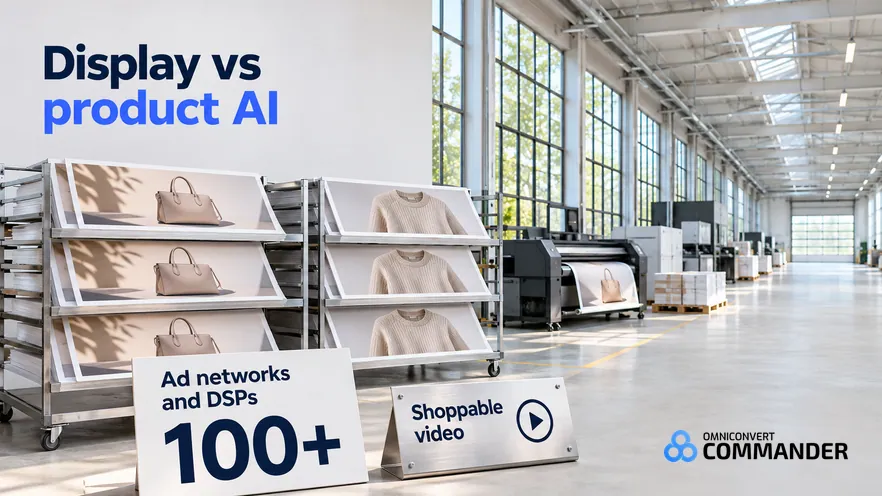
Bannerflow builds and distributes HTML5 display ads with DCO and live updates across 100+ ad networks. Jointellos.com is an AI studio for fashion product photos and on-model video, plus shoppable video for product pages. CLV modelling and True Profit measurement are absent from both. Omniconvert Commander creates ads, builds landing pages, and publishes to Meta and Google.
Compare and choose: Omniconvert Commander Omniconvert Commander pricing Omniconvert Commander customer intelligence Bannerflow vs Omniconvert Commander Tellos vs Omniconvert Commander
- Bannerflow produces, manages, and distributes HTML5 display ads with DCO and live updates across 100+ ad networks and DSPs from one platform.
- Jointellos.com is an AI studio for fashion product photos and on-model video, with shoppable video that lets shoppers buy from the clip.
- Bannerflow is enterprise design scaffolding requiring a design team; Jointellos.com produces product visuals without ingesting CLV or NPS; neither models customer lifetime value.
- Neither Bannerflow nor Jointellos.com tracks True Profit or identifies which customer segment is worth acquiring at the margin level.
- Omniconvert Commander adds CLV segmentation, True Profit tracking, and a prioritised action queue above both Bannerflow and Jointellos.com.
A DTC growth team comparing Bannerflow vs Jointellos.com is choosing between two visual production tools that sit at very different points in the ad supply chain. Bannerflow builds a master HTML5 creative once, scales it to every required format, and pushes it to 100+ ad networks with DCO and live updates. Jointellos.com is an AI studio that turns flat-lay or mannequin shots into on-model product photos and video, plus shoppable clips for product pages. Neither reads customer signals to decide which segment, product, or angle is worth the visual investment, and that decision layer is what Omniconvert Commander is built to hold.
What is Bannerflow, and what is it actually good at?
Bannerflow is an enterprise creative management platform. It covers dynamic creative optimisation, HTML5 display and social ad production, and live updates pushed to 100+ ad networks. It targets enterprise ecommerce, gaming, travel, and automotive teams that ship display at scale. [Bannerflow, 2026]
Bannerflow's distinguishing move is combining HTML5 production with distribution: teams build a master creative once, then scale it to every required format and push it to 100+ ad networks and DSPs from one place. DCO connects live product data feeds to ad variants so personalisation runs automatically at scale. Live ad updates change creative in running campaigns without a rebuild or a republish.
Bannerflow sits in the creative management platform space. It suits enterprise brands and in-house agencies that already have a design team and need to run display advertising across many networks at scale. The scope limit is real: Bannerflow handles production and distribution of ads, not generative creation for non-designers, and full DCO depends on connecting it with other adtech.
On G2, Bannerflow scores 4.6 out of 5 based on 80 reviews as of 2026. Users point to network coverage, DCO, and the live update workflow as standout strengths. The note that appears repeatedly: the platform is enterprise scaffolding built around a design team, so organisations without dedicated design resource or a display-heavy stack tend not to extract full value.
CMPs form the production backbone for display and social advertising. The workflow is: store master creatives centrally, generate every required format, link to product feeds for dynamic creative optimisation, then push to ad networks and DSPs. A CMP's focus is making and distributing ads; customer-signal reading and CLV modelling fall outside its scope.
Where Bannerflow is genuinely strong
- Live ad updates without republishing: edit creative in a running campaign in real time, with no need to rebuild or relaunch.
- 100+ ad network reach from one platform: send directly to networks and DSPs, cutting out manual trafficking and agency handoff.
- DCO with live product feeds: product data drives automatic variant personalisation at enterprise scale, in real time.
Where Bannerflow hits its ceiling
- Enterprise design tool, not no-code: a designer is a prerequisite; the platform is not a self-serve generator for people without design skills.
- No standalone DCO: unlocking full dynamic creative optimisation depends on integrating other adtech into the stack.
- Production infrastructure, not customer intelligence: there is no CLV or customer-behaviour layer to inform which customer segment the display budget should target.
For enterprise display teams, Bannerflow is a capable specialist. The limit appears when the production pipeline is running well but the display budget keeps reaching customers who do not drive long-term value.
What is Jointellos.com, and what is it actually good at?
Jointellos.com is an AI-powered studio for fashion product imagery and video. Its AI Photo Studio converts flat-lay or mannequin shots into photos on AI models, and its AI Video Studio produces on-model video. Fashion and eCommerce brands use it to produce campaign-ready assets without a traditional shoot. [Jointellos.com, 2026]
Jointellos.com sits at the asset-production step of the creative workflow. Instead of generating display ads, it makes product visuals: the AI Photo Studio shows flat-lay or mannequin shots on AI models, the AI Video Studio makes on-model video, and Shoppable Videos let shoppers buy straight from the clip. The output is a finished product photo or video, not a campaign-ready ad set.
The category is AI fashion photo and video studio. The buyer is a fashion or eCommerce brand lead whose real bottleneck is the cost and time of photo and video shoots. The pitch is fewer shoots, faster launches, and product video that shoppers can buy from.
Jointellos.com lists a Shopify integration on its site and has no public G2 rating. Check jointellos.com for current plans.
An AI fashion photo and video studio takes existing product images, such as flat-lay or mannequin shots, and produces photos and video of the product on AI models. It replaces part of a traditional shoot. It does not, on its own, decide which customer segment or angle the asset should serve.
Where Jointellos.com is genuinely strong
- AI at the shoot stage: flat-lay and mannequin shots become on-model photos and video without a traditional shoot.
- Shoppable video: shoppers can buy straight from the clip, and the product documents A/B testing of pages with and without shoppable video, with conversion tracking.
- Built for fashion: the studio targets fashion and eCommerce brands, and its site lists a Shopify integration.
Where Jointellos.com hits its ceiling
- Asset layer, not intelligence layer: the tool produces the photo or video but does not tell you which customer segment or angle the asset should serve.
- No CLV, NPS, or review data ingestion: the customer data that should steer asset decisions sits outside what this tool reads.
- No measurement loop back to margin: a better photo or video is not, on its own, evidence that True Profit moved.
Jointellos.com is a fair fit for fashion brands whose bottleneck is the cost of photo and video production. The ceiling shows up when the assets ship and the campaigns still fail to move margin.
Bannerflow vs Jointellos.com vs Omniconvert Commander: the capability comparison
Bannerflow produces and distributes HTML5 display ads with DCO across 100+ networks for enterprise teams. Jointellos.com makes AI fashion product photos and on-model video, plus shoppable video. Both live in the asset-production part of the workflow, one running display at scale and one making product visuals. Omniconvert Commander covers CLV, determines which segment and angle each asset should serve, creates and publishes the ads, and closes the margin loop with True Profit measurement.
| Capability | Bannerflow | Jointellos.com | Omniconvert Commander |
|---|---|---|---|
| Primary function | Build and distribute HTML5 display ads with dynamic creative optimisation across 100+ ad networks | AI studio for fashion product photos and on-model video, with shoppable video | Autonomous growth intelligence above any creative workflow |
| Unified commerce data | No: data covers production and distribution only, with no commerce intelligence layer | No: product media, not commerce or CLV | Yes: one central creative record for the whole stack |
| AI-prioritised experiment queue | No: a build-and-ship workflow, with no ranked action list | No: no ranked next-action queue; A/B testing compares pages with and without shoppable video to measure conversion lift | Yes: highest-impact action ranked by expected margin gain |
| Creative generation | Partial: takes a master design and scales it to every format while connecting DCO feeds, rather than generating creative from scratch with AI | Yes: AI-generated product photos and on-model video starting from flat-lay or mannequin shots | Yes: test variants ordered by CLV-weighted creative angle |
| True Profit tracking | No: ad delivery metrics only, margin data absent | No: photo and video output only, no margin visibility | Yes: measures margin instead of ROAS, with breakdowns at the campaign and cohort level |
| CLV and segment intelligence | No: CLV and customer behaviour data not included | No: CLV modelling, RFM cohorts, and churn prediction are absent | Yes: RFM segmentation, cohort analysis, churn prediction, NPS signal |
| Autonomous action layer | No: the workflow still depends on designers and trafficking staff | No: human still decides which assets to make and where to run them | Yes: eliminates the human coordination layer between data and action |
| AI creative briefing | No: build-and-distribute infrastructure; creative briefs come from people | Partial: generates assets from your product inputs, does not build the brief from customer data | Yes: briefs generated from CLV, NPS, and review intelligence |
| Pricing model | Annual enterprise contract; contact bannerflow.com for pricing details | AI studio: free plan, Plus $99/mo, Pro $299/mo; shoppable video from $49/mo with a 14-day free trial (checked November 2026, see jointellos.com/pricing) | A free tier is included for stores under 9,999 orders per year; paid plans from $49/month, details at Omniconvert Commander pricing and plans |
| Best for | Large-scale ecommerce, gaming, travel, and automotive teams that run DCO display across many networks | Fashion and eCommerce brands seeking AI-generated product photos and video instead of a traditional shoot | eCommerce businesses above $1M ARR that prioritise margin rather than top-line revenue |
| Integrations | 100+ ad networks and DSPs, Google, Meta, and live product feeds | Shopify, as listed on jointellos.com | Shopify, Klaviyo, Meta, Google, GA4, Gorgias, Triple Whale, Klar, Blueshift (TikTok on the roadmap) |
| User rating | 4.6 / 5 (G2, 80 reviews, 2026) | No public G2 rating | 5.0 out of 5 (Shopify App Store, 66 reviews, as of November 2026) |
Bannerflow columns reflect publicly available feature documentation and G2 ratings as of 2026. Jointellos.com data comes from its own site as reviewed in November 2026; visit jointellos.com to confirm current plans.
What Bannerflow and Jointellos.com cannot do
One runs enterprise HTML5 display production with DCO across 100+ ad networks, the other makes AI fashion product photos and on-model video. Both sit inside the visual production loop. No CLV layer exists in either tool's architecture. Deciding which segment merits acquisition and whether the spend improved margin remains a human task. Omniconvert Commander is built to fill that gap.
Bannerflow handles the production and distribution side of display creative at enterprise scale. Omniconvert Commander sits upstream: it brings CLV and segment data into the brief before Bannerflow's pipeline opens, so the team knows which segment warrants the display investment and which message is worth building.
Jointellos.com handles the product photo or video output. Omniconvert Commander determines which customer segment and creative angle that asset should serve, drawing on CLV data, NPS signals, review themes, and competitor angles combined into a ranked action queue. A polished asset built without customer intelligence is still pointed at the wrong segment.
What neither tool can tell you
- Which customer segments in your existing base justify more acquisition spend. A 12-month CLV model answers that in a way last-click attribution cannot, identifying which segments actually warrant the next budget cycle.
- Which customer segments are within 60 days of churning. That early warning lives in NPS scores, review sentiment, and support ticket patterns, not in a display ad production line or an AI fashion photo and video studio.
- Whether the last campaign you ran lifted True Profit or simply moved the ROAS number. Net margin can compress even as ROAS rises. A measurement approach built around margin is the only way to catch that gap.
- The specific creative angle your highest-value customers actually respond to. A DCO feed personalising by product and a polished on-model product video both miss the specific message your top-CLV cohort actually reacts to.
Omniconvert Commander occupies this layer. It draws on CLV data and NPS signals alongside review intelligence and competitor creative data, ranking all of it into a prioritised action queue before any brief is written or any creative goes into production. Omniconvert Commander targets True Profit as its core metric, not ROAS.
True Profit measures the net margin left once CAC, COGS, return rates, and cohort-level customer acquisition costs have been deducted, not gross revenue or ROAS. That figure is what stays in the business after all costs. Across every experiment, Omniconvert Commander uses True Profit as the primary optimisation metric.
One mobile A/B test by LEROY MERLIN Romania with Omniconvert tested a shorter benefits section on the homepage and returned a +14.36% conversion rate, +8.43% revenue per user, and a 98.4% chance to win. [LEROY MERLIN Romania results, Omniconvert case study]
Which tool is right for you?
If you need enterprise display production and DCO distributed live across many networks, choose Bannerflow. If you are a fashion brand that wants AI product photos, on-model video, or shoppable video without a traditional shoot, evaluate Jointellos.com. If the visuals are live and the spend is running but margin stays flat, the missing piece is CLV, and that is Omniconvert Commander.
- Choose Bannerflow if your team runs enterprise display at scale, needs DCO tied to live product feeds, and requires live creative updates across 100+ networks without republishing.
- Choose Jointellos.com if you sell fashion online and want AI-made product photos, on-model video, or shoppable video on product pages instead of a traditional shoot.
- Add Omniconvert Commander if the visual pipeline is dialled in but the open question is which segment and product are worth acquiring and whether it improved True Profit.
Bannerflow and Jointellos.com address different parts of the same problem: faster, cheaper visual production for enterprise display and for fashion product imagery. One handles display production and distribution at scale, the other generates product photos and video for product pages and ads. Both accelerate the workflow, but neither answers the customer question that sits upstream of both. Omniconvert Commander determines which customers to target by CLV, creates ads for those segments, manages spend on Meta and Google with your approval, and tracks whether it moved margin. Omniconvert Commander handles a distinct layer of the stack, separate from either tool.
What each tool cannot do, honestly
A fair comparison states the limits plainly. Bannerflow provides enterprise production and distribution infrastructure with no CLV or customer intelligence built in. Jointellos.com generates fashion product photos and video but does not supply the customer intelligence that determines which segment and angle they should address. Omniconvert Commander does not run HTML5 display production and is not a product photo or video studio; it creates static ad images, builds matching landing pages, manages campaigns on Meta and Google, and measures True Profit and CLV.
- Bannerflow: enterprise CMP that requires design expertise, cannot run standalone DCO, and has no CLV or customer-behaviour data to guide which customer segment the display budget should target.
- Jointellos.com: fashion photo and video studio only, no CLV or NPS ingestion, no measurement loop back to margin.
- Omniconvert Commander: not an HTML5 display production platform and not a fashion photo and video studio. It defines and measures the margin goal; it relies on tools like either one to supply enterprise display production or fashion product imagery.
The practical split: use Bannerflow for enterprise display production and DCO, use Jointellos.com for AI fashion product photos and video, and use Omniconvert Commander for the CLV signal and margin measurement loop. Together they cover what none of the three can handle on its own.
More on Bannerflow and Tellos
Best tools in this category
See where your store stands against real competitors in your category and country. Ecommerce Benchmark scores six areas free: Creative & Ads, Reviews & UGC, AI Visibility, Agentic Commerce, Competitor Synthesis, and CRO.
Benchmark Your Store FreeFrequently Asked Questions
Should you replace Bannerflow or Jointellos.com with Omniconvert Commander?
Add Omniconvert Commander when display campaigns ship, fashion photography looks strong, and the channel metrics are healthy but margin stays flat. Bannerflow produces HTML5 display and distributes it to 100+ ad networks with DCO. Jointellos.com generates AI fashion product photos and on-model video for product pages. Neither identifies which customer segments are worth acquiring or tracks whether the spend moved True Profit. Omniconvert Commander sequences the next action by projected margin and completes the loop.
Bannerflow and Jointellos.com are strong at execution within their jobs: enterprise HTML5 display production with DCO and 100+ network distribution, and AI-made fashion product photos and on-model video. If scaling display or producing product visuals is your live need, keep the tool that fits.
The more demanding question is whether your team has a dependable way to know which customers to target, what message to use, and whether the result improved margin. That question sits outside what either platform answers, and it is the problem Omniconvert Commander is built to solve.
Stop assembling data.
Start supervising growth.
Omniconvert Commander consolidates your full eCommerce data stack, surfaces revenue anomalies, and produces a prioritised action queue so your team runs the P&L rather than acting as a coordination layer between tools.
5.0 out of 5 across 66 reviews, Shopify App Store , as of November 2026