Celtra vs Creatify vs Omniconvert Commander (2026): Score vs generate.
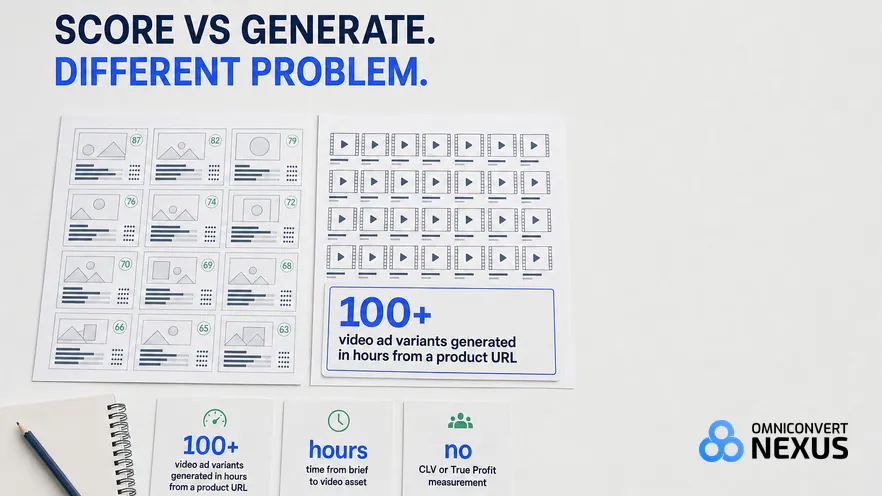
Celtra and Creatify are both AI creative production tools. Celtra is an enterprise creative management platform that scores assets before launch across formats and markets. Creatify generates 100+ UGC-style video ad variants from a product URL in hours. CLV modelling and True Profit measurement are absent from both. Omniconvert Commander supplies the margin layer that sits above them.
- Celtra is an enterprise creative management platform that scores assets before launch and scales creative production across formats and markets.
- Creatify is an AI video ad platform that generates 100+ UGC-style video variants from a product URL in hours, with AI avatars and voiceovers.
- Celtra scores and scales enterprise creative production; Creatify generates DTC video volume; neither models customer lifetime value or performance from customer data.
- Neither Celtra nor Creatify tracks True Profit or identifies which customer segment is worth acquiring at a margin level.
- CLV segmentation, True Profit measurement, and a ranked action queue are what Omniconvert Commander adds to either platform.
A DTC growth team comparing Celtra vs Creatify is weighing two AI creative production tools that solve different scale problems: one is an enterprise creative management platform for large brands with AI asset scoring before launch, the other is an AI video ad platform generating 100+ UGC-style video variants from a product URL. Celtra serves brands managing high-volume creative across formats and markets with production automation. Creatify serves DTC brands needing rapid video ad volume without a film crew. Both tools leave a gap: neither can tell you which segments return profit after acquisition costs, and neither measures whether a campaign raised True Profit. Omniconvert Commander fills that decision layer.
What is Celtra, and what is it actually good at?
Celtra is an enterprise creative management platform for producing, versioning, and distributing high volumes of creative across formats and markets. Its AI asset scoring predicts creative performance before launch, reducing wasted spend on untested creative and integrating with brands' existing media buying stack. [Celtra, 2026]
Celtra centralises creative production automation for large brand and agency teams. It scales creative across formats, markets, and languages from master designs, and adds AI asset scoring that predicts performance before launch. The platform separates creative production from media execution, integrating with media partners rather than replacing the media buying stack.
Celtra sits in the enterprise creative management space. The buyer is a large brand or agency team producing high volumes of creative across markets and needing pre-launch scoring to reduce wasted spend on untested assets. The pitch is production velocity plus predictive scoring: build at scale, test with AI before launch, then distribute through the existing media stack.
Celtra holds a 4.4 out of 5 rating on G2 across roughly 60 reviews as of 2026. Reviews praise the multi-format scaling and the AI asset scoring for pre-launch performance signals. They also flag the ceiling: enterprise pricing, no customer intelligence layer, and scoring based on creative attributes rather than customer data.
A creative management platform (CMP) is a system for producing, versioning, and distributing digital ad creative at scale across many formats and channels from a single source design. It handles production and distribution only. Customer intelligence and measurement live elsewhere.
Where Celtra is genuinely strong
- AI asset scoring: predicts creative performance before launch and reduces wasted spend on untested assets.
- Enterprise production automation: scales creative across formats, markets, and languages for large brand portfolios.
- Media stack integration: separates creative production from media execution and connects into the existing media buying stack.
Where Celtra hits its ceiling
- Enterprise pricing: not accessible for mid-market or SMB brands.
- Production and intelligence only: no media buying, no campaign management, and no bid automation built in.
- No CLV or segment intelligence: asset scoring reads creative attributes, not customer data or lifetime value.
Celtra is a strong specialist for one stack: enterprise brands producing creative across markets that want AI scoring before launch. The ceiling appears when the question shifts from which asset will score well to which customer segment deserves the production spend and whether it improved margin.
What is Creatify, and what is it actually good at?
Creatify is an AI video ad generation platform for DTC eCommerce brands. It generates 100+ UGC-style video ad variants featuring AI avatars and voiceovers from a product URL or brief, reducing the time from brief to video asset from weeks to hours. [Creatify, 2026]
Creatify automates video ad production from a product URL or script. The platform draws on a library of AI avatars and voiceovers to generate UGC-style video ads at volume, and a direct Shopify integration pulls product data automatically for ad generation. Performance marketers use it to compress the video production cycle from weeks to hours.
Creatify falls into the AI video ad generation category. The buyer is a DTC brand or performance agency that needs high volumes of video ad variants without a production crew. The pitch is generation speed and volume: dozens of video variants per campaign, ready to run on Meta, TikTok, and YouTube. Creatify Labs publishes Boreal and Boreal-H3, its ad-optimised video generation models, through the Creatify API, Model Playground, and AdFlow. The Performance Agent claims one-click connections to Shopify, GA4, and six ad platforms. It draws in revenue and conversion data from those sources, then adjusts creative rotation and budget distribution toward whatever delivers the strongest return.
Creatify holds a 4.5 out of 5 rating on G2 across roughly 445 reviews as of 2026. Reviews praise the volume, the AI avatar realism, and the Shopify integration. They also flag the ceiling: no CLV context, and no way to tell which generated video is likely to win before you spend — though its Performance Agent now ingests Shopify and Google Analytics revenue and performance data to rotate creative and reallocate ad budget.
AI video ad generation is the use of large models to produce short-form video ad variants from a product URL or brief, typically featuring AI avatars, generated voiceovers, and stock or product footage. It is a production layer, not a briefing or measurement layer.
Where Creatify is genuinely strong
- Video volume: generates 100+ video ad variants in hours from a single product URL, no film crew required.
- Avatar and voiceover library: a range of realistic AI avatars and voice options for UGC-style content.
- Shopify integration: pulls product data directly for ad generation without manual asset preparation.
Where Creatify hits its ceiling
- Generation only: Creatify produces video assets but does not decide what angle to generate based on customer data.
- No analytics layer: the Performance Agent ingests Shopify and Google Analytics revenue and performance data and reallocates budget toward whatever is driving the best return, but Creatify still does not tell you up front which generated video is likely to perform best.
- No CLV intelligence: all creative decisions still rest with the marketing team, without lifetime value or segment context.
Creatify is a strong specialist for one stack: DTC brands producing large volumes of UGC-style video ads at speed for Meta, TikTok, and YouTube. The ceiling appears when the question shifts from how fast you can produce a variant to which angle deserves the production and which customer segment it should target.
Celtra vs Creatify vs Omniconvert Commander: the capability comparison
Celtra scores and scales enterprise creative production with AI asset scoring before launch. Creatify generates 100+ AI video ad variants from a product URL in hours. Both optimise creative production within their scope. CLV modelling, the creative brief, and the margin feedback loop belong to Omniconvert Commander.
| Capability | Celtra | Creatify | Omniconvert Commander |
|---|---|---|---|
| Primary function | Enterprise creative production and AI asset scoring before launch | AI video ad generation from a product URL at volume | Autonomous growth intelligence above any creative tool |
| Unified commerce data | No: production and scoring tool, not a commerce data layer | No: its Performance Agent ingests Shopify and Google Analytics revenue and performance data for ad buying, but there is no unified commerce data | Yes: unified view across every data source in the stack |
| AI-prioritised experiment queue | Partial: AI asset scoring surfaces predicted winners before launch, team decides what to scale | No: generation tool with a Performance Agent that buys media off Shopify and Google Analytics data, no ranked action queue | Yes: recommended actions ranked by forecast margin impact |
| Creative generation | Partial: takes existing creative and adapts it across formats and markets at scale, rather than generating net-new assets from scratch with AI | Yes: paste in a product URL and get 100+ video variants within hours, each rendered by Creatify's Boreal and Boreal-H3 ad-optimised video models. | Yes: variants ordered by CLV-weighted message angle |
| True Profit tracking | No: no margin layer | No: no margin layer | Yes: tracks margin at campaign and cohort level rather than ROAS |
| CLV and segment intelligence | No: asset scoring on creative attributes, not customer data | No: no customer data informs the generated variant | Yes: RFM scoring, cohort analysis, churn prediction, NPS signals |
| Autonomous action layer | No: humans run the production and scoring workflow | Partial: humans still choose what goes into a run, but its Performance Agent rotates creative and reallocates budget toward whatever is driving the best return | Yes: eliminates manual hand-offs between data and action |
| AI creative briefing | No: production and scoring, no briefing layer from customer data | No: generation only, no briefing from CLV or NPS | Yes: ad brief grounded in CLV, NPS scores, and customer review data |
| Pricing model | Enterprise tier, custom pricing available at celtra.com | Watermarked free tier at 10 credits per month; paid plans start at $10/month on an annual subscription or $15/month on monthly billing. Pricing verified October 2026. | Start free; paid plans from $49/month, see Omniconvert Commander pricing |
| Best for | Large brands and enterprise agencies producing high-volume creative across markets and brand portfolios | DTC brands and performance agencies producing large volumes of video ad content quickly | eCommerce brands past $1M ARR that prioritize margin over volume |
| Integrations | Product feeds, Meta, Google, Trade Desk, various DSPs | Shopify, Meta, TikTok, YouTube, GA4 (the Performance Agent pulls revenue and campaign data from Shopify and GA4) | Shopify, Klaviyo, Meta, Google, TikTok, GA4, Triple Whale |
| User rating | G2 rating: 4.4/5 (60 reviews, 2026) | G2 rating: 4.5/5 (445 reviews, 2026) | 5.0 out of 5 (Shopify App Store, 63 reviews, as of November 2026) |
Celtra and Creatify feature data is drawn from publicly available documentation current as of September 2026. G2 ratings sourced as cited in s1 and s2.
What Celtra and Creatify cannot do
Celtra scores and scales enterprise creative production across formats. Creatify generates volumes of AI video ad variants from a product URL. Both optimise creative production. CLV modelling sits outside the scope of either tool. Whether the spend improved margin still sits with a human. Omniconvert Commander is built to fill that gap.
Celtra is an enterprise creative management platform built around asset scoring at scale. Omniconvert Commander provides the customer intelligence that falls outside that asset-scoring scope: it maps predicted creative performance to CLV-ranked customer segments. Asset performance scores across channels answer a different question from segment targeting, and neither answer reveals what margin those conversions produce.
Creatify generates the video. Omniconvert Commander identifies the right product angle by pinpointing the customer segment with the highest CLV and lowest churn risk. That segment insight is the brief that Creatify cannot generate on its own. Without it, high-volume output has no strategic direction.
What neither tool can tell you
- The customers worth doubling down on in your next acquisition push. Last-click attribution cannot tell you. A 12-month CLV view is what shows which segments justify the next round of paid spend.
- The segments that will lapse within 60 days. The early signal lives in NPS scores, review sentiment, and support ticket patterns, not in a creative scoring model or a video generation pipeline.
- Did your last campaign add True Profit, or just move ROAS? ROAS figures can increase while net margin shrinks. A margin-first measurement loop is the only way to detect that compression.
- How your top-CLV buyers actually respond to messaging. Celtra reads creative attributes across formats; Creatify reads a product URL to generate video; neither reads the actual response patterns of your top-CLV cohort.
Omniconvert Commander covers the margin layer that neither Celtra nor Creatify reaches. It combines NPS signals, review intelligence, competitor creative data, and CLV figures into a prioritised action queue, assembled before the first brief is drafted. ROAS is not the target here: True Profit is.
True Profit is the net margin a business retains once CAC, COGS, return rates, and customer acquisition costs by cohort are deducted from revenue. It excludes gross revenue inflation and ROAS. Omniconvert Commander treats True Profit as its primary metric in every experiment it runs.
LEROY MERLIN Romania's 14-month testing programme with Omniconvert spanned 46 experiments, reached a 39.13% win rate, and grew website revenue by +6.27%. [Full LEROY MERLIN Romania case study on Omniconvert]
Which tool is right for you?
Choose Celtra for enterprise creative production at scale with AI asset scoring before launch. Choose Creatify for high-volume AI video ad generation from a product URL. If the creative runs well but margin is flat, the missing layer is CLV, and that is Omniconvert Commander.
- Choose Celtra if you manage creative production at enterprise scale across multiple markets and need AI scoring to predict asset performance before launch.
- Choose Creatify if you need to produce 50+ video ad variants per week without a production budget and your bottleneck is generation speed, not strategy.
- Add Omniconvert Commander if the creative runs efficiently but the open question is which segment is worth acquiring and whether it improved True Profit.
Celtra and Creatify occupy different positions in the creative stack: one scores and scales enterprise creative production across formats and markets, the other generates video ad variants at volume from a product URL. Both are production tools. Omniconvert Commander operates above them, identifying which customers the spend should target and tracking whether that spend moved margin. Those are distinct problems on a different layer.
What each tool cannot do, honestly
Celtra scores assets and scales production across formats but is enterprise-priced with no CLV data. Creatify generates video volume from a product URL without briefing intelligence or analytics on which variant will win. Omniconvert Commander does neither production job; it supplies the CLV and margin layer both are missing.
- Celtra: enterprise-priced platform with no CLV or segment intelligence layer, and no media buying or bid automation built in.
- Creatify: volume video generation and in-platform media buying, with no analytics on which variant is likely to win before launch and no customer intelligence informing the angle.
- Omniconvert Commander: not an enterprise creative management platform or a video generation engine. It defines and measures the margin goal; it relies on tools like either one to run the creative production.
The honest read: run a creative management platform for enterprise scoring and multi-market production, run an AI video generator for volume UGC output, and run Omniconvert Commander for the CLV signal and margin. Together they cover what none of them can close on their own.
See where your store stands against real competitors in your category and country. Ecommerce Benchmark scores six areas free: Creative & Ads, Reviews & UGC, AI Visibility, Agentic Commerce, Competitor Synthesis, and CRO.
Benchmark Your Store FreeFrequently Asked Questions
Should you add Omniconvert Commander to your Celtra or Creatify stack?
Add Omniconvert Commander if your creative runs efficiently but margin is flat. Celtra scores and scales enterprise creative production with AI asset scoring before launch across formats and markets. Creatify generates 100+ AI video ad variants per hour from a product URL for DTC brands. Neither tool models which customers are worth acquiring or tracks whether a campaign moved True Profit. Omniconvert Commander provides that ranking by projected margin and completes the loop.
Celtra and Creatify are strong at execution within their jobs: enterprise creative production and pre-launch AI scoring on one side, high-volume UGC-style AI video generation on the other. If scoring and scaling enterprise creative or generating video ad volume is your live need, keep the tool that fits.
The harder question is whether your team has a consistent method to know who to target, what message to run, and whether it moved margin. That is the specific question Omniconvert Commander is built to answer.
Stop assembling data.
Start supervising growth.
Omniconvert Commander connects your full eCommerce data layer, surfaces revenue anomalies, and produces a prioritized action queue. Your team runs the P&L instead of acting as the go-between for data and decisions.
5.0 out of 5 across 63 reviews, Shopify App Store , as of November 2026