HeyGen vs Motion vs Omniconvert Commander (2026): Avatar video vs analytics
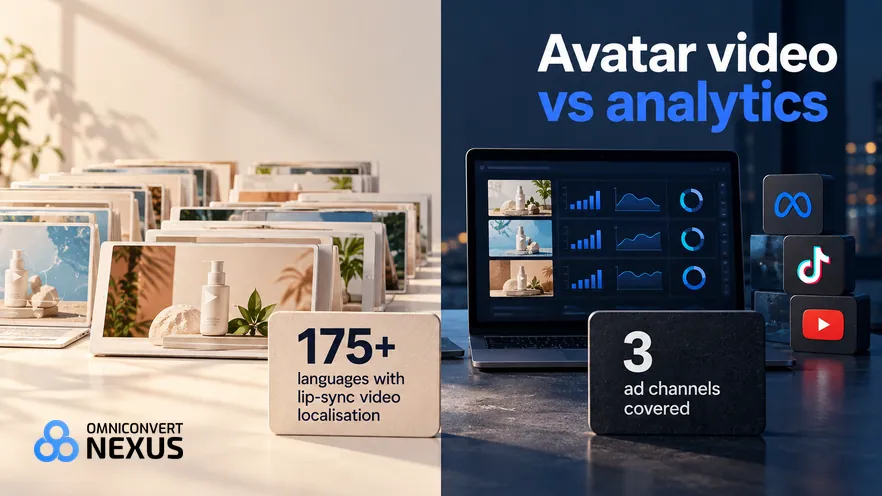
HeyGen and Motion sit in different jobs within paid social. HeyGen produces realistic AI avatar video, with voice cloning available in 175+ languages. Motion connects to Meta and TikTok and surfaces which creative concepts are winning at the concept level. No brief gets built from CLV data in either tool, and True Profit goes untracked in both. That gap is what Omniconvert Commander covers.
- HeyGen wins on realistic avatar video: 500+ presenters on the free plan, voice cloning, and lip-sync localisation across 175+ languages.
- Motion wins on concept-level creative analytics: hook rate, hold rate, and conversion grouped by concept across Meta, TikTok, and YouTube.
- HeyGen and Motion share a common limitation: brief creation draws on no CLV, NPS, or review intelligence in either product, and True Profit goes unmeasured in both.
- Bring Omniconvert Commander in as the layer above both when ROAS appears healthy but margin has stopped improving quarter-on-quarter.
A DTC growth team comparing HeyGen vs Motion is usually solving two different problems: producing realistic avatar video at scale without filming budgets, and understanding which ad concepts are actually driving performance across Meta and TikTok. HeyGen is the specialist for AI avatar video with 500+ presenters on the free plan, voice cloning, and 175-language lip-sync. Motion is the specialist for concept-level creative analytics, breaking down hook rate, hold rate, and conversion by concept rather than by individual ad. Customer segment selection, creative angle decisions, and True Profit measurement sit outside what either tool provides.
What is HeyGen, and what is it actually good at?
HeyGen is an AI video platform centered on photorealistic avatars and voice cloning technology. Studio-quality talking-head video is generated without a camera, with lip-sync accuracy spanning 175+ languages and the ability to build a custom avatar from uploaded photos or footage. [HeyGen, 2026]
Corporate training, explainer content, and multilingual localisation were HeyGen's original focus. By 2026, DTC brands have pulled it into UGC-style ad production as a way to get realistic spokesperson video without paying for a film crew. A single source video adapts to every language market through automated localisation, with no reshooting or recasting required.
HeyGen is an AI avatar and video generation tool. Its target buyer is a brand that needs professional spokesperson video at scale, with multilingual markets as a primary use case. The value it offers pairs realism with reach: 500+ presenters included on the free plan, voice cloning, and localisation across 175 languages with accurate lip-sync.
On G2, HeyGen carries a 4.8 out of 5 score from 900 reviews as of 2026. Reviewers praise avatar realism and localisation quality. A recurring theme in the criticism: output quality depends entirely on the creative direction you bring, and generating that direction is still your team's job.
From a short audio sample, voice cloning builds a digital replica of a chosen voice. That replica can deliver new scripts across any supported language while holding the same tone and cadence. HeyGen adds lip-sync on top, so the avatar's mouth in each localised version stays aligned with the cloned voice.
Where HeyGen is genuinely strong
- 500+ presenters on the free plan: an extensive library alongside custom avatar creation built from your own uploaded photos or video.
- 175-language lip-sync localisation: take one master video and distribute it across every market, with no re-filming and no need to rehire talent per language.
- Voice cloning for brand spokesperson: a synthetic copy of a specific voice that keeps spokesperson delivery consistent across every new script and market.
Where HeyGen hits its ceiling
- General-purpose video tool: the platform was not designed around ecommerce ad workflows, product URL ingestion, or paid social creative testing.
- No ad analytics loop: HeyGen outputs video files but holds no connection to your ad account data or live campaign performance.
- No CLV or segment intelligence: there is no customer data layer shaping what gets made; the brief is a manual input every time.
HeyGen is a focused specialist that does one job well. The ceiling appears when teams find that higher-fidelity avatar video does not, on its own, move True Profit.
What is Motion, and what is it actually good at?
Motion is a creative analytics platform for performance teams. It connects to Meta, TikTok, and YouTube ad accounts and surfaces which creative concepts are driving results, broken down by hook rate, hold rate, and conversion. The buyer is a DTC brand spending $50k to $500k a month on paid social that needs concept-level clarity, not just ad-level dashboards. [Motion, 2026]
Motion sits on top of the Meta, TikTok, and YouTube ad accounts. It groups performance data by creative concept rather than by ad ID, so a team can see which hook, format, or visual pattern is winning across dozens of individual ads. The reporting is fast enough that creative strategists can pull it without an analyst layer between them and the numbers.
Motion is a creative analytics platform. Pricing starts at $999 a month for Starter, which covers up to $50k monthly ad spend; Pro and Growth are by quote (checked October 2026). The typical adopter is a mid-market DTC brand or an in-house creative team at an agency, where the volume of ad variants has outrun the team's ability to eyeball which ones matter.
G2 users give Motion a 4.7 out of 5, based on 312 reviews as of 2026. Reviewers consistently praise the concept-level roll-up and the low friction for non-technical marketers. The same reviews note what Motion does not do: it reports on creative performance, it does not make decisions or produce the next asset.
Concept-level analytics groups ad performance by creative concept (hook, format, visual pattern, angle) rather than by individual ad ID. It answers the question "which idea is working" instead of "which ad variant is working," so a strategist can invest in the concept and drop the losing ones without hunting through ad set structures.
Where Motion is genuinely strong
- Concept-level breakdown: the fastest way to see which ad hooks and concepts are actually driving results, not just which ad IDs.
- Live Meta and TikTok data: connects directly to the ad accounts with no reporting lag, so decisions are made on current numbers.
- Team-friendly UI: creative strategists and non-technical marketers can pull the reports themselves without analyst support.
Where Motion hits its ceiling
- Analytics only: Motion shows what happened; it does not decide what to do next, and it does not generate the next creative.
- Ad-metric horizon: reports track hook rate, hold rate, and ROAS, not net margin, CLV cohorts, or return-rate drag.
- No customer-data layer: the platform optimises for creative performance, so the CLV, NPS, and review signals that should shape the brief still live outside it.
Motion is a strong specialist for teams that need concept-level clarity on ad performance. The ceiling shows up when the underlying question is not "which concept is winning" but "which segment should we be acquiring in the first place."
HeyGen vs Motion vs Omniconvert Commander: the capability comparison
HeyGen handles realistic avatar video with 175-language localisation. Motion handles concept-level creative analytics across Meta, TikTok, and YouTube. Omniconvert Commander operates at the layer above both: identifying which customer to target, which angle the brief should lead with, and whether the resulting spend produced True Profit rather than just ROAS movement.
| Capability | HeyGen | Motion | Omniconvert Commander |
|---|---|---|---|
| Primary function | AI avatar video with voice cloning and localisation across 175 languages | Concept-level creative analytics across paid social | Autonomous growth intelligence above any generator or analytics tool |
| Unified commerce data | No: HeyGen has no unified data layer connecting paid, email, CRO, and retention signals | Partial: tracks creative performance across channels, not the full commerce data stack | Yes: unified data view spanning every tool in the stack |
| AI-prioritised experiment queue | No: no prioritised list of next actions to take | No: surfaces winning concepts, does not rank next experiments to run | Yes: ranks next best actions by projected margin impact across every active channel |
| Creative generation | Yes: photorealistic AI avatar video across 175+ languages with voice cloning | No: analytics only, no creative generation capability | Yes: CLV-weighted ordering of creative angles for ads |
| True Profit tracking | No: profit margin absent, return rates not tracked | Partial: reports ROAS and hook rate, no margin or CLV layer | Yes: measures margin instead of ROAS, at both campaign and cohort level |
| CLV and segment intelligence | No: customer lifetime value not factored in, churn risk not visible | No: CLV, churn risk signals, NPS, and review data are all absent | Yes: RFM segmentation, cohort analysis, churn prediction, NPS signal |
| Autonomous action layer | No: human briefs every run | No: dashboards only, humans still translate insight into action | Yes: raw data flows directly to the next action with no manual coordination required |
| AI creative briefing | No: the marketer writes the brief manually | Partial: highlights top-performing concepts, does not generate briefs from customer data | Yes: briefs are generated from CLV segments, NPS scores, and review data |
| Pricing model | SaaS subscription; Creator plan starts at $29/month; full pricing at heygen.com | Starter $999 a month up to $50k monthly ad spend; Pro and Growth by quote (checked October 2026) | Starts free; paid tiers from $49/month; see Omniconvert Commander pricing |
| Best for | Brands that need professional spokesperson video at scale, with a particular focus on multilingual markets | DTC brands spending $50k to $500k a month on paid social that need concept-level clarity | eCommerce teams above $1M ARR who prioritise margin over ROAS |
| Integrations | Zapier · HubSpot · API | Meta · TikTok · YouTube | Meta · Shopify · Google · Klaviyo · TikTok · Triple Whale · GA4 |
| User rating | G2: 4.8 / 5, 900 reviews (2026) | G2: 4.7 / 5, 312 reviews (2026) | 5.0 out of 5 (Shopify App Store, 63 reviews, as of November 2026) |
HeyGen and Motion columns reflect publicly available feature documentation as of October 2026. Check current pricing and integration details directly on each vendor's website before making a shortlist decision.
What HeyGen and Motion cannot do
The shared blind spot sits upstream of both the video and the report. HeyGen produces the avatar video; Motion shows how the ads that carry it performed. What neither tool does is build the brief from CLV data or confirm whether the campaign shifted True Profit, the figure the business actually retains.
Among AI video tools, HeyGen sets the standard for realism. What it cannot supply is the intelligence that shapes the brief: Omniconvert Commander draws on CLV segmentation and NPS signals to identify which customer segment deserves attention, which pain point to open with, and whether the video that resulted actually moved True Profit.
Motion reports on what already ran. After that, a human still decides what to do next. Omniconvert Commander closes that gap by taking the decision and executing it. The issue is not how deep Motion's analytics go; they are strong. The issue is that Motion has no customer intelligence layer: its optimisation target is ad performance metrics, not the margin value of the segments being acquired.
Both HeyGen and Motion are execution tools in adjacent parts of the same funnel. HeyGen makes the video; Motion measures how the ads that carry it performed. The two tools share a gap: neither challenges the question of which customer segment is worth pursuing or which message should be put to the test. They sharpen execution. They do not question the strategy.
What neither tool can tell you
- Customers worth targeting in the next acquisition push. A 12-month CLV view, not last-click attribution or hook-rate rankings, is what tells you which segments deserve the next round of paid spend.
- Which segments are 60 days from churning. The early signal lives in NPS scores, review sentiment, and support ticket patterns, not in a video generator or a creative analytics dashboard.
- Did your last campaign build True Profit, or did it only improve ROAS? Hook rate can climb and ROAS can look healthy while net margin compresses; only a margin-first measurement loop catches the gap.
- Which messages resonate with your highest-value customers. Their own reviews, NPS verbatims, and support transcripts hold the angle that converts; pulling and synthesising them is still manual in a HeyGen-plus-Motion stack.
Omniconvert Commander addresses exactly this layer. It draws together CLV data, NPS signals, competitor creative data, and review intelligence, ranking them into an action queue ahead of any brief or creative work. True Profit, not ROAS, is the metric Omniconvert Commander optimises toward.
True Profit represents what a cohort actually earns once CAC, COGS, return rates, and acquisition costs are deducted from revenue. Gross revenue and ROAS are both excluded from this figure. What remains is the amount the business actually retains. Every experiment Omniconvert Commander runs is optimised against True Profit as the core metric, not surface-level creative performance signals like those HeyGen or Motion surface.
PRISM+ grouped TVs by category in a listing page redesign and tested it across all devices with Omniconvert: that single A/B test produced +40.74% conversion rate, +14.81% revenue per user, and a 99.48% chance to win. [Omniconvert, PRISM+ case study]
This is not a replacement for HeyGen or Motion. HeyGen still produces the video, Motion still reports on which concepts are winning. Omniconvert Commander sits above them as the intelligence layer that determines which brief to issue and then verifies whether the outcome moved the metric the business actually keeps.
Which tool is right for you?
Pick HeyGen if realistic avatar video at scale, particularly across multilingual markets, is the bottleneck. Pick Motion if creative analytics clarity across Meta, TikTok, and YouTube is what your team lacks. Bring in Omniconvert Commander when ROAS looks acceptable but margin refuses to improve, and your team is burning hours pulling CLV, NPS, and review data together before a brief can be written.
Choose HeyGen if
- Multilingual localisation is the bottleneck: you need to deliver a video in 10+ languages with accurate lip-sync, and hiring new talent for each market is not viable.
- Spokesperson consistency matters: the goal is a reusable AI avatar tied to one specific person, keeping brand video uniform at scale.
- Explainer or training video leads: the primary need is explainer, training, or corporate video, not iteration on performance ad creative.
Choose Motion if
- Concept-level clarity is missing: you want the fastest view of which ad hooks and concepts are driving results across Meta, TikTok, and YouTube.
- Creative strategists own reporting: your team needs dashboards that non-technical marketers can pull without analyst support.
- Volume has outrun eyeballing: you are running enough ad variants that concept-level roll-up is the only way to see which idea is working.
Add Omniconvert Commander if
- Data assembly eats your day: before anyone makes a decision, your team is spending more than 2 hours daily pulling data out of separate tools.
- Paid spend has no margin signal: budget flows to paid media, but nothing in the stack reliably shows which customer segments return the highest margin.
- You want experiments ranked before sprint planning: you need to know which tests deserve dev or creative time before sprints are assigned, not after.
- ROAS hides a margin problem: quarter-on-quarter, net margin stays flat even as ROAS holds steady.
What each tool cannot do, honestly
HeyGen, Motion, and Omniconvert Commander each have real limits. Framing them as rivals competing for the same slot obscures what each one actually does. The accurate picture is three layers of a single stack: a video generator, a creative analytics tool, and an intelligence layer. Each handles a distinct job; none covers the full stack on its own.
Where HeyGen will not stretch
- Not an ecommerce ad workflow: HeyGen is a general-purpose video tool; it has no native product URL scraping or direct push to paid social campaign setup.
- Not a creative analytics layer: HeyGen does not surface which video will perform best or which segment it should run to.
- Not a CLV system: creative direction in HeyGen is entirely manual, with no customer intelligence input.
Where Motion will not stretch
- Not an action layer: Motion reports; it does not decide, pause, scale, or brief the next test.
- Not a creative generator: the platform has no output side, so briefing and production still live in HeyGen, a design team, or a separate specialist tool.
- Not a margin or CLV layer: reporting stops at ad performance metrics, so the customer-value view that should shape which concept is worth scaling still lives outside the platform.
Where Omniconvert Commander has real prerequisites
- Expect the first 4 to 6 weeks to focus on data unification: a ranked action queue performs only as well as the inputs behind it. Fragmented sources produce unreliable outputs.
- Strategy and brand judgment remain human: Automatic execution is Omniconvert Commander's role; category positioning and brand voice remain the team's responsibility.
- Revenue stage threshold: the return compounds above $1M ARR, where data volume justifies the approach and the cost of manual coordination is measurable. Brands below that threshold usually get more from a single focused execution tool first.
See where your store stands against real competitors in your category and country. Ecommerce Benchmark scores six areas free: Creative & Ads, Reviews & UGC, AI Visibility, Agentic Commerce, Competitor Synthesis, and CRO.
Benchmark Your Store FreeFrequently Asked Questions
The verdict
HeyGen is the specialist when realistic AI avatar video at scale is the bottleneck: 500+ presenters on the free plan, voice cloning, 175-language lip-sync. Motion is the pick when your team needs concept-level clarity on which ads are winning across Meta and TikTok. Neither builds the brief itself. Add Omniconvert Commander above whichever pair fits.
HeyGen and Motion are strong specialists in adjacent jobs. If the primary need is realistic avatar video with 175-language localisation, HeyGen is the specialist. If it is concept-level clarity on paid-social creative performance, Motion is the specialist.
The more important question is whether your team can reliably determine who to target, what to say to them, and whether the result moved margin. Neither HeyGen nor Motion addresses that layer, and Omniconvert Commander is the tool on this page that does.
Stop assembling data.
Start supervising growth.
Omniconvert Commander connects your full eCommerce data layer into one place, spots revenue anomalies, and produces a prioritised action queue, so the team runs the P&L directly instead of acting as the link between disconnected tools.
5.0 out of 5 across 63 reviews, Shopify App Store , as of November 2026