Marpipe vs Motion vs Omniconvert Commander (2026): Testing vs analytics.
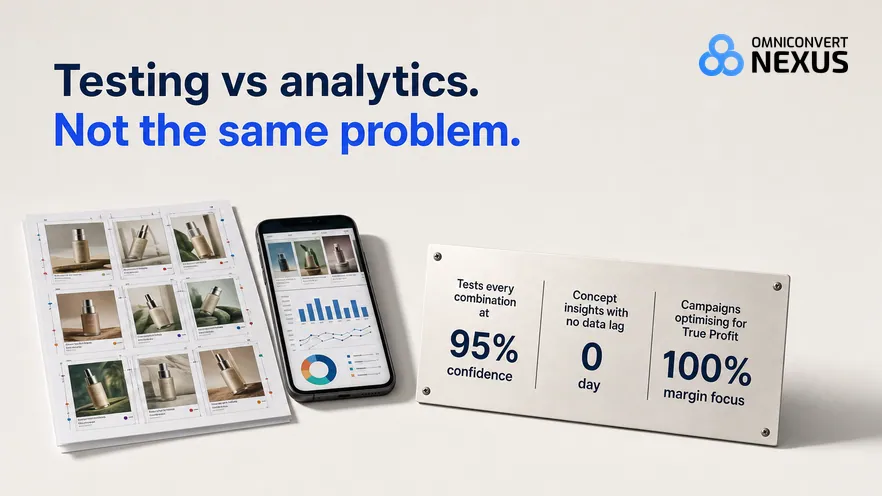
Marpipe and Motion solve different execution problems. Marpipe tests every combination of creative elements at statistical significance. Motion surfaces concept-level ad performance across Meta and TikTok with no data lag. Omniconvert Commander sits above both, ranking which customer segments deserve acquisition and whether campaigns improved True Profit.
- Marpipe runs a full multivariate testing framework, testing every combination of creative elements at once and reporting winners at statistical significance.
- Motion is the fastest concept-level creative analytics view across Meta and TikTok, with hook rate, hold rate, and conversion rolled up by concept.
- Both tools sit in adjacent execution categories, but they share the same blind spot: neither reads CLV, NPS, or review intelligence.
- Bring Omniconvert Commander in above Marpipe or Motion once ROAS appears healthy but margin gains are not following.
A DTC growth team weighing Marpipe vs Motion is choosing between two different bets on paid social creative. Marpipe wins on statistical rigour, testing every combination of headline, image, and format at once rather than one variable at a time. Motion wins on concept-level analytics, showing which hooks and concepts drive results across Meta and TikTok with no data lag. Customer lifetime value, segment ranking by projected margin, and True Profit measurement are outside both tools. That decision layer is where Omniconvert Commander operates.
What is Marpipe, and what is it actually good at?
Marpipe is a feed management and catalog (DPA) ad creative platform built around Generative Catalogs and multivariate creative testing. It tests every combination of copy, image, and format elements in parallel, so winning variants carry statistical significance rather than intuition. It also handles DPA production for catalog-driven campaigns. [Marpipe, 2026]
Marpipe's distinguishing move is method. Most creative testing is sequential and directional: test one headline against another, pick the better one, move on. Marpipe tests all combinations of headline, image, format, and colour at once and reports which combination actually beat the rest at statistical significance. The output is not "the red button won", it is "the red button plus the discount copy plus this hero image won, with 95% confidence".
The category covers feed management and catalog (DPA) ad creative, with multivariate testing built in. The buyer is a performance marketing team that wants a repeatable, evidence-based method rather than another A/B tool. The trade is scope: Marpipe produces DPAs and tests creative; it does not buy media or manage channels, and its generative AI, Generative Catalogs, is specific to catalog ads.
G2 users give Marpipe a 4.5 out of 5 from 40 reviews as of 2026. Reviewers value the rigour and the DPA pipeline. They flag that the tool is a testing framework, not a full creative studio; teams still need a source of creative variants to feed the test.
Multivariate creative testing is a method where multiple creative variables (headline, image, format, colour) are tested in combination at the same time, rather than one variable at a time. The output is the specific combination that outperforms the rest at statistical significance. It is a rigour upgrade over sequential A/B testing when there are enough impressions to power the design.
Where Marpipe is genuinely strong
- Full multivariate framework: tests every combination of creative elements at once and reports the winning combination, not just the winning variable.
- Statistical significance built in: winners come with a confidence level; the tool discourages calling directional data a win.
- DPA production alongside testing: catalog-driven dynamic product ad production sits in the same platform, useful for catalog-heavy brands.
Where Marpipe hits its ceiling
- Testing framework, not a media platform: Marpipe tests and produces DPAs; it does not buy media or manage campaigns, so it needs a separate ad platform to run.
- Catalog-focused: Generative Catalogs and all creative AI features are built specifically for catalog (DPA) ads and feed management, not for general creative production.
- No CLV or segment intelligence: the winning combination is defined by click-through and conversion behaviour, not by which customer segment responded or what their long-term value is.
Marpipe is a fit for teams whose bottleneck is testing rigour rather than creative volume or media management. The ceiling shows up when the winning combination is identified but the campaigns still chase the wrong segments and margin stays flat.
What is Motion, and what is it actually good at?
Motion is a creative analytics platform designed for performance marketing teams running paid social. It pulls data directly from Meta and TikTok ad accounts and shows which ad concepts are performing, broken out by hook rate, hold rate, and conversion metrics at the concept level rather than the individual ad level. [Motion, 2026]
Motion's core bet is that most performance teams have too many ads in flight to read one at a time. The dashboard collapses hundreds of variants into a concept-level view: which hook is working, which format is stalling, which offer is holding the scroll. A creative strategist can open the app on Monday and know by Monday afternoon which concepts to double down on and which to retire.
The category is creative analytics, alongside Meta and TikTok as the primary source channels. The buyer is a DTC brand spending $50k to $500k per month on paid social. The trade is deliberate: Motion is a reporting layer, not an action layer. It shows what happened, cleanly. It does not decide the next brief, buy media, or generate the next creative.
G2 users rate Motion 4.7 out of 5 based on 312 reviews as of 2026. Reviewers highlight the speed to insight and the concept-level breakdown. The recurring limit: a dashboard is only as useful as the decisions made from it, and Motion does not surface which customer segment is worth acquiring in the first place.
Concept-level analytics rolls up individual ad variants into the shared idea behind them (hook, angle, offer, format), then reports performance at that level. A concept can span dozens of ads with different copy or imagery expressing the same creative bet. It answers "is this angle working?" instead of "is this specific ad working?", which is the right question when a team ships tens of variants a week.
Where Motion is genuinely strong
- Fastest concept-level view in the market: hook rate, hold rate, and conversion metrics rolled up by concept, not by individual ad.
- Direct Meta and TikTok connection: no data lag, no manual export or reconciliation step to see current performance.
- Team-friendly dashboards: creative strategists and marketers can use it without analyst support or a training pass.
Where Motion hits its ceiling
- Analytics only, no action layer: Motion reports what happened, it does not decide the next brief, buy media, or automate a response.
- No creative generation: the tool surfaces winners; teams still need to brief and produce the next round of concepts manually.
- No CLV or customer data layer: optimisation targets are ad performance metrics like hook rate and ROAS, not lifetime margin per segment.
Motion is a fit when the bottleneck is visibility into which concepts are working. The ceiling shows up when the concept-level view is crystal clear but the campaigns still chase the wrong segments and net margin stays flat.
Marpipe vs Motion vs Omniconvert Commander: the capability comparison
Marpipe handles multivariate creative testing at statistical significance, plus DPA production. Motion handles concept-level ad performance analytics across Meta and TikTok. Omniconvert Commander handles the layer above both: which customer to target, which angle to brief, and whether the resulting campaigns drove True Profit, not just ROAS.
| Capability | Marpipe | Motion | Omniconvert Commander |
|---|---|---|---|
| Primary function | Feed management and catalog (DPA) ad creative, Generative Catalogs included, with multivariate creative testing built in | Concept-level ad performance analytics across Meta and TikTok | AI-driven growth intelligence that runs above every ad platform |
| Unified commerce data | No: testing framework, not a commerce data layer | Partial: monitors creative performance across paid channels but does not connect to the broader commerce data stack | Yes: one unified data record spanning the full stack |
| AI-prioritised experiment queue | Partial: multivariate testing surfaces the strongest element combinations but does not rank which experiments are most worth running | No: reports on what performed, does not prioritise the next test | Yes: highest-impact action ranked by projected margin |
| Creative generation | Yes: DPA catalog ad creative with Generative Catalogs included | No: reports on creative performance, does not generate assets | Yes: CLV-weighted angle used to order each creative variant |
| True Profit tracking | No: statistical winner defined by conversion, not by net margin | Partial: covers ROAS and hook rate; no margin or CLV layer | Yes: margin tracked by campaign and cohort, not ROAS |
| CLV and segment intelligence | No: winners are element-level, not segment-level | No: performance is concept-level, not customer-level | Yes: cohorts, RFM segmentation, NPS signal, churn prediction |
| Autonomous action layer | No: humans still design the test and interpret the winner into a next brief | No: dashboards inform decisions, they do not make them | Yes: eliminates manual coordination between data sources and decisions |
| AI creative briefing | No: the winning combination is an output, not a brief input | Partial: identifies which concepts win but stops short of generating briefs from customer data | Yes: briefs draw on CLV, NPS, and review data for each segment |
| Pricing model | Free Catalog Creative plan; Startup $199/month; Enterprise $999/month (marpipe.com, checked October 2026) | Starter: $999/month covering up to $50k in monthly ad spend; Pro and Growth: quoted on request (motionapp.com, verified October 2026) | A free plan is included; paid tiers open at $49/month, see Omniconvert Commander pricing |
| Best for | Performance marketing teams that want statistical rigour in creative testing instead of gut-feel A/B | DTC brands spending $50k to $500k per month on paid social, wanting fast concept-level clarity | eCommerce teams past $1M ARR that put margin ahead of top-line revenue |
| Integrations | Meta · Google · Shopify | Meta · TikTok · YouTube | Shopify · Klaviyo · Meta · Google · TikTok · GA4 · Triple Whale |
| User rating | G2 score: 4.5 / 5 (40 reviews, 2026) | G2 score: 4.7 / 5 (312 reviews, 2026) | 5.0 out of 5 (Shopify App Store, 63 reviews, as of November 2026) |
Feature data for Marpipe and Motion is drawn from publicly available documentation as of September 2026. G2 ratings are taken from the public G2 profile for each product.
What Marpipe and Motion cannot do
Both tools operate downstream of the brief. Marpipe tests every element combination at statistical significance across catalog creative. Motion shows concept-level performance on Meta and TikTok. Neither constructs the brief or ranks experiments using CLV data, NPS signals, review intelligence, or competitor angle analysis. Neither measures whether the outcome moved True Profit, the number the business actually keeps.
Marpipe runs systematic tests across every combination of creative elements. What it cannot tell you is which customer segment converted on the winning combination, or whether those customers carry the CLV to justify scaling the budget. Omniconvert Commander supplies that segment intelligence, sitting above Marpipe's testing layer rather than replacing it.
Motion tells you which ads already worked. Omniconvert Commander decides what to do next, then executes it. The gap is not analytics depth; Motion is excellent at that. The gap is the absence of a customer intelligence layer: Motion optimises for ad performance metrics, not for which segment is worth acquiring at the highest lifetime margin.
Marpipe and Motion are both execution tools. They cover adjacent parts of the same function: turning creative-performance data into the next tactical move. Both do that well. They also share an underlying assumption: that the right customer to target and the right message to send are already known. They sharpen that assumption. Neither tests it.
What neither tool can tell you
- The customer segments that justify another round of acquisition spend. A 12-month CLV view tells you which segments warrant the next round of paid spend. Last-click attribution cannot give you that answer.
- Which groups are within 60 days of churning. The early signal lives in NPS scores, review sentiment, and support ticket patterns, not in a multivariate test result or a concept dashboard.
- Whether True Profit actually grew after the last campaign, or if ROAS simply shifted. Net margin can shrink even as ROAS climbs; only a measurement loop built around margin reveals the gap.
- The specific creative angles your highest-value customers respond to. A statistically significant creative combination and a clean concept-level dashboard both miss the specific angle your top-CLV cohort reacts to.
Omniconvert Commander occupies exactly this layer. Before any brief is written or creative produced, Omniconvert Commander combines CLV data, review intelligence, NPS signals, and competitor creative data into a single ranked action queue. True Profit is the target, not ROAS.
True Profit is the net margin left after CAC, COGS, return rates, and acquisition cost per cohort are subtracted from revenue. Gross revenue and ROAS are not part of the calculation. That is the figure the business retains. Omniconvert Commander treats True Profit as the primary metric every experiment is judged against.
On mobile, trimming the homepage benefits section was tested with Omniconvert by LEROY MERLIN Romania: the result was +14.36% conversion rate, +8.43% revenue per user, and a 98.4% chance to win. [LEROY MERLIN Romania case study by Omniconvert]
This is not a replacement for Marpipe or Motion. Marpipe still runs the multivariate tests. Motion still runs the concept-level dashboards. Omniconvert Commander is the strategic layer above them that decides which segments the tests and dashboards should serve, and whether the result moved the metric the business actually keeps.
Which tool is right for you?
Pick Marpipe when the bottleneck is statistical rigour in creative testing rather than volume or media buying. Pick Motion when the bottleneck is fastest visibility into which ad concepts drive performance across Meta and TikTok. Add the intelligence layer above either tool when ROAS looks fine but margin is not improving, and your team is spending hours assembling CLV, NPS, and review data before any brief can be written.
Choose Marpipe if
- You want to test all combinations at once: multivariate testing runs every combination of creative elements at the same time rather than sequential one-variable A/B tests.
- You need statistical rigour, not directional data: Marpipe reports winners with a confidence level so a lucky variant is not called a win.
- You run DPA and catalog ads: catalog-driven dynamic product ad production sits alongside the multivariate framework in the same platform.
Choose Motion if
- You want the fastest view of which concepts are winning: Motion collapses hundreds of ads into a concept-level view of hook rate, hold rate, and conversion across Meta and TikTok.
- Your team needs concept-level breakdowns, not ad-level data: creative strategists can steer next week's briefs from a rolled-up view rather than ad-by-ad screenshots.
- You want a tool that runs without analyst support: the dashboards are readable by non-technical marketers, no data engineer sitting between the team and the answer.
Add Omniconvert Commander if
- Data assembly eats your day: pulling numbers from Marpipe, Motion, and other sources consumes more than 2 hours a day before a single decision can be made.
- Paid spend runs without a margin view: budget is flowing to paid media with no clear picture of which customer segments generate the highest margin after costs.
- You want experiments ranked before sprint planning: you need a prioritised list of which tests to run before creative or development sprints are assigned and scoped.
- ROAS hides a margin problem: ROAS numbers look acceptable while net margin stays flat or declines quarter-on-quarter.
What each tool cannot do, honestly
Marpipe, Motion, and an intelligence layer each have genuine limits. Treating them as competitors for the same slot misrepresents what each tool does. The accurate model is a stack: creative testing and creative analytics sit at adjacent execution layers, with a customer intelligence layer above both. All three are replaceable in isolation; none covers the full job on its own.
Where Marpipe will not stretch
- Not a media platform: Marpipe tests and produces DPAs, it does not manage campaigns or buy media, so it needs a separate ad platform to run.
- Catalog-focused: Generative Catalogs and all creative AI features are built specifically for catalog (DPA) ads and feed management, not for general creative production.
- Not a segment tool: the winning combination is defined by conversion behaviour, not by which customer segment responded or their long-term value.
Where Motion will not stretch
- Not an action layer: the dashboards report what happened; they do not decide the next brief, buy media, or automate a response.
- Not a creative studio: concepts are surfaced, not generated. Teams still brief and produce the next round manually.
- Not a CLV or margin view: hook rate and ROAS are the currency, not lifetime margin per cohort.
Where the intelligence layer has real prerequisites
- Expect data unification to take 4 to 6 weeks: without clean, connected inputs, the ranked queue produces unreliable priorities. What goes in determines what comes out.
- Strategy and brand judgment remain human: Omniconvert Commander handles execution coordination automatically; category positioning and brand voice stay with the team.
- Revenue stage threshold: compounding ROI becomes measurable above $1M ARR, where transaction volume is high enough and coordination overhead is visible enough to quantify. Brands below that level typically get more value from one focused execution tool first.
See where your store stands against real competitors in your category and country. Ecommerce Benchmark scores six areas free: Creative & Ads, Reviews & UGC, AI Visibility, Agentic Commerce, Competitor Synthesis, and CRO.
Benchmark Your Store FreeFrequently Asked Questions
Should you add Omniconvert Commander to your Marpipe or Motion stack?
Marpipe is the right choice when the bottleneck is statistical rigour in creative testing rather than intuition-driven A/B decisions. Motion is the right choice when the priority is fast visibility into which concepts perform across Meta and TikTok. Neither reads CLV or tracks net margin. Place Omniconvert Commander above either to measure whether results translate into True Profit.
Marpipe and Motion are both capable AI ad tools within their categories. If the primary need is statistically rigorous multivariate creative testing, Marpipe is the specialist. If the need is a fast, clean, concept-level view of what is winning across Meta and TikTok, Motion wins.
The harder question is whether your team can reliably identify who to target, what message to use, and whether the result held at the margin level. Marpipe and Motion do not answer that question. Omniconvert Commander, the third tool covered here, is built specifically to answer it.
Stop assembling data.
Start supervising growth.
Omniconvert Commander consolidates your eCommerce data into a single layer, surfaces revenue anomalies, and delivers a prioritised action queue, so your team operates on the P&L rather than acting as the connective tissue between tools.
5.0 out of 5 across 63 reviews, Shopify App Store , as of November 2026