Omneky vs TryHolo vs Omniconvert Commander (2026): Agentic ads vs AI video
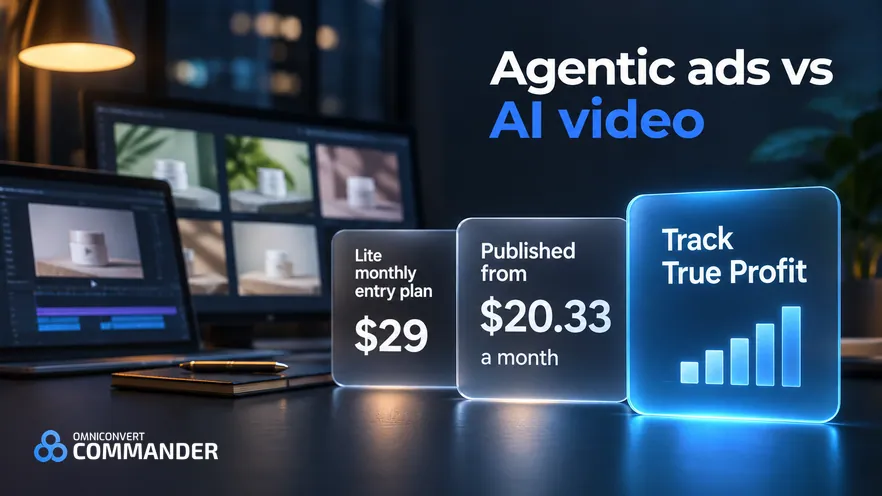
Omneky runs agentic AI advertising workflows end-to-end, from brand analysis through creative generation to campaign launch, held together by a brand system built from your website. TryHolo generates AI video and content for marketing teams. Omniconvert Commander prioritises customer segments by CLV and tracks True Profit, not ROAS.
Compare and choose: Omniconvert Commander Omniconvert Commander pricing Omniconvert Commander customer intelligence Omneky vs Omniconvert Commander TryHolo vs Omniconvert Commander TryHolo alternatives
- Omneky runs an end-to-end agentic ad workflow (brand analysis, creative generation, campaign launch, measurement), held together by a brand system built from your website; 4.9/5 on G2 across 14 reviews as of 2026.
- TryHolo is an AI video and content creation platform for marketing teams and agencies with a production bottleneck; no public G2 rating as of 2026.
- Both optimise execution within their scope and neither models CLV or measures True Profit; neither answers which segments are worth acquiring at current CAC.
- Omniconvert Commander is the right additional layer when ROAS looks healthy but net margin is flat, or when the team is spending hours a day assembling data by hand.
- The choice turns on which problem you are solving right now: autonomous ad execution (Omneky), AI video content production (TryHolo), or strategic prioritisation and True Profit measurement (Omniconvert Commander).
Teams comparing Omneky vs TryHolo usually land here from two different starting points. Omneky's pitch is agentic AI running the entire advertising workflow end-to-end. TryHolo's pitch is AI video and content production for marketing teams and agencies. Neither answers which customer segments are worth acquiring at margin or whether the spend improved True Profit, and that decision layer is what Omniconvert Commander is built to hold.
What is Omneky, and what is it actually good at?
On Omneky, AI agents handle the entire advertising workflow. AI agents run end-to-end workflows, from brand analysis through creative generation to campaign launch and measurement. A brand system is built from your website to keep output on-brand. Best fit: teams wanting autonomous ad management without a large internal headcount.
Omneky's wedge is the agent architecture. Instead of a creative tool, a media buyer and a dashboard sitting side by side with humans gluing them together, Omneky treats the whole workflow as one system. Agents read the brand, generate the creative, launch the campaign, and read the result back into the next cycle.
The brand system is the piece most buyers care about. It reads your website for logos, colours, fonts and brand voice, so creative stays recognisable across formats and channels. For a team pushing hundreds of variants per week, the consistency problem is real, and this is a credible answer to it.
The buyer profile is specific. Omneky is pitched at performance marketers at scale who want fewer people managing more spend, not at founders stitching together a first growth stack.
Where Omneky is genuinely strong
- Full-stack agentic workflow: AI agents handle brand analysis, creative generation, campaign management, and performance measurement in one system.
- Brand system from your website: Omneky ingests your logos, colours, fonts and brand voice directly from your site, so every generated asset holds to your brand standards across formats and channels.
- Performance marketer fit: targets teams that want autonomous campaign management without growing internal headcount.
Where Omneky hits its ceiling
- Pricing climbs with scale: Lite is $29 a month ($24 billed yearly), Standard $99, Pro $249 and Enterprise custom (Omneky, checked November 2026).
- No CLV layer: agentic execution is driven by ad performance data, not customer lifetime value.
- Managed, not configurable: full-stack approach means less granular control for teams wanting to tune individual elements.
What is TryHolo, and what is it actually good at?
Marketing teams and agencies use TryHolo to generate video and content assets with AI. It targets teams whose main constraint is content output volume, not paid-media orchestration or performance measurement.
TryHolo sits in the AI video and content generation category. The product is positioned around producing AI-powered video content for marketing teams and agencies, compressing the production time between brief and finished asset.
The buyer is a marketing team or agency with a content production bottleneck rather than a performance-advertising bottleneck. TryHolo generates the asset; the brief and the distribution plan still come from the team.
TryHolo does not have a published G2 rating as of 2026. Plans are published from $20.33 a month billed monthly at tryholo.ai; the full integration surface is on request.
AI video content generation is the production of video assets with an AI model doing the heavy work of composition, timing and visuals. It compresses production, but the brief, the angle and the distribution plan still sit with the team, and the output is only as targeted as the brief it was given.
Where TryHolo is genuinely strong
- AI video for marketing content: compresses the production step for teams whose bottleneck is time to a finished video asset.
- Content workflow fit: positioned around marketing team and agency workflows, not performance-advertising scoring or autonomous ad management.
Where TryHolo hits its ceiling
- Production, not measurement: no pre-launch performance score and no post-launch margin read on the output.
- No customer or margin layer: no CLV segmentation, no True Profit tracking, no view on which cohort the asset should chase.
- Scope is content: no media buying, no retargeting, no profit reconciliation.
TryHolo is a production tool. It solves the time-to-asset problem; it does not solve the which-customer problem.
Omneky vs TryHolo vs Omniconvert Commander: the capability comparison
Omneky runs the full agentic ad workflow autonomously. TryHolo generates AI video and content for marketing teams. Omniconvert Commander (formerly Nexus) decides which customers to target, builds the ad angle, and measures whether True Profit improved.
| Capability | Omneky | TryHolo | Omniconvert Commander |
|---|---|---|---|
| Primary function | Agentic end-to-end ad workflow with a brand system built from your website | AI video and content generation for marketing teams | Autonomous growth intelligence above any ad or content platform |
| Unified commerce data | Partial consolidates ad channels in one place, but has no connection to CLV, email or complete commerce data | No content production scope, no unified data layer | Yes single source of truth across CLV, NPS, reviews and ad performance |
| AI-prioritised experiment queue | Partial agents prioritise campaigns on ad performance, not CLV-weighted customer segments | No no priority queue for next actions | Yes ranked by CLV weight and projected margin impact |
| Creative generation | Yes generates image, video, avatar and clone ads pulled from your Omneky brand system | Partial AI video and content for marketing, no pre-launch performance score | Yes variants from CLV-weighted angles |
| True Profit tracking | No | No | Yes net margin after CAC, COGS and returns, not ROAS |
| CLV and segment intelligence | No | No | Yes RFM, cohorts and churn prediction |
| Autonomous action layer | Yes agentic workflow from brand analysis to campaign launch | No human still runs the brief and the distribution | Yes recommends scale, hold, reduce or kill; operator approves every change |
| AI creative briefing | Partial briefs from your website and brand system, not from CLV or customer segments | No briefs not generated from customer data | Yes briefs built from CLV, NPS, reviews and competitor data |
| Pricing model | Lite $29 a month ($24 billed yearly), Standard $99 ($79 billed yearly), Pro $249 ($199 billed yearly), Enterprise custom; 7-day free trial on Lite, Standard and Pro (omneky.com/pricing-plans, checked November 2026) | Published from $20.33 a month billed monthly, at tryholo.ai | A free tier is included for stores under 9,999 orders per year. Paid plans begin at $49/month. See Omniconvert Commander pricing details |
| Best for | Brands and teams that want AI agents to run advertising end to end, from a self-serve plan at $29 a month up to a custom Enterprise tier | Marketing teams and agencies with an AI video content production bottleneck | eCommerce $1M+ ARR, margin-focused growth teams |
| User rating | 4.9 out of 5 (G2, 14 reviews, checked November 2026) | No public G2 rating | 5.0 out of 5 (Shopify App Store, 66 reviews, as of November 2026) |
Competitor columns reflect publicly available product documentation as of October 2026. G2 ratings as cited above.
What Omneky and TryHolo cannot do
Omneky optimises for autonomous ad performance across channels. TryHolo produces AI video and content for marketing teams. Neither tells a growth lead which customer segments are worth acquiring at current CAC, which are about to churn, or whether the last campaign actually improved margin. The gap is strategic, not executional.
Omneky handles the full ad workflow through autonomous agents. What those agents lack is a customer intelligence foundation: Omniconvert Commander supplies CLV segmentation and True Profit measurement, converting autonomous execution into margin-positive growth rather than just efficient activity. When the optimisation signal is ROAS instead of margin, faster autonomous execution only accelerates the wrong outcome.
Marketing teams use TryHolo to create AI-powered video content. Before production starts, Omniconvert Commander can supply a brief built from CLV data and customer segment signals, so the finished asset targets the cohort that actually needs moving rather than a generic brand storyline.
Both tools, in different ways, are built around a shared assumption: that you already know which customers to target and which message to use. Each tool refines how that assumption is executed, not whether it is correct. Neither questions it.
What neither tool can tell you
- Which customer segments deserve more acquisition budget, ranked by 12-month CLV rather than last-click attribution or ad-level scoring.
- Which segments sit within 60 days of churning and need a different message today.
- Whether your last campaign improved True Profit or just moved ROAS.
- The messages and themes your best customers respond to, sourced directly from their reviews, NPS scores and support tickets.
Platforms like Omniconvert Commander are built for this layer. Omniconvert Commander synthesises CLV data, NPS signals, review intelligence and competitor creative data into a ranked action queue, before a brief is written or a creative produced. The optimisation target is True Profit, not ROAS.
True Profit is the net margin left after CAC, COGS, return rates and customer acquisition costs are removed from each cohort. Gross revenue and ROAS are both excluded. The figure represents what the business keeps. Omniconvert Commander tracks True Profit as the primary metric across every experiment it runs.
Orange Romania placed an urgency message on the cart page and ran it as a single Omniconvert A/B test across all devices, returning +7.65% conversion rate, +11.53% revenue per user, and a 98.65% chance to win. [Orange Romania results, Omniconvert case study]
Which tool is right for you?
The question is not which tool is best. It is which problem you are solving right now: AI video and content production (TryHolo), or Omniconvert Commander, which creates ads, publishes them to Meta and Google with your approval, manages budgets there, and measures True Profit.
Choose Omneky if
- You want AI agents to manage your entire advertising workflow from brief to launch to measurement.
- Brand consistency is a priority and you want a brand system built from your website.
- Your team aims to run campaign management through autonomous AI agents rather than manually.
Choose TryHolo if
- Your bottleneck is AI video content production for a broader marketing or agency workflow rather than paid-media performance.
- You need generated video assets to flow into an existing marketing calendar, not an agentic campaign system.
Add Omniconvert Commander if
- Your team loses more than 2 hours each day aggregating data from separate tools before any decision can be made.
- You are optimising paid spend but do not have a reliable view of which customer segments drive the highest margin.
- You need to identify which experiments justify dev sprint time before that time is committed.
- ROAS numbers are healthy but net margin has not moved in multiple quarters.
What each tool cannot do, honestly
Every comparison should state what each tool cannot do. Omneky cannot measure True Profit or build briefs from CLV. TryHolo produces content, not a performance read on it. Omniconvert Commander does not render AI avatars, clone voices, or film live footage; it creates product photoshoots, publishes ads to Meta and Google with your approval, and measures True Profit and CLV.
Omneky's honest limits
- No True Profit or CLV measurement: performance is read from ad data, not margin or lifetime value.
- Pricing climbs with scale: Lite is $29 a month, Pro is $249 and Enterprise is custom.
- Managed workflow reduces configurability: teams wanting to tune individual elements get less granular control.
TryHolo's honest limits
- Production only: no pre-launch performance score and no post-launch margin reconciliation on the output.
- No CLV, True Profit, or autonomous execution: does not use customer or margin data to choose which segment an asset should serve.
- No published G2 rating as of 2026: less third-party validation than category peers.
Omniconvert Commander's honest limits
- Operator approval on every change: Omniconvert Commander recommends; it does not trade hands off.
- Does not run retargeting, product-feed management, or DCO, and does not produce HTML5 display creative.
- Does not render AI avatars, clone voices, or shoot product photography; composes with the brand's existing imagery.
The honest read: run Omneky for autonomous full-stack ad management, run TryHolo for AI video content production volume, and run Omniconvert Commander for the CLV signal, the brief and the margin loop. Together the three cover what no single tool addresses on its own.
More on Omneky and TryHolo
Best tools in this category
See where your store stands against real competitors in your category and country. Ecommerce Benchmark scores six areas free: Creative & Ads, Reviews & UGC, AI Visibility, Agentic Commerce, Competitor Synthesis, and CRO.
Benchmark Your Store FreeFrequently Asked Questions
The verdict
If autonomous campaign management across Meta, Google and TikTok is your bottleneck, Omneky is the specialist. If the gap is AI video and content production for a marketing team, TryHolo generates it. Neither tracks whether spend improved True Profit or which customer segments were worth acquiring. Omniconvert Commander ranks the next action by projected margin, then measures the result against CLV cohorts. Teams losing hours to data assembly fit best.
Omneky and TryHolo are both capable within their stated categories. If your primary need is agentic full-stack ad management, Omneky is the specialist. If it is AI video and content production for a marketing workflow, TryHolo warrants a trial; check tryholo.ai for current plans.
The more difficult question is whether your team can reliably identify who to target, what message to deliver, and whether the spend actually improved margin. That is a separate problem, and it is precisely what the third tool on this page addresses.
Stop assembling data.
Start supervising growth.
Omniconvert Commander connects your full eCommerce data layer, surfaces revenue anomalies and outputs a prioritised action queue, so your team shifts from manually stitching data together to actively managing the P&L.
5.0 out of 5 across 66 reviews, Shopify App Store , as of November 2026