The Brief vs Marpipe vs Omniconvert Commander (2026): Static scale vs testing rigour.
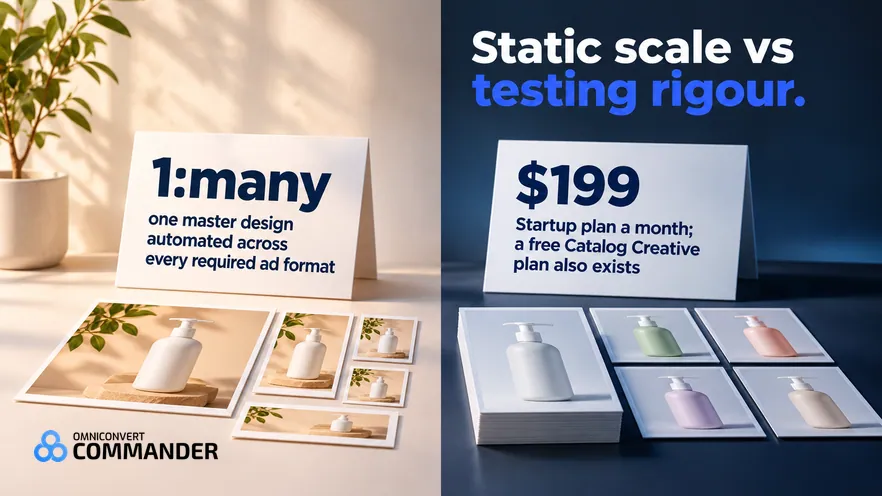
The Brief (formerly Creatopy) and Marpipe are both AI ad tools, in different jobs. The Brief automates a master design across every required ad format and size. Marpipe builds catalog (DPA) ad creative and manages the product feed behind it, including Generative Catalogs. Neither builds the brief from CLV data or tracks True Profit. Omniconvert Commander is built for that layer.
- The Brief (formerly Creatopy) is purpose-built for static ad production scale: one master design automated across every required format and size from a built-in editor.
- Marpipe is purpose-built for catalog (DPA) ad creative and feed management, including Generative Catalogs.
- Both tools share the same blind spot: neither builds the brief from CLV, NPS, or review intelligence.
- Add Omniconvert Commander as the layer above either tool when ROAS looks fine but margin is not improving.
A DTC growth team comparing The Brief vs Marpipe is picking between two different creative execution paths: master-design automation across every static ad format, or catalog (DPA) ad creative built from a product feed. The Brief wins on static production scale, with one master automated across every required size and format from a built-in editor. Marpipe wins on catalog ads built from a feed, with feed management and Generative Catalogs. Neither tool reads customer lifetime value, and that decision layer is what Omniconvert Commander is built to hold.
What is The Brief, and what is it actually good at?
The Brief is a creative automation platform that pairs a built-in design editor with format automation, so one master design produces every required ad size and format across channels. It fits marketing teams and agencies scaling static creative without a separate design tool. [The Brief, 2026]
The Brief's core move is design-to-automation: build one master ad in the built-in editor, then automatically produce every size and format needed for Meta, Google, LinkedIn, and display networks. AI copy and image tools sit inside the editor for faster ideation on headlines and visuals. The result is a static ad production pipeline that scales from one master design to every placement without manual resizing.
The category is creative automation. The buyer is an in-house marketing team or an agency producing on-brand static ads for many campaigns, formats, and clients. The trade is scope: The Brief is stronger on production scale than on generative AI from scratch, so it fits teams that already have a creative strategy and need to execute it across every placement.
The Brief holds a 4.4 out of 5 rating on G2 across roughly 130 reviews as of 2026. Reviews praise the format automation, the editor, and the multi-brand workflow for agencies. The recurring caveat: the design-first approach suits teams with existing creative direction, not teams that need creative strategy derived from customer data.
Master-to-formats automation is the workflow where a single master design is built once, then a rules engine and templates produce every required ad size, aspect ratio, and format automatically. It removes the manual resize step but does not decide what the master design should say, or which customer segment it should reach.
Where The Brief is genuinely strong
- Master to every format: build one design and automatically produce every required ad size and aspect ratio, with no manual resizing.
- Built-in design editor: removes the dependency on Canva or Photoshop for the design step, keeping production inside one tool.
- AI copy and image assist: generative AI helpers for headlines and image editing accelerate ideation inside the editor.
Where The Brief hits its ceiling
- Static creative focused: limited video ad generation compared to specialist video tools.
- Design-first approach: better suited to teams with existing creative strategy than teams deriving strategy from customer data.
- No CLV or segment layer: creative production without customer data informing the brief means the same master design goes to every audience.
The Brief is a strong specialist for creative production scale. The ceiling shows up when the format pipeline runs smoothly but the master design is still guessing which customer to talk to.
What is Marpipe, and what is it actually good at?
Marpipe is a catalog (DPA) ad creative and feed management platform. It builds dynamic product ads from your product feed, including Generative Catalogs, which use generative AI for catalog creative. It began as a multivariate creative testing tool. [Marpipe, 2026]
Marpipe turns a product feed into catalog ads at scale and manages the feed behind them. Generative Catalogs add generative AI to that catalog creative. The platform began with multivariate testing of headlines, images, colours, and formats.
The category is catalog (DPA) ad creative and feed management. The buyer is a performance marketing team at a DTC brand with a large product catalog. The pitch is catalog ads built from the feed, with generative AI in the creative.
Marpipe holds a 4.5 out of 5 rating on G2 across 40 reviews as of 2026. Reviews praise the DPA throughput. They flag the limit every catalog tool shares: Marpipe builds from your feed and your existing elements, not from a new angle to script in the first place.
Catalog (DPA) ads are dynamic product ads built from a product feed (SKUs, prices, images, availability), so every product becomes an ad automatically. Feed management keeps that data clean. Marpipe adds generative AI to catalog creative through Generative Catalogs.
Where Marpipe is genuinely strong
- Catalog ads from a feed: dynamic product ads built from your product feed at scale, with feed management behind them.
- Generative Catalogs: generative AI applied to catalog creative.
- Low entry price: a free Catalog Creative plan, with Startup at $199 a month and Enterprise at $999 a month (checked October 2026).
Where Marpipe hits its ceiling
- Catalog-focused, not campaign management: Marpipe does not buy media or manage bids. A separate ad platform still runs the spend.
- Generative AI sits in the catalog: Marpipe uses generative AI through Generative Catalogs, but its scope is catalog ads built from your feed, not briefs or new angles.
- No CLV or segment intelligence: Marpipe builds catalog ads from your feed. It does not tell you which customer segment to target, or whether those customers have the CLV to justify scaling the spend.
Marpipe is a strong specialist for one specific job. The ceiling looks like The Brief's, from the opposite direction: catalog ads built at scale from the feed do not, by themselves, improve True Profit when they target the wrong segment.
The Brief vs Marpipe vs Omniconvert Commander: the capability comparison
The Brief handles static ad production: one master design automated across every required format and size. Marpipe handles catalog (DPA) ad creative and feed management, including Generative Catalogs. Omniconvert Commander handles the layer above both: which customer to target, which angle to brief, and whether the resulting creative drove True Profit, not just ROAS.
| Capability | The Brief | Marpipe | Omniconvert Commander |
|---|---|---|---|
| Primary function | Master-to-formats static ad creative automation with built-in editor | Catalog (DPA) ad creative and feed management, including Generative Catalogs | Autonomous growth intelligence above any production or catalog tool |
| Unified commerce data | No: no unified data layer across paid, email, CRO, retention | No: no unified data layer across paid, email, CRO, retention | Yes: single source of truth across the stack |
| AI-prioritised experiment queue | No: no ranked queue of next best actions | No: builds catalog ads from the feed, does not prioritise which experiments to run next | Yes: surfaces next best action by projected margin impact |
| Creative generation | Partial: generates static variants from a master design across formats, with AI assists for copy and image, not full generative AI from scratch | Yes: catalog (DPA) ad creative, including Generative Catalogs | Yes: creative variants ranked by CLV-weighted angle |
| True Profit tracking | No: no margin layer, no return rate signal | No: no margin layer, no return rate signal | Yes: margin not ROAS, per campaign and per cohort |
| CLV and segment intelligence | No: no CLV input, no churn risk signal | No: builds catalog ads from the feed, not which segments respond | Yes: RFM, cohorts, churn prediction, NPS signal |
| Autonomous action layer | No: human briefs every master design | No: a human sets up the feed and acts on results | Yes: removes the human middleware between data and action |
| AI creative briefing | No: brief is supplied by the marketer | No: the brief is supplied by the marketer | Yes: brief is built from CLV, NPS, and review data |
| Pricing model | SaaS, Pro $29 a month billed annually, pricing at thebrief.ai (checked October 2026) | Free Catalog Creative plan; Startup $199 a month; Enterprise $999 a month (checked October 2026) | Free plan; paid plans from $49/month, see Omniconvert Commander pricing |
| Best for | Marketing teams and agencies producing high volumes of on-brand static ad creative across many formats | Performance teams with large product catalogs running catalog (DPA) ads | eCommerce $1M+ ARR teams focused on margin, not just ROAS |
| Integrations | Meta · Google · LinkedIn · Zapier | Meta · Google · Shopify | Shopify · Klaviyo · Meta · Google · TikTok · GA4 · Triple Whale |
| User rating | 4.4 out of 5 (G2, 130 reviews, as of 2026) | 4.5 out of 5 (G2, 40 reviews, as of 2026) | 5.0 out of 5 (Shopify App Store, 63 reviews, as of November 2026) |
The Brief and Marpipe columns reflect publicly available feature documentation as of October 2026. G2 ratings as cited in s1 and s2.
What The Brief and Marpipe cannot do
The shared blind spot sits upstream of production and upstream of the test. The Brief automates production from a master design. Marpipe builds catalog ads from an existing product feed. Neither builds the brief from CLV data, NPS signals, or review intelligence, and neither closes the loop on whether the resulting ad improved True Profit, the metric the business actually keeps.
The Brief automates the production of static ad creative from a master design. Omniconvert Commander provides the creative brief before The Brief opens, built from CLV and NPS data, specifying which segment to target and which message converts them at the highest margin.
Marpipe builds catalog ads from your feed. Omniconvert Commander adds the segment intelligence that a feed-driven catalog cannot provide, which customer segment those ads should reach, and whether those customers have the CLV to justify scaling the spend.
Both The Brief and Marpipe are execution tools, in different disciplines. The Brief ships every size and format from a single master faster than a design team could resize by hand. Marpipe builds catalog ads from the feed at scale. They are good at those jobs. They are also built on a shared assumption, that you already know which customer to target and which angle to lead with. They optimise the execution of that assumption. Neither questions it.
What neither tool can tell you
- Which customers are worth acquiring more of. A 12-month CLV view, not last-click attribution, is what tells you which segments deserve the next round of paid spend.
- Which segments are 60 days from churning. The early signal lives in NPS scores, review sentiment, and support ticket patterns, not in a format automator or a catalog feed.
- Whether the last campaign improved True Profit or just moved ROAS. ROAS can rise while net margin compresses; only a margin-first measurement loop catches the gap.
- What your highest-value customers actually respond to. Their own reviews, NPS verbatims, and support transcripts hold the angle that converts, and pulling and synthesising them is still manual in a stack of The Brief plus Marpipe.
Platforms like Omniconvert Commander are built for this layer. Omniconvert Commander synthesises CLV data, NPS signals, review intelligence, and competitor creative data into a ranked action queue, before a brief is written or creative produced. The optimisation target is True Profit, not ROAS.
True Profit is defined as the net margin remaining after subtracting CAC, COGS, return rates, and the cost of customer acquisition from each cohort, not gross revenue or ROAS. It is what the business actually keeps. Omniconvert Commander tracks this as the primary optimisation metric across all experiments.
AliveCor used Omniconvert to run a structured A/B testing programme and achieved +21% conversion rate, +5% revenue per visitor, and 94% statistical relevance across their experiments. [Omniconvert, AliveCor case study]
This is not a replacement for The Brief or Marpipe. The Brief still automates the master-to-formats production. Marpipe still builds the catalog ads. Omniconvert Commander is the strategic layer above them that decides which brief to send, which combination to test next, and whether the result moved the metric the business actually keeps.
Which tool is right for you?
Pick The Brief if your bottleneck is static ad production across every required format from a single master design. Pick Marpipe if it is catalog (DPA) ad creative built from a product feed. Add Omniconvert Commander when ROAS looks fine but margin is not improving, and your team is spending hours assembling CLV, NPS, and review data before any brief can be written or any test designed.
Choose The Brief if
- Format automation is the bottleneck: you need to automate one master design across every required ad size and format without a manual resize queue.
- You want a built-in editor: your team needs the design step inside the same tool, not a Canva or Photoshop handoff.
- Agency with multi-brand workflow: you produce on-brand creative for multiple clients and need format automation at scale per brand kit.
Choose Marpipe if
- Catalog scale is the goal: you want dynamic product ads built from a product feed at scale.
- Feed management matters: you want your product feed managed and kept clean behind the ads.
- Generative Catalogs appeal: you run catalog ads and want generative AI applied to catalog creative.
Add Omniconvert Commander if
- Data assembly eats your day: your team spends more than 2 hours a day pulling data from separate tools before a single decision is made.
- You optimise paid spend without a margin view: you are spending on paid media but have no reliable view of which customer segments drive the highest margin.
- You want experiments ranked before sprint planning: you want to know which tests are worth running before dev or creative sprints are assigned.
- ROAS hides a margin problem: ROAS looks fine but net margin is not improving quarter-on-quarter.
What each tool cannot do, honestly
The Brief, Marpipe, and Omniconvert Commander each have real limits. Treating them as competing for the same job hides those limits. The honest framing is that the three sit at different layers of the same stack: one automates production, one builds catalog ads, and one feeds the strategy above both. Each is replaceable, none is a complete answer alone.
Where The Brief will not stretch
- Not a strategy tool: The Brief will not tell you which segment to target or which angle is most likely to convert for your customers.
- Not a catalog tool: The Brief does not build catalog (DPA) ads from a product feed; for that layer, Marpipe is the stronger pick.
- Not a margin tool: The Brief has no visibility into return rates, COGS, or CAC at cohort level.
Where Marpipe will not stretch
- Not a master-design tool: Marpipe builds catalog ads from your feed; for scaled static ad production across every format, The Brief is the stronger pick.
- Not a media buying system: Marpipe does not buy media or manage bids. A separate ad platform runs the spend.
- Not a CLV system: Marpipe builds from the feed, not from customer segments, so creative direction above the catalog is still manual.
Where Omniconvert Commander has real prerequisites
- Data unification is the first 4 to 6 weeks: an intelligence layer is only as good as the data feeding it. Fragmented inputs produce unreliable ranked queues.
- Strategy and brand judgment remain human: Omniconvert Commander automates execution coordination, not category positioning or brand voice.
- Revenue stage threshold: the ROI compounds above $1M ARR, where data volume is sufficient and manual coordination cost is measurable. Earlier brands typically benefit more from a single execution tool first.
See where your store stands against real competitors in your category and country. Ecommerce Benchmark scores six areas free: Creative & Ads, Reviews & UGC, AI Visibility, Agentic Commerce, Competitor Synthesis, and CRO.
Benchmark Your Store FreeFrequently Asked Questions
The verdict
The Brief is the specialist when static ad production across every required format from a master design is the bottleneck. Marpipe wins when the goal is catalog (DPA) ad creative built from a product feed. Neither writes the brief itself. Add Omniconvert Commander above either tool.
The Brief and Marpipe are both capable AI ad tools within their categories. If the primary need is scaled static ad production across every required format from a single master design, The Brief is the specialist. If the need is catalog (DPA) ad creative built from a product feed, Marpipe wins.
The harder question is whether your team has a reliable way to know who to target, what to say, and whether it worked at the margin level. That is a different question, and it is what the third tool on this page, Omniconvert Commander, is built to answer.
Stop assembling data.
Start supervising growth.
Omniconvert Commander unifies your entire eCommerce data layer, detects revenue anomalies and generates a prioritized action queue, so your team stops being human middleware and starts running the P&L.
5.0 out of 5 across 63 reviews, Shopify App Store , as of November 2026