Convert vs Survicate vs Explore (2026): Where Shopify Revenue Is Won
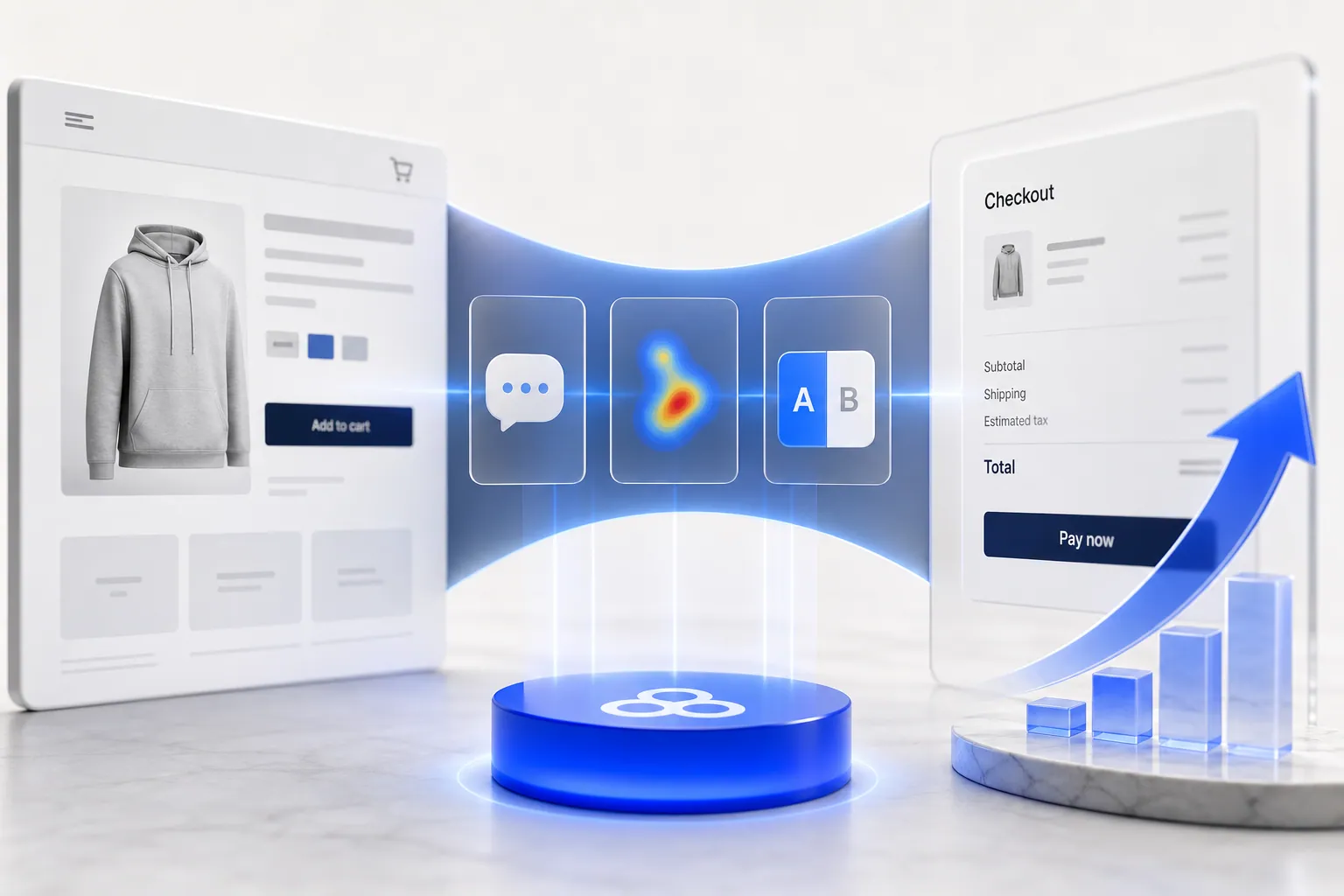
Convert is a privacy-first A/B testing platform for CRO agencies and general websites. Survicate is a multichannel survey tool that collects NPS, CSAT, and voice-of-customer feedback, but it does not run experiments. Omniconvert Explore is the Shopify-native eCommerce CRO platform: it runs experiments on product pages, cart, and checkout, and measures the result in revenue per visitor.
- Convert is a privacy-first A/B testing platform for CRO agencies and general websites, with a 4.7 out of 5 G2 rating. [G2, 2026]
- Survicate is a multichannel survey and feedback tool for NPS, CSAT, and CES, with a 4.6 out of 5 G2 rating. [G2, 2026]
- Convert runs the test and Survicate collects the feedback, so the two are complementary rather than substitutes.
- Neither runs experiments on the Shopify checkout or measures results in revenue per visitor, the surfaces where store revenue is decided.
- Omniconvert Explore unifies feedback and experiment on product, cart, and checkout natively and measures results in revenue per visitor: pick it for Shopify revenue surfaces.
Teams comparing Convert vs Survicate are usually deciding between two inputs to the same decision: the test that proves a change, or the feedback that explains why customers behave the way they do. Convert runs controlled experiments on general websites. Survicate gathers what customers say across web, email, and in-product surveys. Neither is built around the surfaces where a Shopify store actually wins or loses revenue: the product page, the cart, and the checkout. This page covers what each does well, the gap they share, and when Omniconvert Explore is the right layer.
What is Convert, and what is it actually good at?
Convert is a privacy-first A/B testing platform for CRO agencies and mid-market teams. It supports multivariate testing and advanced targeting, integrates with Google Analytics and major analytics platforms, and is known for transparent session-based pricing and a no-data-sharing stance. [Convert, 2026]
Convert is one of the most highly rated tools in the category, with a 4.7 out of 5 rating on G2 across 139 reviews. [G2, 2026] It is a favorite among CRO agencies for transparent, session-based pricing and agency-friendly account features, and its support is consistently praised.
The category Convert sits in is practitioner-led web testing. It runs A/B and multivariate tests on general websites, with a strong privacy posture that appeals to teams handling sensitive traffic. That focus is the point of the product.
Privacy-first testing means the platform avoids sharing experiment data with third parties and minimizes what it collects, which matters for teams under strict compliance requirements. Convert builds this into its product and pricing. It is a separate concern from whether a test runs natively on a store's checkout.
Where Convert is genuinely strong
- Transparent, session-based pricing: predictable costs that agencies and mid-market teams can plan around.
- Strong privacy stance: no data sharing with third parties, useful under strict compliance needs.
- Multivariate and advanced targeting: capable experimentation with granular audience rules.
- Highly rated support and integrations: well-regarded support, with Google Analytics and major analytics connections.
Where Convert hits its ceiling for an eCommerce store
- No native Shopify integration: no eCommerce-specific experiment templates, so store setups are manual.
- Editor is functional, not polished: the visual editor trails VWO and Optimizely for ease of use.
- No built-in voice of customer: no native on-site surveys, so teams add Survicate or similar.
- Generic conversion focus: results are framed around general conversion, not revenue per visitor.
What is Survicate, and what is it actually good at?
Survicate is a multichannel survey and customer feedback platform. It runs targeted NPS, CSAT, and CES surveys across websites, in-product, email, and mobile, and routes the responses into tools like HubSpot, Salesforce, Intercom, and Klaviyo. Its job is capturing the voice of the customer at scale. [G2, 2026]
Survicate is a feedback tool, not a testing tool. It holds a 4.6 out of 5 rating on G2 across 201 reviews. [G2, 2026] Its strength is asking the right question at the right moment and collecting structured answers across every channel a customer touches.
What Survicate does not do is run the experiment. It collects what customers say, but it cannot create variants, split traffic, or measure whether a change lifted conversion. That is a different job from Convert's, and the two are often used side by side.
Voice of customer is the structured collection of what customers think and feel, through surveys, ratings, and feedback widgets, so a team can hear intent and friction directly. Survicate does this well across channels. It is a qualitative input layer, distinct from running a controlled revenue experiment on product, cart, and checkout pages.
Where Survicate is genuinely strong
- Multichannel surveys: web, in-product, email, and mobile from one platform.
- NPS, CSAT, and CES templates: ready-made instruments for standard feedback programs.
- Deep integrations: routes responses into HubSpot, Salesforce, Intercom, Slack, and Klaviyo.
- Fast to launch: non-technical teams can field a survey and collect answers quickly.
Where Survicate hits its ceiling for an eCommerce store
- No A/B testing: it cannot create variants, split traffic, or measure statistical significance.
- Feedback, not validation: it captures what customers say, not whether a change moved conversion.
- No native Shopify experimentation: surveys embed, but there is no checkout-level testing.
- No revenue experiments: it has no concept of revenue per visitor as a tested outcome.
What Convert and Survicate cannot do for an eCommerce store
Convert runs the test and Survicate collects the feedback, but they share one gap for a store. Neither is built around the surfaces where eCommerce revenue is won or lost, product pages, cart, and checkout, or around the metrics that matter there: revenue per visitor, order rate, and the margin a store actually keeps.
Convert is built for CRO practitioners running tests on general websites. With no native Shopify integration, checkout testing happens through manual implementation, and revenue per visitor is not a native experiment metric. The work of connecting a winning variant to checkout revenue still happens by hand.
Survicate is built to listen. It captures why a shopper hesitated or what they wanted instead, which is genuinely useful input. But it cannot run the controlled experiment that turns that feedback into a proven revenue lift, and it has no native concept of the Shopify checkout or order rate. It is the question without the test.
The two gaps are two inputs to one decision, and both stop short of the store's revenue. Convert can run a test but not on the checkout that matters; Survicate can hear the friction but not test the fix. Neither is built around the Customer Value Optimization question: whether a result holds for high-value, repeat buyers. For the wider debate behind this split, see Has personalization replaced A/B testing?
The deeper issue is that the feedback and the experiment live in two disconnected tools. A team reads a Survicate response, forms a hunch, rebuilds the variant in Convert, then reconciles two data models to guess whether it worked. Omniconvert Explore collapses that loop: on-site surveys, heatmaps, and session recordings sit next to the experiment, and the same behavioral and customer data defines the segments you test against. The insight and the test live in one place, on the store's real revenue surfaces, which is the difference between collecting an opinion and proving the fix moved revenue per visitor.
eCommerce conversion rate optimization (CRO) is the practice of running controlled experiments on the revenue surfaces of an online store, product pages, cart, and checkout, and measuring the result in revenue per visitor and order rate rather than generic conversion rate. Omniconvert Explore is defined as an eCommerce conversion rate optimization platform for product, cart, and checkout experiments, native to Shopify and priced for store traffic.
What neither tool can tell an eCommerce team
- Did the win move revenue and margin. Whether a winning variant raised revenue per visitor and order rate, and held its margin once discounts and returns are counted, not just gathered an opinion.
- Which surface to test first. Which pages in the funnel (product, cart, checkout) carry the highest revenue impact if tested next.
- How it behaves in checkout. How an experiment interacts with the Shopify catalog, variants, and checkout flow natively, without engineering glue work.
- Whether it holds for valuable customers. Whether the result holds for repeat, high-value customers, the Customer Value Optimization question, not just first-session visitors.
Omniconvert benchmarks more than 7,000 eCommerce websites in its CROBenchmark Report 2026, across 248+ audit criteria. The data shows where stores actually lose orders: 99.6% fail to make guest checkout visible and prominent, and 85.1% never show the full order cost before the final step. [CROBenchmark Report 2026, Omniconvert]
A survey can tell you shoppers dislike surprise costs at checkout, but it cannot test the fix or price the loss. Explore runs the experiment on the store's real revenue surfaces and reports the outcome in revenue per visitor.
This is what the title means by where Shopify revenue is won. A collected complaint or a lifted micro-conversion can leave the bank balance flat; what moves it is order rate and average order value along the product-to-checkout path, read as revenue per visitor. Explore optimizes for that number directly, and because Customer Value Optimization ties each result back to repeat, high-value buyers, the lift it confirms is margin the store keeps rather than traffic it rents. A variant that wins on revenue per visitor and holds for high-CLV customers protects profit; a variant that only lifts a top-of-funnel click often does not. That is the revenue question Convert and Survicate are not built to answer, and the one Omniconvert Explore is. Explore also reaches Shopify-specific levers most testing tools cannot touch, including price testing; see Explore 3.0: pricing testing on Shopify.
Convert vs Survicate vs Explore: the capability comparison
Side by side, the three tools serve different layers. Convert runs clean privacy-first tests on general websites. Survicate collects multichannel feedback. Explore adds native Shopify experiments, built-in surveys, heatmaps, and overlays, and revenue-per-visitor measurement on the product-to-checkout path. See A/B testing with Explore for how those experiments run natively on the Shopify funnel.
| Capability | Convert | Survicate | Omniconvert Explore |
|---|---|---|---|
| Primary function | Privacy-first general-website A/B testing | Multichannel surveys and feedback | eCommerce CRO on product, cart, and checkout |
| A/B testing | Yes visual and code editor | No surveys only, no variants | Yes visual plus code editor |
| Multivariate testing | Yes | No | Yes |
| Server-side testing | Yes | No | Yes |
| On-site surveys and feedback | No needs third-party tools | Yes its core strength | Yes surveys built in beside the experiment |
| Heatmaps and session recordings | No needs third-party tools | No feedback, not behavior capture | Yes heatmaps and recordings built in |
| Shopify integration | Medium not native, manual setup | Medium embeds and Klaviyo, no testing | Yes native |
| eCommerce focus | Medium agency and mid-market web | Low cross-industry feedback | High built for store revenue workflows |
| Revenue per visitor measurement | No generic conversion metrics | No feedback scores only | Yes revenue per visitor and order rate native |
| Pricing model | Session-based, from $299/mo, free trial | Subscription, from $89/mo, free plan | Session-based, built for store traffic, free trial |
| Best for | CRO agencies wanting privacy-first testing | Teams collecting multichannel customer feedback | Shopify and eCommerce teams optimizing for revenue |
| User rating | 4.7 out of 5 (G2, 139 reviews, as of 2026) | 4.6 out of 5 (G2, 201 reviews, as of 2026) | 4.6 out of 5 (G2, 191 reviews, as of 2026) |
AliveCor used Omniconvert Explore to run a structured A/B testing program and achieved +21% conversion rate, +5% revenue per visitor, and 94% statistical relevance across their experiments. [Omniconvert, AliveCor case study]
Competitor ratings, pricing, and plan details reflect publicly listed figures as of 2026 and can change. Survicate offers a free plan alongside paid tiers. Explore uses session-based pricing; see the Omniconvert pricing page for current plans.
Get the full CROBenchmark data behind these stats: 7,000+ websites, 15+ industries, 248+ audit criteria, 100+ CRO experts. See exactly where eCommerce growth teams are losing margin in 2026.
Get the CROBenchmark ReportFrequently Asked Questions
Should you choose Explore over Convert or Survicate?
Start with the surface where your revenue is decided. If you need clean, privacy-first tests on general pages, keep Convert. If you run cross-channel feedback programs, keep Survicate. For a Shopify store, run your next test on the product-to-checkout path in Explore, with on-site surveys beside it, measured in revenue per visitor. Explore folds both jobs into one platform on the checkout where the order closes.
Convert and Survicate are both strong in their lanes. Convert is transparent, privacy-first, and agency-friendly for testing. Survicate is a fast, multichannel way to hear the voice of the customer.
The question for a store is narrower: can your team run a controlled experiment on the Shopify product, cart, and checkout, ask the shopper why beside it, and read the result in revenue per visitor rather than a click. That is the surface Explore is built for.
Stop guessing.
Start testing what moves revenue.
Explore runs A/B, multivariate, and personalization experiments on your product pages, cart, and checkout, with on-site surveys beside them, then measures the outcome in revenue per visitor, not just clicks.
4.6 out of 5 across 191 reviews, G2 , as of 2026