Crazy Egg vs Unbounce vs Explore (2026): Where Shopify Revenue Is Won
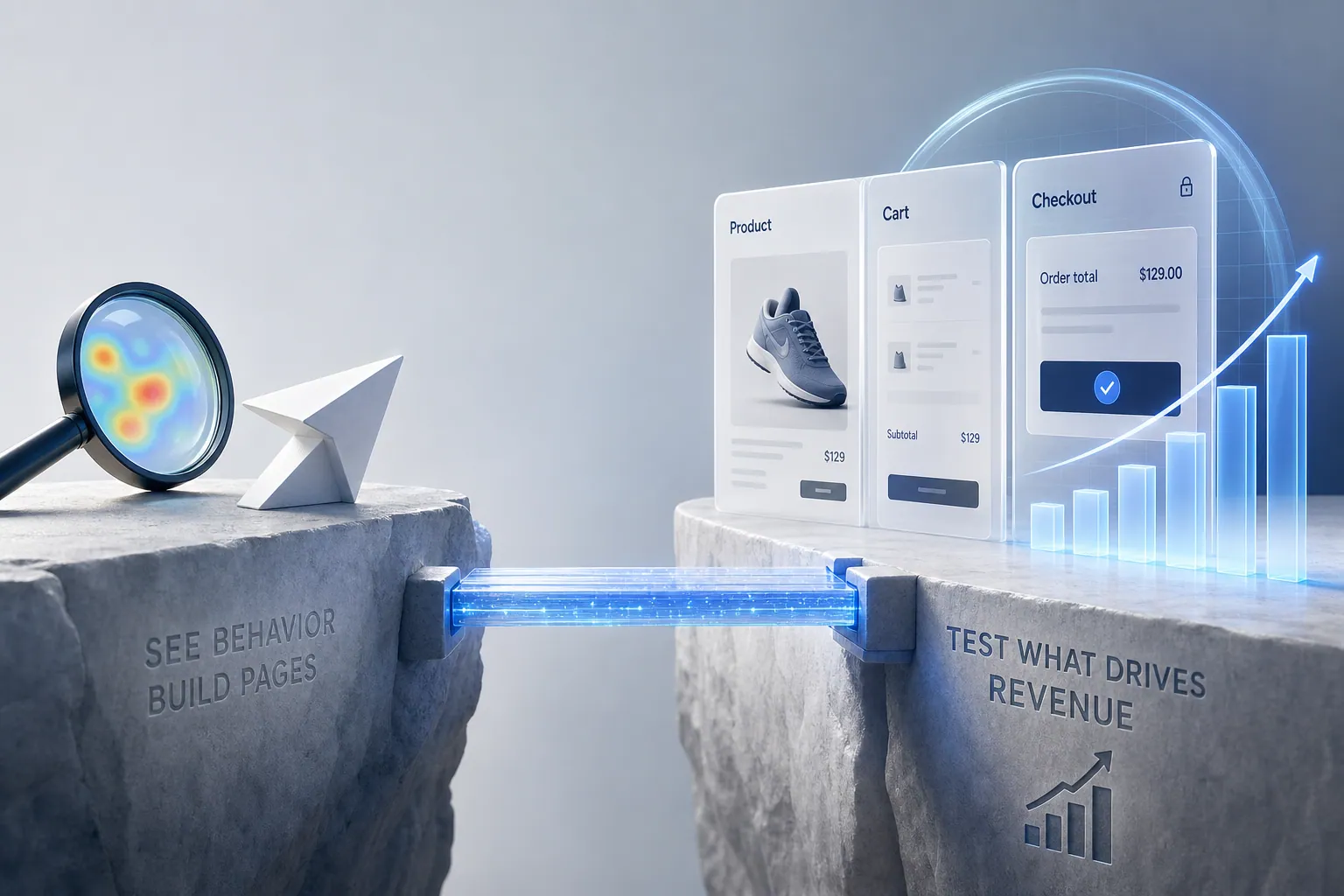
Crazy Egg is a heatmap and session recording tool with basic two-variant A/B testing. Unbounce is a landing page builder with A/B testing for paid-traffic campaigns, not existing site pages. Omniconvert Explore is the Shopify-native eCommerce CRO platform: it runs experiments on product pages, cart, and checkout, and measures the result in revenue per visitor.
- Crazy Egg is a heatmap and session recording tool with basic two-variant A/B testing, and a 4.2 out of 5 G2 rating. [G2, 2026]
- Unbounce is a landing page builder with A/B testing and Smart Traffic AI routing, and a 4.4 out of 5 G2 rating. [G2, 2026]
- Both touch A/B testing but only at the edges: Crazy Egg on single pages, Unbounce on standalone landing pages.
- Neither tests existing Shopify product, cart, or checkout pages or measures results in revenue per visitor, the surfaces where store revenue is decided.
- Omniconvert Explore runs experiments across the store funnel natively and measures results in revenue per visitor: pick it for Shopify revenue surfaces.
Teams comparing Crazy Egg vs Unbounce are usually deciding where to spend the next marketing dollar: on understanding on-page behavior, or on building landing pages that convert paid traffic. Crazy Egg shows where visitors click and adds a light test. Unbounce builds and tests standalone landing pages. Neither is built around the surfaces where a Shopify store actually wins or loses revenue: the product page, the cart, and the checkout. This page covers what each does well, the gap they share, and when Omniconvert Explore is the right layer.
What is Crazy Egg, and what is it actually good at?
Crazy Egg is a heatmap and session recording tool with lightweight A/B testing. It shows where users click, scroll, and engage on a page, and includes a basic two-variant test in every plan at a low price point. It is accessible to non-technical marketers. [Crazy Egg, 2026]
Crazy Egg is a behavior analytics tool first and a testing tool second. It holds a 4.2 out of 5 rating on G2 across 144 reviews. [G2, 2026] Its strength is making click, scroll, and engagement data easy to see for teams without an analyst, at an entry price that starts around $49 per month.
The A/B testing it includes is deliberately simple: single-page, two-variant tests. That suits a marketer who wants to try one headline against another, not a program of experiments across a funnel.
A heatmap aggregates where visitors click, move, and scroll on a page into a visual overlay, so a team can see attention and friction at a glance. Crazy Egg does this well and pairs it with recordings. It is a diagnosis layer, distinct from running a controlled revenue experiment on product, cart, and checkout pages.
Where Crazy Egg is genuinely strong
- Heatmaps and scroll maps: a clear, visual read on where clicks and attention land.
- Session recordings: watch real sessions to see where users hesitate.
- Low entry price: accessible plans that small businesses can start on quickly.
- Basic A/B testing included: a simple two-variant test in every plan for light experiments.
Where Crazy Egg hits its ceiling for an eCommerce store
- Testing is basic: no multivariate testing, server-side testing, or advanced audience targeting.
- No checkout experiments: it cannot run tests on Shopify product, cart, or checkout flows.
- Analytics first: teams serious about CRO outgrow its experiment features quickly.
- Generic conversion focus: no concept of revenue per visitor as a tested outcome.
What is Unbounce, and what is it actually good at?
Unbounce is a landing page builder with built-in A/B testing. Marketing teams use it to build and publish campaign landing pages without a developer, then split-test variants. Its Smart Traffic feature uses AI to route each visitor to the variant most likely to convert. [Unbounce, 2026]
Unbounce is a landing page tool first. It holds a 4.4 out of 5 rating on G2 across 377 reviews. [G2, 2026] Its strength is speed: a marketer can launch a dedicated page for a paid campaign, test headlines and layouts, and let Smart Traffic optimize routing, all without engineering.
What Unbounce does not do is test existing website pages. Its A/B testing applies to the standalone landing pages it builds, not to a store's product, cart, or checkout. It is a paid-traffic conversion tool, not a full CRO platform.
Landing page testing builds standalone campaign pages and split-tests their variants, usually for paid traffic from ads. Unbounce does this well with a drag-and-drop builder and AI routing. It is a top-of-funnel acquisition layer, distinct from running a controlled revenue experiment on a store's existing product, cart, and checkout pages.
Where Unbounce is genuinely strong
- Fast landing page building: drag-and-drop pages live without developer involvement.
- Built-in A/B testing: split-test headlines, layouts, and offers on campaign pages.
- Smart Traffic AI routing: automatically sends visitors to the best-performing variant.
- Ad and CRM integrations: connects to major ad platforms and CRMs for paid campaigns.
Where Unbounce hits its ceiling for an eCommerce store
- Landing pages only: it cannot test existing website pages or the store funnel.
- No checkout experiments: no server-side or multivariate testing on product, cart, or checkout.
- Limited Shopify fit: it optimizes standalone pages, not the highest-revenue store surfaces.
- Generic conversion focus: no concept of revenue per visitor across the funnel.
What Crazy Egg and Unbounce cannot do for an eCommerce store
Crazy Egg shows behavior and Unbounce builds landing pages, but they share one gap for a store. Both touch A/B testing at the edges, yet neither is built around the surfaces where eCommerce revenue is won or lost, product pages, cart, and checkout, or around the metrics that matter there: revenue per visitor, order rate, and the margin a store actually keeps.
Crazy Egg shows clicks and scrolls and adds a simple two-variant test, but that test cannot reach the Shopify cart or checkout, and it has no multivariate or server-side capability. It diagnoses on the surface and experiments only at the edges. Revenue per visitor is not a metric it reports.
Unbounce tests the landing page a paid visitor lands on, which is genuinely useful for acquisition. But its testing stops at that standalone page. It cannot experiment on the product detail page, the add-to-cart flow, or the checkout, the surfaces where a store's orders are actually placed. Those pages live in Shopify, outside Unbounce's reach.
The two gaps come from different directions but land in the same place: short of the store's revenue. Crazy Egg sees the funnel but cannot test it; Unbounce tests a page but not the funnel. Neither is built around the Customer Value Optimization question: whether a result holds for high-value, repeat buyers. For the wider debate behind acting on behavior data, see Has personalization replaced A/B testing?
The deeper issue is that neither tool experiments where the order is placed. A team can heatmap a product page in Crazy Egg and build a slick landing page in Unbounce, and still have no way to test the Shopify checkout that decides the sale. Omniconvert Explore closes that loop: heatmaps, session recordings, and surveys sit next to a full experimentation engine that runs on the store's real pages, and the same behavioral and customer data defines the segments you test against. The insight and the test live in one place, on the revenue surfaces, which is the difference between optimizing the doorway and optimizing the sale.
eCommerce conversion rate optimization (CRO) is the practice of running controlled experiments on the revenue surfaces of an online store, product pages, cart, and checkout, and measuring the result in revenue per visitor and order rate rather than generic conversion rate. Omniconvert Explore is defined as an eCommerce conversion rate optimization platform for product, cart, and checkout experiments, native to Shopify and priced for store traffic.
What neither tool can tell an eCommerce team
- Did the win move revenue and margin. Whether a change raised revenue per visitor and order rate across the store, and held its margin once discounts and returns are counted, not just lifted a landing page click.
- Which surface to test first. Which pages in the funnel (product, cart, checkout) carry the highest revenue impact if tested next.
- How it behaves in checkout. How an experiment interacts with the Shopify catalog, variants, and checkout flow natively, without engineering glue work.
- Whether it holds for valuable customers. Whether the result holds for repeat, high-value customers, the Customer Value Optimization question, not just first-session visitors.
Omniconvert benchmarks more than 7,000 eCommerce websites in its CROBenchmark Report 2026, across 248+ audit criteria. The data shows where stores actually lose orders: 99.6% fail to make guest checkout visible and prominent, and 85.1% never show the full order cost before the final step. [CROBenchmark Report 2026, Omniconvert]
A better landing page cannot fix a checkout that hides the full order cost, and a heatmap cannot test the fix. Explore runs the experiment on the store's real revenue surfaces and reports the outcome in revenue per visitor.
This is what the title means by where Shopify revenue is won. A higher landing-page click rate or a lifted micro-conversion can leave the bank balance flat; what moves it is order rate and average order value along the product-to-checkout path, read as revenue per visitor. Explore optimizes for that number directly, and because Customer Value Optimization ties each result back to repeat, high-value buyers, the lift it confirms is margin the store keeps rather than traffic it rents. A variant that wins on revenue per visitor and holds for high-CLV customers protects profit; a variant that only lifts a top-of-funnel click often does not. That is the revenue question Crazy Egg and Unbounce are not built to answer, and the one Omniconvert Explore is. Explore also reaches Shopify-specific levers most testing tools cannot touch, including price testing; see Explore 3.0: pricing testing on Shopify.
Crazy Egg vs Unbounce vs Explore: the capability comparison
Side by side, the three tools work at different points of the funnel. Crazy Egg shows behavior and runs a light test. Unbounce builds and tests campaign landing pages. Explore adds native Shopify experiments across the store, heatmaps, surveys, and overlays, and revenue-per-visitor measurement on the product-to-checkout path. See A/B testing with Explore for how those experiments run natively on the Shopify funnel.
| Capability | Crazy Egg | Unbounce | Omniconvert Explore |
|---|---|---|---|
| Primary function | Heatmaps with basic A/B testing | Landing page builder with A/B testing | eCommerce CRO on product, cart, and checkout |
| A/B testing | Partial basic two-variant, single page | Partial landing pages only, not site pages | Yes across the store funnel |
| Multivariate testing | No | No | Yes |
| Server-side testing | No | No | Yes |
| Tests existing store pages | No single-page tests only | No standalone landing pages only | Yes product, cart, and checkout |
| Heatmaps, recordings, surveys | Partial heatmaps and recordings, no surveys | No page builder, not analytics | Yes built in beside the experiment |
| Shopify integration | Medium installs but no checkout testing | Low standalone pages, limited fit | Yes native |
| eCommerce focus | Low small-business diagnostics | Low paid-traffic landing pages | High built for store revenue workflows |
| Revenue per visitor measurement | No behavioral metrics only | No landing page conversion only | Yes revenue per visitor and order rate native |
| Pricing model | Session-based, from $49/mo, free trial | Session-based, from $99/mo | Session-based, built for store traffic, free trial |
| Best for | Small teams wanting heatmaps and light tests | Marketers building paid-traffic landing pages | Shopify and eCommerce teams optimizing for revenue |
| User rating | 4.2 out of 5 (G2, 144 reviews, as of 2026) | 4.4 out of 5 (G2, 377 reviews, as of 2026) | 4.6 out of 5 (G2, 191 reviews, as of 2026) |
AliveCor used Omniconvert Explore to run a structured A/B testing program and achieved +21% conversion rate, +5% revenue per visitor, and 94% statistical relevance across their experiments. [Omniconvert, AliveCor case study]
Competitor ratings, pricing, and plan details reflect publicly listed figures as of 2026 and can change. Unbounce tests standalone landing pages rather than existing store pages. Explore uses session-based pricing; see the Omniconvert pricing page for current plans.
Get the full CROBenchmark data behind these stats: 7,000+ websites, 15+ industries, 248+ audit criteria, 100+ CRO experts. See exactly where eCommerce growth teams are losing margin in 2026.
Get the CROBenchmark ReportFrequently Asked Questions
Should you choose Explore over Crazy Egg or Unbounce?
Decide by where the order is placed. If you want cheap heatmaps, Crazy Egg does the diagnosis; if you run paid campaigns, Unbounce builds the landing pages. But the sale closes on the Shopify checkout, which neither tool can test. For a store, run your next experiment on the product-to-checkout path in Explore, measured in revenue per visitor. Explore optimizes the surfaces where revenue is actually won, not just the doorway.
Crazy Egg and Unbounce are both useful in their lanes. Crazy Egg is a low-cost way to see on-page behavior. Unbounce is a fast, developer-free way to build and test landing pages for paid traffic.
The question for a store is narrower: can your team run a controlled experiment on the Shopify product, cart, and checkout and read the result in revenue per visitor rather than a landing page click. That is the surface Explore is built for.
Stop guessing.
Start testing what moves revenue.
Explore runs A/B, multivariate, and personalization experiments on your product pages, cart, and checkout, with heatmaps and surveys beside them, then measures the outcome in revenue per visitor, not just clicks.
4.6 out of 5 across 191 reviews, G2 , as of 2026