Drift vs Fullstory vs Explore (2026): Where Shopify Revenue Is Won
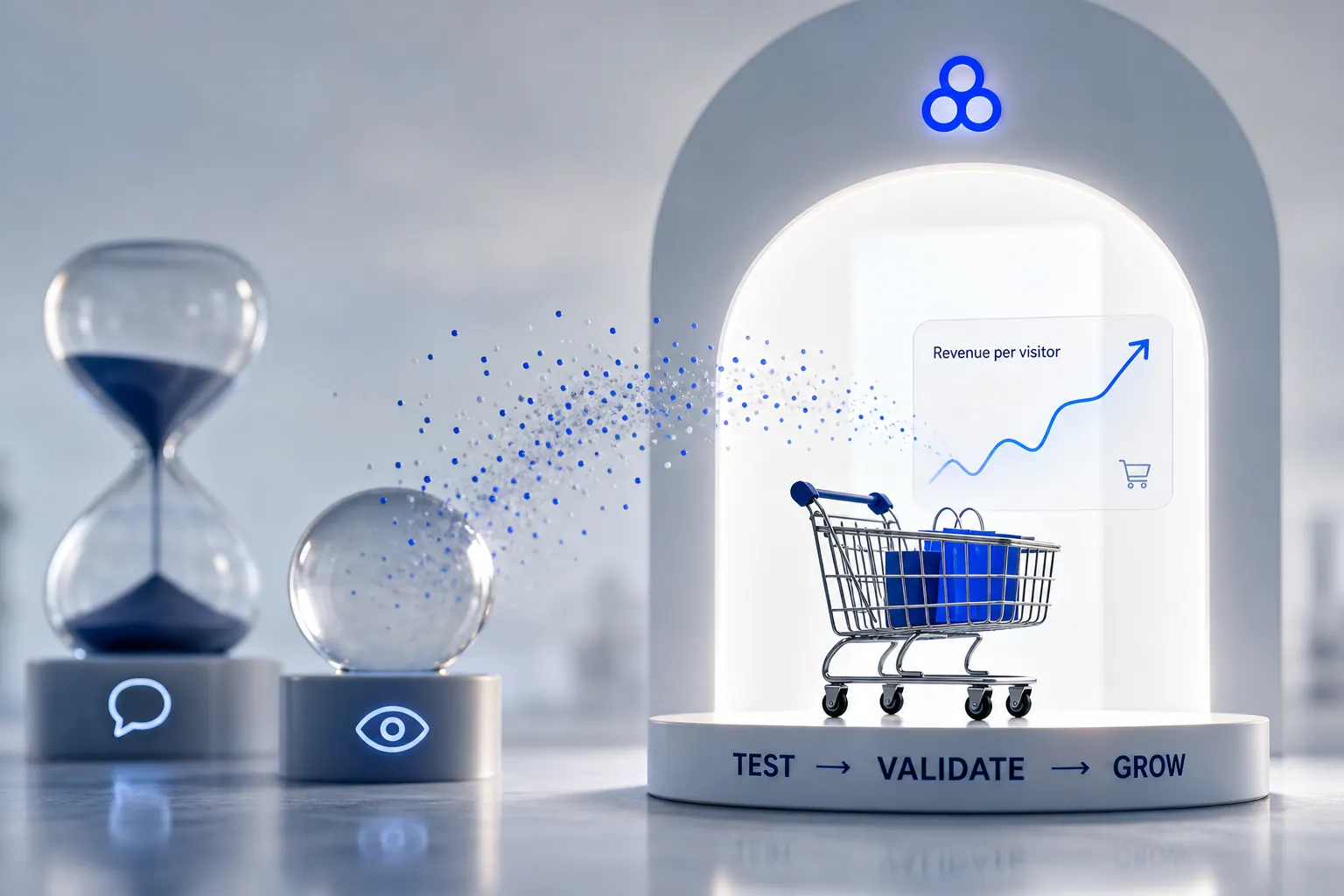
Drift was a B2B conversational chat platform, but Salesloft announced its sunset in March 2026 and named 1mind the successor. Fullstory is digital experience analytics built on session replay. Omniconvert Explore is the Shopify-native eCommerce CRO platform: it runs experiments on product pages, cart and checkout, measured in revenue per visitor.
- Drift was a B2B conversational marketing and chatbot platform for engaging and routing visitors, rated 4.4 out of 5 on G2. [G2, 2026] Salesloft announced its sunset in March 2026 and named 1mind the successor, so it is not a candidate for new work.
- Fullstory is a digital experience analytics tool built on session replay and autocapture, with a 4.5 out of 5 G2 rating. [G2, 2026]
- Neither runs a controlled A/B test: Drift starts conversations and Fullstory analyzes sessions, so they sit outside the CRO category.
- Neither measures results in revenue per visitor on the Shopify checkout, the surface where store revenue is decided.
- Omniconvert Explore runs experiments on product, cart, and checkout natively and measures results in revenue per visitor: pick it for Shopify revenue surfaces.
Teams comparing Drift vs Fullstory were usually weighing two very different tools: one that starts conversations with visitors, and one that records and analyzes what they do. That choice has since been settled for them: Salesloft announced Drift’s sunset in March 2026 and named 1mind as the successor, so Drift is not a candidate for new work. Fullstory replays sessions and surfaces frustration signals. Neither runs a controlled experiment, and neither is built around the surfaces where a Shopify store actually wins or loses revenue: the product page, the cart, and the checkout. This page covers what each does well, the gap they share, and when Omniconvert Explore is the right layer.
What is Drift, and what is it actually good at?
Drift was a conversational marketing and chatbot platform. It engaged website visitors through live chat and automated playbooks, qualified them, routed them to the right sales rep and booked meetings, all aimed at B2B pipeline. Salesloft acquired Drift in 2024, and after the Clari merger the combined company announced its sunset in March 2026, naming 1mind as the successor for existing customers. Every drift.com URL, the pricing page included, now redirects to Salesloft Chat Agents.
Drift was a conversation and pipeline tool, and a well-regarded one: it holds a 4.4 out of 5 rating on G2 across more than 1,200 reviews. [G2, 2026] Its strength was real-time engagement: chatbots and playbooks that qualified leads around the clock and shortened B2B sales cycles. That rating reflects the product as it was sold, not a product you can buy today.
Drift could A/B test its own playbooks on higher tiers, but that testing optimised chat messages and routing, not store pages. It was built for B2B and SaaS sales teams, not for transactional eCommerce checkout flows. Active development has stopped, and no public end-of-life date has been given, so an existing contract’s renewal date is the practical deadline.
Conversational marketing engages visitors in real time through chat and automated playbooks, qualifying and routing them to sales. Drift did this well for B2B pipeline, and Salesloft Chat Agents and 1mind now carry the category. It is a demand and engagement layer, distinct from running a controlled revenue experiment on product, cart, and checkout pages of a store.
Where Drift was genuinely strong
- Real-time chat and chatbots: engaged high-intent visitors the moment they arrived.
- Automated playbooks: qualified and routed leads to the right rep without manual triage.
- Pipeline acceleration: booked meetings and shortened B2B sales cycles.
- CRM and martech integrations: connected to Salesforce, HubSpot and Marketo.
Where Drift hit its ceiling for an eCommerce store
- Built for B2B pipeline: designed for lead capture and sales, not transactional store revenue.
- No store experimentation: its A/B testing covers chat playbooks, not product or checkout pages.
- No native Shopify integration: oriented to CRM and martech, not the store funnel.
- No revenue experiments: no concept of revenue per visitor on the checkout.
What is Fullstory, and what is it actually good at?
Fullstory is a digital experience analytics platform. It autocaptures every click, scroll, and interaction, then provides session replay, funnels, and product analytics across web and mobile. It surfaces frustration signals like rage clicks and dead clicks, and it ships a native Shopify app that captures the checkout. [G2, 2026]
Fullstory is a diagnostics and analytics platform, and a strong one. It holds a 4.5 out of 5 rating on G2 across 764 reviews. [G2, 2026] Its strength is best-in-class session replay paired with autocapture, so teams can both quantify where users drop off and watch the actual sessions behind the numbers.
What Fullstory does not do is run experiments. It integrates with testing tools like Optimizely, VWO, and Convert, but it does not create variants, split traffic, or measure significance itself. It shows where and why users struggle; it does not test the fix.
Session replay reconstructs real user sessions from autocaptured interactions, so a team can watch exactly how a visitor navigated, hesitated, and dropped off. Fullstory does this at high fidelity, including on the Shopify checkout. It is a diagnosis layer, distinct from running a controlled revenue experiment on those same pages.
Where Fullstory is genuinely strong
- Best-in-class session replay: watch real sessions reconstructed from full autocapture.
- Autocapture: records every interaction without predefining events to track.
- Frustration signals: surfaces rage clicks, dead clicks, and error clicks automatically.
- Native Shopify app: captures store interactions, including the checkout, out of the box.
Where Fullstory hits its ceiling for an eCommerce store
- No A/B testing: it analyzes behavior but cannot create variants or split traffic.
- Diagnosis, not validation: it reveals problems and relies on separate tools to test fixes.
- Enterprise pricing: quote-based, session-volume billing that many teams find expensive.
- No revenue experiments: no revenue per visitor measurement as a tested outcome.
What Drift and Fullstory cannot do for an eCommerce store
Drift starts conversations and Fullstory analyzes sessions, but they share one gap for a store. Neither runs a controlled A/B test, and neither is built around the surfaces where eCommerce revenue is won or lost, product pages, cart, and checkout, or around the metrics that matter there: revenue per visitor, order rate, and the margin a store actually keeps.
Drift was built to engage and route visitors, mostly for B2B pipeline. Its testing tuned chat playbooks, not store pages, and it had no native Shopify concept of a product, cart or checkout. For a transactional store it operated alongside the funnel rather than on it, and it is now being sunset, so that gap is permanent.
Fullstory is built to observe, and it observes the Shopify checkout richly through its native app. It can show you exactly where a shopper rage-clicks and abandons the cart. But it cannot run the controlled experiment that proves a fix, and it has no revenue-per-visitor experiment outcome. It is high-fidelity diagnosis without the treatment.
The two gaps come from opposite ends, engagement and analytics, but land in the same place: short of a tested revenue lift. Drift talks to the visitor; Fullstory watches the visitor; neither runs the experiment that changes the outcome. Neither is built around the Customer Value Optimization question: whether a result holds for high-value, repeat buyers. For the wider debate behind acting on behavior data, see Has personalization replaced A/B testing?
The deeper issue is that a store can engage visitors and analyze their sessions and still never test the page where the order is placed. Fullstory can even record the checkout friction in high fidelity, then hand off to a separate testing tool to do anything about it. Omniconvert Explore closes that loop: heatmaps, session recordings, and surveys sit next to a full experimentation engine that runs on Shopify natively, and the same behavioral and customer data defines the segments you test against. The insight and the test live in one place, on the revenue surfaces, which is the difference between observing checkout friction and proving the fix moved revenue per visitor.
eCommerce conversion rate optimization (CRO) is the practice of running controlled experiments on the revenue surfaces of an online store, product pages, cart, and checkout, and measuring the result in revenue per visitor and order rate rather than generic conversion rate. Omniconvert Explore is defined as an eCommerce conversion rate optimization platform for product, cart, and checkout experiments, native to Shopify and priced for store traffic.
What neither tool can tell an eCommerce team
- Did the win move revenue and margin. Whether a change raised revenue per visitor and order rate, and held its margin once discounts and returns are counted, not just started a chat or recorded a drop-off.
- Which surface to test first. Which pages in the funnel (product, cart, checkout) carry the highest revenue impact if tested next.
- How it behaves in checkout. How an experiment interacts with the Shopify catalog, variants, and checkout flow natively, without engineering glue work.
- Whether it holds for valuable customers. Whether the result holds for repeat, high-value customers, the Customer Value Optimization question, not just first-session visitors.
Omniconvert benchmarks more than 7,000 eCommerce websites in its CROBenchmark Report 2026, across 248+ audit criteria. The data shows where stores actually lose orders: 99.6% fail to make guest checkout visible and prominent, and 85.1% never show the full order cost before the final step. [CROBenchmark Report 2026, Omniconvert]
A chatbot cannot fix a checkout that hides the full order cost, and a session replay can only show it happening. Explore runs the experiment on the store's real revenue surfaces and reports the outcome in revenue per visitor.
This is what the title means by where Shopify revenue is won. A booked chat or a recorded rage-click can leave the bank balance flat; what moves it is order rate and average order value along the product-to-checkout path, read as revenue per visitor. Explore optimizes for that number directly, and because Customer Value Optimization ties each result back to repeat, high-value buyers, the lift it confirms is margin the store keeps rather than traffic it rents. A variant that wins on revenue per visitor and holds for high-CLV customers protects profit; a variant that only lifts a top-of-funnel signal often does not. That is the revenue question Drift and Fullstory are not built to answer, and the one Omniconvert Explore is. Explore also reaches Shopify-specific levers most testing tools cannot touch, including price testing; see Explore 3.0: pricing testing on Shopify.
Drift vs Fullstory vs Explore: the capability comparison
Side by side, the three tools sat in different categories. Drift engaged and routed visitors, until Salesloft began sunsetting it. Fullstory records and analyzes their sessions. Explore adds native Shopify experiments, built-in heatmaps, recordings, and surveys, and revenue-per-visitor measurement on the product-to-checkout path. See A/B testing with Explore for how those experiments run natively on the Shopify funnel.
| Capability | Drift | Fullstory | Omniconvert Explore |
|---|---|---|---|
| Primary function | Conversational marketing and chatbots | Session replay and experience analytics | eCommerce CRO on product, cart, and checkout |
| A/B testing | Partial chat playbooks only, higher tiers | No analytics only, no variants | Yes visual plus code editor |
| Multivariate testing | No | No | Yes |
| Server-side testing | No | No | Yes |
| Session recordings and heatmaps | No chat, not analytics | Yes its core strength | Yes built in beside the experiment |
| On-site surveys and overlays | Partial chat prompts, not surveys | No analytics, not surveys | Yes surveys and overlays built in |
| Shopify integration | Low CRM oriented, no native flow | Yes native app, capture only | Yes native, testing and capture |
| eCommerce focus | Low B2B pipeline | Medium store diagnostics | High built for store revenue workflows |
| Revenue per visitor measurement | No pipeline metrics | No behavioral metrics only | Yes revenue per visitor and order rate native |
| Pricing model | No longer sold; was quote-based, from about $2,500/mo | Quote-based, session-volume, free tier | Session-based, built for store traffic, free trial |
| Best for | Nothing new; existing customers migrating to Salesloft Chat Agents or 1mind | Teams diagnosing sessions in high fidelity | Shopify and eCommerce teams optimizing for revenue |
| User rating | 4.4 out of 5 (G2, 1200 reviews) for the product as sold | 4.5 out of 5 (G2, 764 reviews, as of 2026) | 4.6 out of 5 (G2, 191 reviews, as of 2026) |
AliveCor used Omniconvert Explore to run a structured A/B testing program and achieved +21% conversion rate, +5% revenue per visitor, and 94% statistical relevance across their experiments. [Omniconvert, AliveCor case study]
Competitor ratings, pricing, and plan details reflect publicly listed figures as of 2026 and can change. Drift is being sunset: Salesloft and Clari announced it in March 2026, named 1mind the successor, and drift.com now redirects to Salesloft Chat Agents. Fullstory offers a native Shopify app for capture but does not run experiments. Explore uses session-based pricing; see the Omniconvert pricing page for current plans.
Get the full CROBenchmark data behind these stats: 7,000+ websites, 15+ industries, 248+ audit criteria, 100+ CRO experts. See exactly where eCommerce growth teams are losing margin in 2026.
Get the CROBenchmark ReportFrequently Asked Questions
Should you choose Explore over Drift or Fullstory?
Decide by the job, with one option already closed. Drift is being sunset, so conversational marketing for a sales pipeline now means Salesloft Chat Agents or 1mind; enterprise session replay means Fullstory. Neither tests the page where a store's order is placed. For a Shopify store, run your next experiment on the product-to-checkout path in Explore, measured in revenue per visitor.
Fullstory is strong in its category, and Drift was in its own. Drift accelerated B2B pipeline through conversation, but Salesloft is sunsetting it. Fullstory delivers high-fidelity session replay and experience analytics, with a native Shopify capture app.
The question for a store is narrower: can your team run a controlled experiment on the Shopify product, cart, and checkout and read the result in revenue per visitor rather than a chat or a recording. That is the surface Explore is built for.
Stop guessing.
Start testing what moves revenue.
Explore runs A/B, multivariate, and personalization experiments on your product pages, cart, and checkout, with recordings and surveys beside them, then measures the outcome in revenue per visitor, not just clicks.
4.6 out of 5 across 191 reviews, G2 , as of 2026