Conductrics alternative (2026): API-first vs Shopify CRO
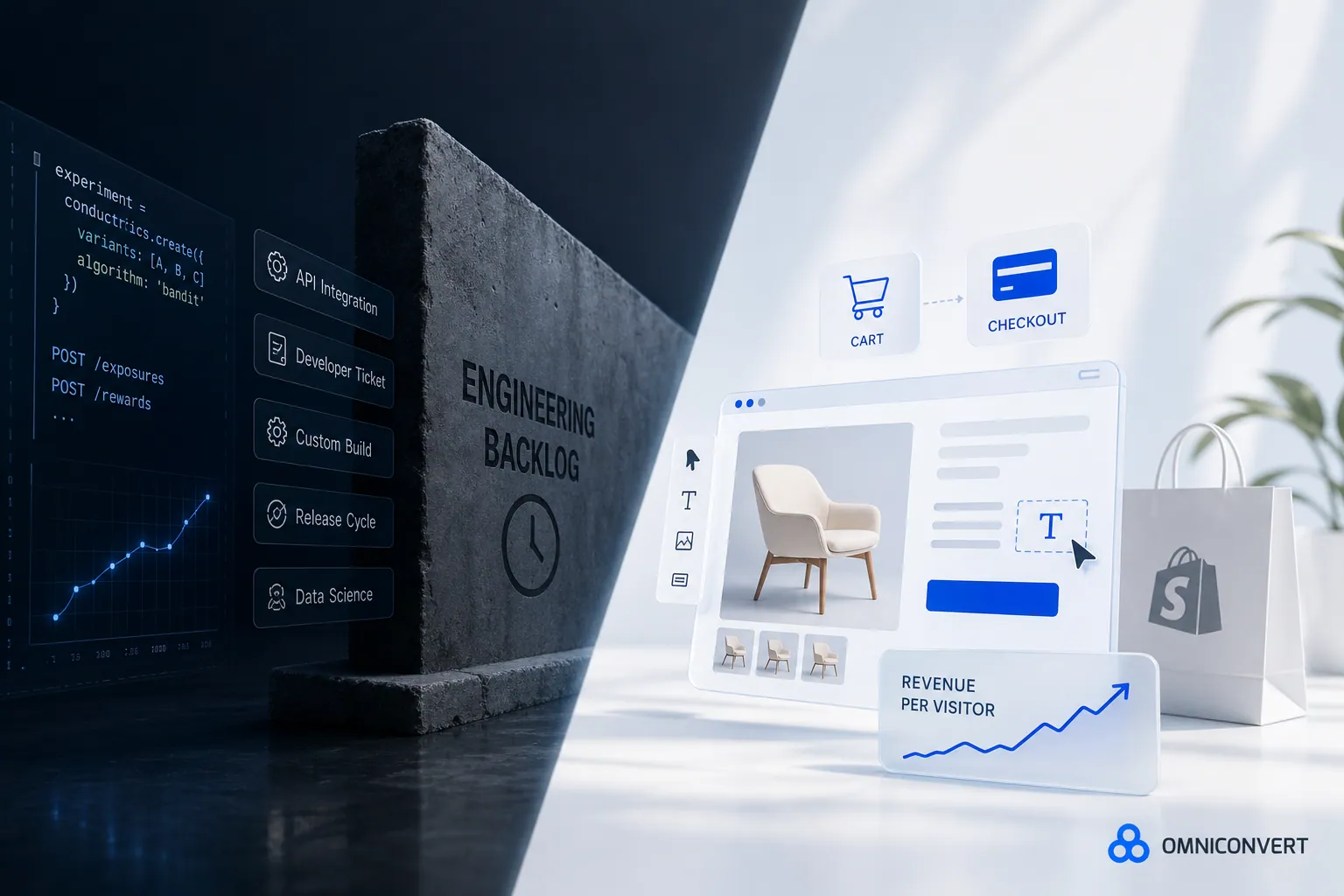
Conductrics is an API-first experimentation platform built for data science and engineering teams embedding adaptive optimisation into their own applications. Omniconvert Explore is a Shopify-native CRO platform that runs product, cart, and checkout tests through a visual editor and measures results in revenue per visitor. Different jobs, rarely overlapping.
- Conductrics is an API-first experimentation and adaptive optimisation platform for technical teams, with a 4.3 out of 5 G2 rating across 12 reviews. [G2, 2026]
- Conductrics delivers multi-armed bandit optimisation, adaptive targeting, and programmatic experimentation embedded inside a team's own applications.
- Conductrics has no visual editor, no native Shopify integration, no multivariate testing, and requires developer implementation for every test.
- Omniconvert Explore runs experiments on Shopify product, cart, and checkout pages without an API or engineering team, and measures results in revenue per visitor.
- The two rarely compete: data science teams pick Conductrics for embedded application optimisation; Shopify brands pick Explore for storefront CRO.
Teams comparing Conductrics vs Omniconvert Explore are usually asking two different questions dressed as one. Conductrics is an API-first experimentation and adaptive optimisation platform, built for data science and engineering teams that want multi-armed bandit logic and adaptive targeting embedded directly into a custom application. Omniconvert Explore is a Shopify-native CRO platform that runs experiments on product, cart, and checkout without engineering plumbing, and measures the outcome in revenue per visitor. This page explains where each fits and where they never really compete.
What is Conductrics, and what does it actually do?
Conductrics is an API-first experimentation and adaptive optimisation platform. It exposes A/B testing, multi-armed bandit logic, and adaptive targeting through APIs and SDKs so technical teams can embed optimisation directly inside their own applications. It is a data science and engineering tool, shaped for organisations that treat experimentation as a machine learning problem rather than a marketing workflow. [Conductrics, 2026]
Conductrics holds a 4.3 out of 5 rating on G2 across 12 reviews. [G2, 2026] The product has a small but loyal following among data science and engineering teams who want programmatic control over experimentation rather than a marketing dashboard. It is deliberately narrow in audience and priced through a custom sales process.
The category Conductrics sits in is API-first experimentation with adaptive optimisation. Variants are served through API calls, exposure and reward events are posted back, and multi-armed bandit algorithms shift traffic toward the best-performing variant over time. The philosophy is that optimisation should live inside the application code, not on top of a rendered page.
The question this page answers is narrower: is API-first adaptive experimentation the same job as running conversion experiments on a Shopify store? And if not, where is the gap?
API-first experimentation means the platform ships as APIs and SDKs rather than a visual editor, and every experiment is authored, released, and monitored by engineers inside a product codebase. It suits organisations that already run their own applications and want optimisation logic embedded as a service. It is a separate concern from whether a marketer can launch a Shopify product page test without a developer.
Where Conductrics is genuinely strong
- Programmatic control: the API-first model lets engineering teams wire experiments into any application layer, from a mobile backend to a search ranker to a pricing service.
- Multi-armed bandit optimisation: adaptive algorithms shift traffic toward winning variants during the test rather than after, which suits fast-moving product surfaces with clear reward signals.
- Adaptive targeting: the platform can learn which segments respond to which variant, which is useful for teams personalising a custom application experience.
- Embedded optimisation: because logic lives behind an API, experimentation can run on interfaces a page-based tool cannot reach, such as internal apps, mobile screens, or backend decisions.
Where Conductrics hits its ceiling for an eCommerce store
- No visual editor: every experiment requires developer implementation, which locks marketing and CRO teams out of self-serve testing.
- No native Shopify integration: product page, cart, and checkout tests need custom API glue against the Shopify catalog and checkout flow.
- No multivariate testing: classic A/B and bandit optimisation are supported, but full MVT designs are not part of the product.
- Low public documentation and brand footprint: compared with the mainstream experimentation category, Conductrics has minimal public docs, community, and Shopify-specific guidance.
- Custom pricing, no free trial: the buying process is a sales conversation, shaped for organisations that already staff a data science team with an experimentation mandate.
None of this makes Conductrics a weak product. It makes it a data science tool. The friction shows up specifically when the site under test is a Shopify store and the team running experiments does not have a backend engineer, a data scientist, and a release process behind every hypothesis.
What Conductrics cannot do for an eCommerce store
Conductrics is an API-first experimentation tool designed for technical teams embedding optimisation into their own applications. It has no visual editor and cannot run experiments on a Shopify storefront through a marketer-accessible interface. It is not designed for self-serve eCommerce CRO, and that is the gap an eCommerce-first platform closes.
Omniconvert Explore is built for the layer Conductrics leaves open. Conductrics can serve a bandit-optimised variant well through an API, but a store does not need every experiment authored in code; it needs the product page, the cart, and the checkout tested, and the result expressed in revenue per visitor. Those are not the same task.
Most API-first experimentation tools are built around a generic call and a generic reward event. They optimise the mechanics of adaptive traffic allocation. They are not built around the surfaces where eCommerce revenue is actually won or lost, or around a marketer-accessible interface for launching a test on a Shopify checkout.
eCommerce CRO is the practice of running controlled experiments on the revenue surfaces of an online store, product pages, cart, and checkout, and measuring the result in revenue per visitor and order rate rather than generic conversion rate. Omniconvert Explore is defined as an eCommerce conversion rate optimization platform for product, cart, and checkout experiments, native to Shopify and priced for store traffic.
What Conductrics cannot tell an eCommerce team
- Did the win move revenue. Whether a bandit-selected variant actually raised revenue per visitor and order rate, not just an API-posted reward event.
- Which surface to test first. Which pages in the Shopify funnel (product, cart, checkout) carry the highest revenue impact if tested next.
- How it behaves in checkout. How an experiment interacts with the Shopify catalog, variants, and checkout flow natively, without custom API glue on every page.
- Whether it holds for valuable customers. Whether the result holds for repeat, high-value customers, the Customer Value Optimization question, not just first-session traffic.
Across the 7,000+ eCommerce websites in Omniconvert's CROBenchmark Report 2026, the stores testing fastest are the ones where a marketer or CRO lead can launch a product page or checkout experiment the same week it is proposed; Conductrics's API-first model pushes that work into the engineering backlog, and the benchmark shows testing cadence drops sharply when every experiment needs a developer ticket and a release. [CROBenchmark Report 2026, Omniconvert]
Explore runs the experiment on the store's real revenue surfaces and reports the outcome in revenue per visitor. AliveCor used Omniconvert Explore to run a structured A/B testing program and achieved +21% conversion rate, +5% revenue per visitor, and 94% statistical relevance across their experiments. [Omniconvert, AliveCor case study]
Conductrics vs Explore: the capability comparison
Side by side, Conductrics and Explore share almost no overlap in daily job. Conductrics serves API-driven experiments and bandit-optimised variants inside a custom application. Explore ships Shopify-native experiments on product, cart, and checkout, adds surveys and overlays, and reports in revenue per visitor. Where they touch is server-side testing, and the fit still splits by team.
| Capability | Conductrics | Omniconvert Explore |
|---|---|---|
| Primary function | API-first experimentation and adaptive optimisation for technical teams | eCommerce CRO on product, cart, and checkout pages |
| A/B testing | Yes API-first, no visual editor | Yes visual editor plus code editor |
| Multivariate testing | No | Yes |
| Server-side testing | Yes | Yes |
| Visual editor | No API and code required for every test | Yes no developer required |
| On-site surveys and overlays | No not part of the product | Yes surveys and overlays built in |
| Shopify integration | Low no native app, engineering integration required | Yes native |
| eCommerce focus | Low built for data science and engineering teams | High built for store revenue workflows |
| Pricing model | Custom pricing, contact sales, no free trial | Session-based, built for store traffic, free trial |
| Best for | Data science and engineering teams wanting API-first experimentation with multi-armed bandit and adaptive optimisation | Shopify and eCommerce teams optimizing product, cart, and checkout for revenue |
| User rating | 4.3 out of 5 (G2, 12 reviews, as of 2026) | 4.6 out of 5 (G2, 191 reviews, as of 2026) |
Competitor pricing and plan details reflect publicly listed figures as of 2026 and can change. Explore uses session-based pricing; see the Omniconvert pricing page for current plans.
Get the full CROBenchmark data behind these stats: 7,000+ websites, 15+ industries, 248+ audit criteria, 100+ CRO experts. See exactly where eCommerce growth teams are losing margin in 2026.
Get the CROBenchmark ReportFrequently Asked Questions
Should you choose Explore over Conductrics?
If your experiments run on a Shopify store and you need marketers to launch product page, cart, and checkout tests without writing code, choose Explore: it ships a visual editor, native Shopify integration, and measures revenue per visitor. If your data science team wants API-first experimentation with multi-armed bandit optimisation embedded in a custom application, Conductrics is purpose-built for that. The two rarely compete; different teams, different surfaces, different metrics.
Conductrics earns its niche. It is a coherent, well-designed API-first platform for data science teams that want adaptive optimisation living inside their own code, which is exactly the setup a machine learning group wants when experimentation is treated as an engineering discipline.
The question for a store is narrower: are the experiments that move revenue running natively on the product, cart, and checkout pages, without an API integration or a backend engineer in the loop, and are they measured in revenue per visitor. That is the surface Explore is built for.
Stop guessing.
Start testing what moves revenue.
Explore runs A/B, multivariate, and personalization experiments on your product pages, cart, and checkout, then measures the outcome in revenue per visitor, not just clicks.
4.6 out of 5 across 191 reviews, G2 , as of 2026