Dema alternative (2026): commerce data vs growth execution
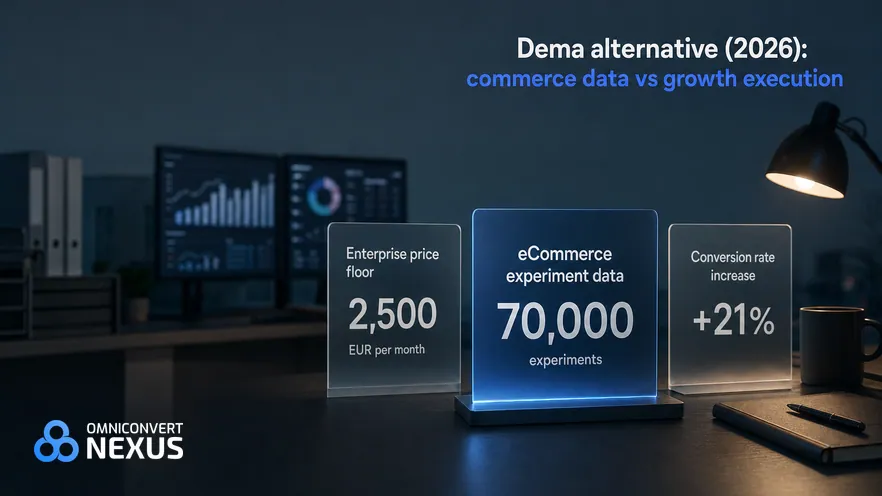
Dema is a commerce intelligence platform. It models SKU-level profit across orders, costs, inventory and POS, then runs approval-gated agents on spend and assortment. Nexus by Omniconvert is an AI eCommerce growth engine. It models the customer, ranks the next experiment by profit, produces the creative, launches, and reports True Profit.
- Dema is an agentic commerce intelligence platform: SKU-level profit across orders, costs, inventory and POS, with approval-gated agents on spend and assortment.
- Nexus by Omniconvert is an AI eCommerce growth engine: customer intelligence, ranked experiments, briefs, creative, launched campaigns and True Profit measurement.
- Dema forecasts profit-based LTV and builds rule-based customer sets. It does not run RFM programmes, NPS, onsite experiments or competitor ad intelligence.
- Nexus does not model inventory, assortment or POS data, and does not run marketing mix modelling or geo holdouts. That is Dema's lane, not a gap in Nexus.
- Dema starts from EUR 2,500 a month before add-ons, which puts it in a different budget bracket for most brands under $10M.
Dema is the closest thing on this list to Nexus by Omniconvert, so the comparison deserves more care than most. Both join messy commerce data. Both put AI agents on top of it. Both make a human approve before anything goes live. The split is what each one models. Dema models the operation: margin per SKU, assortment, inventory, returns, spend. Nexus models the customer: CLV, RFM position, cohorts, churn risk, and what the next campaign should say. This page maps both columns honestly.
What is Dema, and what does it actually do?
Dema is a Stockholm-based commerce intelligence platform founded in 2022 by Marcus Tagesson, Henrik Hoffman and David Feldell, backed by roughly EUR 11M across a pre-seed and a seed round. It ingests orders, returns, shipping and payment costs, marketing spend, inventory and POS data, reports operational profit down to SKU level, and runs approval-gated AI agents on top of that model. [Dema, 2026]
The product line has three parts. The first is the data layer: 30+ integrations across Shopify, Centra, Meta Ads, Google Ads, TikTok Ads, Klaviyo, NetSuite and Slack, joined into one governed model that Dema hosts in the EU.
The second is measurement. Dema combines marketing mix modelling, incrementality testing and attribution into a single profit view, with geo experiments and holdouts rather than platform-reported ROAS alone.
The third is the agent layer, and it is the part most people are buying. Brands configure agents with their own playbooks and schedules: a margin sentry watching contribution margin per SKU, a spend guard pausing feed ads on out-of-stock inventory, a CRM agent classifying customers and proposing segment updates to Klaviyo. In Dema's own words, the agent reads, drafts, and pushes, and you approve before anything goes live.
Agentic commerce intelligence is defined as a governed data model of a commerce business, covering orders, costs, inventory and channels, with scheduled AI agents that read that model, draft an operational action, and hold it for human approval. It optimises the operation. It is not a customer intelligence or experimentation layer.
Where Dema is genuinely strong
- SKU-level profit: contribution margin per product after returns, shipping and payment costs.
- Omnichannel truth: POS and offline sales joined to the online picture, not reported beside it.
- Serious measurement: marketing mix modelling, incrementality tests, geo holdouts and attribution in one profit view.
- Operational agents: inventory, assortment, replenishment and spend actions drafted on a schedule.
- Governance: EU-hosted data and an approval step in front of every push to Meta, Google or Klaviyo.
Where Dema hits its ceiling
- No onsite experimentation: Dema decides spend and assortment, and does not test the site itself.
- No voice of the customer: no NPS, survey or feedback signal feeding the segments.
- Rule-based segments: customer sets are built from filters on LTV, frequency and recency, not from a maintained RFM programme.
- No competitor ad intelligence: the outside market is not part of the data model.
- Enterprise price floor: plans start from EUR 2,500 a month, with add-ons for measurement and omnichannel on top.
The Dema column on this page reflects publicly available Dema materials as of August 2026.
What Dema cannot do
Dema answers what the business should sell, hold and spend. It does not decide which customer segment justifies the next dollar, rank the experiment queue by projected margin, write the brief from that segment, or generate the ad and email creative that goes out. That is where Nexus by Omniconvert operates.
Dema's LTV forecasting is real, and worth crediting. It predicts profit-based lifetime value per customer, retrains monthly, and updates daily. Customer sets can then filter on lifetime value, order frequency, return rate, days since last purchase and acquisition source, and push a list to Klaviyo.
The gap is what happens after the list exists. A filtered segment is not a growth programme. Nobody has decided which segment to fund first, what the message should be, which onsite experiment would move it, or what the campaign earned once COGS, shipping, returns and fees came out at the campaign and product level.
That is the work Nexus is built for, and it starts from the other end. The segment, the ranked experiment, the brief, the creative, the launch, and the margin report are one sequence rather than five handovers.
What Dema cannot tell you
- Which experiment to run first. This needs a queue ranked by projected margin against a real experiment history, not a list of ideas somebody argued for in a meeting.
- Why customers leave, in their own words. This needs NPS and survey signal joined to behaviour, not transaction data alone.
- What the next campaign should say, and to whom. This needs a brief generated from RFM position and churn risk, then creative produced against it.
- What the market is already saying. This needs continuous competitor ad intelligence, classified and ready to feed a brief.
Platforms like Nexus are built for this layer. Nexus maintains CLV, RFM, cohorts, churn risk and NPS continuously, ranks the next action by projected profit impact, generates the brief and the creative, launches after a human approves, and reports True Profit. The ranking draws on 13 years of eCommerce experiment data: 7,000+ websites benchmarked and 70,000 experiments.
The reverse is equally true, and worth saying plainly. Nexus does not model inventory, replenishment or assortment, does not run marketing mix modelling or geo holdouts, and does not join POS data from physical stores. Those are Dema's lane, not gaps in Nexus. For the wider argument about measuring growth on margin, see what an AI eCommerce growth engine actually does.
True Profit is defined as revenue minus COGS, shipping, returns and payment fees, attributed per campaign, per ad and per product, then weighted by the lifetime value of the customers acquired. It is what the business actually keeps. Nexus tracks this as the primary optimisation metric across all experiments.
AliveCor used Omniconvert to run a structured A/B testing programme and achieved +21% conversion rate, +5% revenue per visitor, and 94% statistical relevance across their experiments. [Omniconvert, AliveCor case study]
Dema vs Nexus: the capability comparison
Dema leads on SKU margin, inventory, omnichannel data and marketing mix measurement. Nexus by Omniconvert leads on customer intelligence, experiment prioritization, creative generation, competitor ad intelligence and True Profit per campaign. The overlap is real on data joining and approval-gated agents, so read the table as two different jobs rather than one winner.
| Capability | Dema | Nexus by Omniconvert |
|---|---|---|
| Core focus | Commerce operations: margin, assortment, inventory, spend | Growth execution and profit measurement |
| Unified data layer | Yes: orders, costs, inventory, POS, ad spend | Yes: customer, order and campaign data |
| Customer intelligence (RFM, CLV, churn, NPS) | Partial: profit-based LTV forecast and rule-based customer sets, no RFM programme or NPS | Yes: native Customer Intelligence layer |
| Onsite experimentation and CRO | Not offered | Yes: built on 13 years of CRO practice |
| Experiment prioritization | Not offered | Yes: ranked by profit impact |
| Ad and email creative generation | Partial: image and video generation priced in credits, not brief-driven | Yes: AI-generated from the segment brief, human-approved |
| Campaign launch | Yes: agents push to Meta, Google and Klaviyo after approval | Yes: launches after your approval |
| Competitor ad intelligence | Not offered | Yes: continuous, classified, brief-ready |
| Marketing mix modelling and incrementality | Yes: MMM, geo holdouts, lift tests | No: measurement is per campaign, ad and product |
| Inventory, assortment and replenishment | Yes: forecast and sell-through driven | Not offered |
| Offline and POS data | Yes: omnichannel add-on | Not offered |
| True Profit per campaign, ad, product | Operational profit per SKU and channel | Yes: CLV-weighted |
| Pricing basis | From EUR 2,500 a month, plus measurement and omnichannel add-ons and AI credits | Revenue-based, see Nexus pricing |
| Best for | Multi-market brands whose margin problem is assortment, inventory and spend | eCommerce teams from $5M to $200M focused on margin |
| Data heritage | Founded 2022, no experiment dataset | 13 years, 7,000+ websites, 70,000 experiments |
| User rating | No public G2 rating | 5.0 out of 5 (Shopify App Store, 60 reviews, as of September 2026) |
Dema column reflects publicly available Dema materials as of August 2026. Nexus is now onboarding founding brands; see current plans on the Nexus pricing page.
See where your store stands against real competitors in your category and country. Ecommerce Benchmark scores six areas free: Creative & Ads, Reviews & UGC, AI Visibility, Agentic Commerce, Competitor Synthesis, and CRO.
Benchmark Your Store FreeFrequently Asked Questions
Should you add Nexus to your Dema stack?
Add Nexus if Dema has already given you clean margin numbers and the open question is now what to do about them. Dema tells you which products and channels make money. Nexus decides which customers to go after, ranks the experiment worth running, produces the creative, launches it, and reports what it earned after COGS, shipping, returns and fees. [Omniconvert, 2026]
Dema alone is the right call when the margin problem is operational. Assortment, inventory, returns and cross-market spend are where the money leaks, physical retail is part of the picture, and the budget supports an enterprise data platform.
Nexus alone is the right call when you are between $5M and $200M with real order history, acquisition works, repeat purchase does not, and nobody can say what a customer from a given campaign is worth six months later.
Running both is a reasonable outcome for larger brands, because the two model different halves of the same P&L. Dema holds the product and inventory question. Nexus holds the customer question, and reports what each campaign earned in True Profit.
Clean margin data is half of it.
Nexus does the other half.
Turn your customer data into named segments, briefs, approved creative, and launched campaigns, then measure every one in True Profit after COGS, shipping, returns, and fees.
5.0 out of 5 across 60 reviews, Shopify App Store , as of September 2026