Luca alternative (2026): finance reasoning vs growth execution
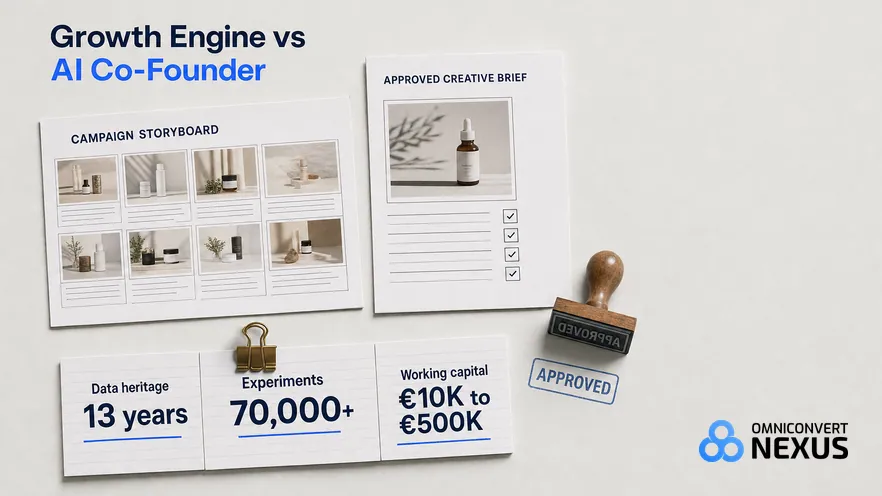
Luca is an AI Co-Founder focused on cross-functional intelligence and cash. It unifies commerce, marketing, and finance data, answers questions like whether you can afford to scale, and offers working capital. Nexus by Omniconvert is an AI eCommerce growth engine focused on execution. It turns customer intelligence into briefs, creative, launched campaigns, and True Profit measurement. Luca tells you whether to scale and can fund it. Nexus does the scaling and measures the profit.
- Luca is an AI Co-Founder: a conversational layer over commerce, marketing, finance, and banking data, with capital access from €10K to €500K.
- Nexus by Omniconvert is an AI eCommerce growth engine: customer intelligence, briefs, creative, launched campaigns, and True Profit measurement.
- Luca advises and can fund. It does not generate creative, launch campaigns, or rank experiments by profit impact.
- Nexus does not offer capital, financing, or inventory forecasting. Capital is Luca's lane, not a gap in Nexus.
- Brands that need both answers run both: Luca sets the ceiling on spend, Nexus decides where the spend goes and what it earned.
These two products are often shortlisted together, and they should not be. They sit in different lanes. Luca is a reasoning layer over your money: one conversational surface across Shopify, Stripe, accounting, ad platforms, and your bank, plus capital when the answer is yes. Nexus by Omniconvert is an execution layer over your customers: segments, briefs, creative, launched campaigns, and margin. This page maps what each one does, what neither one does, and how a brand running both would split the work.
What is Luca, and what does it actually do?
Luca positions itself as an AI Co-Founder. It connects Shopify, Stripe, Xero, Meta, Google, and banking through Plaid into one conversational intelligence layer, reasons across those sources, and sends proactive alerts. It also provides capital access from €10K to €500K, priced at 5 to 12 percent. Subscription is roughly €299 to €499 a month plus capital fees. [Luca, 2026]
Luca was founded by Eric Bidinger and positions itself against analytics dashboards such as Triple Whale. The argument it makes is fair: a dashboard shows you numbers, and a co-founder tells you what they mean.
The interesting part of the product is the range of the data it holds. Most eCommerce tools stop at commerce and marketing. Luca pulls in accounting and bank data too, which is what lets it answer a question a marketing tool cannot: can we afford this?
The capital offer is the second half of the same idea. If the answer is yes, Luca can supply the money, from €10K to €500K, priced at 5 to 12 percent. Few software products can close that loop.
An AI Co-Founder is a conversational reasoning layer over the whole business. It joins commerce, marketing, finance, and banking data, answers questions in plain language, and raises alerts when something moves. It advises. It does not produce creative or run campaigns.
Where Luca is genuinely strong
- Cross-functional data: commerce, marketing, accounting, and banking joined in one place.
- Conversational answers: plain-language questions rather than dashboard navigation.
- Cash reasoning: affordability and runway questions answered against real bank data.
- Proactive alerts: movement surfaced without someone opening a report.
- Capital access: €10K to €500K available, priced at 5 to 12 percent.
Where Luca hits its ceiling
- Reasoning, not execution: the answer arrives on a screen, and a person still turns it into a live campaign.
- No customer intelligence layer: no CLV modelling, RFM position, cohort behaviour, or churn signal per customer.
- No creative or launch: briefs, ad and email variants, and campaign launch sit outside the product.
- Business-level margin: financial reporting covers the company, not margin per campaign, ad, and product.
The Luca column on this page reflects publicly available Luca materials as of August 2026.
What Luca cannot do
Luca reasons across your money well, and it can lend you more of it. What it does not do is decide which customer segment to acquire, write the brief, generate the creative, launch the campaign, and report the result in True Profit. That execution loop is where Nexus by Omniconvert operates.
A conversational BI layer is a fast way to get an answer. The limit is what happens next. The answer arrives on a screen, and a person still has to turn it into a segment, a brief, a set of assets, an approval, and a live campaign.
That handover is where most weeks go. It is also where the answer degrades, because the brief a human writes from a chat reply is rarely tied back to CLV by cohort and source.
Nexus closes the same gap from the other side. It knows less about your bank balance and more about your customers, and it does not stop at the insight. The segment, the brief, the creative, the launch, and the margin report are one sequence.
What Luca cannot tell you
- Which segment justifies the next dollar. This needs CLV, RFM position, and churn signal per customer, maintained continuously rather than assembled for a review.
- What the next campaign should say, and to whom. This needs a brief generated from that segment, then creative produced against it.
- Which experiment should run first. This needs a queue ranked by projected margin, not a list of ideas in priority order somebody argued for.
- What this ad earned after costs. This needs margin attributed at campaign, ad, and product level. Company-level financial reporting says the business made money, not which campaign made it.
Platforms like Nexus are built for this layer. Nexus maintains CLV, RFM, cohorts, churn risk, and NPS continuously, ranks the next action by projected profit impact, generates the brief and the creative, launches after a human approves, and reports True Profit. The ranking draws on 13 years of eCommerce experiment data: 7,000+ websites benchmarked and 70,000 experiments.
The reverse is equally true, and worth saying plainly. Nexus cannot tell you whether your bank balance supports a bigger media budget next month, and it does not offer capital, financing, or inventory forecasting. Capital is Luca's lane, not a gap in Nexus. For the wider argument about measuring growth on margin, see what an AI eCommerce growth engine actually does.
True Profit is defined as revenue minus COGS, shipping, returns, and payment fees, attributed per campaign, per ad, and per product, then weighted by the lifetime value of the customers acquired. It is what the business actually keeps. Nexus tracks this as the primary optimisation metric across all experiments.
AliveCor used Omniconvert to run a structured A/B testing programme and achieved +21% conversion rate, +5% revenue per visitor, and 94% statistical relevance across their experiments. [Omniconvert, AliveCor case study]
Luca vs Nexus: the capability comparison
Luca leads on cross-functional reasoning, cash visibility, and capital. Nexus by Omniconvert leads on customer intelligence, creative generation, campaign launch, experiment prioritization, and True Profit measurement. Neither product covers the other's column, so the table reads as a division of labour rather than a winner.
| Capability | Luca | Nexus by Omniconvert |
|---|---|---|
| Core focus | Cross-functional finance and cash intelligence | Growth execution and profit measurement |
| Interface | Conversational BI | Action queue and approvals |
| Customer intelligence (RFM, CLV, churn) | Not the focus | Yes: native Customer Intelligence layer |
| Ad creative generation | Not offered | Yes: AI-generated, human-approved |
| Campaign launch | Not offered | Yes: launches after your approval |
| Experiment prioritization | Not offered | Yes: ranked by profit impact |
| Competitor ad intelligence | Not offered | Yes: continuous, classified, brief-ready |
| True Profit per campaign, ad, product | Financial reporting across the business | Yes: CLV-weighted |
| Accounting and banking data | Yes: Xero and banking through Plaid | No: cost inputs feed True Profit instead |
| Working capital | Yes: €10K to €500K at 5 to 12 percent | Not offered |
| Pricing basis | Subscription about €299 to €499 a month, plus capital fees | Revenue-based, see Nexus pricing |
| Best for | Brands where cash timing, runway, and funding are the open question | eCommerce teams from $5M to $200M focused on margin |
| Data heritage | Newer, no experiment dataset | 13 years, 7,000+ websites, 70,000 experiments |
| User rating | No public G2 rating | 5.0 out of 5 (Shopify App Store, 60 reviews, as of September 2026) |
Luca column reflects publicly available Luca materials as of August 2026. Nexus is now onboarding founding brands; see current plans on the Nexus pricing page.
See where your store stands against real competitors in your category and country. Ecommerce Benchmark scores six areas free: Creative & Ads, Reviews & UGC, AI Visibility, Agentic Commerce, Competitor Synthesis, and CRO.
Benchmark Your Store FreeFrequently Asked Questions
Should you add Nexus to your Luca stack?
Add Nexus if Luca is answering your money questions well but the week is still full, because somebody has to turn each answer into a segment, a brief, a set of assets, and a live campaign. Luca changes what you know and what you can afford. Nexus changes what is live and what it earned. [Omniconvert, 2026]
Luca alone is the right call when the open question is financial: runway, affordability, cash timing, or funding. Marketing execution is already handled, in-house or by an agency, and the thing you cannot see is money.
Nexus alone is the right call when you are between $5M and $200M with real order history, acquisition works, repeat purchase does not, and nobody can say what a customer from a given campaign is worth six months later.
Running both is the common outcome, because the two touch the same P&L from opposite ends. Luca holds the money question. Nexus holds the customer question, and reports what the campaign earned after COGS, shipping, returns, and fees.
Knowing what to do is half of it.
Nexus does the other half.
Turn your customer data into named segments, briefs, approved creative, and launched campaigns, then measure every one in True Profit after COGS, shipping, returns, and fees.
5.0 out of 5 across 60 reviews, Shopify App Store , as of September 2026