Needle alternative (2026): agency output vs customer intelligence
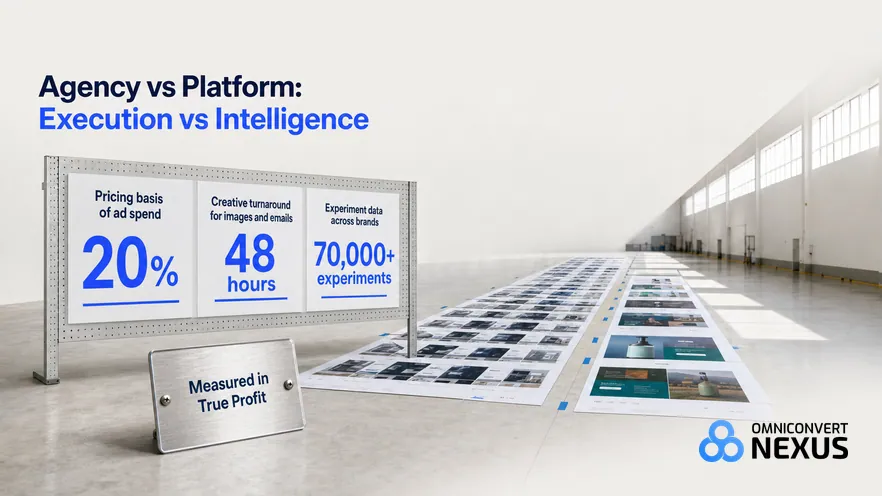
Needle is a done-for-you AI-plus-human marketing agency for brands doing $1M to $10M, priced at roughly 20 percent of ad spend. Nexus by Omniconvert is an AI eCommerce growth engine your own team runs, built for brands doing $5M to $200M, that turns your customer data into launched, profit-measured campaigns. One is a service you outsource to. The other is a system you own.
- Needle is a done-for-you AI-plus-human marketing agency for brands doing $1M to $10M, priced at roughly 20 percent of ad spend.
- Nexus by Omniconvert is an AI eCommerce growth engine your own team runs, built for brands doing $5M to $200M.
- Needle produces a weekly calendar and creative. It has no CLV, RFM, or NPS layer, so it cannot decide which segment is worth acquiring.
- Needle reports campaign ROI. Nexus reports True Profit after COGS, shipping, returns, and fees, weighted by CLV.
- A media-share fee scales with your ad budget. A subscription does not, so the crossover arrives early for brands scaling paid media.
Both products promise the same outcome: less manual marketing work and faster output. They get there in opposite ways. Needle sends the work to an outside team with AI behind it, and bills a share of your media budget. Nexus by Omniconvert puts a growth engine inside your business, starts from your customer data, and measures every campaign in True Profit. This page covers what each one does, what each one cannot do, and which model fits which brand.
What is Needle, and what does it actually do?
Needle is an AI-first marketing agency for DTC brands, aimed at the $1M to $10M range. It connects Shopify, Meta, and Klaviyo, auto-generates a weekly marketing calendar, and drafts email and ad creative. A human team refines the output, and the client approves before anything ships. Pricing is about 20 percent of ad spend. [Needle, 2026]
Needle is a service, and it is honest about that. You are not buying a seat in a tool. You are buying output: a calendar, emails, ads, and the people who tidy them up before they reach you.
The AI does the first draft, which is where the speed comes from. Needle publishes turnaround times of roughly 48 hours for images and emails, and about four days for video. For a small team with no in-house designer, that cadence is a genuine change.
Needle says its approach has been tested across 200-plus DTC brands. Treat that as agency experience rather than a product dataset, because it is the team's client history, not a measured experiment library.
An AI-plus-human agency uses generative models for the first draft and human staff for editing, strategy, and account management. The client receives finished assets. The pricing is usually a share of media spend, so the fee grows as the media budget grows, whether or not the work grows with it.
Where Needle is genuinely strong
- No hiring required: a calendar and creative arrive without a designer, copywriter, or media buyer on payroll.
- Fast first drafts: roughly 48 hours for images and emails, about four days for video.
- Familiar stack: Shopify, Meta, and Klaviyo connected, so nothing exotic is needed to start.
- Human editing layer: AI output is reviewed by people before you see it.
- Approval gate: nothing publishes without a client sign-off.
Where Needle hits its ceiling
- Production, not decision: the calendar answers what to publish, not which customer is worth the next dollar.
- No customer intelligence layer: no CLV modelling, RFM position, cohort behaviour, or churn signal.
- Campaign ROI, not True Profit: reporting stops before COGS, shipping, returns, and payment fees.
- Media-share pricing: the fee scales with your ad budget rather than with the work delivered.
- Capability leaves with the contract: when the retainer stops, the calendar stops.
The Needle column on this page reflects publicly available Needle materials as of August 2026.
What Needle cannot do
Needle produces a calendar and creative for you. It does not know which customer segment is worth acquiring, because it has no CLV, RFM, or NPS layer. It reports campaign ROI rather than True Profit after COGS, shipping, returns, and fees. Nexus by Omniconvert starts from customer intelligence, decides which segment justifies the next dollar, briefs from that, and measures the result in True Profit.
A weekly calendar answers the question "what should we publish?" That is a production question. It is not the question that decides whether a quarter compounds.
The question that decides the quarter is "which customer is worth the next dollar?" You cannot answer it from ad-platform data. You need repeat-purchase behaviour, CLV by cohort and source, RFM position, and churn signal. Those live in your order history, not in Meta.
The measurement gap is the second half of the same problem. A campaign can post a healthy ROI and still lose money once COGS, shipping, returns, and payment fees are counted. If the reporting stops at campaign ROI, the loss is invisible until the P&L catches up a quarter later.
What Needle cannot tell you
- Which segment justifies the next dollar. This needs CLV and RFM position per customer, not a content calendar.
- Which experiment should run first. This needs a queue ranked by expected profit impact rather than by whoever argued hardest.
- What this campaign actually earned. This needs margin after COGS, shipping, returns, and payment fees, attributed per campaign, ad, and product.
- What competitors are running right now. This needs continuous ad monitoring, classified and turned into brief-ready input.
The fee curve is the structural limit, and it is worth putting numbers on. A media-share retainer prices your growth rather than the service, and the work at $250,000 of spend is not fifty times the work at $5,000.
| Monthly ad spend | Needle at about 20 percent |
|---|---|
| $5,000 | About $1,000 a month |
| $25,000 | About $5,000 a month |
| $100,000 | About $20,000 a month |
| $250,000 | About $50,000 a month |
Percentage-of-spend pricing also points the incentive in an awkward direction. Spending less is often the profitable move, and a media-share fee does not reward it.
Platforms like Nexus are built for the layer above production. Nexus maintains CLV, RFM, cohorts, churn risk, and NPS continuously, ranks the next action by projected profit impact, generates the brief and the creative, launches after a human approves, and reports True Profit. The ranking draws on 13 years of eCommerce experiment data: 7,000+ websites benchmarked and 70,000 experiments.
None of this makes Needle a bad service. It makes Needle a production layer. If the decision layer above it is missing, faster production simply produces the wrong thing sooner. For the underlying argument, see why ROAS misleads growth teams.
True Profit is defined as revenue minus COGS, shipping, returns, and payment fees, attributed per campaign, per ad, and per product, then weighted by the customer lifetime value of the buyers acquired. It is the number that survives a board meeting. ROAS and campaign ROI are proxies for it.
AliveCor used Omniconvert to run a structured A/B testing programme and achieved +21% conversion rate, +5% revenue per visitor, and 94% statistical relevance across their experiments. [Omniconvert, AliveCor case study]
Needle vs Nexus: the capability comparison
Needle leads on done-for-you production: you send nothing and receive finished assets. Nexus by Omniconvert leads on customer intelligence, profit-ranked prioritization, competitor ad intelligence, and True Profit measurement. The two also differ on ownership. When Needle stops, the calendar stops. When Nexus runs, the capability stays in your business.
| Capability | Needle | Nexus by Omniconvert |
|---|---|---|
| Delivery model | Done-for-you: AI-plus-human agency | Software: your team owns and supervises it |
| Best-fit revenue | $1M to $10M | $5M to $200M |
| Pricing basis | Percentage of ad spend: about 20 percent | Revenue-based: see Nexus pricing |
| Customer intelligence (RFM, CLV, churn) | Not offered | Yes: native Customer Intelligence layer |
| Segment to brief to creative | Calendar and creative: not segment-driven | Yes: CLV to RFM to named segment to brief |
| True Profit after COGS, shipping, returns, fees | Campaign ROI reporting | Yes: per campaign, ad, and product |
| Experiment prioritization | Not offered | Yes: ranked by profit impact |
| Competitor ad intelligence | Not offered | Yes: continuous, classified, brief-ready |
| Human approval before launch | Yes | Yes |
| Creative turnaround | About 48 hours: images and emails, about 4 days for video | Same day: variants generated for approval |
| Data heritage | Agency experience across 200-plus brands | 13 years, 7,000+ websites, 70,000 experiments |
| Capability after you stop paying | Output stops | Team keeps the process: the data stays yours |
| User rating | No public G2 rating | 5.0 out of 5 (Shopify App Store, 60 reviews, as of September 2026) |
Needle column reflects publicly available Needle materials as of August 2026. Nexus is now onboarding founding brands; see current plans on the Nexus pricing page.
See where your store stands against real competitors in your category and country. Ecommerce Benchmark scores six areas free: Creative & Ads, Reviews & UGC, AI Visibility, Agentic Commerce, Competitor Synthesis, and CRO.
Benchmark Your Store FreeFrequently Asked Questions
Should you add Nexus to your Needle stack?
Add Nexus if the assets arrive on time, ROAS looks healthy, and the P&L has not moved. Needle answers what to publish. It does not answer which customers were worth acquiring, or what the campaign earned after COGS, shipping, returns, and fees. [Omniconvert, 2026]
Needle is the right call when you are between $1M and $10M, you have no designer or copywriter, and paid media spend is small enough that 20 percent of it is cheaper than a hire. Production is the constraint, and outsourcing it removes the constraint this month.
Nexus is the right call when the constraint is deciding what to do next and proving it made money. More production does not help there. It only produces the wrong thing sooner.
The deeper difference is ownership. A media-share retainer buys output for as long as you pay for it. A growth engine builds a loop that runs on your customer data, keeps the segments and the margin history inside your business, and gets better as that data grows.
An agency delivers a calendar.
Nexus delivers profit-measured campaigns.
Turn your customer data into named segments, briefs, approved creative, and launched campaigns, then measure every one in True Profit instead of campaign ROI.
5.0 out of 5 across 60 reviews, Shopify App Store , as of September 2026